
Pick where the store is and what it holds, then enter what shares one bund or pallet. It applies that country’s rule, shows which part of it governs, and lists the pallets in our range that pass.
Result for this link
2 × 1,000-litre IBCs of oil or fuel in Japan need a bund or spill pallet of at least 1,100 litres.
Rule applied: No capacity rule for containers in the Fire Service Act. Common practice; outdoor tank dikes are 110%, 危険物の規制に関する規則 Art. 22.
Smallest pallets in our range that pass: F21-IB-201 · Double IBC pallet (1,100 L), F21-ST-501 · Double IBC (1,400 L), F21-IB-301 · Triple IBC / ten-drum pallet (1,600 L).
A licensed container store needs an impermeable, sloped floor with a collection pit indoors, or drainage and a collection pit outdoors (Cabinet Order Art. 10 and 16). Dikes around outdoor tanks hold 110% of the largest tank.
Worked out by the calculator on this page. The same answer as JSON: /api/bund-size
Result
226 L minimum sump capacity
Stand everything on one pallet or in one bund that holds at least this much. The pallets that pass are listed below.
Always check this figure against your local rules before you buy. A permit, insurer or fire authority can ask for more.
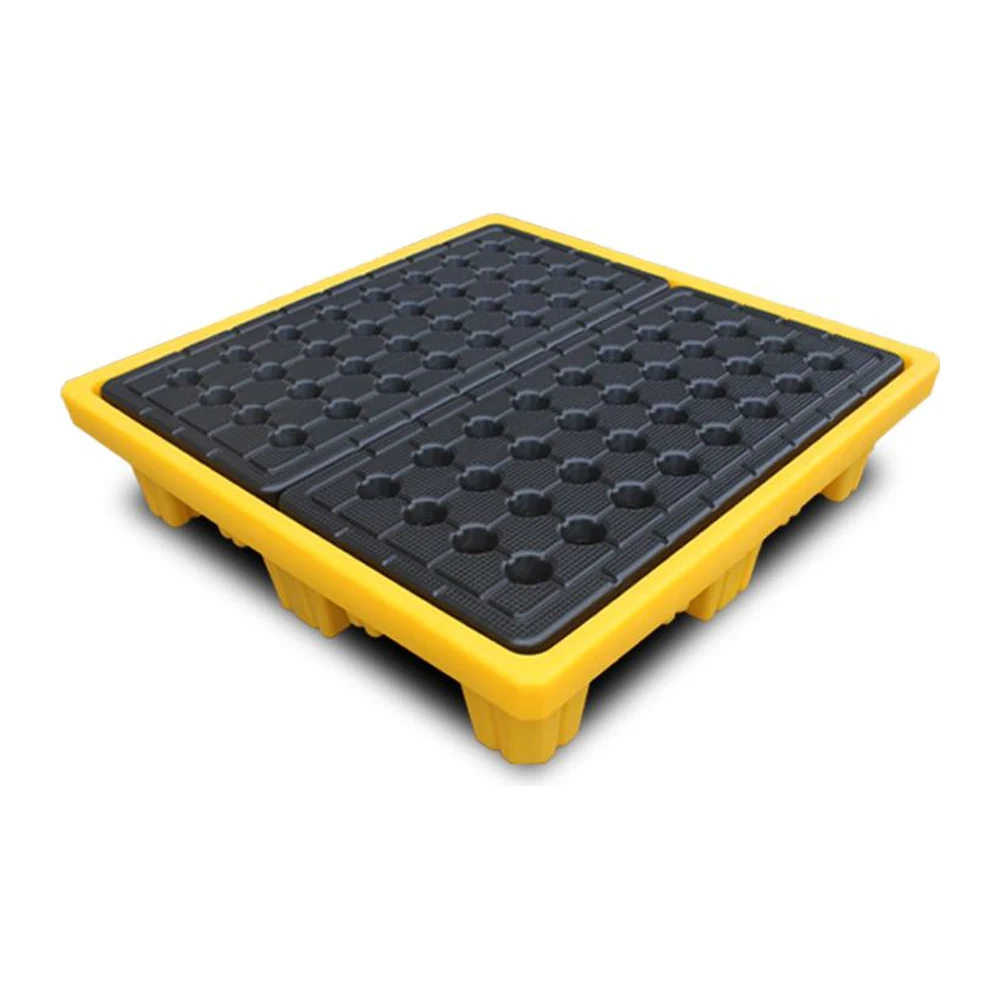 F21-SP-401 · Four-drum pallet, standard250 L sumpF21-SP-401 · Four-drum pallet, rackable280 L sump
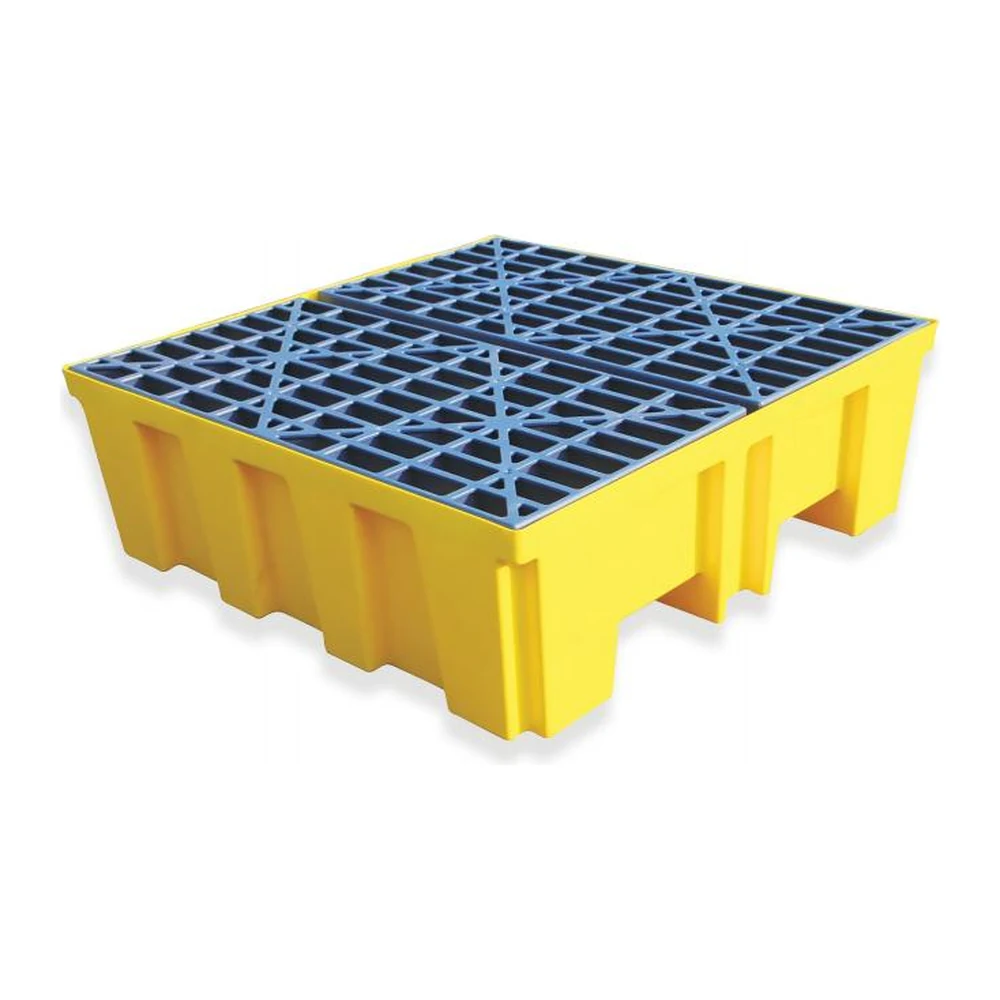 F21-SP-403 · High-sump four-drum, plastic grate488 L sumpF21-SP-403 · High-sump four-drum, steel grate488 L sump
Law Control of Pollution (Oil Storage) (England) Regulations 2001, reg 3(2)(a) and 3(5); scope reg 2(2)
Outside the regulations in England: oil inside a building or wholly underground, waste oil, a home tank of 3,500 litres or less, refineries and distribution depots, and oil used for agriculture on a farm, which falls under the farm fuel rules once the farm holds more than 1,500 litres.
The rule bars any valve, pipe or other opening used to drain the bund, so the pallets listed leave out our drain-plug versions.
The minimum sump capacity a bund or spill pallet needs for the drums, IBCs and cans that share it, under the rule where the store is. It names the part of the rule that governs, lists the pallets in our range that pass, and for a large store sets out ways to split it across several pallets or bunds.
Site and facilities managers, environmental and health and safety leads preparing for an audit, farm managers storing fuel and agrochemicals, and distributors quoting containment for a customer’s store.
Products behind the numbers: Spill Containment & Site Safety, drum spill pallets, IBC spill pallets, drip trays.
Quick answers: UK bund capacity · SPCC secondary containment · IBC bund size · Spill pallet size for drums
Pick where the store is and what it holds, and the calculator applies that place’s rule. The rules differ more than most buyers expect: the same four 205-litre drums of oil need anything from 205 to 820 litres of containment depending on the country. Each row names the instrument and says whether it is law, a model code, guidance or common practice.
| Where | Liquid | One container | Several sharing a bund | Drums on a drip tray | Rule |
|---|---|---|---|---|---|
| England | Oil or fuel | 110% of the container | The greater of 110% of the largest and 25% of the total | 25% of the drums | Law Control of Pollution (Oil Storage) (England) Regulations 2001 |
| England | Flammable liquids and chemicals | 110% of the container | The greater of 110% of the largest and 25% of the total | No reduction | Good practice No figure in English law for this liquid. Common practice, as in GPP 26 (NetRegs, 2022) |
| Wales | Oil or fuel | 110% of the container | The greater of 110% of the largest and 25% of the total | 25% of the drums | Law Water Resources (Control of Pollution) (Oil Storage) (Wales) Regulations 2016 |
| Wales | Flammable liquids and chemicals | 110% of the container | The greater of 110% of the largest and 25% of the total | No reduction | Guidance GPP 26: Safe storage of drums and intermediate bulk containers (NetRegs, 2022) |
| Scotland | Oil or fuel | 110% of the container | The greater of 110% of the largest and 25% of the total | 25% of the drums | Law Environmental Authorisations (Scotland) Regulations 2018, Schedule 9 |
| Scotland | Flammable liquids and chemicals | 110% of the container | The greater of 110% of the largest and 25% of the total | No reduction | Guidance GPP 26: Safe storage of drums and intermediate bulk containers (NetRegs, 2022) |
| Northern Ireland | Oil or fuel | 110% of the container | The greater of 110% of the largest and 25% of the total | 25% of the drums | Law Control of Pollution (Oil Storage) Regulations (Northern Ireland) 2010 |
| Northern Ireland | Flammable liquids and chemicals | 110% of the container | The greater of 110% of the largest and 25% of the total | No reduction | Guidance GPP 26: Safe storage of drums and intermediate bulk containers (NetRegs, 2022) |
| Ireland | All liquids | 110% of the container | The greater of 110% of the largest and 25% of the total | No reduction | Guidance EPA IPC Guidance Note on Storage and Transfer of Materials for Scheduled Activities (2004) |
| Germany | All liquids | 100% of the container | Up to 100 m³: the greater of the largest container and 10% of the total. To 1,000 m³: 3%, at least 10 m³. Above: 2%, at least 30 m³ | No reduction | Law Verordnung über Anlagen zum Umgang mit wassergefährdenden Stoffen (AwSV), 2017 |
| France | All liquids | 100% of the container | The greater of 100% of the largest and 50% of the total. Containers of 250 L or less: 50% of the total for flammable liquids, 20% for others, at least 800 L or the whole total | No reduction | Law Arrêté du 4 octobre 2010 (ICPE soumises à autorisation) |
| Netherlands | All liquids | 110% of the container | The greater of 110% of the largest and 10% of the total | No reduction | Law PGS 15:2021, binding through Besluit activiteiten leefomgeving art. 4.1012 |
| Spain | All liquids | 100% of the container | The greater of 100% of the largest and 10% of the total | No reduction | Law Real Decreto 656/2017, ITC MIE APQ-10 (recipientes móviles) |
| United States | Oil or fuel | 100% of the container | 100% of the largest container | No reduction | Law EPA Spill Prevention, Control, and Countermeasure (SPCC) rule, 40 CFR part 112 |
| United States | Flammable liquids and chemicals | 100% of the container | 100% of the largest container | No reduction | Model code International Fire Code 2024, adopted by states and cities |
| United States | Hazardous waste for disposal | 100% of the container | The greater of 100% of the largest and 10% of the total | No reduction | Law EPA hazardous waste rules (RCRA), 40 CFR 264.175 |
| Canada | Oil, fuel and flammable liquids | 100% of the container | 100% of the largest container. Drums and small containers handled on pallets: at least 1,000 L, or the whole store if less | No reduction | Model code National Fire Code of Canada 2020, adopted by the provinces |
| Canada | Chemicals and other hazardous liquids | 110% of the container | The greater of 110% of the largest and 25% of the total | No reduction | Good practice No national figure for this liquid in Canada. Common practice, as in British Columbia's Hazardous Waste Regulation |
| Australia | All liquids | 110% of the container | The greater of 110% of the largest and 25% of the total | No reduction | Guidance EPA Victoria Publication 1698, Liquid storage and handling guidelines (2018, reissued 2025) |
| New Zealand | Oil, fuel and flammable liquids | 100% of the container (50% up to 60 L) | Sized on all such liquid at the place. Containers over 60 L: 100% below 5,000 L, then the greater of 50% and 5,000 L. Up to 60 L: 50% below 5,000 L, then the greater of 25% and 2,500 L. Each size band counts on its own and the bands add up | No reduction | Law Health and Safety at Work (Hazardous Substances) Regulations 2017 |
| New Zealand | Chemicals and other hazardous liquids | 110% of the container (25% up to 60 L) | Sized on all such liquid at the place. Containers over 60 L: the greater of 25% and 110% of the largest below 20,000 L, then the greater of 5% and 5,000 L. Up to 60 L: 25% below 20,000 L, then the greater of 5% and 5,000 L. Each size band counts on its own and the bands add up | No reduction | Law Health and Safety at Work (Hazardous Substances) Regulations 2017 |
| Singapore | All liquids | 110% of the container | The greater of 110% of the largest and 25% of the total | No reduction | Good practice No set percentage for drums in Singapore law. Common practice; SS 593 sizes tank bunds at 100% of the largest tank |
| Japan | All liquids | 110% of the container | The greater of 110% of the largest and 25% of the total | No reduction | Good practice No capacity rule for containers in the Fire Service Act. Common practice; outdoor tank dikes are 110% |
| Somewhere else | All liquids | 110% of the container | The greater of 110% of the largest and 25% of the total | No reduction | Good practice Common practice where no local figure is known |
The calculator applies the published rule for the place you pick, read from the official texts linked above on 3 October 2026. Treat its figure as the starting point. Rules change, many apply only above a threshold or to certain sites, and the result notes those limits when they matter. A site permit, an insurer or the fire authority can set a higher figure, and so can a store that sits near a drain, a watercourse or a flood zone.
In England the figure comes from the Control of Pollution (Oil Storage) (England) Regulations 2001. Where one container stands in the bund, the bund holds 110 per cent of it. Where several share it, the bund holds 110 per cent of the largest or 25 per cent of the total, whichever is greater. Drums are the exception: a drip tray under them may hold 25 per cent of their combined capacity.
The regulations reach oil stored outside a building in containers of more than 200 litres, and oil includes petrol. They exclude:
Where a store sits outside the rules, the same arithmetic is still the right way to size a bund you fit by choice, and the calculator says so when it happens.
Standard 205-litre drums and 1,000-litre IBCs under the English rule. The last column is the lowest-capacity model in our range that holds the containers and meets the bund figure.
| Store | Stored | 110% of largest | 25% of total | Bund needs | Drip tray, drums | Smallest pallet that passes |
|---|---|---|---|---|---|---|
| One 205-litre drum | 205 L | 226 L | 52 L | 226 L | 52 L | F21-SP-203, 260 L |
| Two drums | 410 L | 226 L | 103 L | 226 L | 103 L | F21-SP-203, 260 L |
| Four drums | 820 L | 226 L | 205 L | 226 L | 205 L | F21-SP-401, 250 L |
| One 1,000-litre IBC | 1,000 L | 1,100 L | 250 L | 1,100 L | — | F21-IB-102, 1,100 L |
| Two IBCs | 2,000 L | 1,100 L | 500 L | 1,100 L | — | F21-IB-201, 1,100 L |
| Three IBCs | 3,000 L | 1,100 L | 750 L | 1,100 L | — | F21-IB-301, 1,600 L |
| Four drums and one IBC | 1,820 L | 1,100 L | 455 L | 1,100 L | — | Fixed bund |
| Ten 20-litre cans | 200 L | 22 L | 50 L | 50 L | — | F21-BT-201, 50 L |
| Twenty 20-litre cans | 400 L | 22 L | 100 L | 100 L | — | F21-BT-201, 145 L |
Two results catch people out. A single drum needs 226 litres in a bund, which a pallet with a 202-litre sump does not reach; on a drip tray the same drum needs 52. And two IBCs need no more than one, because 110 per cent of one IBC (1,100 litres) is more than a quarter of both (500).
Once a store outgrows one pallet, or mixes drums and IBCs, the calculator lists ways to split it, with every pallet or bund sized for what stands on it. Take 100 drums and 50 IBCs of oil in England, 70,500 litres in all. One fixed bund around the lot needs 17,625 litres, a quarter of the total. From pallets in our range the fewest units is 27: ten-drum pallets for the drums and triple IBC pallets for the IBCs. Four-drum and double IBC pallets take 50 units and 34 m² less floor.
Each pallet or bund is sized for what stands on it.
A fixed bund needs the least containment, because every container shares the 25 per cent. Pallets give each group its own sump and move with the stock. Run this store in the calculator, then change the country to see the plan shift.
In England, regulation 3 sets four more. The bund must be protected from impact as far as is reasonably practicable. Its base and walls must be impermeable to water and oil. Nothing used for draining it may pass through them. And any fill or draw-off pipe through a wall must be sealed where it passes. A sump that holds the right volume but drains through a valve fails the rule.
Three checks stay with you. The pallet has to fit the containers, which is why the calculator matches drum and IBC counts. Its load rating has to carry them full, and a pallet moved on forks works to its lower dynamic figure. And an outdoor bund collects rain, so it needs freeboard above the working capacity. Our guide to choosing a spill pallet covers all three.
All three use England’s figures: 110 per cent of one container, the greater of 110 per cent of the largest or 25 per cent of the total for several, and 25 per cent for drums on a drip tray. Their scope differs. Wales has no exclusion for oil stored inside a building. Scotland’s rule, General Binding Rule 28 under the Environmental Authorisations (Scotland) Regulations 2018 since 1 November 2025, reaches a 200-litre drum, where the other three nations start above 200 litres. Northern Ireland leaves farms to separate farm fuel rules that start at 1,250 litres.
US federal rules size a bund on the largest container. The EPA’s SPCC rule asks for its full capacity plus freeboard for rain, at facilities holding more than 1,320 US gallons of oil above ground. The International Fire Code, which states and cities adopt, adds 20 minutes of sprinkler water indoors or a 25-year, 24-hour storm outdoors. The 10 per cent of the total often quoted for the fire code comes from the federal hazardous waste rules.
Canada’s National Fire Code asks for a barrier that contains the spill and sets no percentage. Its explanatory note sizes the spill to plan for: at least 1,000 litres for drums handled on pallets, since a forklift can spear a four-drum pallet, and at least the largest container for IBCs and tanks. The calculator applies both.
Australian law asks for spill containment without a number, and state guidance supplies one. EPA Victoria asks for 25 per cent of the total for drums, and its worked figure takes the greater of that and 110 per cent of the largest container, which the calculator applies. New Zealand sets figures in law. Its regulations size containment on all the liquid at the place, in three container bands: up to 60 litres, 60 to 450 litres, and larger. Each band is sized on its own and the results add up.
Singapore and Japan set no percentage for drums and cans. Both regulate tank bunds, and the calculator applies the 110 and 25 per cent rule there as common practice.
Safety advisers, trainers and trade bodies can embed it free. Paste the code into any web page. The tool updates when we update the rules, and the credit line links back here. Building software instead? The same answer comes as JSON from our free API.
For four 205-litre drums in a bund, 226 litres: 110 per cent of one drum beats 25 per cent of the total, which is 205. On a drip tray the English regulations accept 25 per cent, 205 litres. Our four-drum models run from 80 litres on a low deck to 488 on a high-sump pallet, and the smallest that passes in a bund holds 250.
At least 1,100 litres for one 1,000-litre IBC, which is 110 per cent of it. Two IBCs in one bund still need 1,100 litres, because 110 per cent of one is more than a quarter of both (500 litres).
Not under the English regulations, which only reach containers of more than 200 litres. Bund them anyway where a spill could reach a drain: ten cans need 50 litres, a quarter of the 200 they hold, against 22 for one can.
In England, no: the 2001 regulations exclude containers inside a building or wholly underground. Wales, Scotland and Northern Ireland have no such exclusion, so an indoor drum store there still needs the 110 and 25 per cent bund. Fire and workplace rules apply indoors everywhere, including the dangerous substances regulations wherever petrol is stored.
Under § 31 of the AwSV, a drum and container store of up to 100 cubic metres needs a retention volume of 10 per cent of the total, but at least the volume of the largest container. Four 205-litre drums therefore need 205 litres. A store of 220 litres or less in total is outside the AwSV, unless it sits in a water protection or flood zone.
No federal rule sets 110 per cent. The EPA's SPCC rule asks for the capacity of the largest container plus freeboard for rain, so four 205-litre drums of oil need 205 litres before rain. The International Fire Code also starts from the largest vessel. The 10 per cent figure comes from the hazardous waste rules in 40 CFR 264.175: the greater of the largest container and 10 per cent of the total.
No national law sets a percentage. The Work Health and Safety Regulations ask for spill containment, and state regulators publish the figures. EPA Victoria's liquid storage guidelines ask for 25 per cent of the total for drums and small containers, and their worked figure takes the greater of that and 110 per cent of the largest. Four 205-litre drums therefore need 226 litres. Flammable liquid stores also meet AS 1940 where a regulator calls it up.
It is the minimum the published rule sets for the place and liquid you pick. Many rules apply only above a threshold, and a site permit, an insurer or the fire authority can raise the figure, for example to hold rain or firefighting water. Confirm it with your regulator or a competent adviser before you buy.
For ICPE sites under the authorisation regime, article 25 of the arrêté of 4 October 2010 asks for the greater of 100 per cent of the largest container and 50 per cent of the total. Where every mobile container holds 250 litres or less, it is 50 per cent of the total for flammable liquids and 20 per cent for others, with a minimum of 800 litres or the whole total if smaller. Four 205-litre drums of fuel therefore need 800 litres.
The standards and regulations this page relies on, at their issuing body. Where a market rule is named here, check the current revision before you specify against it.
Tell us the containers, the liquid and where the store sits. We come back with the pallet or bund, its load rating and a quotation.