
Bund capacity calculator for the UK
How much a bund or spill pallet must hold in England, Wales, Scotland and Northern Ireland, worked out for common drum and IBC stores, with the calculator set up for each.
A UK bund must hold 110 per cent of the largest container, or 25 per cent of everything stored in it, whichever is greater. One 205-litre drum needs 226 litres, and four drums still need 226. The 25 per cent only takes over at the fifth 1,000-litre IBC, at 1,250 litres.
Result
Sump size for these containers
226 L minimum sump capacity
Stand everything on one pallet or in one bund that holds at least this much. The pallets that pass are listed below.
- Smallest pallet that passes
- F21-SP-401 · Four-drum pallet, standard 250 L sump
- Set by
- 110% of largest
- Rule
- Law England
Always check this figure against your local rules before you buy. A permit, insurer or fire authority can ask for more.
Pallets in our range that pass
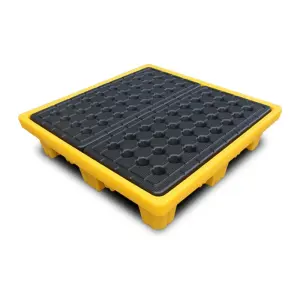 F21-SP-401 · Four-drum pallet, standard250 L sump
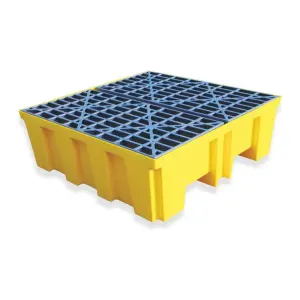 F21-SP-403 · High-sump four-drum, plastic grate488 L sump
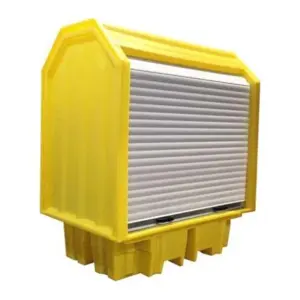 F21-SR-301 · Four-drum, hard cover240 L sump
How this figure was worked out
- Total stored: 820 L
- 110% of the largest container: 226 L
- 25% of the total: 205 L
- The largest-container rule governs.
Law Control of Pollution (Oil Storage) (England) Regulations 2001, reg 3(2)(a) and 3(5); scope reg 2(2)
Outside the regulations in England: oil inside a building or wholly underground, and waste mineral oil such as used engine or hydraulic oil (waste cooking and vegetable oil stay in scope). A home tank of 3,500 litres or less is outside them, as are refineries and distribution depots. So is oil used for agriculture on a farm, which falls under the farm fuel rules once the farm holds more than 1,500 litres.
The rule bars any valve, pipe or other opening used to drain the bund, so the pallets listed leave out our drain-plug versions.
Open the calculator for England Scotland Wales Northern Ireland
Bund capacity for common stores
Standard 205-litre drums and 1,000-litre IBCs of oil under the English rule. The last two columns name the smallest pallet in our range that passes and open the calculator with that store entered.
| Store | Stored | 110% of largest | 25% of total | Bund needs | Drip tray, drums | Smallest pallet | Calculator |
|---|---|---|---|---|---|---|---|
| One 205-litre drum | 205 L | 226 L | – | 226 L | 52 L | F21-SP-203, 260 L | Open |
| Two drums | 410 L | 226 L | 103 L | 226 L | 103 L | F21-SP-203, 260 L | Open |
| Four drums | 820 L | 226 L | 205 L | 226 L | 205 L | F21-SP-401, 250 L | Open |
| Eight drums | 1,640 L | 226 L | 410 L | 410 L | 410 L | F21-IB-301, 1,600 L | Open |
| One 1,000-litre IBC | 1,000 L | 1,100 L | – | 1,100 L | – | F21-IB-102, 1,100 L | Open |
| Two IBCs | 2,000 L | 1,100 L | 500 L | 1,100 L | – | F21-IB-201, 1,100 L | Open |
| Four IBCs | 4,000 L | 1,100 L | 1,000 L | 1,100 L | – | Fixed bund | Open |
| Five IBCs | 5,000 L | 1,100 L | 1,250 L | 1,250 L | – | Fixed bund | Open |
| Four drums and one IBC | 1,820 L | 1,100 L | 455 L | 1,100 L | – | Fixed bund | Open |
Drums and IBCs in one store need separate pallets or one fixed bund. A fixed bund outdoors also needs freeboard for rain above the figure.
The rule in each nation
All four nations use the same percentages and differ in what falls inside the rules.
| Nation | Law | Containers in scope | Scope |
|---|---|---|---|
| England | Control of Pollution (Oil Storage) (England) Regulations 2001 | More than 200 litres | Outside the regulations in England: oil inside a building or wholly underground, and waste mineral oil such as used engine or hydraulic oil (waste cooking and vegetable oil stay in scope). A home tank of 3,500 litres or less is outside them, as are refineries and distribution depots. So is oil used for agriculture on a farm, which falls under the farm fuel rules once the farm holds more than 1,500 litres. |
| Wales | Water Resources (Control of Pollution) (Oil Storage) (Wales) Regulations 2016 | More than 200 litres | Wales has no exclusion for oil stored inside a building, and farm fuel oil follows the same rule. A home tank is outside it only if it was already in use when the regulations took effect for it. |
| Scotland | Environmental Authorisations (Scotland) Regulations 2018, Schedule 9 | 200 litres or more | In force from 1 November 2025, replacing the Controlled Activities Regulations. A 200-litre drum is in scope in Scotland, and the rule applies inside buildings and on farms. Waste oil, and a home tank of 2,500 litres or less for heating or cooking, come under other rules. |
| Northern Ireland | Control of Pollution (Oil Storage) Regulations (Northern Ireland) 2010 | More than 200 litres | Unlike England, Northern Ireland has no exclusion for oil kept inside a building. Major-hazard (COMAH) sites are excluded for a container of 2,500 tonnes or more. |
Working it out by hand
- List the capacity of every container that will share the bund.
- Take 110 per cent of the largest one.
- Take 25 per cent of the total.
- The bund holds whichever of the two is greater. For a single container, 110 per cent of it.
- Outdoors, add freeboard for rain on top of that figure.
Capacity is one condition of five. The bund must also be impermeable, protected from impact, free of any valve or pipe used to drain it, and sealed where a fill pipe passes through. Our guide to choosing a spill pallet covers load ratings and fit.
Measuring a fixed bund
A built bund holds its inside volume less everything standing in it below the top of the wall. Measure inside the walls, multiply length, width and wall height in metres, and multiply by 1,000 for litres. Then take off the volume of plinths, supports and any container that stands inside. A spill pallet needs none of this: the containers stand on a grate above the sump, so the whole sump counts.
| Step | Working | Litres |
|---|---|---|
| Inside volume | 3.0 × 2.0 m, walls 0.45 m high | 2,700 |
| Tank plinth | 1.6 × 1.2 m, 0.15 m high | −288 |
| A 205-litre drum standing in the bund | 585 mm across, 0.45 m of it below the top of the wall | −121 |
| Net capacity | What a spill can fill | 2,291 |
| Needed for a 2,000-litre tank and the drum | 110% of 2,000 beats 25% of 2,205 | 2,200 |
Move the drum out to its own pallet and the margin grows to 212 litres. Outdoors the spare room also has to take rain, so a bund that only just passes on paper fails after a wet week unless someone empties it. The calculator sizes the bund; this sum tells you whether the one you have is big enough.
Common questions
How do you calculate bund capacity in the UK?
Take 110 per cent of the largest container and 25 per cent of the total stored, and size the bund to whichever is greater. With one container it is 110 per cent of that container. One 205-litre drum needs 226 litres; four drums need 226; five 1,000-litre IBCs need 1,250.
Do 20-litre cans need a bund?
Not under the oil storage rules. England, Wales and Northern Ireland start at containers of more than 200 litres, and Scotland at 200 litres, so a store of 20-litre cans sits outside all four however large it grows. A bund sized the same way is still good practice, and a site permit or insurer can ask for one.
Does a spill pallet count as a bund?
Its sump is the bund for what stands on it, so size it the same way: 110 per cent of the largest container or 25 per cent of the total. Drums may stand on a drip tray of 25 per cent of their combined capacity; whether a given pallet counts as a drip tray is for your regulator to decide.
Do the rules differ between England, Wales, Scotland and Northern Ireland?
The percentages are the same in all four. The scope differs: Wales, Scotland and Northern Ireland include oil kept inside a building, which England excludes, and Scotland brings a 200-litre container into scope where the other three start above 200 litres.
How do you calculate the volume of a bund?
Multiply the inside length, width and wall height in metres, then by 1,000 for litres. Take off the room used by anything standing in the bund below the top of the wall: tank plinths, supports and other containers. What is left must reach 110 per cent of the largest container, or 25 per cent of the total where that is greater.
Does a 1,000-litre IBC of diesel need a bund in England?
Yes, when it stands outside a building at a business other than a farm, because it holds more than 200 litres. It needs secondary containment of at least 1,100 litres, as a bund or an IBC spill pallet. England excludes oil kept inside a building; Wales, Scotland and Northern Ireland do not. Farms follow separate rules.
References
The standards and regulations this page relies on, at their issuing body. Where a market rule is named here, check the current revision before you specify against it.
- The Control of Pollution (Oil Storage) (England) Regulations 2001
- GOV.UK: oil storage regulations for businesses (containers of 201 litres or more)
- The Water Resources (Control of Pollution) (Oil Storage) (Wales) Regulations 2016
- Environmental Authorisations (Scotland) Regulations 2018, Schedule 9
- Control of Pollution (Oil Storage) Regulations (Northern Ireland) 2010
Figures worked out by our spill pallet calculator, applying each rule as read from the official text on 3 October 2026.
Page updated
Send us the store and we will size it
Tell us the containers, the liquid and which nation the store is in. We come back with the pallet or bund, its load rating and a quotation.