
What an intermediate bulk container is, how big and heavy it is, how high it stacks, which valve it takes, and when a used one may still be filled.
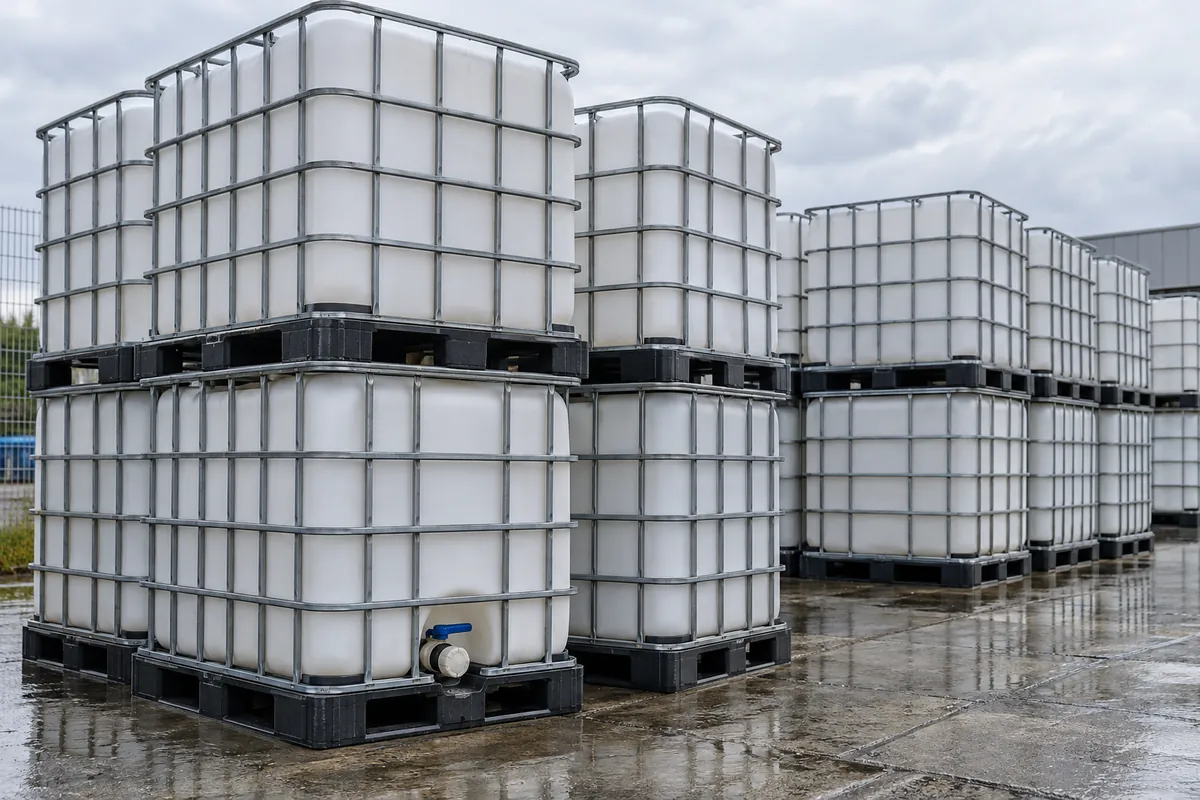
An IBC tote is an intermediate bulk container: a plastic bottle in a steel cage on a pallet, built for forklift handling and capped at 3,000 litres. The common 1,000 L tote stands on a 1,200 × 1,000 mm base about 1,160 mm tall, weighs 52–65 kg empty and about 1,060 kg full of water. Its UN mark sets how much may stand on top.
Quick answer: What is an IBC tote?
An IBC is an intermediate bulk container, a portable packaging of up to 3,000 litres built for mechanical handling (ADR 2025, 1.2.1). The common tote is a 1,000 litre HDPE bottle in a galvanised steel cage on a 1,200 by 1,000 mm pallet. It stands 1,150 to 1,180 mm tall and weighs 52 to 65 kg empty.
ADR 2025 defines an intermediate bulk container (IBC) in 1.2.1 as a rigid or flexible portable packaging of not more than 3.0 m³ for liquids and solids of packing groups II and III. It is designed for mechanical handling and tested against the stresses of handling and transport. Liquids of packing group I may not go in an IBC at all, and the US rule says the same in 49 CFR 173.35(j). The common tote is the caged version, coded UN 31HA1: 31 for an IBC for liquids, H for the plastic inner receptacle, A for the steel casing and 1 for a rigid bottle.
A caged tote has three main parts. The bottle is blow-moulded high-density polyethylene, natural or pigmented against light. The cage is galvanised steel tube or wire, and the pallet beneath it is galvanised steel, plastic, wood or a steel and plastic composite. ADR 6.5.5.4.2 says the bottle is not intended to contain anything without its casing: the two work as one unit. An all-plastic IBC with its own moulded frame is a different design type, UN 31H1, whose body carries the stack itself.
Jerry can, drum or IBC sets out when a tote beats a drum, and our 205 litre drum guide covers the next size down.
Most IBC totes hold a nominal 1,000 litres on a 1,200 × 1,000 mm pallet. Data sheets from makers and distributors put the height at 1,150 to 1,180 mm and the brimful capacity at 1,050 to 1,060 litres. That is why North America sells the same tote as 275 US gallons (1,041 L) when 1,000 L is 264. Smaller and larger totes keep one of two bases.
| Nominal size | US gallons | Base (mm) | Height (mm) | Note |
|---|---|---|---|---|
| 640 L | 169 | 1,200 × 800 | about 1,000 | Euro-pallet base, low height |
| 800 L | 211 | 1,200 × 800 or 1,200 × 1,000 | 1,000–1,180 | Two bases in use; check the drawing |
| 1,000 L | 264 (sold as 275) | 1,200 × 1,000 | 1,150–1,180 | Brimful 1,050–1,060 L |
| 1,250 L | 330 | 1,200 × 1,000 | about 1,350 | Same base, taller cage |
The cage takes the pallet’s footprint: one maker’s 1,000 L cage measures 1,198 mm long and 1,035 mm high. Cage feet and pallet runners differ between makers, so a spill pallet or rack that suits one tote can foul another. Quote fittings against the tote you run.
Empty, a caged 1,000 L tote weighs about 52 kg on a plastic pallet and 65 kg on a steel one, according to Australia’s heavy vehicle regulator, NHVR. Full, it weighs the litres times the density plus the empty tote. At mid-range densities and a 60 kg tote, 1,000 litres of petrol come to about 808 kg, diesel 893 kg, water 1,060 kg, AdBlue 1,150 kg, 50% caustic soda 1,580 kg and 98% sulphuric acid 1,900 kg.
Check that figure against the last number of the UN mark, the maximum permissible gross mass. The example 31HA1 mark in ADR 6.5.2.1.1 ends 10800/1200, and on that design a full 1,000 L of caustic soda or acid is over the limit. One large maker offers standard totes rated for liquids up to 1.9 kg/L and lighter ones to 1.6 kg/L, so match the rating to the liquid before you order.
A 20ft container takes 18 to 20 totes double-stacked. A 40ft takes 20 per tier, though 40 totes of water would exceed a 40ft standard’s payload and stop at 25. Two stacked totes stand about 2,320 mm, above a standard container door. Drums, IBCs and jerry cans per container runs the numbers for your liquid.
An IBC valve is the tap at the base of the bottle’s front face, and most are DN50, a 2-inch bore. DN80 (3-inch) valves pass more flow for viscous products. Three bodies are in use: a butterfly valve turns a disc in the bore, a ball valve seals on a drilled ball and a cylindrical valve turns an internal cylinder. Gaskets come in polyethylene, EPDM, FKM or PTFE to suit the contents. Check the gasket against the liquid in the chemical compatibility guide.
The outlet thread decides what you can connect. European valves often end in a coarse S60x6 thread, 60 mm across with a 6 mm pitch; valves for North America use 2-inch NPS threads, and some end in a camlock coupling. Order hoses and adapters by the thread.
ADR 2025, 6.5.3.1.8, requires a bottom valve that locks closed, a discharge system protected from damage, a lever that cannot open by accident and shows its position, and a second seal on the outlet such as a blank cap.
The top opening of a 1,000 L tote is DN150, a 6-inch screw cap, with DN225 (9 inch) as the larger option, and the outlet valve below it is DN50 or DN80. Those sizes come from makers’ data sheets and are typical: no standard fixes them. Outlet threads and hose adapters are in drum bungs and fittings.
| Part | Typical size or type | What it does |
|---|---|---|
| Fill opening | DN150 (6 in) or DN225 (9 in) | Takes the fill, a cleaning head or a top pump |
| Plain lid | Screw cap, colour-coded by some makers | Seals the opening and keeps dust out |
| Degassing lid | Membrane vent in the cap | Lets gas from the contents out and keeps liquid in |
| Air-inlet lid | One-way or two-way vent with a filter | Lets air in as the tote drains, so the lid stays on |
| Outlet valve | DN50 or DN80: butterfly, cylindrical or ball | Bottom discharge that can be secured shut |
| Valve foil and cap | Peel-off aluminium seal, then a screw cap | The foil shows tampering; the cap is the second seal of ADR 6.5.3.1.8 |
| Cage | Welded grid of galvanised steel tube | Carries any stack and guards the bottle |
| Pallet | Galvanised steel, plastic, wood or a steel and plastic composite | Fork entry; its type decides food, racking and Ex-zone use |
Vents follow a rule of their own. ADR 2025, 4.1.1.8, allows a vent where the gas released is not dangerous for its toxicity, flammability or quantity, and requires one where normal decomposition of the contents could build dangerous pressure. In the carriage position it must keep liquid in and dirt out. A vented IBC may not travel by air, and for the leakproofness test the vent is sealed or swapped for a plain cap (6.5.6.7.2).
Valve handle colours can name the gasket. ICPP, the plastics packaging makers’ confederation, cites DIN 30823, 5.4.2, which colours outlet valve handles grey white for FKM, graphite black for NBR, carmine red for EPDM and sky blue for PTFE. Makers vary: one uses green lids and handles to mark its food IBCs. Match the gasket to the liquid with the chemical compatibility guide.
The cage is the A in UN 31HA1, and one maker’s design uses 6 horizontal and 20 vertical galvanised tubes. ICPP’s guidance says never move a tote by ropes tied to the cage or its cross-members, and the European Printing Ink Association (EuPIA) says a tote with a damaged cage may not be stacked on or under another. Data sheets list four-way fork entry on steel pallets, plastic ones for food and pharmaceuticals, optional heat treatment on wood and earthing for Ex zones on composites. Our drum and IBC adapters come in polymer or stainless for common IBC thread patterns; send the one you run, because they differ.
Under ADR 2025 they do: an IBC of more than 450 litres is labelled on two opposite sides (5.2.2.1.7) and carries its UN number on two opposite sides (5.2.1.4). Canada lets an IBC of 3,000 litres or less carry placards, or labels with the UN number and shipping name, on two opposite sides instead of all four (TDG 4.15.3). US rules allow placards on two opposite sides or labels instead (49 CFR 172.514(c)), and ask for duplicate labels only on an IBC of 1.8 m³ (64 cubic feet) or more (172.406(e)(6)). On a 1,000 L tote one set of labels meets the US rule, while the identification number still goes on two opposing sides (172.302(a)(2)).
Every tote carries two sets of marks. The maker’s set stays with the tote: the UN mark (6.5.2.1.1), the stacking symbol and a plate. The plate gives capacity at 20 °C, tare mass, test pressure and the month and year of the last leakproofness test and inspection (6.5.2.2.1; 49 CFR 178.703(b)). The bottle of a composite tote carries its own code, maker and date; where the cage hides them, a copy headed “Inner receptacle” goes on the outside (6.5.2.2.4). The second set belongs to the load: the UN number, the environmentally hazardous substance mark where it applies, and hazard labels at least 100 mm square (ADR 5.2.2.2.1.1.2; 49 CFR 172.407(c)).
| Load mark | ADR 2025 | 49 CFR (US) | TDG (Canada) |
|---|---|---|---|
| UN number | Two opposite sides, 12 mm high (5.2.1.1, 5.2.1.4) | Two opposing sides, 25 mm high (172.302) | Beside the label, 25 mm high, or in a white box on it (4.15.3) |
| Hazard labels | Two opposite sides (5.2.2.1.7) | One set below 1.8 m³, or placards on two sides (172.406, 172.514) | Two opposite sides, with the shipping name, or placards (4.15.3) |
Place each label where no cage bar, pallet runner or fitting hides it: ADR 5.2.2.1.6(b) and 49 CFR 172.406(f) both rule out a label obscured by an attachment. ADR marks must withstand open weather (5.2.1.2), and the environmentally hazardous substance mark goes beside the UN number on both sides (5.2.1.8.1). In the US, if a tote’s number cannot be seen once it is loaded, the vehicle or container carries the number on each side and end (172.331(c)).
Yes, when the mark allows it. The second-last number of an IBC’s UN mark is its stacking test load in kilograms, and a 0 there means the design may not be stacked at all (ADR 2025, 6.5.2.1.1(g)). Divide the test load by 1.8 for the most weight that may rest on the IBC, because the stacking test in 6.5.6.6.4 loads it with 1.8 times the gross mass of the IBCs meant to stand above. The ADR example mark, 31HA1/Y/0501/D/Müller/1683/10800/1200, allows 6,000 kg on top: five full totes of 1,200 kg. That is the load the design was tested to bear; ICPP’s guidance still stacks filled totes no more than two high in transport.
That permitted load appears on a stacking symbol beside the mark, at least 100 × 100 mm, and a crossed-out symbol means do not stack (6.5.2.2.2). Our UN packaging code decoder reads each part of the mark.
A warehouse stack should stay lower than the transport rating allows. HSE’s HSG71, paragraph 175, calls it good practice to stack IBCs only two high in storage unless the maker has confirmed a greater height, and to check that the stacked totes are compatible. The load must travel through cage and pallet, never the bottle (6.5.5.4.25), so a bent cage post or a pallet that misses the frame below puts weight on the HDPE. HSG71 also lists stacking on poor surfaces among the causes of IBC failure.
Drain it, wash it through the lid, rinse, dry and inspect it. Until then, an empty tote that held a dangerous good is regulated as if it were full (ADR 2025, 4.1.1.11). Tilt the tote towards the valve to drain it, then wash through the 150 or 225 mm lid opening with a rotating IBC cleaning head and a cleaner that dissolves the residue without attacking HDPE. Take the valve off to clean its body and gasket, and verify leaktightness when it goes back on.
Rinse until the water runs clear, drain and dry, then look for cracks, crazing and discolouration in the bottle, broken welds and bent posts in the cage, and damage to the pallet. The wash water carries the residue, so treat it as waste. In the US, a container that held hazardous waste counts as empty once everything that can be poured or pumped out is gone. It must also hold no more than 2.5 cm of residue, or 0.3% of capacity by weight for containers over 119 gallons (40 CFR 261.7).
Cleaning is routine maintenance in ADR 1.2.1. Anyone other than the owner who does it marks the IBC near its UN mark with their State and their name or symbol (4.1.2.4). Washing resets no dates: the bottle’s date and the plate’s test dates still govern.
The trade sells washed totes, which keep their original bottle, and rebottled ones, with a new bottle in the original cage and pallet. ADR sorts the same work three ways in 1.2.1. Routine maintenance covers cleaning, replacing closures or service equipment, and straightening the frame. Repair restores the IBC to its design type, and a new rigid bottle of the original design from the same maker counts as one. Remanufacture turns a non-UN tote into a UN type, or one design type into another. A damaged bottle cannot be repaired; it is replaced.
Rebottling with the original maker’s design puts the tote through the full tests of 6.5.4.4, and the tester marks the State, its name and the date beside the UN mark (6.5.4.5.3). A bottle of another design or maker makes it a remanufactured IBC: the old marks come off and new ones go on (6.5.2.4).
Before you fill a used tote, read the plate dates and the bottle’s own date into the IBC inspection date checker. Find out what it held, inspect the bottle, cage, pallet, valve and lid gasket, and refuse any tote with no plate. The US makes the filler carry out this visual check before every fill (49 CFR 173.35(b)).
A tote that carries dangerous goods needs a UN mark for a design type rated for the substance; a non-UN tote may carry only liquids outside the dangerous goods rules. Y on the mark covers packing groups II and III and Z covers III only (6.5.2.1.1(c)). The packing instruction in column 8 of ADR Table A decides which IBC types a substance may use: IBC02 and IBC03 both allow the 31HZ1 composite family that includes the 31HA1 tote. The UN number packaging finder looks it up; packing groups explained covers the grading.
For any liquid with a flash point of 60 °C or lower, ADR 4.1.2.1 asks for measures to prevent a dangerous electrostatic discharge, and HSG71, paragraph 174, advises conducting IBCs where charge can build. Leave ullage: at a mean bulk temperature of 50 °C a liquid may fill no more than 98% of the IBC’s water capacity (ADR 4.1.1.4; 49 CFR 173.35(d)).
A food-grade IBC is one whose bottle, valve and gaskets suit food contact. In the EU, plastics that touch food fall under Regulation (EU) No 10/2011, whose Article 15 requires a written declaration of compliance at every stage before retail; in the US, polyethylene for food contact falls under 21 CFR 177.1520. For food, take a new tote or one rebottled with a new food-grade bottle, since a declaration covers the material as made.
Under ADR 2025 and the UN Model Regulations, a plastic or composite IBC may carry dangerous goods for five years from the date its bottle was made (4.1.1.15). The competent authority can approve longer, and some substances set less: two years for nitric acid over 55%. Within that life, every metal, rigid plastic and composite IBC takes a leakproofness test at 20 kPa before first use and at most every 2.5 years. It also takes an external and valve inspection on the same cycle, and a full inspection before service and every five years (6.5.4.4).
An IBC past a test date may not be filled. One filled before the date may travel for up to three months after it (4.1.2.2), and the owner keeps each test report until the next one (6.5.4.4.3). US rules differ: 49 CFR 180.352 keeps the 2.5 and 5-year tests from manufacture or repair but sets no five-year end of use. Outside dangerous goods there is no legal expiry, though HSG71, paragraph 173, warns that IBCs degrade in long-term storage.
An IBC carrying dangerous goods follows the rulebook of each leg it travels. That means ADR 2025 by road in Europe (RID 2025 shares its IBC chapters by rail), 49 CFR in the United States, the TDG Regulations in Canada and the IMDG Code at sea. Each has one part for building and testing the design and another for filling and use.
| Rulebook | Building and testing the IBC | Filling and use | Periodic test |
|---|---|---|---|
| ADR 2025 (road, Europe) | Chapter 6.5 | 4.1.1, 4.1.2 and packing instructions IBC01 to IBC08 (4.1.4.2) | 2.5 and 5 years (6.5.4.4) |
| 49 CFR (United States) | Part 178, subparts N (178.700 to 178.710) and O (178.800 to 178.819) | 173.35 | 2.5 and 5 years: part 180, subpart D (180.350 to 180.352) |
| TDG Regulations (Canada) | CAN/CGSB-43.146, Part I, for IBCs made in Canada (TDG 5.6) | CAN/CGSB-43.146, Part II (TDG 5.12 and 5.14) | Every 30 months, per Transport Canada |
In ADR, column 8 of Table A names each substance’s packing instruction, and 4.1.4.2 lists the IBC types it allows. IBC01 allows metal IBCs only (31A, 31B and 31N), so a liquid assigned IBC01 may not go in a caged plastic tote. IBC02 adds rigid plastic IBCs such as UN 31H1 and the 31HZ1 composites that include the 31HA1 tote; IBC03 also allows composites with a flexible inner receptacle, such as 31HA2. IBC04 to IBC08 cover solids. Special provision BB4 bars IBCs over 450 litres for some viscous packing group III liquids, adhesives (UN 1133) and paint (UN 1263) among them. ADR 2025 explained covers the agreement.
In the US, 49 CFR 178.700 bases the IBC standards on the UN Recommendations, and the mark follows ADR’s sequence (178.703). One timing rule differs: ADR lets an IBC filled before its test date travel for up to three months past it (4.1.2.2), while 49 CFR 173.35(a) exempts any IBC filled before the due date and sets no cut-off. US hazmat shipping basics covers the rest.
Canada’s TDG Regulations call up CAN/CGSB-43.146, the national standard for designing, making and using IBCs for classes 3, 4, 5, 6.1, 8 and 9, as amended from time to time. Transport Canada lists the 2022 edition as in force and sets the leak test and inspection every 30 months.
At sea the IMDG Code applies under SOLAS chapter VII. The UK Maritime and Coastguard Agency’s MIN 715 notes that IMO revises it every two years to keep it in step with the other modes, and Amendment 42-24 has been mandatory since 1 January 2026. ADR records one IBC rule that differs at sea: the IMDG Code bars calcium hypochlorite (UN 1748, 2208, 2880 and 3485 to 3487) from IBCs (IBC08, B13). In the US, 49 CFR 171.25 lets a shipment with a sea leg follow the IMDG Code on its land legs too. IATA and IMDG basics covers the sea rules.
Inspect the tote before every fill and again before it leaves. ADR 2025 puts the duty on two parties: the consignor may use only IBCs approved for the substance and bearing the prescribed marks (1.4.2.1.1(c)), and the packer who fills the tote answers for the packing, marking and labelling rules (1.4.3.2). In the US the person filling the IBC makes an external visual check of the tote and its service equipment (49 CFR 173.35(b)). The IBC inspection date checker works out the plate dates.
Before filling, read the plate. The last leakproofness test and inspection must be in date (ADR 4.1.2.2; 49 CFR 173.35(a) and 180.352(a)), and under ADR the bottle of a plastic or composite tote must be under five years old (4.1.1.15). Match the UN mark to the load: the IBC code must be one the packing instruction allows, and the Y or Z must cover the packing group (packing groups explained). The load must suit the marked maximum gross mass (49 CFR 173.35(l)). Then check for corrosion, contamination, cracks and other damage, and work the valve and lid (ADR 4.1.1.9; 49 CFR 173.35(b)). US rules have missing or hard-to-read marks restored before use (173.35(b)(2)).
While filling, leave room so the liquid fills no more than 98% of the tote at a mean bulk temperature of 50 °C (ADR 4.1.1.4; 49 CFR 173.35(d)). Close the tote as its maker instructs, and where two closures sit in series, shut the one nearest the contents first (ADR 4.1.1.1 and 4.1.1.7.1; 173.35(e)). Wipe off any spill, because no dangerous residue may stay on the outside (ADR 4.1.1.1; 173.35(f)(1)). A spill pallet under the tote catches a leaking valve; IBC bund size gives the volume it needs.
Before it leaves, fix the UN number and hazard labels on two opposite sides and refit the cap over the valve outlet. In the US the tote must also be fastened to or held inside the vehicle or container (173.35(f)(2)).
Storage rules come from pollution and fire law. In England, the Control of Pollution (Oil Storage) (England) Regulations 2001 cover oil in any container over 200 litres that is not inside a building (regulation 2(2)). An outdoor tote of diesel or lubricant therefore needs secondary containment of 110% of the largest container or 25% of the total, whichever is greater (regulation 3(2)(a)). Oil kept on a farm for agricultural use falls outside them (regulation 2(2)(e)). One to four 1,000 L totes need 1,100 litres. IBC bund size gives other countries, the spill pallet sizing calculator works out your store, and oil storage regulations in the UK covers the rest.
Flammable contents add a fire risk. HSG71, paragraph 173, records that IBCs in a fire fail early at the valve or elsewhere and feed the fire within minutes. Paragraph 175 asks for flammable totes in bunded areas sized for one IBC’s failure, outdoors where possible and protected from vehicles. The DSEAR guide covers the risk assessment; secondary containment requirements covers other markets.
Weathering is on HSG71’s list of failure causes too. ADR asks for ultraviolet protection, such as carbon black or other pigments, where the bottle needs it, and makers offer white or black bottles for light-sensitive contents. A natural bottle outdoors belongs under a cover.
Keep the liquid above 0 °C with a heated building, an insulated cover or an IBC heating jacket, and drain a tote and its valve before it stands unused through a frost. ADR 2025, 6.5.6.9.2(c), has plastic and composite IBC designs drop-tested with tote and liquid chilled to −18 °C or lower, with antifreeze to stop the test liquid freezing. The test covers cold plastic and never a tote of ice. Resin data sheets put HDPE’s brittleness point far below −18 °C (HDPE properties).
One US IBC supplier’s winter guide puts the growth of freezing water at about 9% by volume. It warns that water trapped in a closed butterfly or ball valve can split the housing. It also warns that a few gallons left in an “empty” tote can crack the bottle, and that the cracks may not leak until the tote is refilled. For a tote stood down over winter it advises draining the valve body and leaving the valve open with the top cap off. The same guide rates an insulated cover alone for light frost, down to about −2 °C for short spells, and pairs it with a thermostatic blanket heater for sustained cold. One heating-jacket maker sells IBC jackets with a 0–90 °C thermostat and an insulating cover to slow cooling. ICPP gives 70 °C as the highest filling temperature for a composite IBC, well under the jacket’s 90 °C top setting, so check the tote maker’s limit before you set the thermostat.
In summer the cover keeps off sun. IChemE’s Safety Centre warns that IBCs aged by UV light or cold become susceptible to impact and should be checked at intervals. Heat also raises the pressure inside: EuPIA’s guidelines ask for totes of liquids with a flash point of 60 °C or below to stay out of direct sun where possible, or to carry a vent or relief valve. Our PVC covers for single and double IBC spill pallets keep rain out of the sump that IBC bund size works out. A cover gives no fire protection.
An IBC tote is not a pressure vessel. Its pressure rating is the hydraulic test pressure of its design type, printed in kPa on the plate beside the UN mark (ADR 2025, 6.5.2.2.1). ICPP describes composite IBCs as made for pressure-free filling, storage and discharge, and advises against pressurising them.
ADR 6.5.6.8 sets the hydraulic test for every IBC design type for liquids: the test pressure held for at least 10 minutes, the tote unrestrained, with no leak and no permanent deformation that makes it unsafe to carry. For the caged family (31HZ1 in the rule) the test pressure is the greater of two values. One is worked from the contents’ vapour pressure at 50 or 55 °C, where two of the three methods set a 100 kPa minimum; the other is twice the contents’ static pressure, at least twice that of water (6.5.6.8.4.2). A test report for one caged 275 gallon design records 100 kPa for 10 minutes. Steel IBCs take 200 kPa. In service a tote faces only the 20 kPa air leak test (6.5.6.7.3), whose dates the IBC inspection date checker tracks.
Let the bottle breathe when its temperature or level changes. IChemE’s Safety Centre notes that IBCs are not designed for internal overpressure, can burst if their contents expand and are best fitted with caps that vent. A tote filled warm pulls a vacuum as it cools, so ICPP asks for enough venting to stop the bottle deforming. On emptying, loosen the lid before you open the valve, and keep a fixed discharge pipe from drawing a vacuum. Fuel-can venting and pressure sets out the physics.
Never empty a tote with compressed air. ICPP and EuPIA both say emptying must not be done under pressure. HSE’s HSG140 rules out compressed air for moving flammable liquids by gas pressure, because it can create an explosive vapour and air mixture inside the vessel (paragraph 171). It also warns that filling a container by gas pressure risks a violent rupture (paragraph 172). Drain through the bottom valve or pump from the top.
We do not make IBCs. We make the containment and transfer equipment around them: spill pallets and low-profile decks for one to three totes, and steel pallets where a plastic bund is ruled out. We also make PVC covers for single and double IBC pallets, and adapters that take a tote’s valve down into a can.
For the smaller volumes that leave the tote, we build UN jerry cans in steel and HDPE, certified per design type and made under quality assurance the competent authority accepts, in factories holding ISO 9001, 14001 and 45001. Send the tote you run, how many and what they hold, and we size the containment.
| Your use case | Recommended can | Why this one |
|---|---|---|
| One to three IBCs in a store | 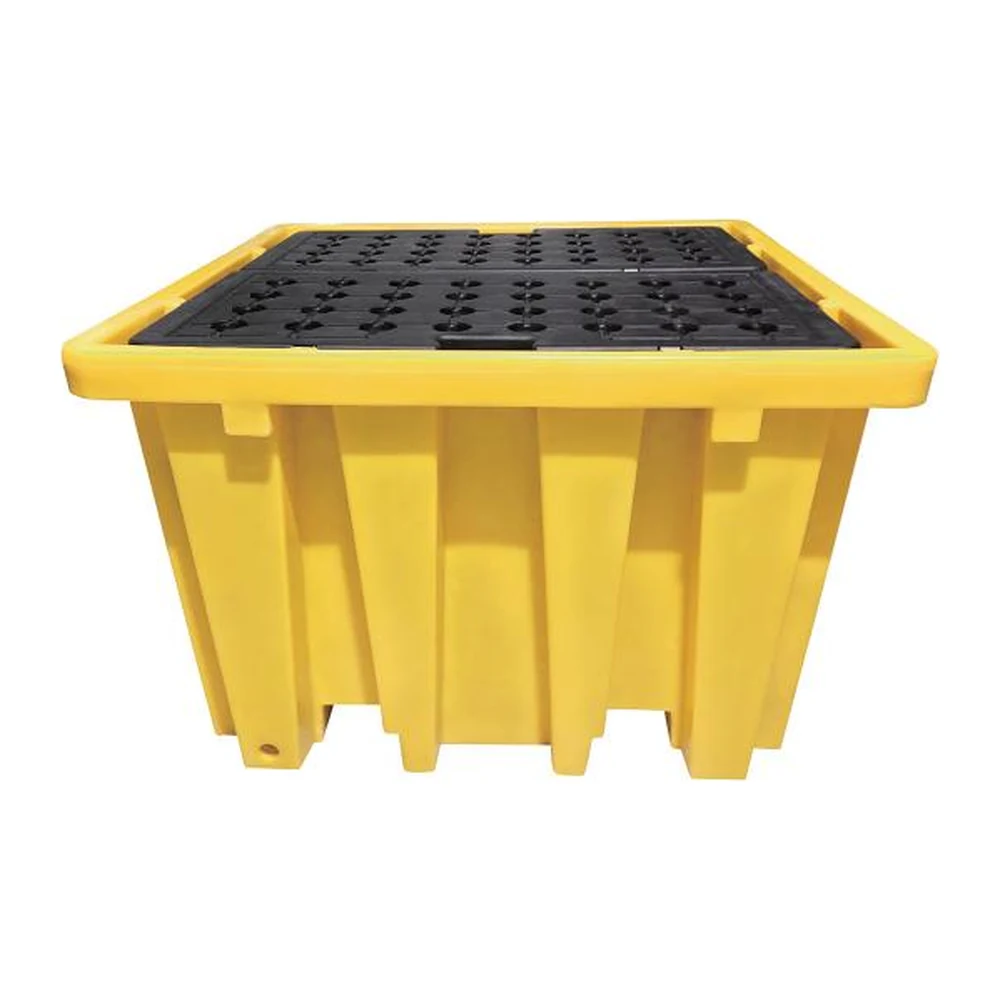 IBC & Multi-Container Spill Pallets |
Sumps from 120 to 1,600 litres, linkable, for tanks of 800 to 1,200 litres. |
| IBCs in a fire-assessed store | 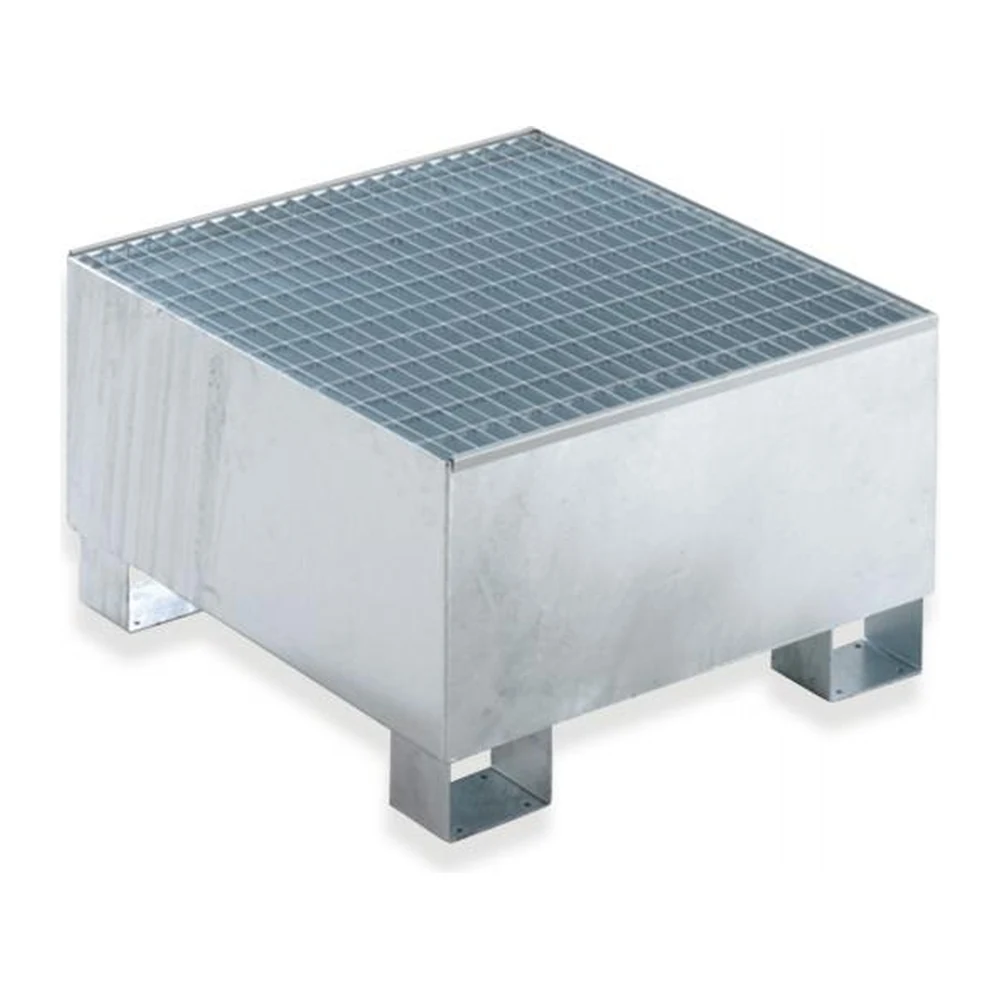 Steel Spill Pallets |
Double-layer 3 mm steel, 1,200 and 1,400 litre sumps for one or two IBCs. |
| IBC pallets outdoors | 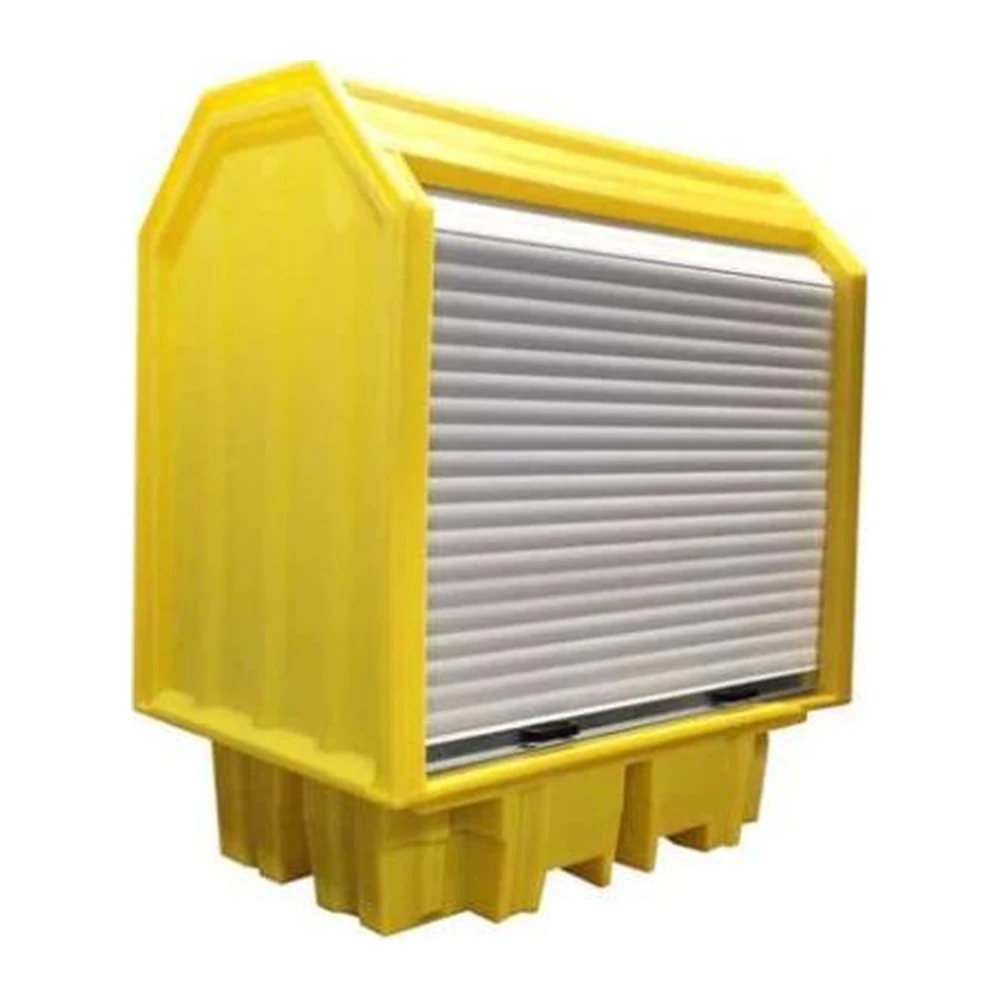 Covered Spill Pallets & Covers |
PVC covers sized to single and double IBC pallets keep rain out of the sump. |
| Decanting from the IBC valve | 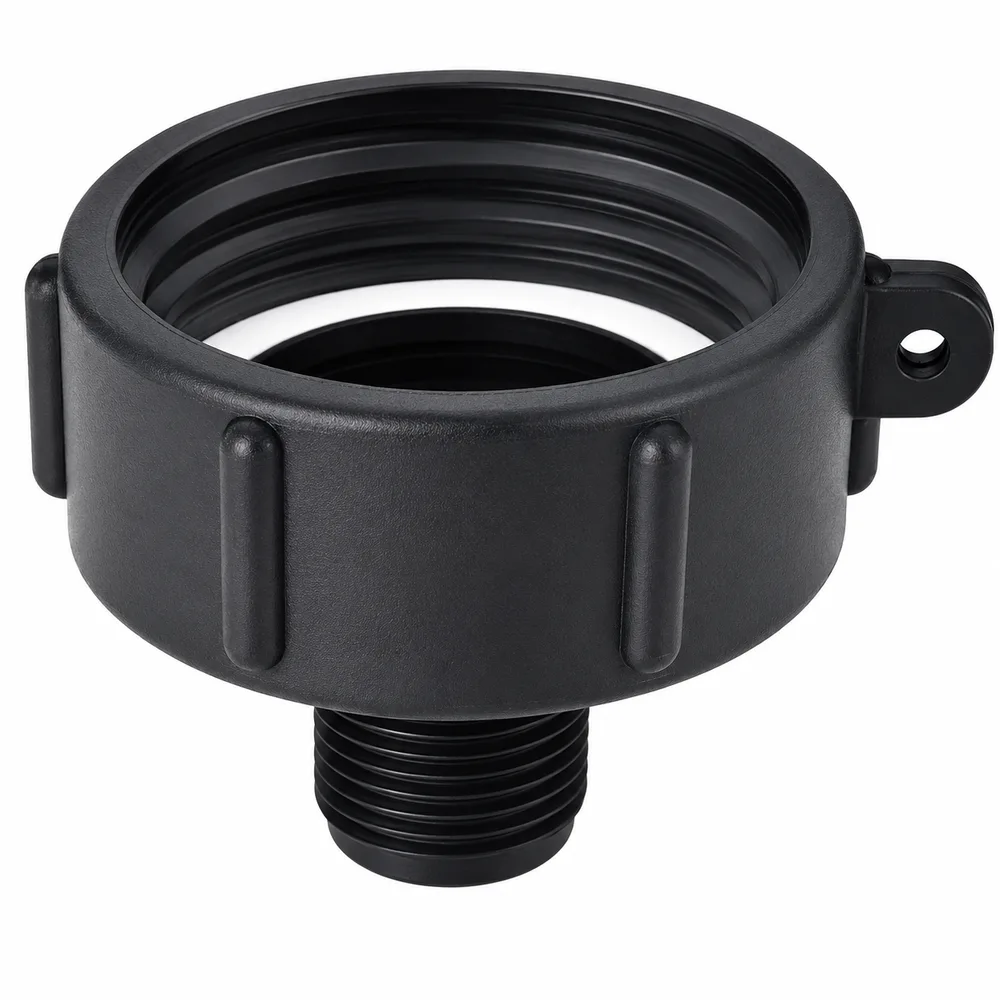 Drum & IBC Adapters |
Outlet couplings that take the tote down into jerry cans without a funnel. |
A standard 1,000 litre IBC holds 264 US gallons nominal. North American suppliers sell it as the 275 gallon tote because it holds 1,050 to 1,060 litres brimful, more than 275 gallons (1,041 litres). The 1,250 litre tote is the 330 gallon size, and 640 and 800 litre totes hold about 169 and 211 gallons. One US gallon is 3.785 litres.
The cage of a 1,000 litre tote matches its pallet, about 1,200 mm long and 1,000 mm wide. One maker’s cage measures 1,198 mm long and 1,035 mm high, and the pallet brings the whole tote to 1,150 to 1,180 mm. A 1,250 litre tote keeps the footprint and stands about 1,350 mm. Cage feet differ between makers, so measure the tote before you buy a pallet or rack for it.
Moving and holding liquids by the thousand litres: chemicals, paints and coatings, adhesives, oils, food and beverage ingredients, water and AdBlue. They were designed for transport, and HSE’s HSG71 notes that their use for storage, flammable liquids above all, has grown. Many end up holding rainwater; check what a used tote held before it holds anything you will use.
The bottle is blow-moulded from high-density polyethylene, the cage is galvanised steel tube, and the pallet is steel, plastic, wood or a composite. The valve and lid are fitted, and the design type is tested for vibration, lifting, stacking, leakproofness, hydraulic pressure and drop. Every tote built to it then takes a leakproofness test at 20 kPa before its first use (ADR 2025, 6.5.4.4.2).
Take off the seal foil or the cap on the outlet, connect your hose or adapter, release the lever lock and turn the handle. A quarter turn opens a butterfly or ball valve fully, and ball and cylindrical valves can be set part-open to regulate flow. Loosen the lid or open its vent so air can replace the liquid. Close the valve and refit the cap afterwards: ADR asks for a secondary seal on the outlet (6.5.3.1.8).
Drain and clean the tote, undo the valve’s union nut or flange bolts with an IBC valve wrench, then fit a valve and gasket to the tote maker’s original specification and check the IBC for leaks. ADR counts this as routine maintenance only on those terms (1.2.1), and anyone other than the owner marks the IBC with their State and name (4.1.2.4). In the US, 49 CFR 180.352(d)(3) asks for an external inspection and a leak check.
The contents can, and water expands as it turns to ice. ADR asks makers to take low-temperature performance into account in the bottle material (6.5.5.4.6), but the valve holds liquid in its body at the lowest, most exposed point of the tote. Drain the valve, leave headspace, and keep a water tote in a building, under an insulated cover or with a heater made for plastic tanks.
Yes. Diesel travels as UN 1202, packing group III, under packing instruction IBC03, which allows UN-marked composite totes such as 31HA1. Where the flash point is 60 °C or lower, ADR 4.1.2.1 asks for measures against electrostatic discharge, and HSE’s HSG71 advises conducting IBCs where charge can build. On a business site in England other than a farm, a diesel tote stored outdoors needs secondary containment of at least 110 per cent.
Petrol (gasoline) is UN 1203, packing group II, and ADR allows it in an IBC under IBC02 only where its vapour pressure is no more than 110 kPa at 50 °C or 130 kPa at 55 °C (special provision BB2). As a packing group II flammable liquid its flash point is below 23 °C (2.2.3.1.3), so the static rule of 4.1.2.1 applies. Use an antistatic design rated for it, and treat the store as a DSEAR assessment.
For carriage, an IBC of more than 450 litres holding dangerous goods carries its UN number mark and hazard labels on two opposite sides (ADR 2025, 5.2.1.4 and 5.2.2.1.7), with the UN number at least 12 mm high (5.2.1.1). The maker’s UN mark and plate stay as applied. HSE’s HSG71 (paragraph 174) asks for totes in a store to stay labelled as they would be for carriage.
Only in a tote made for it: a new or rebottled IBC whose bottle, valve and gaskets come with a food-contact declaration, never one that held chemicals. In the EU the plastic falls under Regulation (EU) No 10/2011; in the US, polyethylene for food contact is covered by 21 CFR 177.1520. Keep the tote out of sunlight, in a white or black bottle or under a cover, and clean it on a schedule.
About 47.2 by 39.4 inches on the base and 45.3 to 46.5 inches tall. One maker’s data sheet gives its 1,000 litre, 275 gallon tote as 1,200 by 1,000 by 1,160 mm, which is 47.2 by 39.4 by 45.7 inches, or about 3.9 by 3.3 by 3.8 feet. In centimetres that is 120 by 100 by 116 cm, and other data sheets put the height at 115 to 118 cm. Measure your own tote before you buy a rack or spill pallet for it.
The whole tote, before every fill. ADR 2025, 4.1.1.9, asks for each IBC to be checked before filling and carriage for corrosion, contamination and other damage, and for its valves and other service equipment to work. EuPIA’s guidelines add a visual check that it is empty and clean and, on an antistatic tote, that the earthing cable is intact. Read the plate as well: a tote past its 2.5-year test date may not be filled.
Return it to the IBC trade or send it for recycling. ICPP notes that makers may run return schemes and that reconditioners recycle the HDPE and the steel, with used HDPE made into products such as pallets. Its collection conditions ask for a drained, scraped-clean tote with valves closed, an undamaged bottle, cage and pallet, and legible labels. A cage keeps its original UN mark only with a new bottle of the original design from the same maker (ADR 2025, 1.2.1).
With forks that reach right under the pallet, on a truck rated for the full weight, and never by the cage. ICPP’s guidance rules out ropes tied to the cage or its cross-members. EuPIA’s guidelines say never drag or push a tote, keep the forks tilted slightly back, and secure it to the mast above 0.5 m unless you are placing it in a store. Take any tote that has suffered a heavy impact out of use.
Three high, by EuPIA’s guidelines, where the totes are of one type and nest correctly; filled totes should not go above two. ICPP adds that a stack needs flat ground and must nest two on two, never one across three. EuPIA also rules out stacking filled or empty totes in racks. For a filled tote, the stacking load on its UN mark still sets the limit.
Yes. ICPP lists a pump through the top fill opening as the second way to empty a composite IBC. Do not fix the pump, mixer or any other device to the cage, support pipes, filters and heavy valves on their own, and keep pump vibration off the tote. EuPIA’s guidelines ask for an operator in attendance throughout and, for liquids with a flash point of 60 °C or below, conductive or dissipative hoses with everything bonded and earthed.
Under ADR, a tester the competent authority accepts; in Canada, a facility registered with Transport Canada. ADR 2025 has every metal, plastic and composite IBC inspected to the satisfaction of the competent authority, with the leak test run under a quality assurance programme it accepts (6.5.4.4.1 and 6.5.4.4.2). A registered Canadian facility marks the tote R, the month and year, and its registration number. In the US, 49 CFR 180.352(g) has the records name each test facility and each inspector.
The tote, the test, the result and who did it. ADR 2025, 6.5.4.4.3, has the owner keep a report of each inspection and test, with its results and the party that performed it, at least until the next one. 49 CFR 180.352(g) lists the design type and specification, the test and inspection dates, the facility’s name and address, the inspectors’ names and the results, kept until the next successful test or for at least 2.5 years. The plate then takes the new month and year.
Yes, until they are cleaned. ADR 2025, 5.1.3.1, has empty uncleaned IBCs marked and labelled as if full, and 49 CFR 172.302(d) keeps a US bulk packaging marked until it is cleaned or refilled with something harmless. Residue totes going for testing get some relief. US rules drop the shipping papers under strict conditions but keep the labels (173.29(d)). For most classes, Canada drops the marks if a “Residue IBC(s)” document travels with the totes and the vehicle shows DANGER placards (TDG 1.44).
Yes, for testing or disposal. ADR 2025, 4.1.2.2, lets an emptied, uncleaned IBC travel to its test before it is refilled. It also lets one carry dangerous goods or residues back for disposal or recycling for up to six months after the date, unless the competent authority approves otherwise, with “CARRIAGE IN ACCORDANCE WITH 4.1.2.2 (b)” on the transport document (5.4.1.1.11). In the US, 49 CFR 173.35(a) exempts any IBC filled before its due date.
Yes, on conditions. In the US, 49 CFR 173.24(d)(2) accepts a UN standard packaging made abroad if it conforms in full to the UN Recommendations and could pass the part 178 tests. It must also come from a country whose competent authority treats US-made UN packaging the same way. Canada’s TDG Regulations (5.6) accept an IBC bearing the UN marks that was made to chapter 6.5 of the UN Recommendations and the national rules of its country of manufacture.
In the US it is: 49 CFR 171.8 counts a packaging that holds more than 450 litres of liquid as bulk, so a 1,000 litre tote follows the bulk marking rules. ADR 2025 defines an IBC as a portable packaging (1.2.1) and adds that an IBC built to chapter 6.5 is not a container, so its marks and labels follow the rules for packages in chapter 5.2. Canada’s TDG Regulations call any means of containment over 450 litres a large means of containment.
A 1,000 litre tote typically has a DN150 fill opening, a 6 inch screw cap, and some makers offer a larger DN225 (9 inch) opening. The sizes come from makers' data sheets and no standard fixes them, so measure the cap before you order a lid, funnel or fill head. The opening takes the fill, a rotating cleaning head or a top pump. Lids come plain, with a degassing membrane, or with a vent that lets air in as the tote drains.
Most IBC tote valves are DN50, which has a 2-inch bore. DN80 valves, with a 3-inch bore, pass more flow for viscous products. The outlet thread decides what connects to them. European valves often end in a coarse S60x6 thread, 60 mm across with a 6 mm pitch. Valves for North America use 2-inch NPS threads, and some end in a camlock coupling.
Yes, when the UN mark allows it. The second-last number in the mark is the stacking test load in kilograms, and a 0 means the design may not be stacked. Divide the test load by 1.8 for the most weight that may rest on the tote: an example mark ending 10800/1200 allows 6,000 kg on top, which is five full totes of 1,200 kg. HSE's HSG71 calls it good practice to stack IBCs two high at most in storage unless the maker confirms a greater height.
An empty caged 1,000 litre tote weighs about 52 kg on a plastic pallet and 65 kg on a steel one, according to Australia's heavy vehicle regulator, NHVR. A full tote weighs the litres times the density plus the empty weight. With a 60 kg tote, 1,000 litres comes to about 808 kg for petrol, 893 kg for diesel, 1,060 kg for water and 1,150 kg for AdBlue. The last number in the UN mark gives the maximum gross mass.
A 1,000 litre IBC tote stands 1,150 to 1,180 mm tall on its 1,200 by 1,000 mm pallet, according to maker and distributor data sheets. A 1,250 litre tote keeps that footprint and stands about 1,350 mm, and a 640 litre tote on the 1,200 by 800 mm Euro-pallet base stands about 1,000 mm. Two 1,000 litre totes stacked reach about 2,320 mm.
IBC totes come in four common nominal sizes: 640, 800, 1,000 and 1,250 litres, and most hold 1,000 litres. The 640 litre tote sits on a 1,200 by 800 mm base. The 800 litre tote uses a 1,200 by 800 or a 1,200 by 1,000 mm base, so check the drawing. The 1,000 and 1,250 litre totes use the 1,200 by 1,000 mm base. Filled to the brim, a 1,000 litre tote holds 1,050 to 1,060 litres.
IBC cages are made of galvanised steel tube or wire. They hold a blow-moulded HDPE bottle, natural or pigmented against light, on a pallet of galvanised steel, plastic, wood or a steel and plastic composite. When totes stack, the cage and pallet take the load (ADR 2025, 6.5.5.4.25).
A standard composite tote does. ADR 2025 (6.5.5.4.2) says its plastic bottle is not intended to contain anything without the casing, so the bottle and cage work as one unit. An all-plastic IBC with its own moulded frame, coded UN 31H1, is a different design type whose body carries the stack itself, so it needs no cage.
An IBC storage tank is an intermediate bulk container: a rigid or flexible portable packaging of up to 3,000 litres, designed for mechanical handling and tested against the stresses of handling and transport (ADR 2025, 1.2.1). The common caged tote is a 1,000 litre HDPE bottle in a galvanised steel cage on a pallet. HSE notes that people use IBCs for storage more often than before, flammable liquids above all, although they were designed for transport.
The standards and regulations this page relies on, at their issuing body. Where a market rule is named here, check the current revision before you specify against it.
Last reviewed by David Guru, Co-Founder & Business Development Director.
Tell us the containers, the liquid and where the store is. We come back with the pallet or bund, its load rating and a quotation.