
Which oil stores the rules catch in each UK nation, how big the bund must be, what changed in Scotland in 2025, and who enforces it.
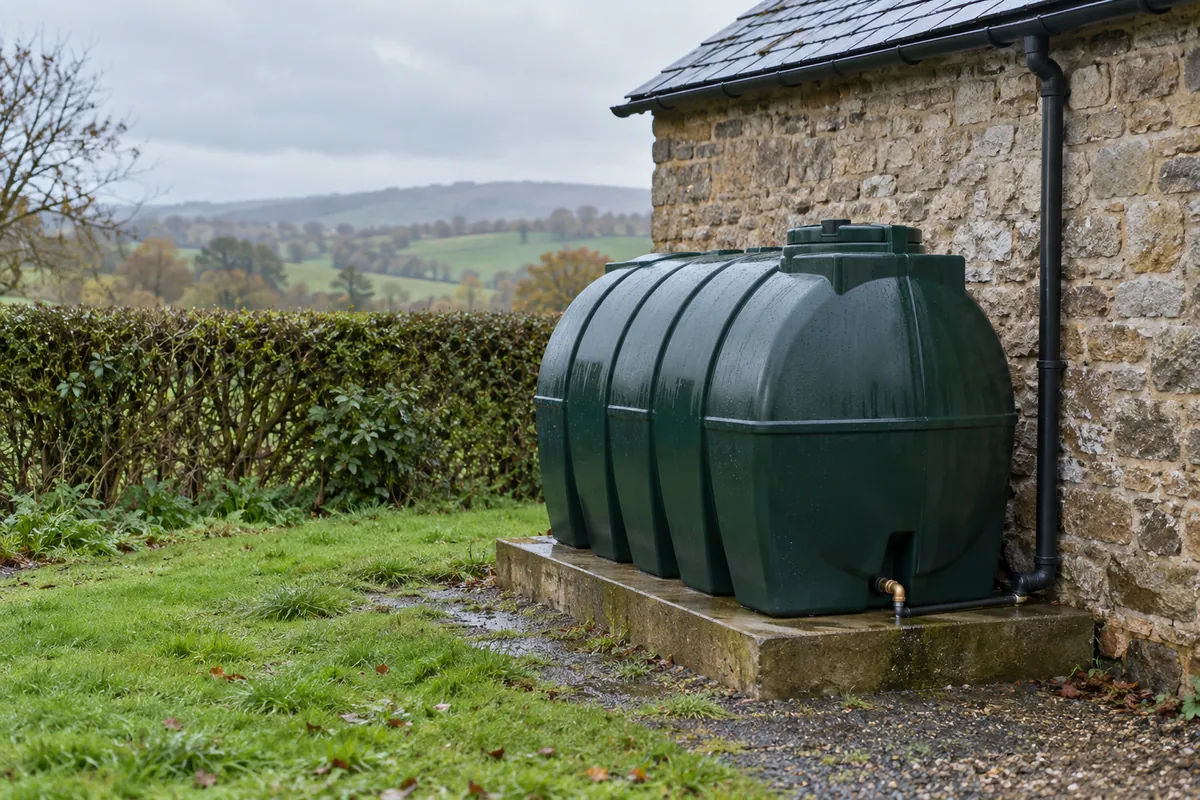
UK oil storage regulations apply to a business holding oil in any container over 200 litres (200 litres and up in Scotland). The container must stand in a bund of 110% of the largest container or 25% of the total stored, whichever is greater; drums may use a 25% drip tray. All four nations use these figures and differ on buildings, farms and waste oil.
Quick answer: What do the UK oil storage regulations require of a business?
A business that keeps oil in any container over 200 litres, or 200 litres and up in Scotland, must bund it to the greater of 110% of the largest container and 25% of the total; drums may stand on a 25% drip tray. A store of 20 litre cans sits outside the rule, however many cans it holds.
Every container in scope must meet the same short list of conditions, and the wording changes little between the four nations. In England they sit in regulation 3 of the Control of Pollution (Oil Storage) (England) Regulations 2001. Wales, Scotland and Northern Ireland repeat them with small additions.
| Requirement | What it means on site | England |
|---|---|---|
| Container strength | Unlikely to burst or leak in ordinary use | reg 3(1) |
| Bund capacity | 110% of one container; with several, 110% of the largest or 25% of the total, whichever is greater | reg 3(2)(a) |
| Impact protection | Sited or guarded away from vehicle and forklift routes | reg 3(2)(b) |
| Impermeable bund | A base and walls that oil and water cannot pass through | reg 3(2)(c) |
| No drain | No valve, pipe or opening used to drain the bund; any pipe through a wall sealed | reg 3(2)(d) and (e) |
| Kit inside the bund | Valves, filters, sight gauges and vent pipes within it; a drip tray under a remote fill point | reg 3(3) and (4) |
Fixed tanks carry more under regulation 4, including overfill prevention where the tank cannot be seen from the fill point and a non-return valve on any pump, and GOV.UK rules out a drip tray for them. A mobile bowser needs any fixed tap or valve that can release oil locked shut when not in use (regulation 5).
The size test applies to each container on its own. Regulation 2(2)(c) of the England regulations excludes ‘any container with a storage capacity of 200 litres or less’, and GOV.UK states it from the other side: the rules apply to a container of 201 litres or more. A store of 20 litre jerry cans sits outside the rule however many cans it holds. One 205 litre drum is inside it.
A container, in the regulations, is a drum, an intermediate bulk container (IBC), a fixed tank or a mobile bowser. Oil is read wide. GOV.UK lists petrol, diesel, biofuels, kerosene, vegetable oils, hydrotreated vegetable oil (HVO), synthetic and lubricating oils, oil-based solvents, liquid bitumen products, cutting fluids and insulating oils. LPG, solid bitumen, non-oil solvents such as trichloroethylene, and aromatics such as benzene and toluene fall outside.
A can store below the line still has duties: DSEAR covers petrol at work, and an insurer can ask for a bund the law does not. Size it the same way; spill containment for fuel and chemicals covers the options.
Take 110% of the largest container and 25% of the total stored, and build to the greater figure. With one container it is 110% of that container. For containers of equal size the 110% figure governs up to four, and a quarter of the total takes over at the fifth. One 205 litre drum and four drums both need 226 litres, and eight need 410. One 1,000 litre IBC needs 1,100 litres, four need the same, and five need 1,250.
Drums have a second route. Regulation 3(5) lets drums stand on a drip tray of 25% of their combined capacity, so one 205 litre drum needs a 52 litre tray. GOV.UK sizes the tray by what it can hold: a tray built for four 205 litre drums needs 205 litres even with one drum on it. The allowance covers drums alone, so an IBC, a bowser or a fixed tank needs the full 110%.
Containers joined by pipework count as one. Where tanks are hydraulically linked, GOV.UK asks for 110% of their combined capacity, and you may add bund volumes together only where the bunds are linked too. The bund capacity calculator works the figure for each nation, and the spill pallet sizing calculator lists pallets that pass. For worked stores, see spill pallet size for 1, 2 and 4 drums and IBC bund size.
The Control of Pollution (Oil Storage) (England) Regulations 2001 have applied since 1 March 2002, and the Environment Agency enforces them. Regulation 2(2) leaves out:
GOV.UK defines a building as a permanent or temporary structure with walls and a roof that would capture leaking oil; an indoor store may need fire measures under the Building Regulations. The waste exclusion covers mineral oil drained from engines and gearboxes, turbine and hydraulic oil, and spoiled fuel mixes. Waste cooking, vegetable and synthetic oil stay inside the rule, as does oil a farm keeps for a non-farm business, such as fuel for its lorries.
Agricultural fuel oil on a farm in England comes under the Water Resources (Control of Pollution) (Silage, Slurry and Agricultural Fuel Oil) (England) Regulations 2010, known as SSAFO. Regulation 5(2)(b) brings a farm in once the total fuel oil stored there exceeds 1,500 litres. This threshold counts the whole farm, tanks and drums together, where the business rule tests each container.
Schedule 3 sets the bund at 110% of a single tank, the greater of 110% of the largest or 25% of the total where tanks share it, and 25% of the total where drums stand with no tank. The bund and base must be impermeable and built to last at least 20 years with maintenance, and no part may sit within 10 metres of inland or coastal waters. Stores in use before 1 March 1991 are exempt under regulation 6, and GOV.UK says a substantial change ends that exemption.
Northern Ireland has its own farm rule with a lower trigger: the 2003 farm regulations apply above 1,250 litres of fuel oil on a farm, with the same 110% and 25% but no 25% drip-tray route for drums. Wales and Scotland fold farm fuel into their general oil rule. For cans and handling, see agricultural and on-farm fuel storage.
Wales uses the Water Resources (Control of Pollution) (Oil Storage) (Wales) Regulations 2016, which Natural Resources Wales enforces. They applied to new storage from 15 March 2016. Existing containers were covered from 15 March 2020, or from 15 March 2018 where a container stood within 10 metres of water or 50 metres of a well or borehole (regulation 1). Regulation 5 repeats the English 110%, 25% and drum drip-tray figures.
The Welsh scope is wider. Regulation 3 has no building exclusion, and farm fuel oil is inside it, because regulation 12 took fuel oil out of the Welsh farm regulations of 2010. The exclusions are containers of 200 litres or less, underground containers outside a building, storage under an environmental permit, depots, refineries, and home tanks in use when the rules took effect for them. Wales also wants an anti-siphon valve on any suction pipe under 8 mm bore (regulation 6(7)).
The Scottish oil rule moved on 1 November 2025. The Environmental Authorisations (Scotland) Amendment Regulations 2025 brought water activities into the Environmental Authorisations (Scotland) Regulations 2018, and the general binding rules of the old Controlled Activities Regulations (CAR) gave way to new ones in Schedule 9. Oil storage is general binding rule 28. SEPA enforces it, and a store that meets it in full is authorised without an application.
Rule 28 keeps the 110% and 25%, the 25% drum drip tray and the ban on drain openings. Its scope differs in three places. Rule 26 covers portable containers of less than 200 litres and asks only that they will not burst or leak, so a 200 litre drum falls under rule 28. Rule 28 has no building or farm exclusion. It leaves out waste oil, vehicles and vessels, wholly underground containers, and home heating or cooking tanks of 2,500 litres or less (rule 27). Waste oil returns through Chapter 3 of Schedule 9: more than 200 litres in temporary storage must meet rule 28.
Northern Ireland uses the Control of Pollution (Oil Storage) Regulations (Northern Ireland) 2010, in operation since 20 March 2011 and enforced by DAERA through the Northern Ireland Environment Agency (NIEA). Regulation 4 sets the same 110%, 25% and drum drip-tray figures. Regulation 3(2) excludes containers of 200 litres or less, private dwellings with a container of 3,500 litres or less, oil for agriculture on a farm, containers wholly underground, and containers of 2,500 tonnes or more on major-hazard (COMAH) sites.
Two differences from England catch workshops. The Northern Ireland definition of oil names waste oil, and there is no building exclusion, so drums of used engine oil inside a unit are in scope. A 2011 amendment changed none of the figures.
Breaking the oil storage rules is a criminal offence in all four nations. The fines and prison terms differ:
| Nation | Regulator | Lower court | Higher court |
|---|---|---|---|
| England | Environment Agency | Fine of any amount | Fine of any amount |
| Wales | Natural Resources Wales | Fine of any amount, or civil sanctions | Fine of any amount |
| Scotland | SEPA | Up to £40,000, 12 months in prison, or both | Fine, up to 5 years, or both |
| Northern Ireland | DAERA (NIEA) | Up to £20,000, 3 months, or both | Fine, up to 2 years, or both |
The English regulation 9 capped the magistrates’ court fine at the statutory maximum, then £5,000, until section 85 of the Legal Aid, Sentencing and Punishment of Offenders Act 2012 removed the cap. Natural Resources Wales can also impose monetary penalties and stop notices (Wales regulation 10), and the Environment Agency can serve an anti-pollution works notice, GOV.UK says. Report a spill at once: 0800 80 70 60 in England, Scotland and Northern Ireland, 0300 065 3000 in Wales.
The oil storage rules protect water. Fire and explosion risk at work is a separate duty under the Dangerous Substances and Explosive Atmospheres Regulations 2002 (DSEAR), which has no container-size threshold. Petrol counts as oil for the pollution rules and as a dangerous substance under DSEAR, so a petrol store at a business answers to both. HSE guidance HSG51 (third edition, 2015) gives the working figures for flammable liquids in containers up to 1,000 litres:
| Situation | HSG51 figure | Where |
|---|---|---|
| Workroom cabinet, extremely or highly flammable liquids such as petrol | 50 L at most | para 211 |
| Workroom cabinet, other flammable liquids up to 60 °C flash point | 250 L at most | para 211 |
| Spill retention inside a cabinet | 110% of the largest vessel | para 207 |
| Outdoor store up to 1,000 L | 2 m from buildings, boundary and ignition sources | Table 1 |
| Outdoor store, 1,000–100,000 L | 4 m | Table 1 |
| Outdoor store above 100,000 L | 7.5 m | Table 1 |
HSG51 asks for a bund of at least 110% of the largest container where the containers are metal, and warns that a store of plastic containers can fail within about 10 minutes in a fire (paragraph 55). Petrol at filling stations and homes comes under the Petroleum (Consolidation) Regulations 2014: see UK petrol container rules. Zoning is in DSEAR and ATEX for fuel and chemical storage, and shelf life in storing fuel safely.
Used engine oil splits the four nations more than any other liquid. England leaves waste mineral oil out of the oil rule and asks you to check whether you need an environmental permit. Northern Ireland includes it. Wales includes it unless the store already sits under an environmental permit, and Scotland applies rule 28 once more than 200 litres is held. GOV.UK treats oily water from a bund, and absorbent soaked in oil, as hazardous waste.
Chemicals other than oil have no bund figure in English law. For Wales, Scotland and Northern Ireland, the regulators’ joint guidance GPP 26 recommends the same 110% and 25% for drums and IBCs of oil or chemicals. It also recommends 110% to 185% for pesticides stored indoors and an extra 100 mm of wall height on large outdoor stores for rain and firefighting water. COSHH covers the health side. See COSHH storage requirements, secondary containment requirements and chemical compatibility before you choose a bund material.
We make the containment that sits under drums and IBCs. Our polyethylene drum spill pallets have sumps of 42 to 488 litres and our IBC pallets 120 to 1,600 litres. Our double-layer 3 mm steel pallets suit stores where a fire assessment rules out plastic. For a UK oil store, choose a version without a drain plug, because all four nations bar a drain opening in the bund.
Drum decks suit drums in daily use, where a 25% drip tray is allowed; check the deck sump against that figure. Covered pallets keep rain out of an outdoor sump. Send us the containers, the liquid and the nation, and we will size the pallet against the rule that applies.
| Your use case | Recommended can | Why this one |
|---|---|---|
| Drums of oil in storage | 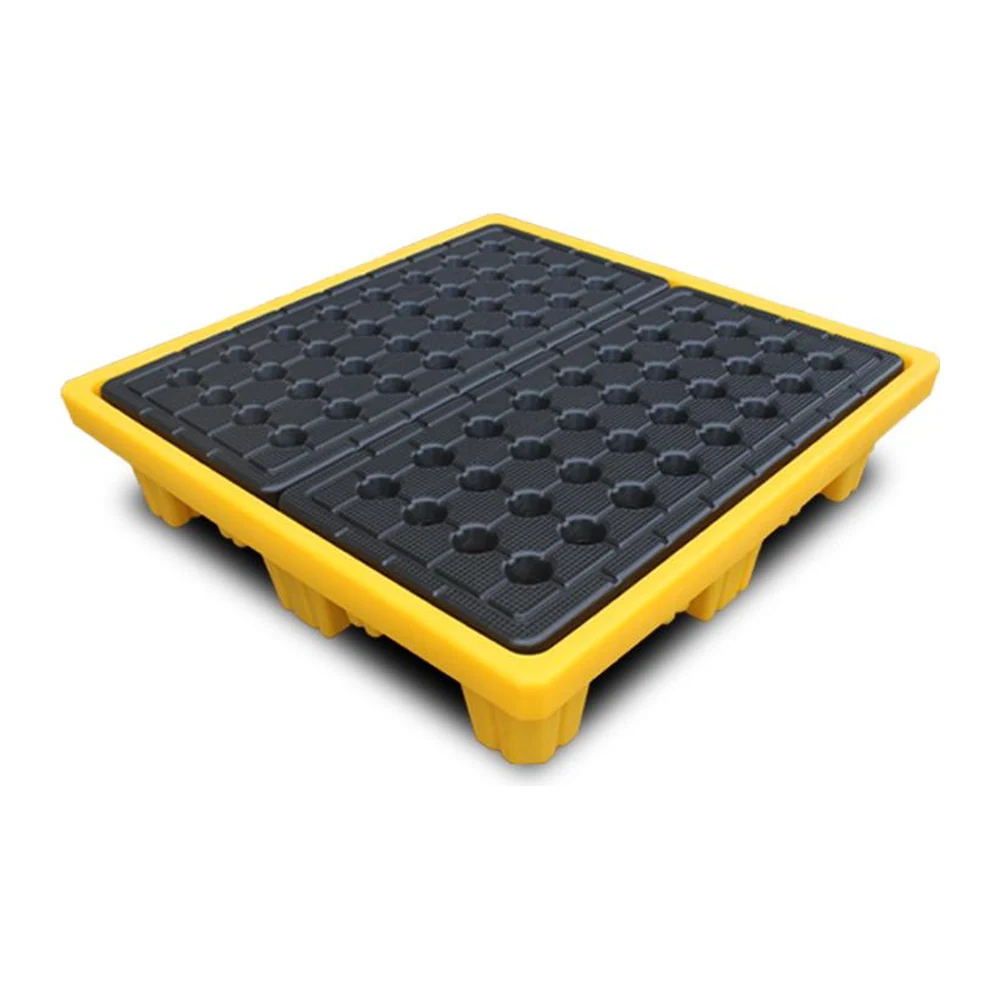 Drum Spill Pallets |
Sumps up to 488 litres, past the 226 litres that one to four 205 litre drums need. |
| IBCs of oil | 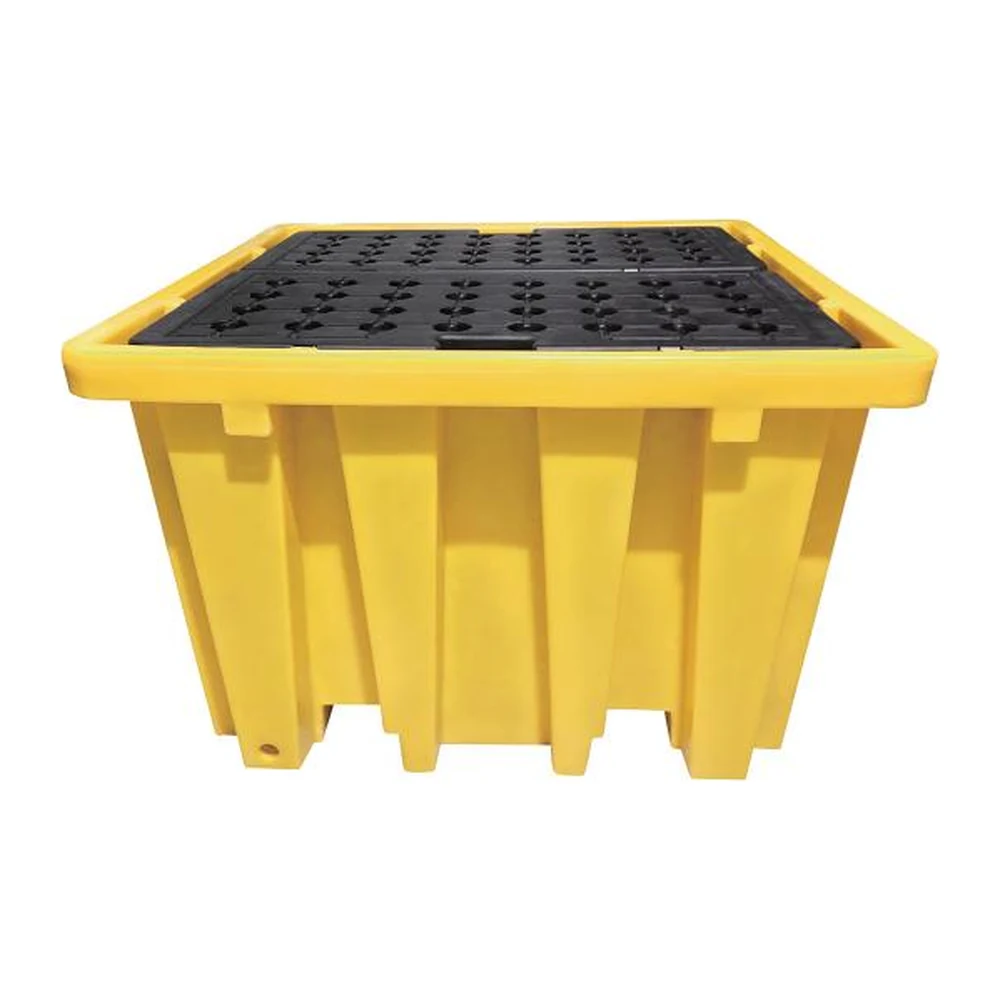 IBC & Multi-Container Spill Pallets |
Sumps from 120 to 1,600 litres; one 1,000 litre IBC needs 1,100. |
| Fire-assessed stores | 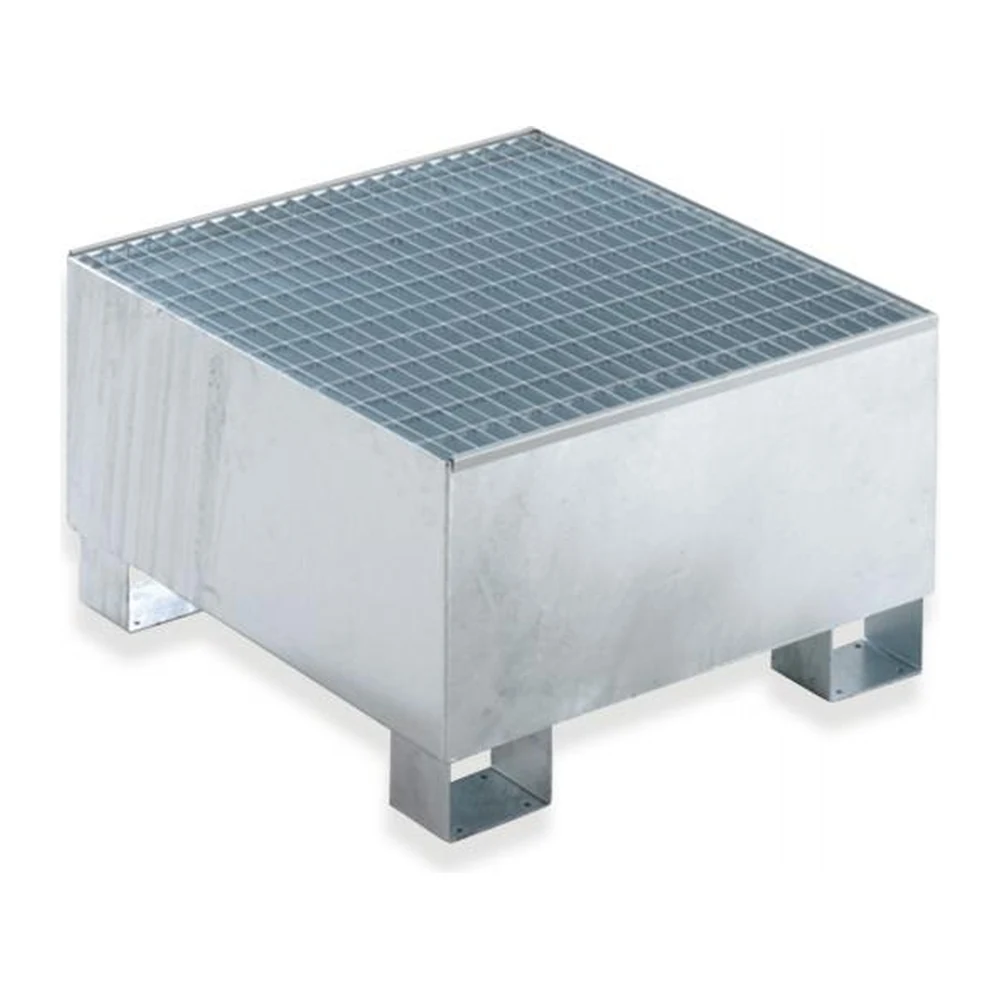 Steel Spill Pallets |
Double-layer 3 mm steel where a plastic bund is ruled out. |
| Outdoor oil stores | 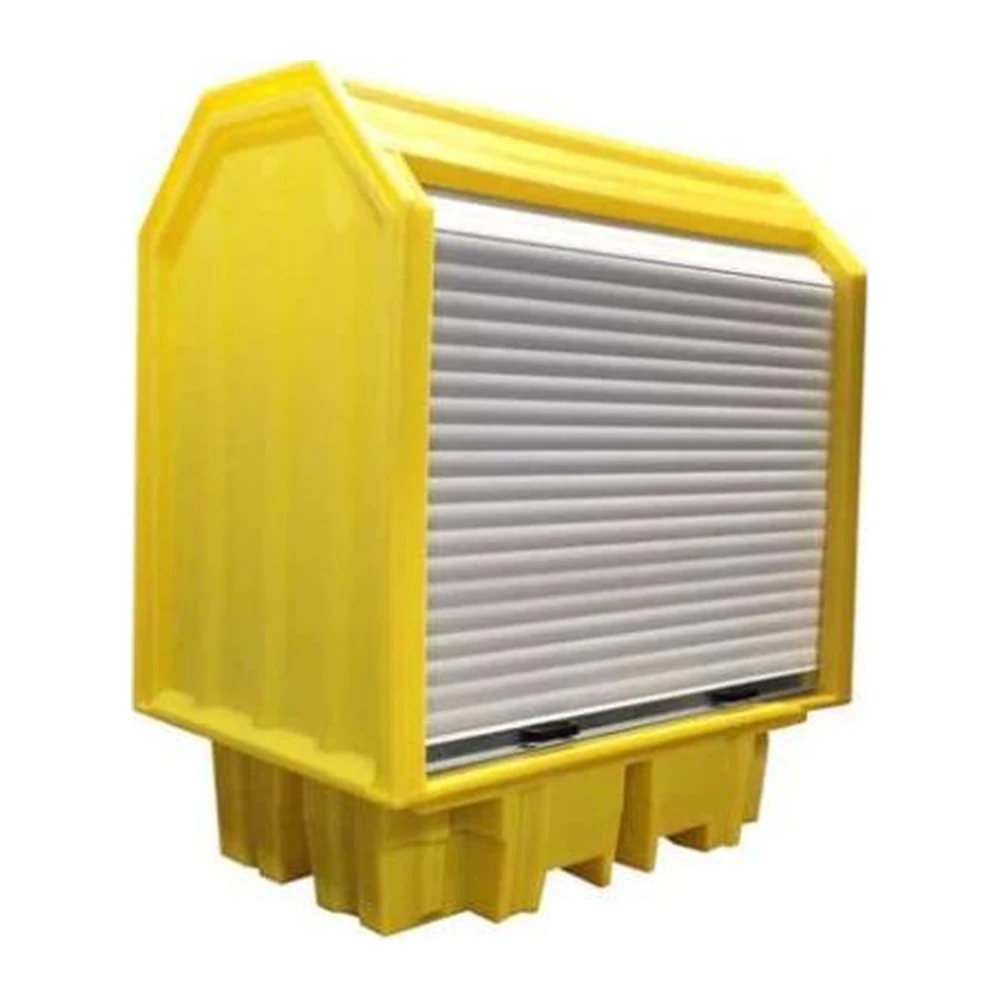 Covered Spill Pallets & Covers |
A cover keeps rain out, so the sump has room for oil. |
| Drums being dispensed | 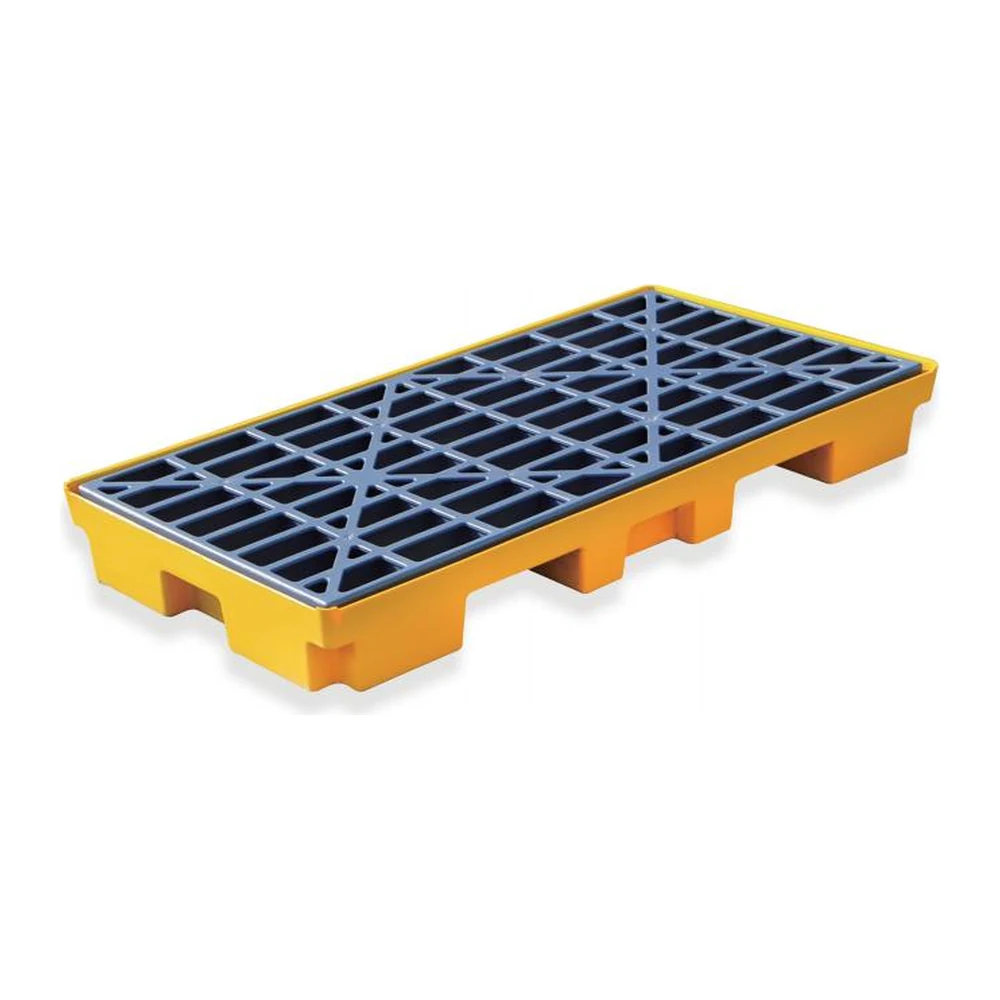 Drum Spill Decks |
Low decks for drums in use; check the deck sump against the 25% drip-tray figure. |
| Remote fill points and pails | 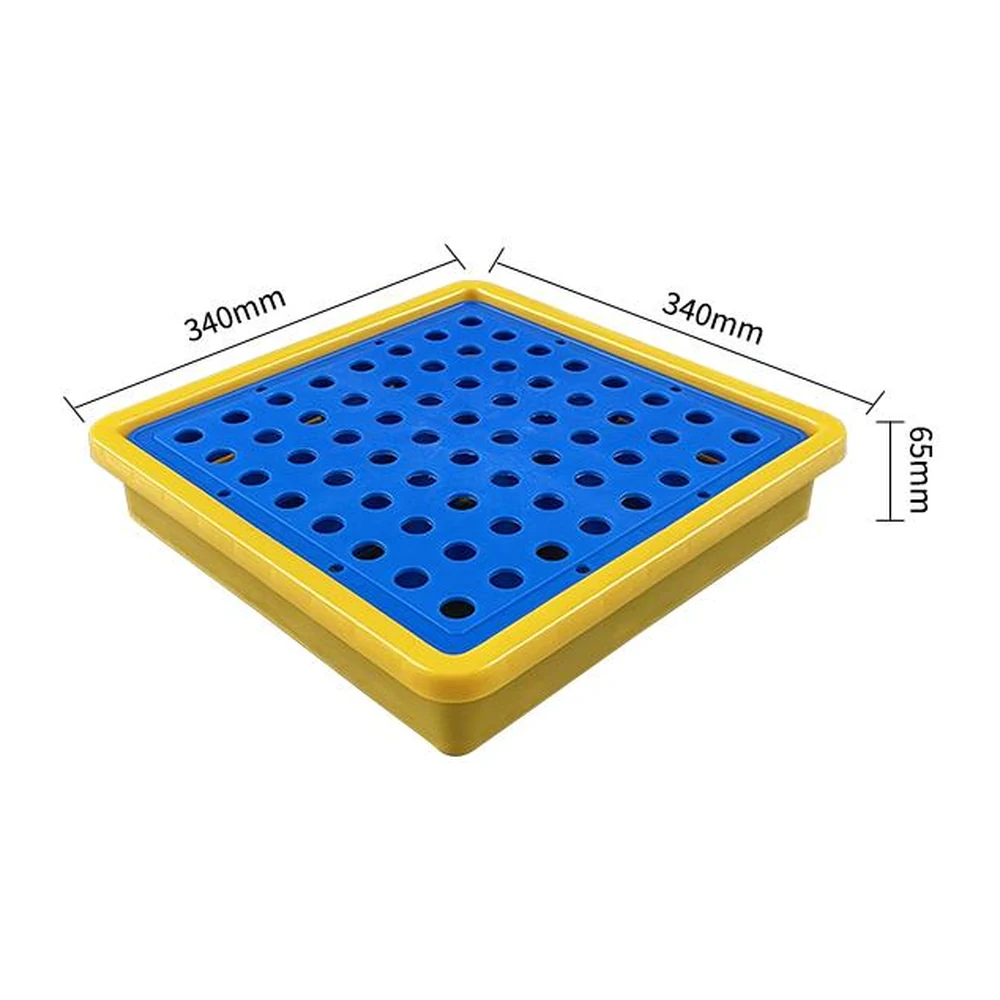 Bench Trays & Drip Trays |
Regulation 3(4) wants a drip tray under a fill point outside the bund. |
Yes, in England, where the generator has a connected oil tank of 201 litres or more. GOV.UK names two cases: a standby generator kept for emergencies, and a generator in daily use whose tank is not emptied within a day. The tank then needs the same secondary containment as any other container, 110% of its capacity, with its valves, filters and gauges inside the bund.
No. GOV.UK says a double-skinned or twin-walled tank does not count as secondary containment in England, and nor does an oil separator. An integrally bunded tank, where the maker builds the bund around the tank, does count, provided the bund holds 110% of the tank and has no drain opening.
No. All four UK oil rules bar any valve, pipe or other opening used to drain the bund. Pump rainwater out instead, check it for oil first, and treat oily water as hazardous waste, as GOV.UK directs. A cover or roof over an outdoor store keeps the sump empty for the spill it exists to hold.
Not under the oil rules. The 25% drip-tray allowance is written for drums, so an IBC of oil needs secondary containment of 110% of its capacity: 1,100 litres for a 1,000 litre tote. GPP 26, the guidance for Wales, Scotland and Northern Ireland, says the same. Where several IBCs share a bund, the greater of 110% of the largest or 25% of the total applies.
Red diesel follows the same storage rules as any other diesel. Off the farm, that is the oil storage rule for your nation. On a farm in England it is SSAFO once the farm holds more than 1,500 litres of fuel oil, and in Northern Ireland the 2003 farm rules above 1,250 litres. HMRC’s Excise Notice 75 controls who may use rebated fuel; the storage standard comes from the pollution rules.
For a business tank in England the 2001 regulations ask for no notice, though planning permission and, for an indoor store, the Building Regulations can apply. A new or altered farm fuel store in England must be notified to the Environment Agency at least 14 days before use (SSAFO regulation 9). In Scotland a store that meets general binding rule 28 is authorised without applying to SEPA.
For farm fuel in England, no part of the store or its bund may sit within 10 metres of inland or coastal waters, a ditch or land drain included (SSAFO Schedule 3). The Environment Agency also recommends 50 metres from a borehole, well or spring. The business rules set no fixed distance, though the same 10 and 50 metre figures decided which existing stores had to comply first in England and Wales.
Without a permanent leak detector, test underground fill, draw-off and overflow pipes before first use, then at least every 5 years if they have mechanical joints and every 10 years if not (England regulation 4(3)). A permanent detector must be kept working and tested at suitable intervals; Wales and Scotland set at least every 5 years.
Yes, in England. GOV.UK says a drum or IBC marked UN meets the design standard for strength. For fixed tanks it names BS 5410, OFTEC OST T100 for plastic, and OFTEC OFS T200 or BS 799-5 for metal. If your container has none of these, GOV.UK suggests asking the Environment Agency whether it is strong enough. The UN mark says nothing about the bund.
The person with custody or control of the oil. The England, Wales and Northern Ireland regulations place the duty and the offence on that person, which on a leased site is often the tenant who runs the store. In Scotland, failing to meet general binding rule 28 is an offence for whoever does so (regulation 69). Agree in the lease who maintains the bund.
Yes. GOV.UK lists vegetable oils, including plant oils such as sunflower oil, among the oils the England rules cover, and waste cooking oil and waste vegetable oil stay inside the rule. A restaurant or food plant holding cooking oil outdoors in a container over 200 litres needs the same bund as a diesel store.
No. They cover England, Wales, Scotland and Northern Ireland. The Republic of Ireland, the United States under the EPA’s SPCC rule, Australia and each EU state set their own containment rules, with their own thresholds and percentages. Our secondary containment requirements guide covers rules beyond the UK, and the spill pallet sizing calculator applies the local rule for each region it lists.
The standards and regulations this page relies on, at their issuing body. Where a market rule is named here, check the current revision before you specify against it.
Last reviewed by Clarence Cheang, Co-Founder.
Tell us the containers, the liquid and where the store is. We come back with the pallet or bund, its load rating and a quotation.