
How much a bund, spill pallet or containment tray must hold under each country’s rule, from the UK 110% rule to US SPCC, with the law, guidance and thresholds behind each figure.
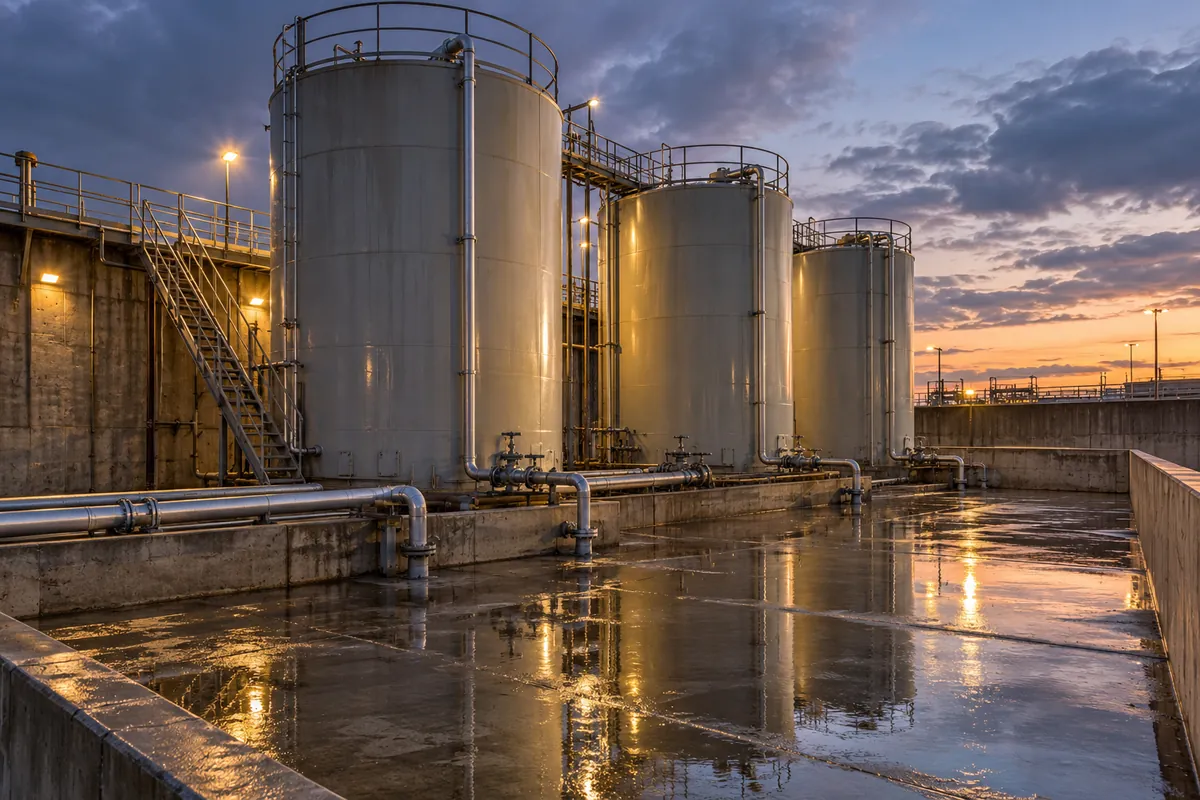
Most rules size secondary containment from two numbers: the largest container and the total stored. The UK and Ireland ask for 110% of the largest or 25% of the total, whichever is greater. US SPCC asks for 100% of the largest plus room for rain. France, Germany, the Netherlands and Spain set their own share of the total, and New Zealand can ask for all of it.
Quick answer: How much must a bund hold?
Take two figures and build to the larger: a share of the largest container and a share of the total stored. UK and Irish rules take the greater of 110% of the largest and 25% of the total; US SPCC takes 100% of the largest plus room for rain. Ten 205 litre drums in the UK need 513 litres.
Work out two figures and size the bund to the larger. One is a share of the largest container: 110% in the UK, Ireland and the Netherlands, 100% under SPCC, RCRA, France and Spain. The other is a share of everything the bund serves: 25% in the UK and Ireland, 10% in the Netherlands, Spain and RCRA, 50% in France.
Ten 205-litre drums hold 2,050 litres. 110% of one drum is 226 litres and 25% of the total is 513, so a UK bund for them needs 513 litres. Four drums stop at 226, because 110% of one drum beats a quarter of four; with equal containers the total takes over at the fifth. The spill pallet sizing calculator runs the sum for each country it covers.
To check a bund you already have, multiply its inside length, width and wall height, then subtract the space the containers take up inside it, as EPA Victoria’s Publication 1698 sets out. Outdoors, add height for rain.
Secondary containment is a second barrier that catches liquid escaping from the primary container: a drum, IBC, tank or can. A bund is the walled area that does it, in concrete, masonry or a moulded spill pallet; US rules say dike or berm. The English regulations define it as a drip tray, a bunded area or any other system that stops escaped oil leaving the place where it is stored.
A spill pallet or containment tray is a bund you can move. A double-skinned tank carries its own, and Ireland’s EPA guidance accepts a double-walled tank with leak detection in place of a bund. None of these clean anything up: the US RCRA rule makes the operator remove spilled waste and rain before the sump overflows (40 CFR 264.175(b)(5)).
Bund, dike and berm all name the wall that holds a spill, and the country decides which word you hear. Rules in the UK, South Africa and Singapore say bund, as do Australian ones (see bunding in Australia and New Zealand). US rules say dike or berm, and dyke is the British spelling of dike. A bond wall is a misspelling of bund wall.
The US texts use both of their words without giving either a different size. SPCC lists “dikes, berms, or retaining walls” impervious to oil among the ways to contain a spill (40 CFR 112.7(c)(1)(i)), and OSHA’s flammable liquids standard sizes a diked area round tanks (1910.106(b)(2)(vii)). Whatever the wall is called, the capacity comes from the rule: the SPCC rule takes the largest container plus rain, and the UK oil storage regulations take 110% and 25%.
On roads and farms, berm and windrow mean a bank of loose material that holds no liquid. US mine safety rules define a berm as a mound along an elevated roadway that limits a vehicle’s force to keep it from going over the bank. The berm is built to at least mid-axle height of the largest vehicle on the road (30 CFR 56.2 and 56.9300). Western Australia’s mines regulator calls that bank a windrow or bund (Mines Safety Bulletin 179). In composting, a windrow is a long row of material about twice as wide as it is high (US EPA). A storage bund needs a floor and walls impermeable to what it holds, which none of these banks have.
Bonding is an electrical safeguard. HSE’s HSG140 asks for containers to be bonded together and earthed while liquid is decanted, so static charge cannot spark (paragraphs 73 and 200). A fuel store can need both: a bund for the spill and bonding for the transfer, which DSEAR and ATEX for fuel stores covers.
All four UK nations use the same figures for oil. A single container needs 110%. Several need 110% of the largest or 25% of the total, whichever is greater. Where drums stand on a drip tray, it needs 25% of the drums. England’s text is regulation 3 of the Control of Pollution (Oil Storage) (England) Regulations 2001, in which petrol counts as oil. The base and walls must be impermeable, with no valve, pipe or opening used for draining (reg 3(2)(c) and (d)).
Scope is where the nations differ. England leaves out containers of 200 litres or less, oil in a building or wholly underground, waste oil, home tanks up to 3,500 litres, refineries, depots and farm oil (reg 2(2)). English farms come under the SSAFO Regulations 2010 above 1,500 litres of fuel oil. Wales and Northern Ireland have no building exclusion. Scotland’s General Binding Rule 28, in force since 1 November 2025, leaves out only portable containers under 200 litres. The UK bund capacity calculator, the UK oil storage regulations guide and agricultural fuel storage cover each case.
The figure is for several containers sharing one bund, and “or” means whichever is greater. Law can be prosecuted; a model code binds once a state or province adopts it; guidance is a regulator’s expectation, which a permit or licence can make binding.
| Where | Rule | Several containers in one bund | Status |
|---|---|---|---|
| England | Oil Storage Regulations 2001, reg 3 | 110% of largest or 25% of total; drip tray 25% | Law: oil, over 200 L, outdoors |
| Wales, Scotland, Northern Ireland | Wales 2016, GBR 28, NI 2010 | As England | Law: oil, indoors too; Scotland from 200 L |
| UK, other liquids | GPP 26, 5.2.3 | 110% of largest or 25% of total | Guidance, not in England |
| Ireland | EPA guidance note 2004, 5.3.1 | 110% of largest or 25% of total | Guidance for licensed sites |
| US, oil | SPCC, 40 CFR 112.8(c) | 100% of largest plus rain | Law: over 1,320 US gal |
| US, hazardous waste | 40 CFR 264.175(b)(3) | 100% of largest or 10% of total | Law: permitted storage |
| US, fire code | IFC 2024, 5004.2.2 | Largest vessel plus sprinkler water or rain | Model code |
| Canada | National Fire Code 2020 | Drums on pallets 1,000 L; one tank 110% | Model code |
| Australia | WHS r 357; EPA Victoria 1698 | No figure in law; guidance 110% of largest or 25% of total | Law and guidance |
| New Zealand | Hazardous Substances Regulations 2017 | 60–450 L containers: 100% of total below 5,000 L | Law |
| Germany | AwSV § 31(2) | 10% of total, at least the largest (to 100 m³) | Law |
| France | Arrêté of 4 October 2010, art. 25 | 100% of largest or 50% of total; small containers 50% or 20%, at least 800 L | Law: ICPE sites |
| Netherlands | PGS 15:2021, 3.6.1 | 110% of largest or 10% of total | Binding through the Bal |
| Spain | APQ-10, art. 10.2 | 100% of largest or 10% of total | Law |
| Singapore | NEA guidelines; SCDF Fire Code for generator diesel | No percentage for drum stores; 100% for generator diesel | Practice: 110% and 25% |
| Japan | Hazardous Materials Rules, art. 22 | Tank dikes 110%; no drum figure | Law for tanks |
Our drum spill pallet size and IBC bund size pages work these rules for one to four drums and IBCs.
UK law sets a capacity for oil only. For other liquids in Wales, Scotland and Northern Ireland, the regulators’ guidance GPP 26 asks for 110% of a single IBC and, for several containers, 25% of the total or 110% of the largest, whichever is greater (5.2.3). It recommends 110% to 185% for agrochemicals stored in a building, and 100 mm of extra wall on large outdoor stores. GPP 26 is not Environment Agency guidance in England, which has no general figure in law for chemicals; the same rule is common practice there.
A chemical bund has two further duties: it must resist the liquid and keep incompatible ones apart. Regulation 357(2) in Queensland and Western Australia bars a containment system that brings incompatible chemicals together, so acids and alkalis, or oxidisers and flammables, need separate bunds. Check materials in the chemical compatibility guide and the workplace side in COSHH storage requirements.
SPCC is the US EPA’s Spill Prevention, Control, and Countermeasure rule, 40 CFR part 112. It applies where a facility stores more than 1,320 US gallons (4,997 litres) of oil above ground and could reasonably be expected to discharge oil to navigable waters or shorelines (112.1). Only containers of 55 gallons (208 litres) or more count. Oil means oil of any kind: petroleum, fuel, synthetic, mineral and vegetable oils, and animal fats.
Bulk storage containers need secondary containment for the entire capacity of the largest single container plus sufficient freeboard for precipitation (112.8(c)(2)), and drums and other portable containers take the same test (112.8(c)(11)). EPA considers a 25-year, 24-hour storm the proper freeboard but did not write it into the rule, so 110% is a US rule of thumb. The SPCC containment calculation works it for drums and IBCs.
A licensed Professional Engineer certifies the plan (112.3(d)) unless the facility qualifies to self-certify. It qualifies with 10,000 gallons or less in aggregate and no discharge over 1,000 gallons, or two over 42 gallons within twelve months, in the past three years (112.3(g)). Rainwater leaves a dike only through a bypass valve kept sealed shut, opened under supervision after inspection and recorded (112.8(c)(3)).
OSHA sets no percentage for drums. Its flammable liquids standard, 29 CFR 1910.106, asks for a dike around tanks that holds what the largest tank can release ((b)(2)(vii)(c)). Inside storage rooms it asks for sills or ramps at least 4 inches (102 mm) high ((d)(4)(i)), and around outside container stores for grading or a curb at least 6 inches (152 mm) high ((d)(6)(iii)).
RCRA permitted hazardous waste storage needs 10% of the containers’ volume or the largest container, whichever is greater, counting only containers with free liquids (40 CFR 264.175(b)(3)). A large quantity generator holding waste up to 90 days under 262.17 has no federal figure. The International Fire Code 2024, as states and cities adopt it, takes the largest vessel and adds 20 minutes of sprinkler water indoors or a 25-year, 24-hour rainfall outdoors (5004.2.2.3 and 5004.2.2.4). This holds where its Table 5004.2.2 applies and a vessel exceeds 55 gallons or the total exceeds 1,000. Outdoors it accepts a containment pallet with a sump of at least 66 gallons (250 litres), kept out of the rain (5004.2.3).
Australian law asks for containment without a number. Regulation 357 of the model WHS Regulations, adopted everywhere except Victoria and numbered 357 in Queensland and Western Australia, requires a spill containment system that keeps any spill and its effluent within the workplace. In Victoria, EPA Victoria points to regulation 40 of the Dangerous Goods (Storage and Handling) Regulations 2022.
EPA Victoria’s Publication 1698 (2018) gives figures: 25% of the total or 110% of the largest, whichever is greater, plus about 10% freeboard where rain or fire water can enter. Flammable liquids also meet AS 1940 where it applies. In NSW, Queensland or WA, a licence or consent can set its own figure.
New Zealand puts the numbers in law (Hazardous Substances Regulations 2017, r 10.30–10.33). For flammable liquids in containers over 60 and up to 450 litres, the bund holds the whole total below 5,000 litres, then the greater of 5,000 litres or 50%. Containers of 60 litres or less need half that, and mixed sizes add up. Petrol is in from 1,000 litres at a place and diesel above 10,000. A farm of 4 hectares or more with under 2,000 litres of fuel, sited clear of buildings and water, is exempt.
Germany’s AwSV sizes a container store on its total volume: up to 100 m³, 10% but at least the largest container; to 1,000 m³, 3% and at least 10 m³. Above that, 2% and at least 30 m³ (§ 31(2)). Stores of 220 litres or less outside protection and flood zones are exempt (§ 1(3)). France asks the most of small containers: at ICPE authorisation sites, containers of 250 litres or less need 50% of the total for flammable liquids and 20% for others. That volume is at least 800 litres or the whole total if less (art. 25). The Netherlands asks 110% of the largest or 10% of the total, and the Bal leaves diesel and heating oil with a flash point of 55 °C or more outside PGS 15. Spain asks 100% of the largest or 10% of the total.
Canada’s National Fire Code asks for a barrier that keeps a flammable or combustible spill out of waterways and sewers (4.1.6.1). Its note sizes the credible spill for drums on pallets at 1,000 litres, a speared four-drum pallet, and tank bunds take 110% of one tank (4.3.7). Singapore sets no drum percentage: NEA’s pollution control guidelines ask large oil and chemical stores to show how they contain spills, leaks and firefighting water. Japan sets 110% for dikes around outdoor tanks (Rules, art. 22) and an impermeable, sloped floor with a collection pit for indoor stores (Cabinet Order, art. 10). Ten 205-litre drums of petrol need from 205 litres of containment in Germany and Spain to 2,050 in New Zealand.
South Africa sets its bund figure in municipal fire by-laws: a bund wall round an above-ground tank of flammable liquid holds 110% of the tank, and a flammable store holds its whole stock plus 10%. Cape Town’s Community Fire Safety By-law sets the tank figure in section 39(8). Johannesburg’s Emergency Services By-laws write it into the definition of a bund wall, built of impervious material.
Both cities call up two national standards. SANS 10089-1:2008 covers the layout and design of bulk petroleum depots, and Cape Town applies it where several tanks share a bund. SANS 10131:2025 covers above-ground tanks at consumer installations holding up to 200 m³ in total. The SABS sells both, and their bund clauses are not public, so the figures here are the by-laws’.
Diesel storage needs a fire certificate from about 200 litres. Cape Town’s flammable substance certificate is required above 200 litres of any flammable liquid (s 37(6)), so one 205-litre drum of diesel crosses the line. Johannesburg’s certificate of registration starts above 40 litres of class I liquids, or above 210 litres of class II and IIIA together, the flash point bands from 38 to 93 °C that take in diesel (Schedule 2). A flammable store needs a sunken floor or sill that holds the certified quantity plus 10% in Cape Town (s 49(3)), or the most the store can hold plus 10% in Johannesburg (s 54). A store for ten 205-litre drums needs 2,255 litres there, where the UK rule asks for 513. Warehouses of packaged dangerous goods follow SANS 10263-0:2017, and drum storage requirements compares the UK and US rules for drum stores.
Two national Acts put a legal duty behind the bund, for chemicals as well as fuel. Section 28 of the National Environmental Management Act 107 of 1998 (NEMA) makes anyone who causes or may cause significant pollution take reasonable measures to prevent it, which can include containing pollutants or stopping them moving (28(3)(d)). Section 19 of the National Water Act 36 of 1998 lays the same duty on the owner, occupier or user of land where water could be polluted. A store of 80 m³ or more of dangerous goods in containers also needs environmental authorisation under NEMA’s Listing Notice 1 (activity 14), and one above 500 m³ falls under Listing Notice 2 (activity 4).
Singapore needs an SCDF storage licence for more than 1,500 litres of diesel, and its Fire Code sizes the bund for a generator’s diesel at 100%. SCDF classes petroleum by flash point: Class I below 23 °C, Class II from 23 to 60 °C and Class III above 60 up to 93 °C, where diesel is the only licensable product. Outside a factory, a business may keep 20 litres of Class I and 200 of Class II without a licence; a factory may keep 400 and 1,000. Both may keep 1,500 of Class III, all in air-tight containers (Fire Safety (Petroleum and Flammable Materials) Exemption Order, First Schedule).
The Fire Code 2023 sets the bund figures for generators. SCDF’s explanation of clause 3.2.5j allows up to 700 litres of diesel in a generator room, with the drums in a bunded area that holds 100% of them. It asks for SCDF approval before building plans go in for any other store of flammable or combustible liquid. An outdoor emergency generator keeps its diesel in a double-skin steel day tank inside an enclosure that holds any leak, or behind an internal bund for 100% of the tank, with 1,000 litres at most (5.2.4b). For drums on a pallet, check the sump against the drums’ total volume (choosing a spill pallet).
Beyond generators, the Fire Code points to SS 532:2024, the Singapore Standard code of practice for storing flammable liquids, which reaches liquids with flash points up to 150 °C. It governs the tank behind a site’s own fuel pump (9.6.5b) and spillage control where flammable liquid waste is handled (9.6.6b). A chemical warehouse sizes its spill bund and firewater retention basin to SS 532 and NFPA 30, with gate valves on the bund placed where firefighters can work them, draining to a safe area or storm drain (9.8.4e). The UK oil rules bar any such outlet. SS 532’s own bund figure sits in the paid standard, which we have not read.
Chemicals come under NEA. Storing a controlled hazardous substance needs NEA’s hazardous substances permit, and NEA asks for the store to be sheltered, fenced, locked and ringed with a kerb or hump, without setting a capacity. For drums and IBCs that no Singapore rule sizes, the 110% and 25% rule in the table above is common practice; IBC bund size and the sizing calculator apply it.
Rain in an open bund uses up the capacity the rule counted on. All four UK oil rules bar a drain opening, so the water is pumped out after a check for oil. SPCC allows a bypass valve kept sealed shut and opened under supervision. EPA Victoria warns that a drain tap left open empties the bund.
Freeboard is the margin above the rule’s figure: a 25-year, 24-hour storm for SPCC and the IFC, about 10% or a 1-in-20-year, 24-hour storm in EPA Victoria’s guideline, and 100 mm of extra wall in GPP 26. A cover removes the question, which is why the IFC accepts an outdoor containment pallet only if rain cannot collect in its sump.
We make the pallets and decks these rules size. Drum spill pallets take one to four drums, with sumps from 42 to 488 litres. IBC pallets take one to three tanks, with sumps from 120 to 1,600 litres. Double-layer 3 mm steel pallets are for stores where a fire assessment rules out polyethylene. Check the sump against your figure: in the UK one 205-litre drum needs 226 litres, more than some single-drum pallets hold.
For outdoor stores we supply covered pallets and tarp covers, and for UK oil we quote models without a drain plug. Send us the containers, the liquid and the country, and we size the store to that rule.
| Your use case | Recommended can | Why this one |
|---|---|---|
| Drums in storage | 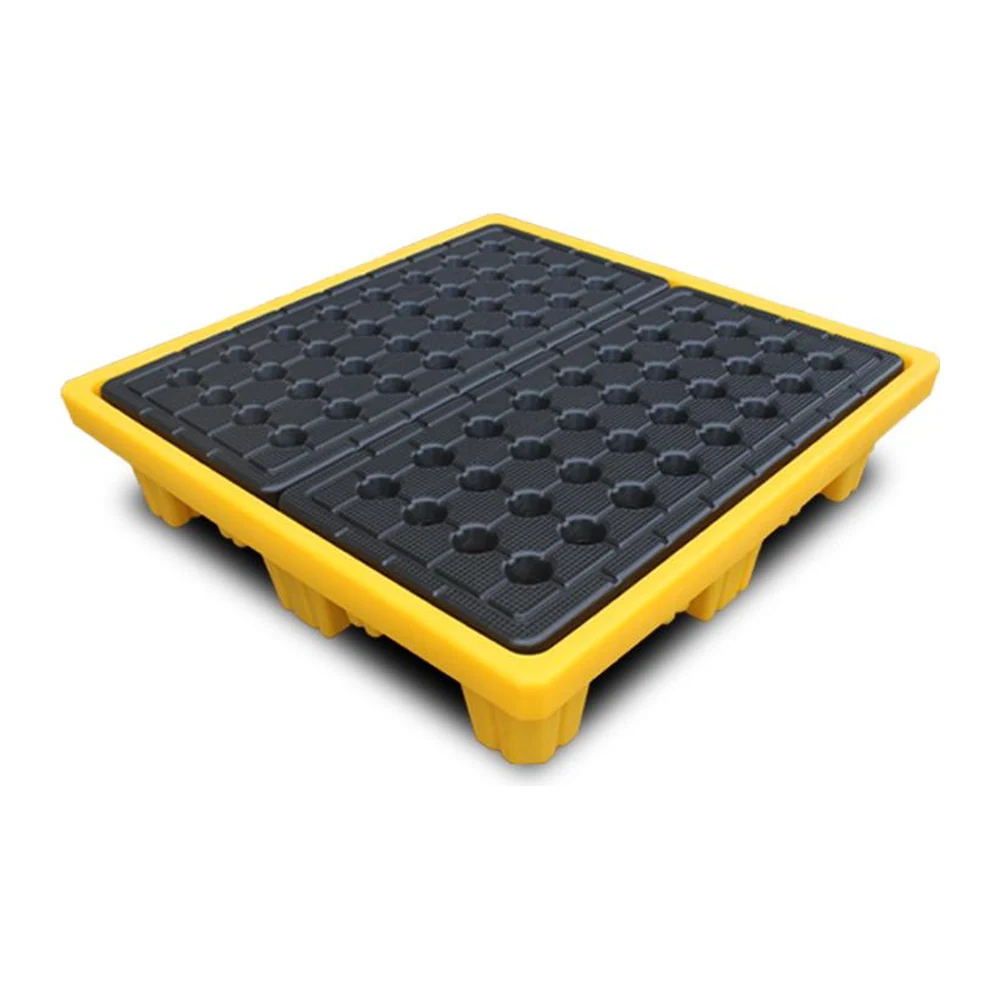 Drum Spill Pallets |
Sumps from 42 to 488 litres for one to four drums. |
| IBC tanks | 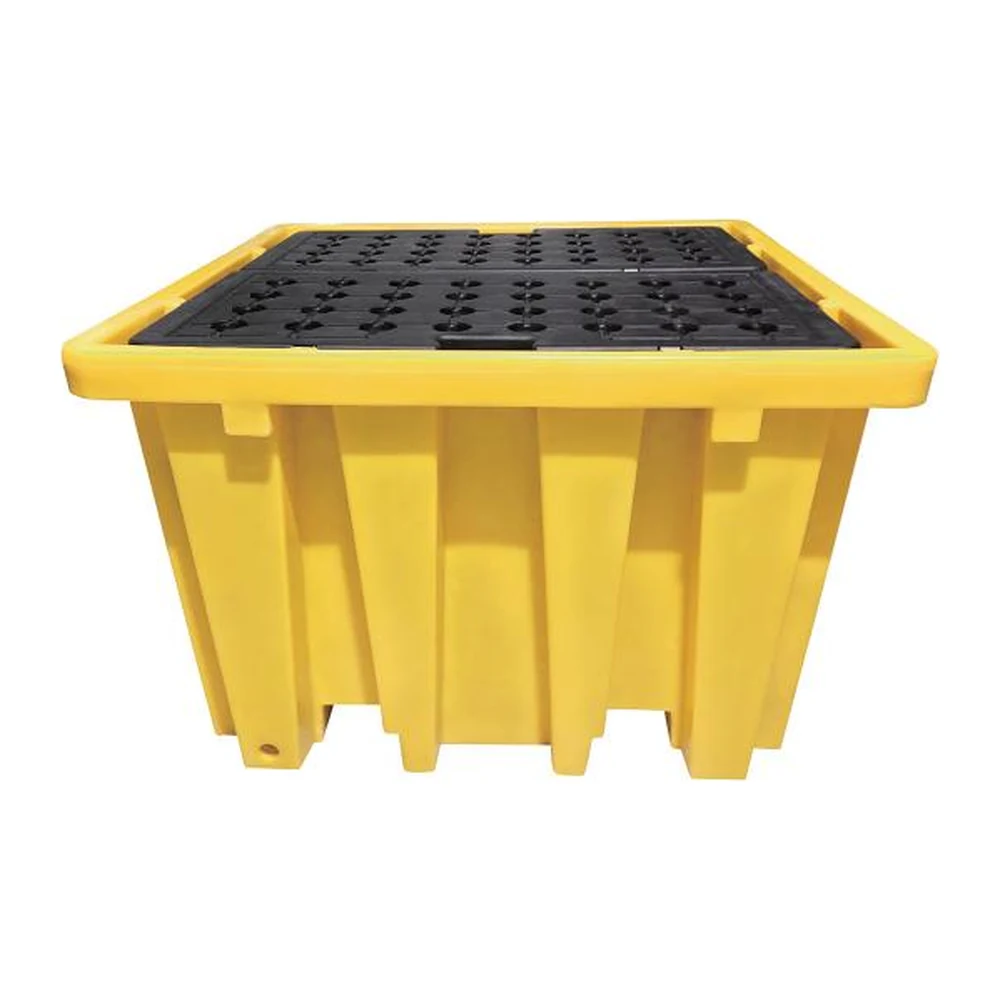 IBC & Multi-Container Spill Pallets |
Sumps from 120 to 1,600 litres for one to three IBCs. |
| Fire-assessed stores | 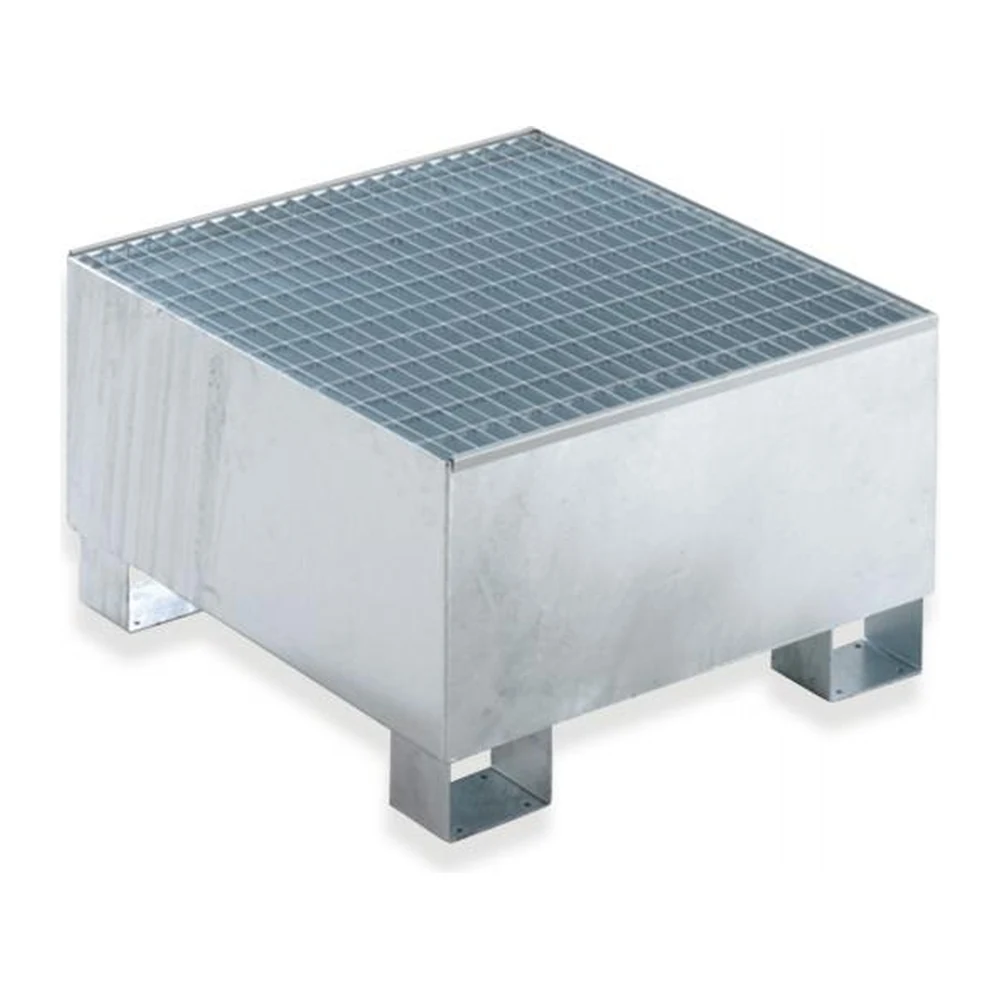 Steel Spill Pallets |
Double-layer 3 mm steel where a plastic bund is ruled out; check the 203 to 216 litre drum sumps against a 110% rule. |
| Outdoor stores | 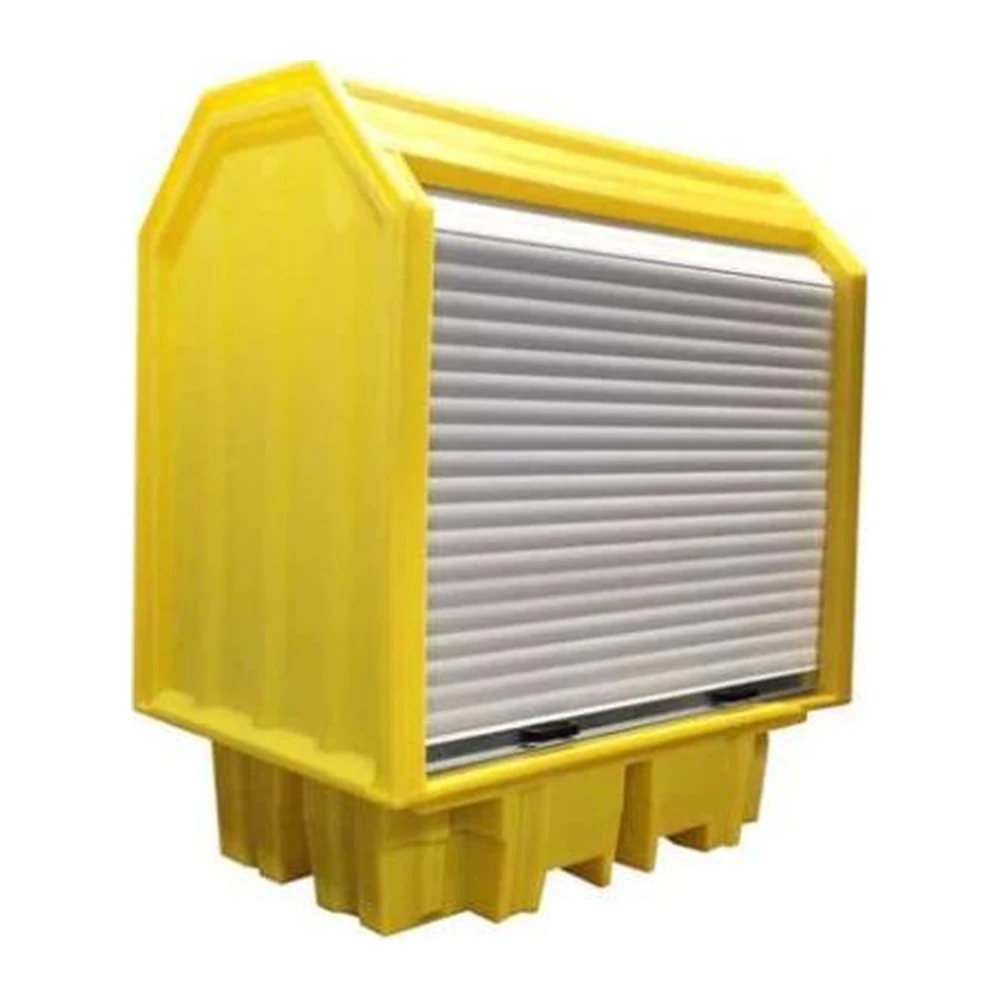 Covered Spill Pallets & Covers |
A cover keeps rain out of the sump the rule counts on. |
| Drums in use | 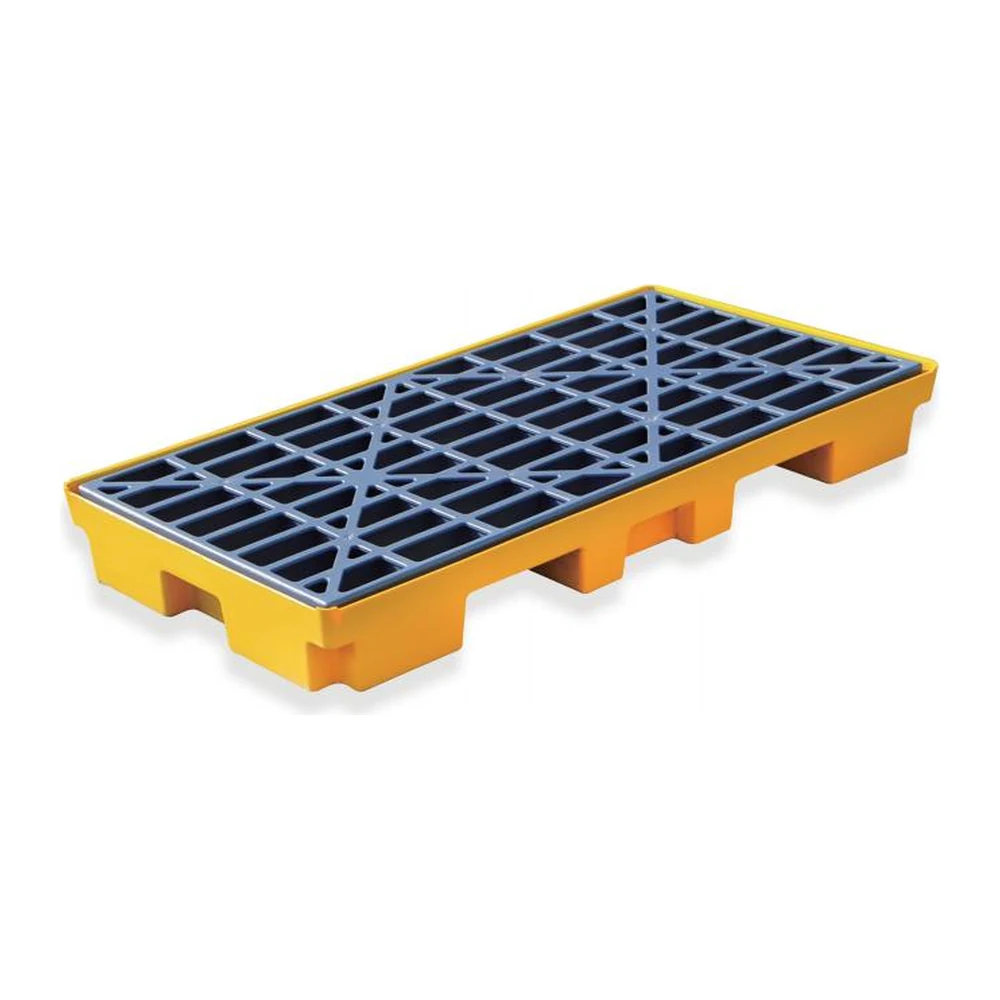 Drum Spill Decks |
Low decks with grates that show a leak at the working position. |
| Loading drums | 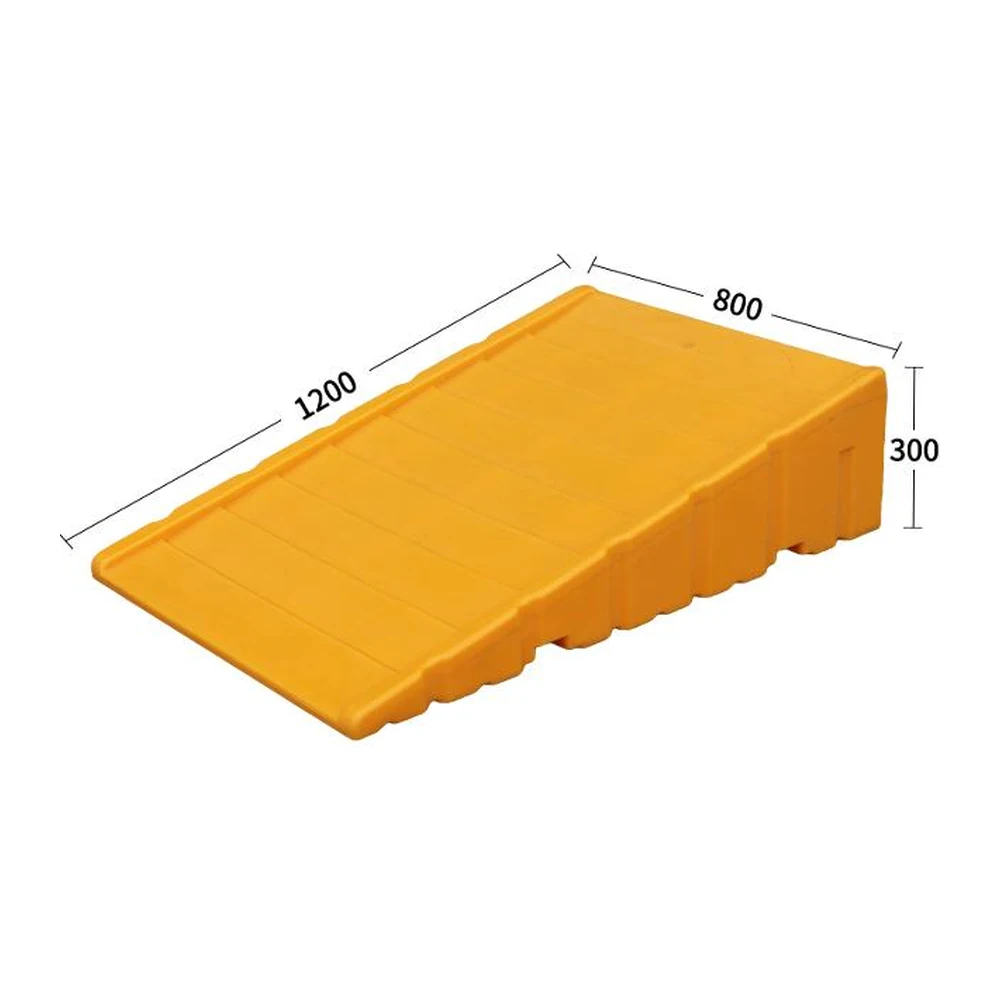 Spill Pallet Ramps |
Ramps matched to pallet heights from 10 to 30 cm. |
In farming, a bund is an earth or stone bank built across a slope to hold back water and soil. Contour bunds follow the level and keep rain where it falls. Graded bunds run at a slight fall, 0.5 to 2% in high-rainfall areas according to the FAO, so surplus water drains away safely. Soil builds up behind the banks over the years and turns them into terraces. In storage, a bund is the wall around a tank or drum store.
The Clean Water Act. EPA made 40 CFR part 112 under 33 U.S.C. 1251 and following, and the rule covers facilities that come under section 311(j) of that Act. That is why a site is in scope only if it could reasonably be expected to discharge oil to navigable waters or their shorelines. The expectation is judged on its location and with dikes, buildings and other man-made structures left out of the assessment.
Transformers are oil-filled operational equipment under 40 CFR 112.2, not bulk storage containers, so the largest-container rule in 112.8(c)(2) does not apply. They need the general containment in 112.7(c), sized to the typical failure and the most likely quantity released. A facility with no single discharge from such equipment over 1,000 gallons, and no two over 42 gallons in twelve months, in the last three years qualifies. It can use inspections, a contingency plan and a written commitment of resources instead (112.7(k)).
Only above set capacities. Under the 2014 WRRDA amendments, as EPA’s 2015 fact sheet sets out, a farm with under 2,500 gallons of aboveground oil storage needs no plan, and nor does one under 6,000 gallons with no reportable discharge history. Containers of 1,000 gallons or less on separate parcels do not count. From 6,000 to 20,000 gallons, with no tank over 10,000 and no spill history, the farmer can self-certify; otherwise a Professional Engineer certifies.
California’s Aboveground Petroleum Storage Act covers a tank facility with 1,320 gallons or more of petroleum, counting tanks and containers of 55 gallons or more (Health and Safety Code 25270.2 and 25270.3). The facility prepares an SPCC plan in the federal 40 CFR 112 format even where the federal rule does not reach it (25270.4.5), so the containment figure is the SPCC one: the largest container plus rain. The local CUPA enforces it.
Alberta enforces the National Fire Code 2023 Alberta Edition, in force since 1 May 2024. In the national code, a bund for one aboveground tank holds 110% of it, and a bund for several holds the largest plus 10% of the greater of that tank or all the others (Subsection 4.3.7). For drums handled on pallets, its explanatory note puts the credible spill at 1,000 litres. Check the Alberta edition and your site approval for any local wording.
A metal cabinet built to OSHA 29 CFR 1910.106(d)(3) carries a little of its own: the door sill sits at least 2 inches (51 mm) above the cabinet floor, which keeps drips and small leaks inside. It will not hold a burst container. Keep the cabinet within OSHA’s limit of 60 gallons of category 1 to 3 flammable liquids, and size any bund for the wider store against the rule that applies there.
Not under the oil rules. Diesel exhaust fluid is a urea solution made to ISO 22241, so it is not oil under the UK oil storage regulations or the US SPCC rule, and it is not a flammable liquid. A site permit, an insurer or a customer’s standard can still ask for a bund, and a spill pallet sized to the 110% and 25% rule answers that. Our DEF and AdBlue guide covers the containers.
Yes. In the hierarchy of controls it is an engineering control: a physical barrier that holds a spill with nobody acting, which is why the rules size it before anything goes wrong. Spill kits, drain covers, inspections and procedures sit on top of it as the response and administrative layer. A bund that relies on someone closing a valve has moved part of its job into that layer.
Containment put in place when a spill happens rather than built beforehand: sorbent booms, drain covers, portable dikes or a spill kit used by trained staff. The US SPCC rule lets general containment be active or passive and lists sorbent materials among the options (40 CFR 112.7(c)). Canada’s fire code note accepts drain covers, sorbents and portable dikes where only small quantities, up to 5,000 litres, are present.
Under US SPCC, once the facility is in scope, the full 55 gallons (208 litres) plus freeboard for rain where rain can reach it. RCRA permitted waste storage also asks for 55 gallons. In England, a 205-litre drum of oil kept outdoors needs 226 litres, 110% of the drum, or a drip tray holding a quarter of it. Germany asks for the drum’s 205 litres once the whole store holds more than 220 litres.
Yes, under US SPCC once the facility is in scope. Drums, totes and other portable oil containers of 55 gallons or more need a dike, catchment basin or other secondary containment that holds the largest container or compartment plus freeboard for rain. Mobile refuellers and similar tank trucks are excepted (40 CFR 112.8(c)(11)). Containers under 55 gallons fall outside the rule. In England, containers of 200 litres or less are exempt, and larger drums kept outdoors need 110%, or a drip tray of 25%.
Under US SPCC, the tote’s full 275 gallons (1,041 litres) plus freeboard for rain where rain can reach it (40 CFR 112.8(c)(11)). Under the UK 110% rule a tote of that size needs 1,145 litres, and a 1,000-litre IBC needs 1,100. RCRA permitted waste storage asks for the tote’s 275 gallons, or 10% of all the containers if that is more. Our IBC bund size guide works the figures for one to four totes.
In Cape Town and Johannesburg, at least 3.5 metres from boundaries and buildings. Cape Town’s fire safety by-law adds other flammable substances and combustible material (s 39(6)), and Johannesburg’s adds excavations, roads and driveways (s 63(1)(a)(ii)). In Singapore, the Fire Code’s explanation of clause 3.2.5j asks for oil tanks in the open air at ground level where possible, at least 6 metres from adjacent buildings. Elsewhere the fire code or tank standard in force sets the gap.
No bund rule applies to a tank of water. Cape Town’s fire safety by-law regulates above-ground tanks only where they hold flammable liquids (s 39(1)), and Johannesburg defines a bund wall around tanks of flammable substances. NEMA’s storage listings count dangerous goods, which water is not. A tank of treatment chemicals is a different case: the duty of care in section 28 of NEMA and section 19 of the National Water Act reaches any liquid that could pollute.
Yes, on a construction site. NEA’s code of practice for environmental control officers on specified construction sites asks for a full containment bund wall around bulk oil storage tanks, skid tanks included, with a collection sump for spills (5th edition, 2022, section 8.8). Drums of oil and chemicals go in a designated store inside a building or covered shed, on a concrete floor with means to contain leaks. Spilled oil goes to a licensed toxic waste collector.
The municipal fire service enforces the fire by-laws, including the flammable substance certificate in Cape Town and the certificate of registration in Johannesburg. Under section 28(4) of NEMA, the Director-General or a provincial head of department can direct a person who fails to take reasonable measures against pollution to take them. Under section 19(3) of the National Water Act, a catchment management agency can direct an owner or occupier to start, continue and finish set measures by given dates.
Yes, at a permitted hazardous waste storage facility in the US. 40 CFR 264.175 requires a containment system with an impervious base and capacity for 10 per cent of the containers' volume or the largest container, whichever is greater, counting only containers with free liquids. A large quantity generator holding waste for up to 90 days under 262.17 has no federal capacity figure, so check your state rule.
Work out two figures and size the containment to the larger. One is a share of the largest container: 110 per cent in the UK, Ireland and the Netherlands, 100 per cent under US SPCC. The other is a share of the total stored: 25 per cent in the UK and Ireland, 10 per cent in the Netherlands. Ten 205 litre drums hold 2,050 litres, so a UK bund needs 513 litres: 25 per cent of the total beats 110 per cent of one drum, which is 226 litres.
An SPCC plan is the written Spill Prevention, Control, and Countermeasure plan that the US EPA's rule at 40 CFR part 112 requires of some facilities. It applies to a facility that stores more than 1,320 US gallons (4,997 litres) of oil above ground and could reasonably be expected to discharge oil to navigable waters or shorelines. Only containers of 55 gallons or more count towards that total. A licensed Professional Engineer certifies the plan unless the facility qualifies to self-certify.
The standards and regulations this page relies on, at their issuing body. Where a market rule is named here, check the current revision before you specify against it.
Last reviewed by Clarence Cheang, Co-Founder.
Tell us the containers, the liquid and where the store is. We come back with the pallet or bund, its load rating and a quotation.