
Sump capacity, load rating and material, and the way each of the three gets read wrong.
A spill pallet is bought on three numbers: sump capacity, load rating and material. Each one has a way of being read wrong, and the wrong reading produces a pallet that passes at purchase and fails at inspection.
The sump capacity you need is set by the regulation that governs your site, and it is decided before you look at a single product. Two formulas are in use and they give different answers. The first is a percentage of the largest single container in the store, commonly 110 per cent. The second is a percentage of everything stored, commonly 25 per cent. Where both appear, the requirement is whichever is greater.
In England the text is the Control of Pollution (Oil Storage) (England) Regulations 2001, which bite above 200 litres of oil stored above ground at industrial, commercial or institutional premises. In the United States it is the EPA SPCC rule at 40 CFR 112, which asks for containment that is sufficiently impervious and sized to the largest container, with OSHA 1910.106 governing the workplace store on top of it. In Australia the figures come from AS 1940 for flammable and combustible liquids and AS 3780 for corrosives. The European Union has no single instrument at all: containment is written into national water-protection law, and Germany’s WHG and AwSV are the strictest of them and the usual benchmark for a supplier quoting into Europe.
Work an example before you shop, because the two formulas cross over sooner than people expect. Four 200 litre drums hold 800 litres. Twenty-five per cent of that is 200 litres; 110 per cent of the largest drum is 220 litres. The largest-container rule wins, narrowly. Now make it ten 20 litre jerricans: the total is 200 litres, 25 per cent is 50 litres, and 110 per cent of a single can is 22 litres. The total-volume rule wins by more than double. A store of small containers is almost always governed by the total, which is exactly the case where buyers reach for a drip tray and come up short.
Two pallets with identical external dimensions can differ by a factor of three in the volume they hold. A 132 by 66 cm two-drum unit at 15 cm high holds 80 litres; the same footprint at 43 cm holds 260. The number on the drawing that matters is the sump, and it is the one a cheap listing leaves out.
Two things eat that capacity after purchase, and both are inspection findings rather than design faults. The first is a second layer of drums going on top of a pallet sized for one layer, which doubles the stored volume without changing the sump. The second is the sump being used for storage: absorbent, a funnel, a spare pump. Nothing about the product says either is a problem, which is why they keep happening.
Three conventions appear across this category and they are not interchangeable.
Ask for the test basis. A published load figure is the output of a test regime, and the regime is what makes it comparable between two suppliers. A number offered without one is a number that has never been checked.
The two formats answer different questions. A low deck, 10 to 15 cm high with an open grate, is for drums in use: decanting, dosing, being worked several times a day. It is low enough to walk a drum on and off without a ramp, and the grate lets an operator see standing liquid on a walk past. Its sump is small by design, usually 30 to 170 litres.
A spill pallet, 20 to 60 cm high, is for drums in storage. It holds a burst drum rather than a drip, and the sump volume is the product. The 202 litre single-drum pallet exists for one reason: a 200 litre drum failing completely, with the margin the 110 per cent rule asks for.
The common mistake is buying decks for a store because they are cheaper and load more easily, then discovering at audit that the combined sump falls short of a percentage-of-total rule. Deck for the working position, pallet for the store.
Polyethylene resists most acids, alkalis and water-based chemicals, will not rust, and is a fraction of the weight. It covers most of the market and it is what you should specify unless something rules it out.
Two things rule it out. The first is a fire assessment: a flammable liquid store assessed against a fire scenario cannot have a combustible bund in it, and steel is the only answer. The second is solvents, which craze polyethylene that holds detergent happily.
Steel has its own limit. It is non-combustible, not inert. Acids and some aqueous salts attack both galvanising and powder coat, and a corroded sump leaks at the seam where nobody is looking. Specify the finish against the contents: hot-dip galvanising for outdoor life and general service, powder coat where the colour codes the contents or the finish has to match a chemical.
Whichever you choose, ask the compatibility question of the bund on its own terms rather than inheriting the answer from the container. A sump meets its contents neat, at whatever temperature they were at, with no closure limiting evaporation and often with rainwater already in it changing the concentration. A material rated for storing a chemical is not automatically rated for catching it.
A filled 200 litre drum weighs around 200 kilograms and will not go up a 30 cm step. A store with no ramp is a store where the pallet stands empty and the drums sit on bare floor, which is the most expensive way to fail an inspection.
Match the ramp to the pallet height, not to the drum. It is the one dimension that gets guessed, and a 15 cm ramp against a 30 cm pallet is a step with a slope in front of it. Pallet heights in a typical range run 10, 15, 17, 20, 30, 43, 50, 60 and 70 cm, and only some have a matching ramp, so quote the two together. Where the drum is being moved rather than loaded once, a dolly with its own sump keeps the containment under the drum in transit instead of leaving it behind on the pallet.
An open bund left outside fills with rain, and a sump full of water has no capacity for the spill it exists to catch. So it has to be drained, and the moment it is drained it becomes a discharge route to the environment it was protecting.
The answer is a manually operated valve kept locked shut, opened only after someone has inspected what is in the sump, with contaminated water removed as waste. An automatic drain defeats the purpose: it discharges fuel as readily as rain. Freeboard on top of the working capacity is what buys the time between inspections, and a cover is the cheapest way to stop the problem arising. A PVC tarp sized to a pallet you already own costs a fraction of replacing it with a covered unit, and it ships flat.
A 1,000 litre IBC makes the containment the largest single line on the order, and the percentage rule turns into a four-figure sump. Two features exist for that. Linkable pallets carry bulkhead fittings that pass liquid between neighbouring units, so a row of 250 litre sumps behaves as one volume and reaches a total-stored figure that no single pallet would. Height decides whether the store is workable: every tap, sample and hose connection on an IBC happens at the outlet, and a pallet that puts the outlet above chest height buys sump volume at the cost of a ladder.
Cage dimensions vary between tank makers. A pallet that fits a 1,000 litre tank from one supplier can foul the cage feet of another, so quote against the tank you actually run rather than against the nominal litre figure.
Here is what we build, and the question each one answers.
| Your use case | Recommended can | Why this one |
|---|---|---|
| Drums being worked daily | 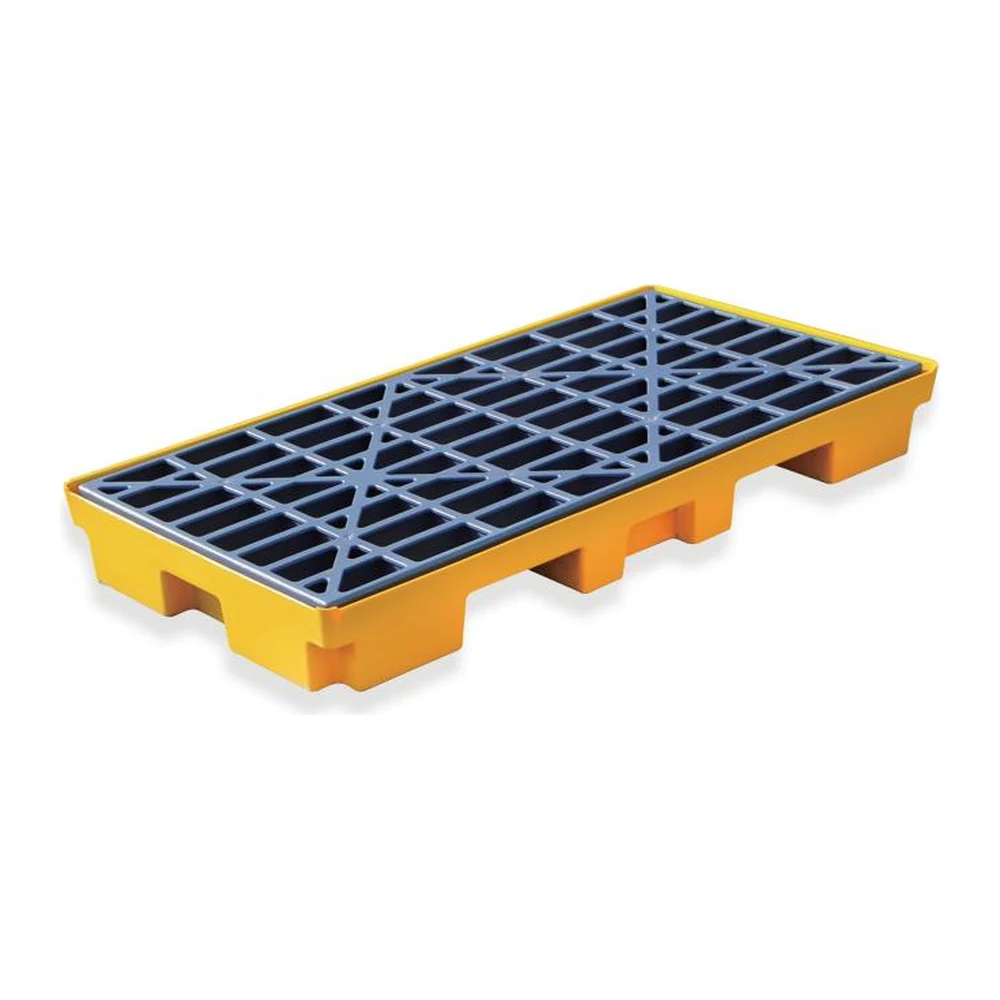 Drum Spill Decks Drum Spill Decks |
Low enough to load by hand, with a grate that shows a leak. |
| Drums in storage | 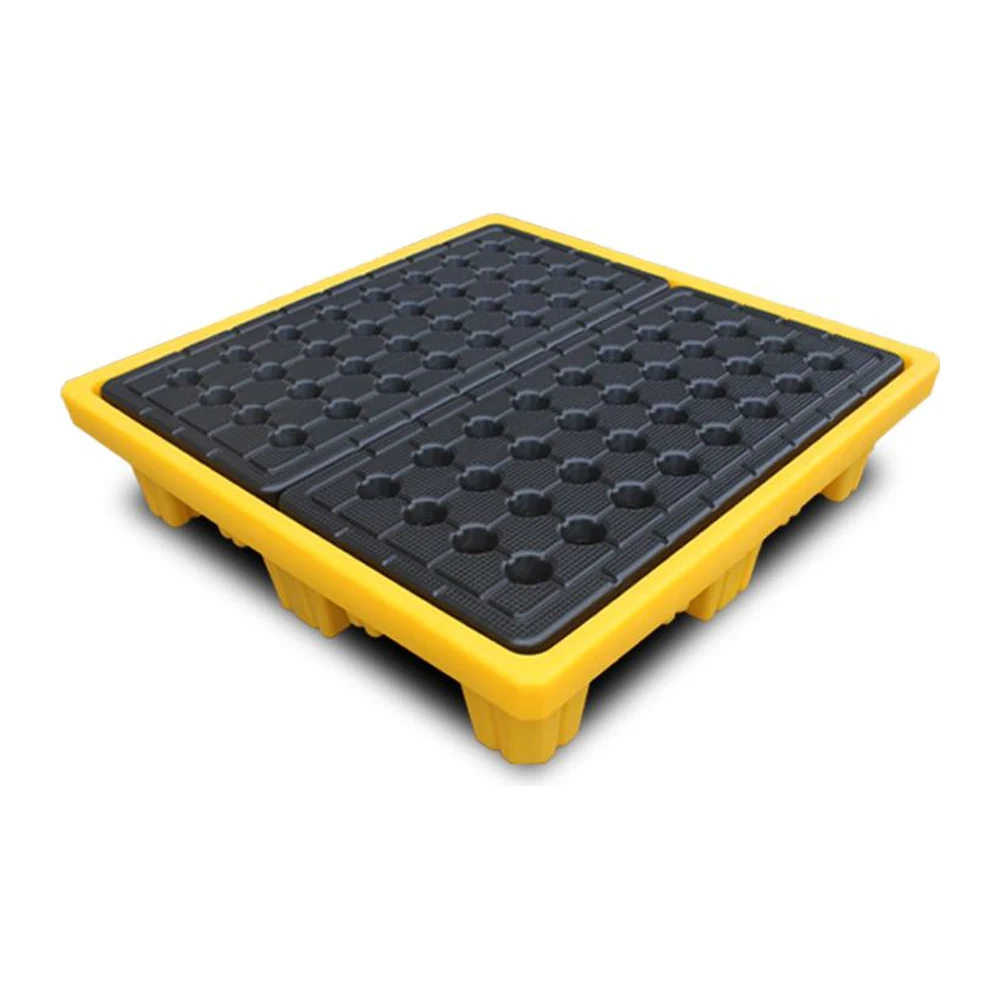 Drum Spill Pallets Drum Spill Pallets |
Sumps to 488 litres, rackable and modular versions. |
| IBC tanks | 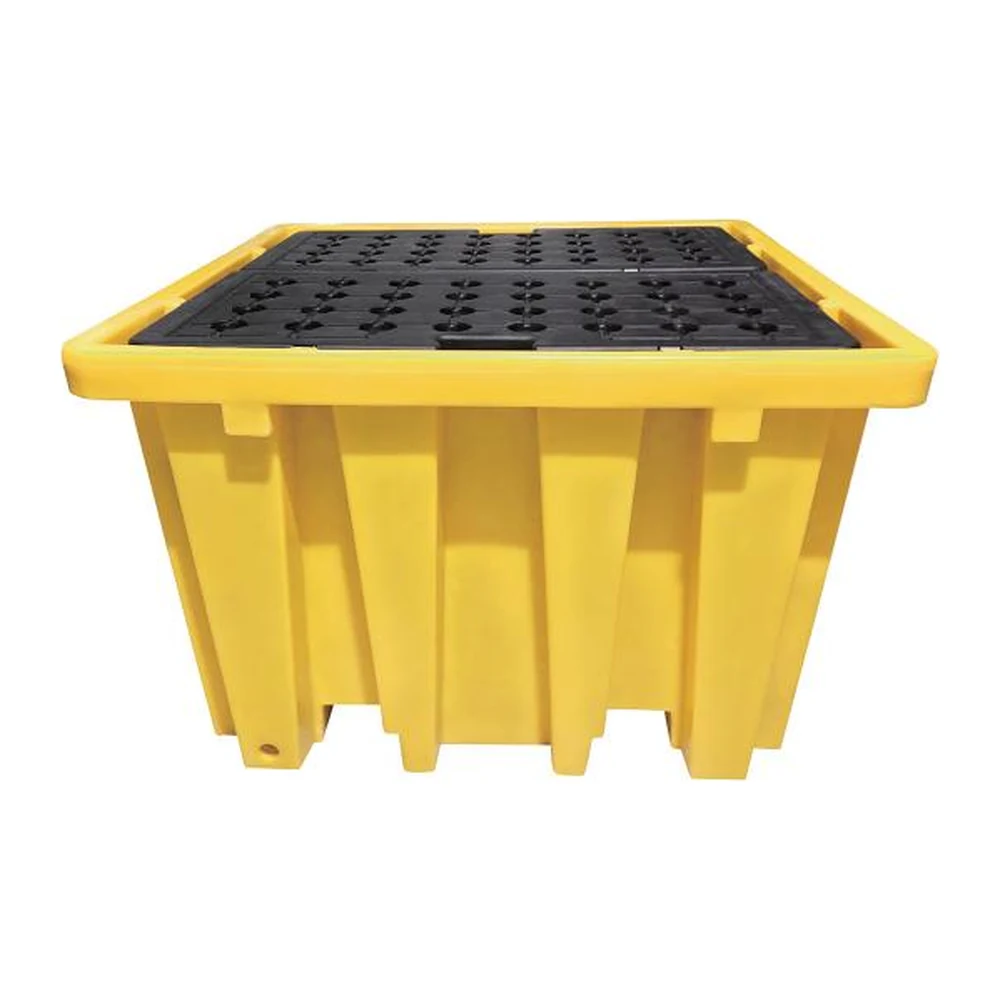 IBC & Multi-Container Spill Pallets IBC & Multi-Container Spill Pallets |
Linkable sumps pool capacity to reach a total-volume rule. |
| Fire-assessed stores | 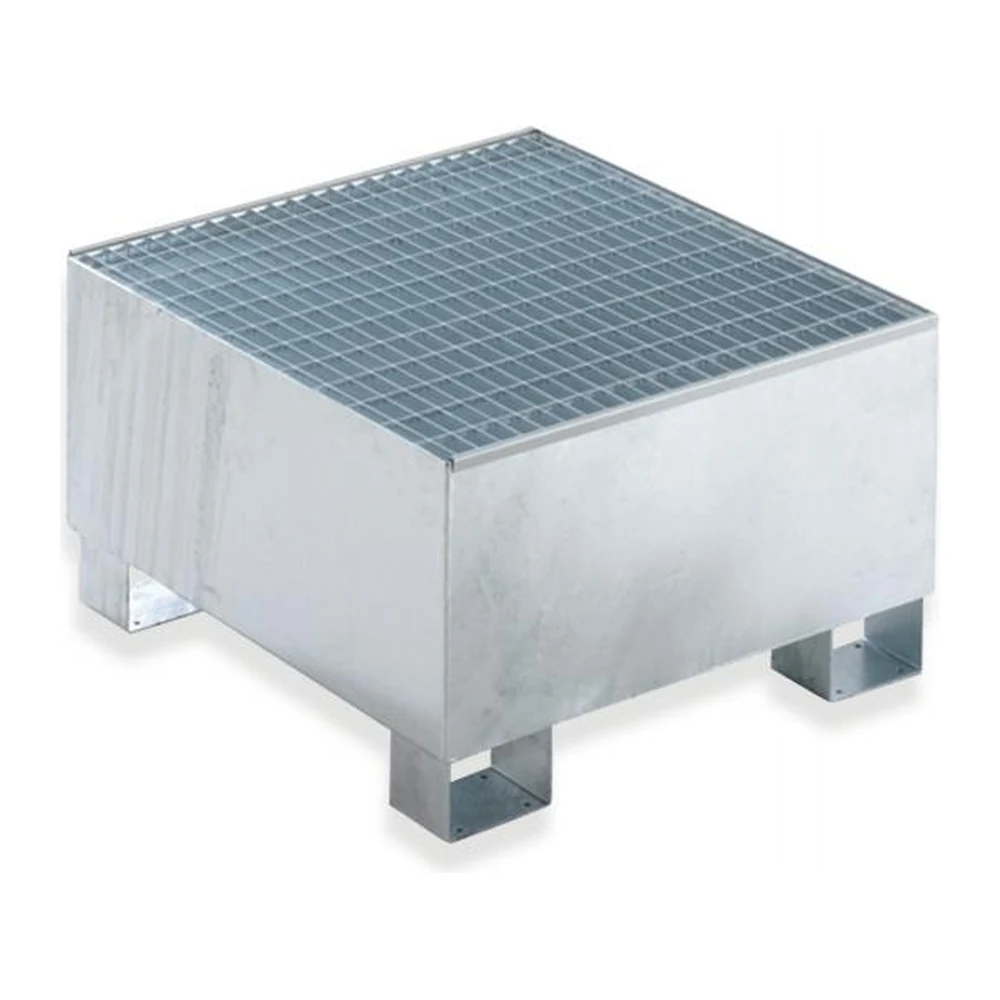 Steel Spill Pallets Steel Spill Pallets |
Double-layer 3 mm steel where a plastic bund is ruled out. |
| Benches and pails | 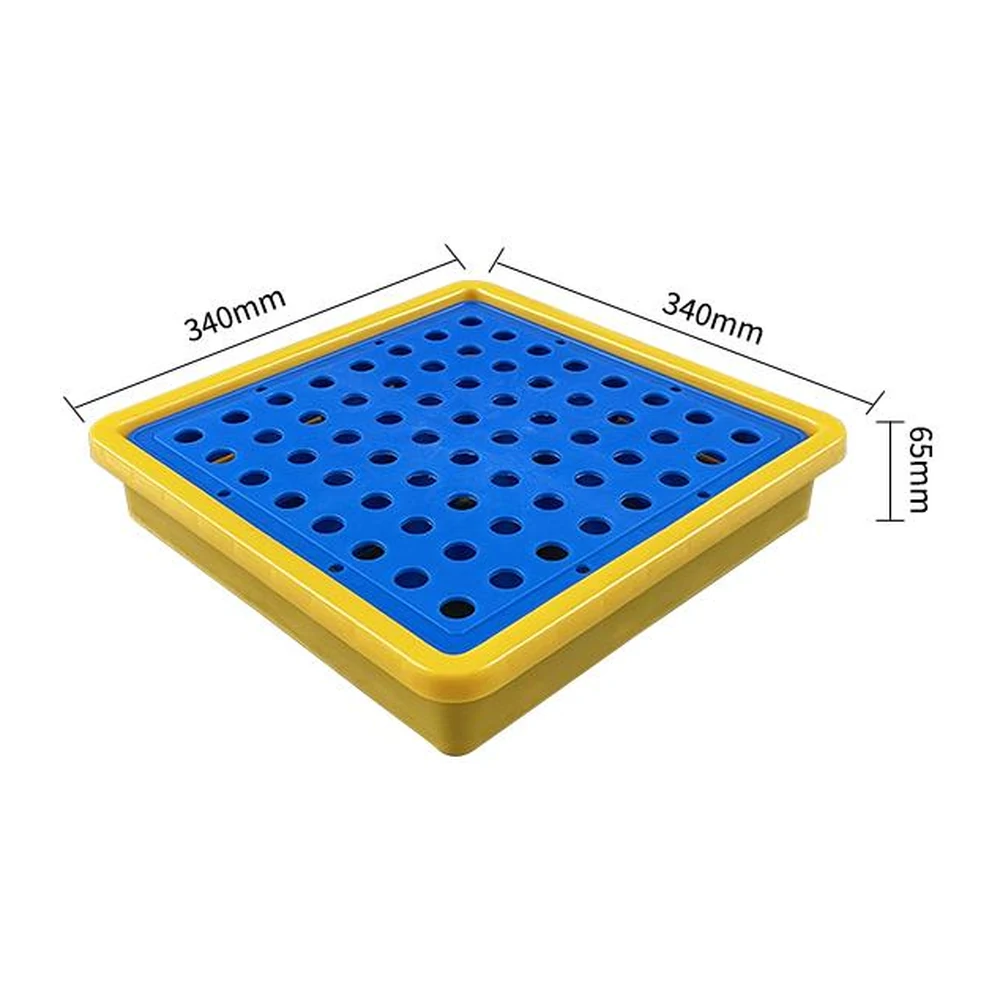 Bench Trays & Drip Trays Bench Trays & Drip Trays |
From a 4 litre bench tray to a 145 litre pail pallet. |
| Loading the pallet | 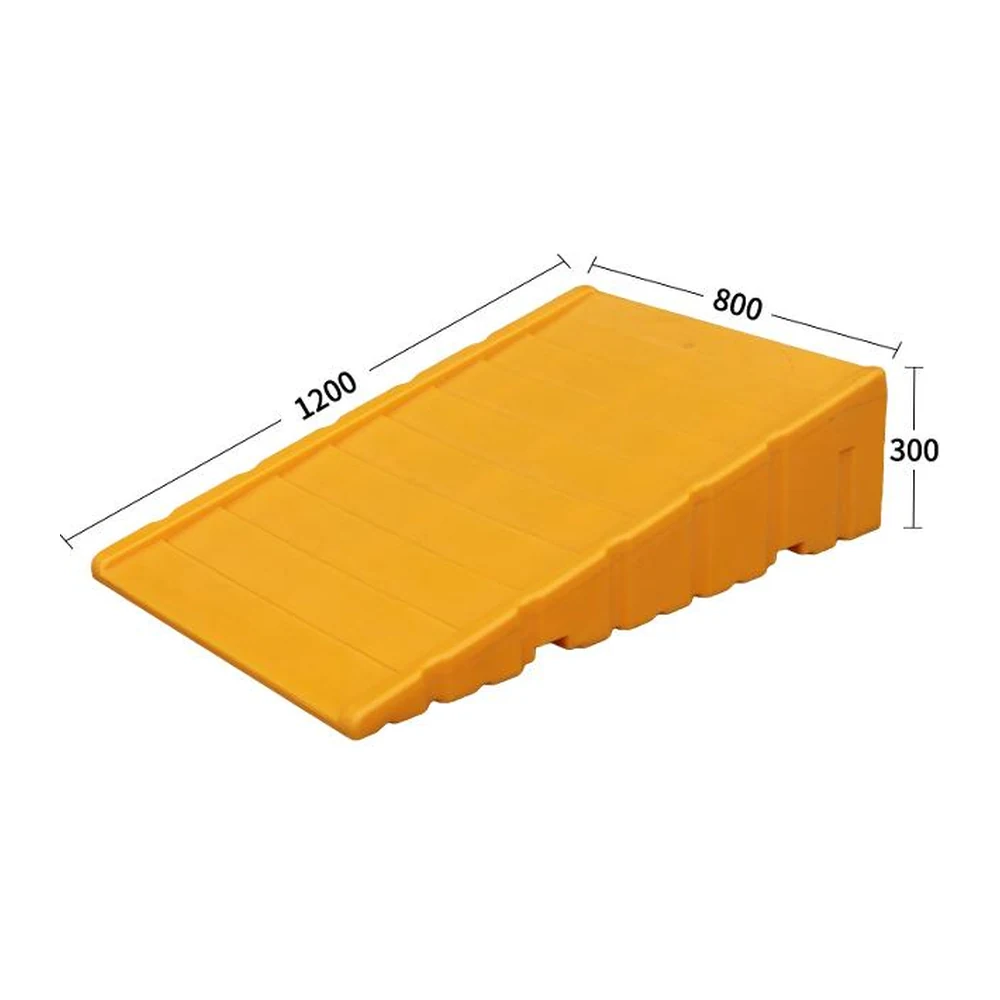 Spill Pallet Ramps Spill Pallet Ramps |
Sized to pallet height, which is the dimension people guess. |
Whatever your regulator asks for, which is either a percentage of the largest single container or a percentage of everything stored, whichever is greater. England writes 110 per cent of the largest and 25 per cent of the total; the US SPCC rule asks for containment sized to the largest container. A store of small containers is almost always governed by the total-volume figure, which is where buyers undersize.
Height and sump volume. A deck is 10 to 15 cm with a small sump, low enough to roll a drum on by hand, and it is for drums being worked. A pallet is 20 to 60 cm with a sump that will hold a burst drum, and it is for drums in storage. Buying decks for a store is the common error, because they are cheaper and easier to load.
The weight the pallet is rated to carry while it is being lifted and moved on forks or a pallet truck, as opposed to standing still. It is always lower than the static figure, and it is the one that governs anything mobile. A separate racking rating applies only to pallets specifically built for racking.
Only if it is a rackable model, and only to its racking load, which is typically a fraction of its floor rating. A four-drum pallet rated 3,000 kg static may be rated 500 kg in a rack. A standard pallet that happens to fit the beam spacing is not a rackable pallet.
Polyethylene unless something rules it out. It resists most acids, alkalis and water-based chemicals, will not rust, and weighs a fraction as much. Steel is for a store assessed against a fire scenario, where a combustible bund is not permitted, and for solvents that craze polyethylene. Steel is non-combustible but not inert, so match the finish to the contents.
The standards and regulations this page relies on, at their issuing body. Where a market rule is named here, check the current revision before you specify against it.
Last reviewed .
Tell us your market, your fuel and your volumes. We come back with a specification sheet and a quotation.