
What the EPA’s SPCC rule asks of a facility: who needs a plan, how to count to 1,320 gallons, who certifies it, and the containment, inspection and farm rules in 40 CFR part 112.
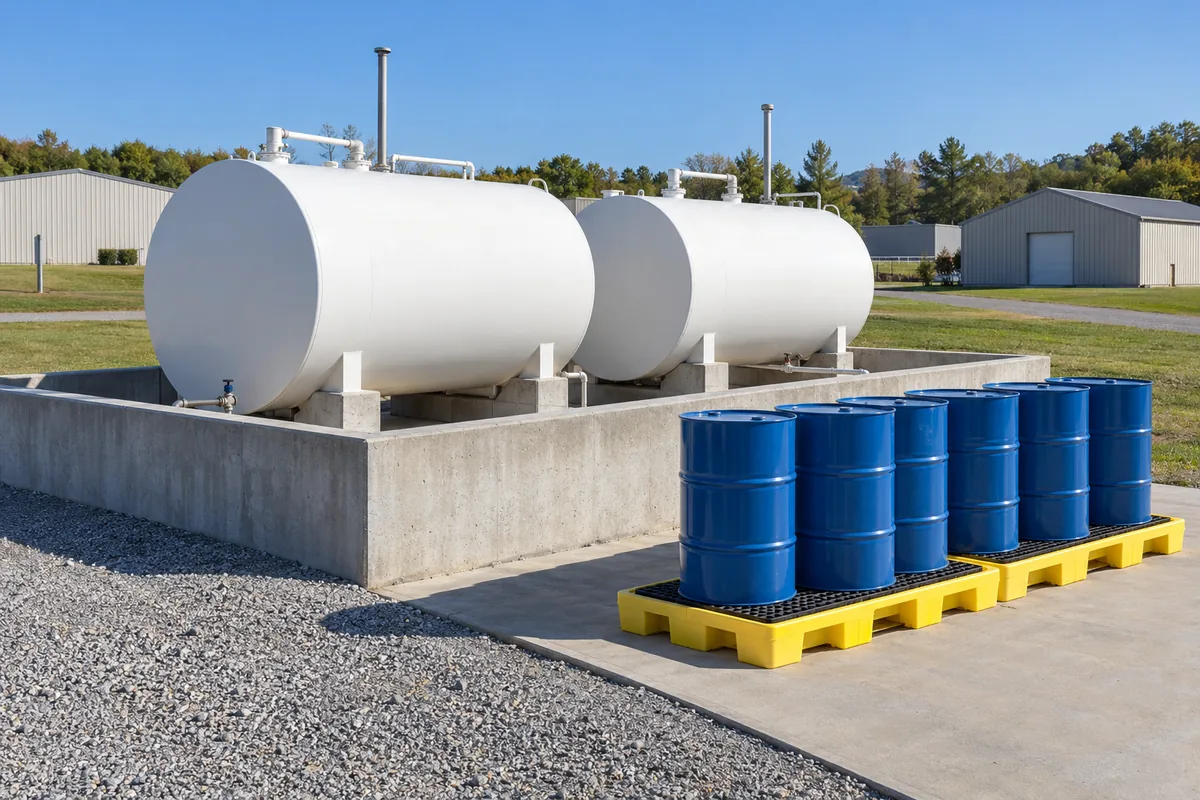
SPCC stands for Spill Prevention, Control, and Countermeasure, the US EPA’s oil rule at 40 CFR part 112. A facility needs an SPCC plan when a spill could reach navigable waters and it stores more than 1,320 US gallons of oil above ground or 42,000 gallons completely buried. Only containers of 55 gallons or more count. Containment must then hold the largest bulk container plus rainfall.
Quick answer: What is the SPCC rule?
It is the US EPA's Spill Prevention, Control, and Countermeasure rule, 40 CFR part 112. A facility that could spill oil into navigable waters and stores more than 1,320 US gallons above ground, counting only containers of 55 gallons or more, needs an oil spill plan, certified by a Professional Engineer unless it qualifies to self-certify.
SPCC stands for Spill Prevention, Control, and Countermeasure. Under 40 CFR 112.2 the SPCC plan is the document that sets out the equipment, workforce, procedures and steps a facility uses to prevent, control and respond to an oil discharge. Section 112.1(e) adds that every other federal, state and local law still applies.
The rule is part of EPA’s Oil Pollution Prevention regulation, first published in 1973 under section 311 of the Clean Water Act. EPA cites section 311(j)(1)(C), as amended by the Oil Pollution Act of 1990, as its authority, so the SPCC regulations sit under the Clean Water Act. SPCC is also a Japanese cold-rolled steel grade; our steel grades guide compares it with SPHC, SECC and SS400.
Section 112.1(b) covers the owner or operator of a non-transportation-related facility that stores, uses, transfers or otherwise handles oil. It applies where the location means a facility could reasonably be expected to discharge harmful quantities to navigable waters or adjoining shorelines. Harmful means a breach of a water quality standard, a film or sheen on the water, or a sludge deposited beneath it (40 CFR 110.3). The location test looks at geography alone, such as distance to water, land contour and drainage. Dikes and other man-made features are left out (112.1(d)(1)(i)), so a bund cannot take a site out of scope.
Oil means oil of any kind (112.2): petroleum, fuel oil, sludge, synthetic and mineral oils, vegetable oils, and animal, fish or marine mammal fats. A bakery’s vegetable oil tanks count in the same way as a depot’s diesel, under their own subpart, 112.12, which uses the same containment wording. Chemicals outside the definition follow other rules, set out in chemical storage best practices.
A facility is exempt while its aboveground oil capacity is 1,320 US gallons (4,997 litres) or less and its completely buried capacity is 42,000 gallons (about 159,000 litres) or less (112.1(d)(2)). Only containers of 55 gallons (208 litres) or more count, at shell capacity whatever the fill level (112.2), and EPA’s inspector guidance includes drums, totes and transformers in the count.
Twenty-four 55-gallon drums make 1,320 gallons and stay exempt; the 25th takes the site to 1,375. Jerry cans of 20 litres add nothing, however many there are (112.1(d)(5)). The 55-gallon drum guide and the IBC tote guide give the capacities to add up.
| Left out of the aboveground count | 40 CFR 112.1 |
|---|---|
| Containers under 55 US gallons | (d)(5) |
| Permanently closed containers | (d)(2)(ii)(A) |
| Motive power containers, such as a vehicle’s own fuel tank | (d)(7) |
| Hot-mix asphalt; pesticide application equipment | (d)(8), (d)(10) |
| Heating oil used only at a single-family home | (d)(9) |
| Milk and milk product containers | (d)(12) |
| Plant used only for wastewater treatment | (d)(6) |
Section 112.7 sets the content, and management must approve the plan at a level that can commit the resources to carry it out. Every plan needs a facility diagram, the SPCC site map. It marks each fixed oil container and its contents, the storage area for drums and other mobile containers, transfer stations and connecting pipes, and any exempt buried tanks, labelled “exempt” (112.7(a)(3)).
| What the plan covers | 40 CFR |
|---|---|
| Oil type and capacity of each fixed container; a list or an estimate for mobile ones | 112.7(a)(3)(i) |
| Transfer procedures, drainage controls and secondary containment | 112.7(a)(3)(ii)–(iii), 112.7(c) |
| Response, clean-up, disposal, and contacts including the National Response Center | 112.7(a)(3)(iv)–(vi) |
| Likely equipment failures, with direction, rate of flow and quantity | 112.7(b) |
| Written inspection procedures, records kept three years | 112.7(e) |
| Training and a person accountable for discharge prevention | 112.7(f) |
| Security, and tank truck loading racks | 112.7(g), (h) |
A licensed Professional Engineer certifies the plan unless the facility qualifies to self-certify (112.3(d)). The PE attests to having visited the site, in person or through an agent, to a plan prepared to good engineering practice and industry standards, and to inspection and test procedures being in place.
A qualified facility may self-certify (112.3(g)). Tier II means 10,000 US gallons (37,854 litres) or less above ground, with no single discharge over 1,000 gallons and no two over 42 gallons each within twelve months, in the past three years. Tier I adds a 5,000-gallon limit on any one container and can use EPA’s template in appendix G (112.6(a)). A Tier II plan may claim environmental equivalence or impracticability only in parts a PE certifies (112.6(b)(3)). A facility other than an oil production site that opens after 10 November 2011 must have its plan in place before it starts operating (112.3(a)(1)). A change such as a new or moved tank means an amendment within six months (112.5(a)).
SPCC asks for containment at two levels. The general duty in 112.7(c) covers every source of a discharge: transfer areas, piping, oil-filled equipment and containers. It is sized to the typical failure and the most likely quantity released, may be active or passive, and must hold oil until clean-up. The rule’s options run from dikes, berms, curbing and drip pans to sumps, drains, booms, ponds and sorbents. EPA’s guidance accepts drain covers and spill mats from a spill kit if staff can deploy them before oil reaches water.
Bulk storage containers carry the sized duty: secondary containment for the entire capacity of the largest single container plus sufficient freeboard for precipitation, in a dike impervious to oil (112.8(c)(2)). The rule leaves freeboard undefined. EPA’s inspector guidance prefers the rain from a 25-year, 24-hour storm without making it enforceable, and calls 110% of the largest tank a rule of thumb that can fall short in heavy rain. The SPCC containment calculation works the sums, and secondary containment requirements by country sets SPCC beside the UK 110% rule.
Rain leaves a dike only through a bypass valve kept sealed closed, opened under supervision after a check for oil, then resealed and recorded (112.8(c)(3)); flapper drain valves are barred (112.8(b)(2)). Where containment is impracticable, a PE-certified plan must say why and add integrity testing, a contingency plan and a written commitment of resources (112.7(d)).
Section 112.8(c)(11) asks for mobile or portable containers to be positioned to prevent a discharge, with containment such as a dike or catchment basin for the largest single container plus freeboard for rain. A pallet of four 55-gallon drums needs 55 gallons (208 litres) plus freeboard, and the 220-gallon total does not come into it. The plan can estimate the number and sizes of drums and totes instead of listing each (112.7(a)(3)(i)). Mobile refuelers are excluded from the sized duty and take general containment.
A spill pallet is the usual answer. Check its sump against the largest container: 208 litres for a 55-gallon drum, 1,041 for a 275-gallon tote and 1,249 for a 330-gallon tote, and cover it outdoors. Choosing a spill pallet covers load ratings and materials. EPA’s guidance notes that under the STI SP001 standard, visual inspection of drums and totes with adequate secondary containment satisfies the integrity testing rule, and records can cover the drum store as a whole. Drum storage requirements adds the OSHA and RCRA rules.
Double-walled tanks still need secondary containment, and the outer wall can provide it. EPA’s inspector guidance, drawing on agency memos of 1992 and 2002, says a shop-fabricated double-wall aboveground tank of any size may meet 112.7(c) and 112.8(c)(2). The inner tank must be UL-listed steel and the outer tank built to an industry standard, with an overfill alarm, an automatic flow restrictor or shut-off, and every transfer watched throughout. The outer wall does not catch a vent overfill, which the overfill devices or an active measure must handle.
Partially buried, bunkered and vaulted tanks count as aboveground (112.2). Completely buried tanks count towards the 42,000-gallon line unless they meet all the technical requirements of EPA’s underground tank rules in 40 CFR part 280 or an approved state programme. Those are left out, and the diagram marks them “exempt” (112.1(d)(4)). Buried metallic tanks installed from 10 January 1974 need coatings or cathodic protection and leak testing (112.8(c)(4)).
A generator’s fuel tank is a bulk storage container and takes sized containment; EPA’s guidance treats the gen-set’s lubrication system as oil-filled operational equipment. Transformers, circuit breakers and hydraulic systems are oil-filled operational equipment too (112.2): they count towards 1,320 at 55 gallons or more and need general containment only. A facility with no reportable discharge from such equipment in three years may use an inspection or monitoring programme, a contingency plan and a written commitment of resources instead (112.7(k)). Generator fuel storage covers sizing the reserve.
Section 112.8(c)(6) requires each aboveground container to be tested or inspected for integrity on a regular schedule and after material repairs. Industry standards set the inspector’s qualifications, the frequency and the type of test, allowing for size and design; EPA’s Pacific Southwest Region names API 653 for field-erected tanks and STI SP001 for shop-fabricated containers. Methods range from visual inspection to hydrostatic, ultrasonic and radiographic testing, with comparison records and frequent checks for leaks and oil in the dike.
Written procedures and signed records stay with the plan for three years (112.7(e)). Oil-handling staff are trained in the equipment, discharge procedures, pollution law, facility operations and the plan. One named person answers for discharge prevention, and briefings run at least once a year (112.7(f)). Visible leaks are corrected, and oil in a dike removed, as soon as they are found (112.8(c)(10)).
A farm, for SPCC, is a facility growing crops or raising animals, fish included, that sold, or in a normal year would sell, US$1,000 or more of produce (112.2). The Water Resources Reform and Development Act of 2014 raised its thresholds. As EPA’s 2015 fact sheet sets out, a farm needs no plan below 2,500 US gallons above ground, or below 6,000 with no reportable discharge history. It can self-certify between 6,000 and 20,000 gallons with no tank over 10,000 and no such history; otherwise a PE certifies.
The farm count leaves out containers of 1,000 gallons or less on separate parcels, the farmhouse heating oil, pesticide equipment, milk containers and FDA-approved animal feed ingredients. EPA’s farm guidance counts trailer tanks, fuel trucks used only on the farm and 55-gallon drums. The 6,000-gallon line is interim: EPA’s 2015 farm study recommended 2,500, and EPA says a rule changing the thresholds is still to come. Agricultural fuel storage covers the cans and tanks.
An SPCC plan is a document the facility writes and keeps, and no permit is issued for it. EPA’s Pacific Southwest Region states that plan holders do not submit plans to EPA, which may ask for one at an inspection or after a spill. The plan stays at any facility attended at least four hours a day (112.3(e)). The same region states the programme is not delegated to any other agency, so the federal text reads the same in Ohio or Texas. States can add rules of their own, as California does under its Aboveground Petroleum Storage Act (see secondary containment requirements).
| SPCC plan | Facility Response Plan | SWPPP | |
|---|---|---|---|
| Law | CWA 311(j)(1)(C); 40 CFR 112 | CWA 311(j)(5), Oil Pollution Act 1990; 40 CFR 112.20 | CWA 402(p); NPDES permits |
| Covers | Preventing and containing oil discharges | A worst-case oil discharge | Pollutants in stormwater |
| Trigger | Over 1,320 gal above ground or 42,000 buried | 42,000 gal with over-water transfers, or 1 million gal plus a risk factor | Listed industrial activity; construction of 1 acre or more |
| Sent to EPA | No | Yes, to the Regional Administrator | Notice of intent; the plan stays on site |
A site can need all three. EPA’s stormwater guide lets an industrial SWPPP cite the relevant parts of an SPCC plan in place of copying them out. The 2022 Construction General Permit accepts existing SPCC controls for fuel and oil where they meet the permit and the SWPPP refers to them (Part 2.3).
We make the spill pallets, decks and trays an SPCC plan can name as containment. For 112.8(c)(11) the sump must hold the largest container. Our four-drum pallets hold 250 to 488 litres and the high-sump two-drum pallet 260, enough for one 55-gallon drum; our 202 and 203 litre single-drum sumps fall short of its 208 litres. IBC pallets of 1,350 and 1,600 litres take a 330-gallon tote, and covers keep rain out of outdoor sumps.
We do not write, review or certify SPCC plans, and we hold no US approval to do so; a Professional Engineer, or the owner of a qualified facility, certifies the plan. Send us the containers, the oil and whether the store is indoors or out, and we will match a pallet to the plan’s figure, with its load rating.
| Your use case | Recommended can | Why this one |
|---|---|---|
| Drums in an SPCC store | 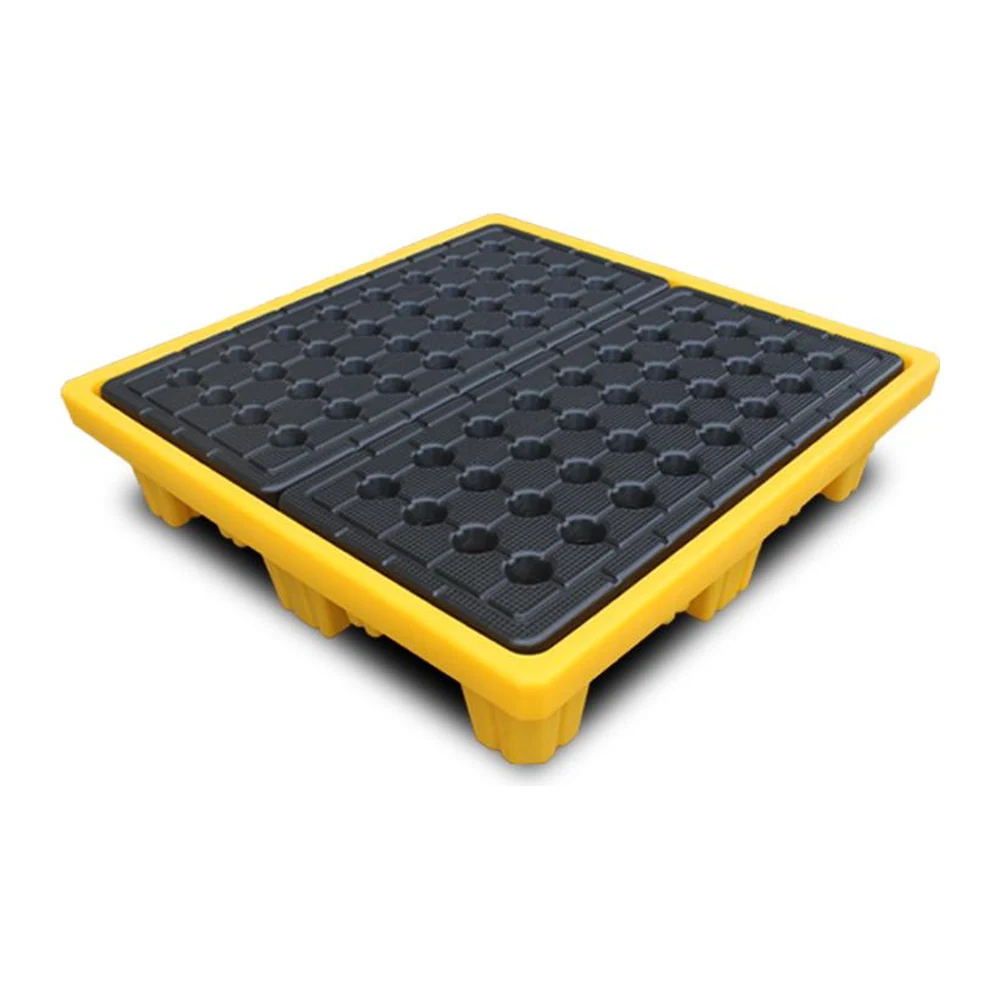 Drum Spill Pallets |
Four-drum sumps of 250 to 488 litres hold one 55-gallon drum, 208 litres, with room to spare. |
| IBC totes | 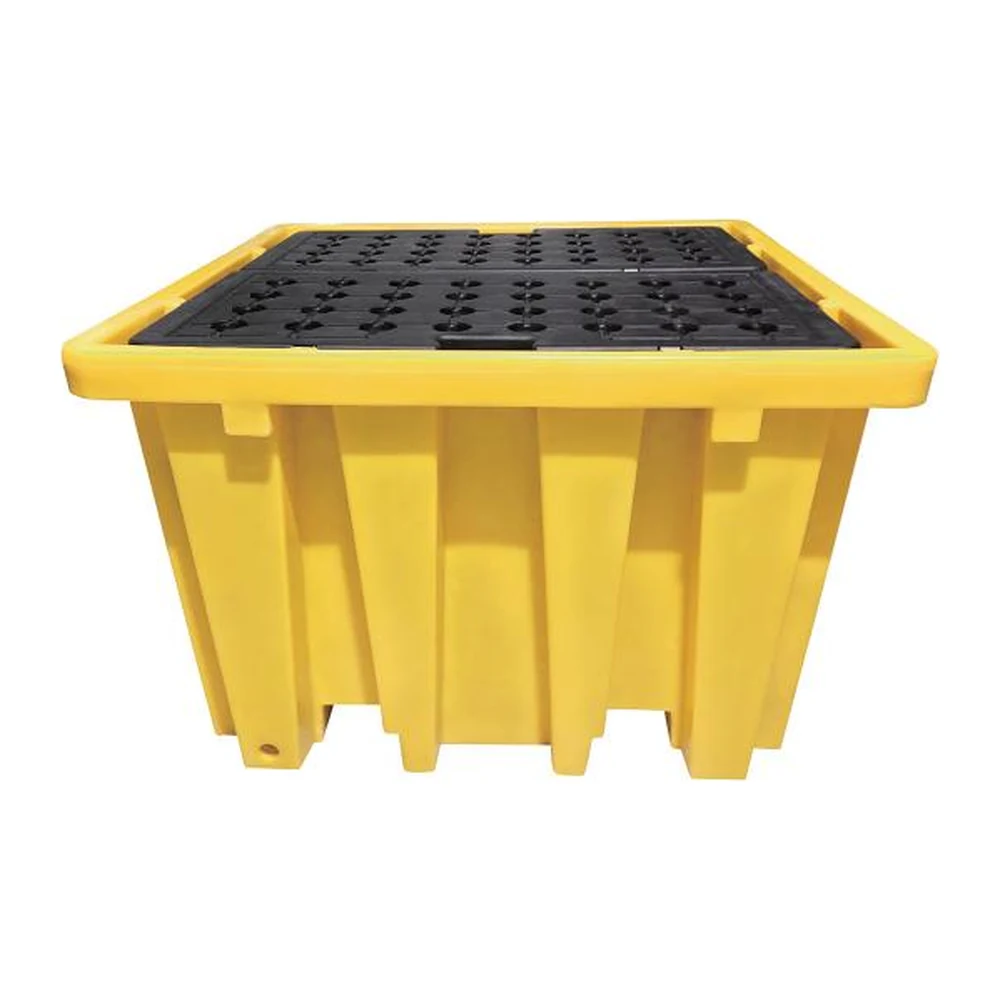 IBC & Multi-Container Spill Pallets |
Sumps to 1,600 litres; a 275-gallon tote needs 1,041 litres and a 330-gallon tote 1,249. |
| Fire-assessed stores | 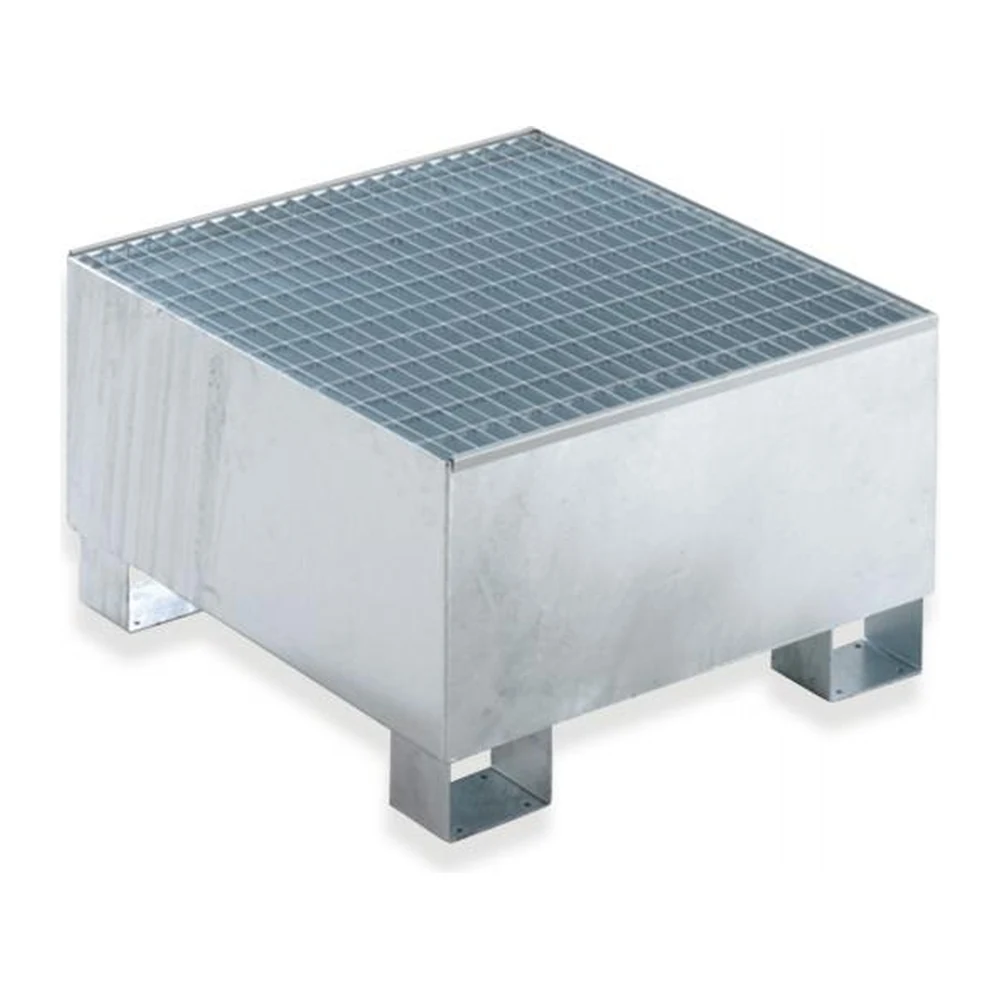 Steel Spill Pallets |
Steel where polyethylene is ruled out; the 215 and 216 litre two- and four-drum sumps clear 208 litres. |
| Outdoor drums | 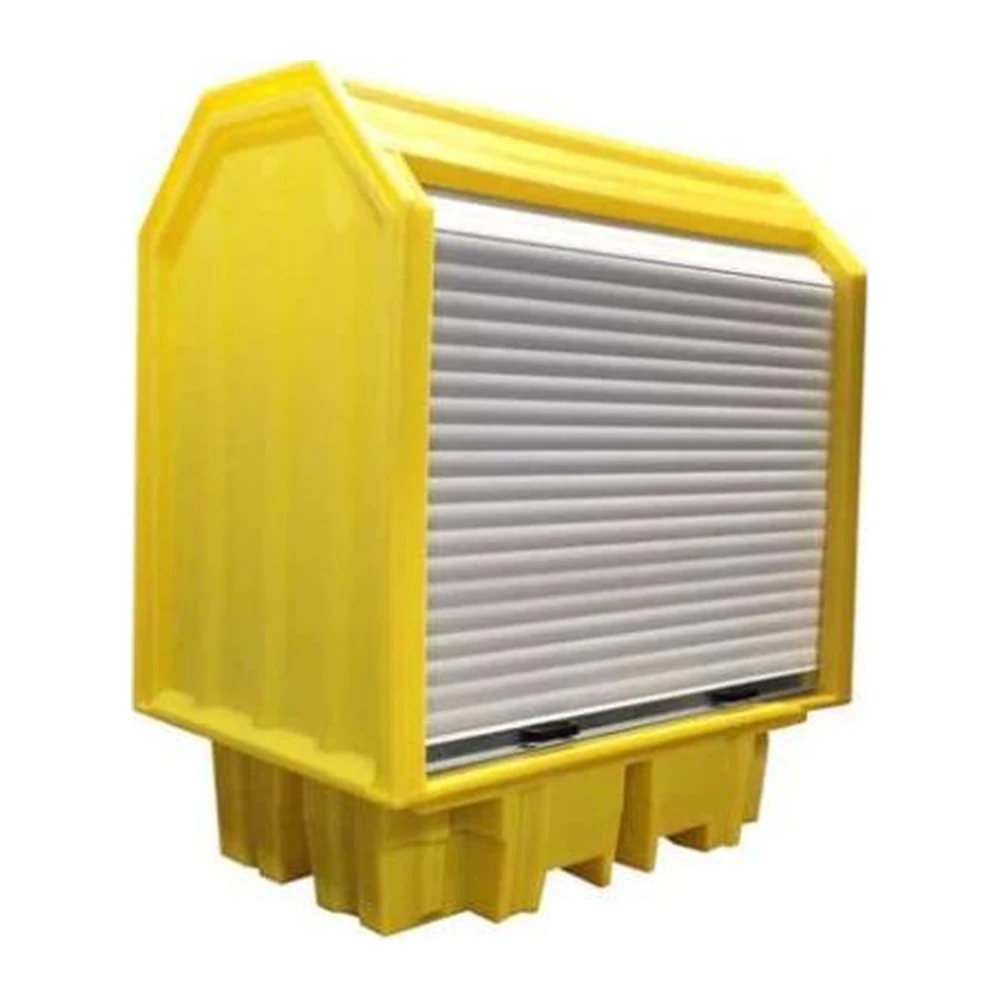 Covered Spill Pallets & Covers |
A cover keeps rain out of the sump, so the freeboard the plan counts on stays empty. |
| Drums being decanted | 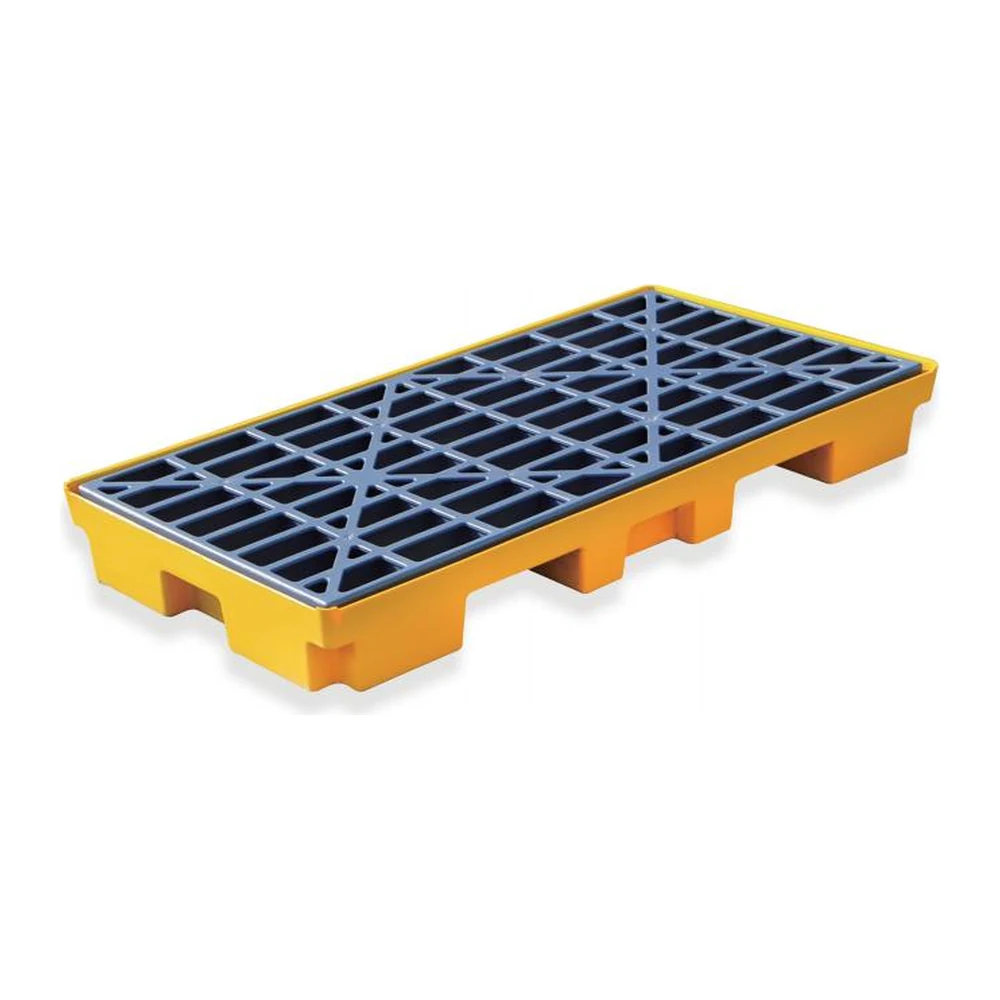 Drum Spill Decks |
General containment at the working position, with sumps of 30 to 170 litres. |
| Dispensing points |  Bench Trays & Drip Trays |
Drip pans, one of the 112.7(c) options, from 4 to 150 litres. |
| Spill response | 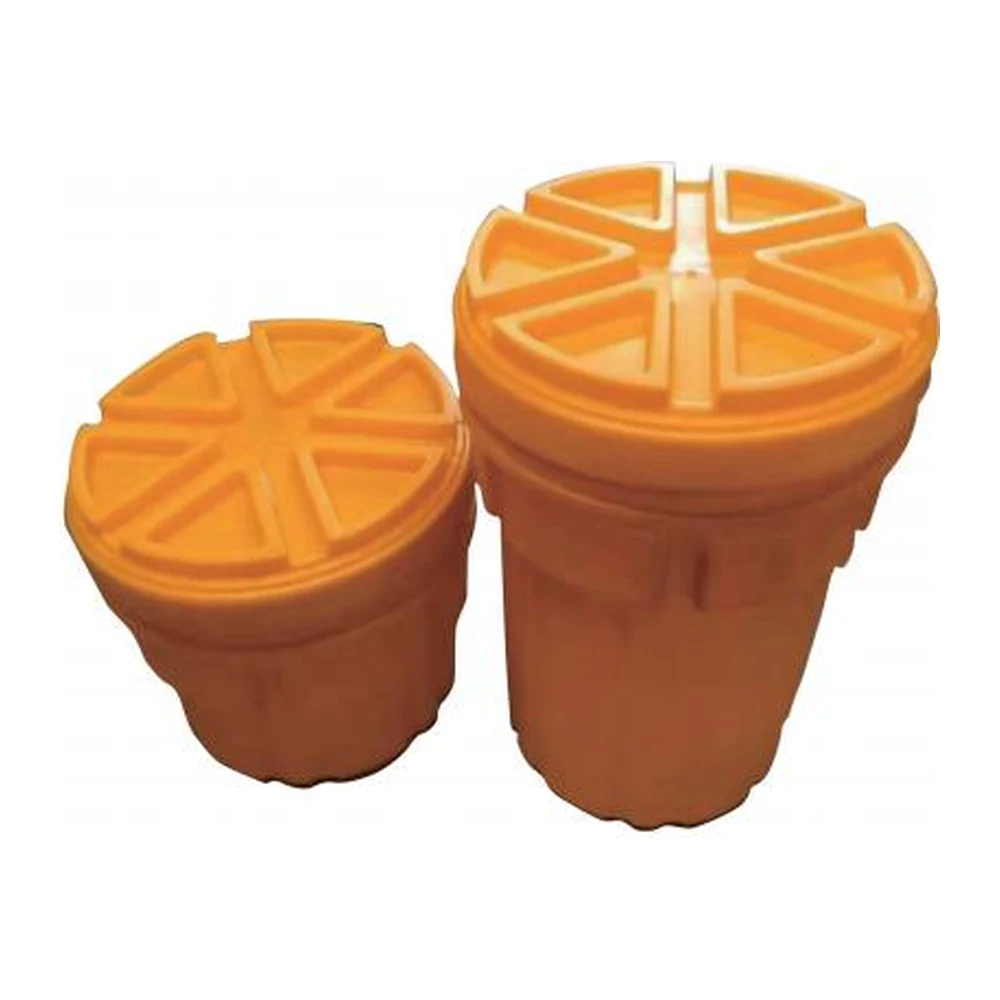 Salvage Drums & Spill Response Storage |
Overpack drums of 75 to 360 litres and kit storage for the countermeasures a plan lists. |
Yes. The SPCC rule covers oil of any kind, which 40 CFR 112.2 defines to include petroleum, fuel oil, sludge, synthetic and mineral oils, vegetable oils and animal fats. Other liquids fall under other rules. Permitted hazardous waste storage needs containment for 10% of the volume or the largest container, whichever is greater (40 CFR 264.175), and OSHA’s 29 CFR 1910.106 governs flammable liquid storage at work. Our chemical storage guide covers stores outside the oil definition.
Only where one session covers what both rules list. SPCC training for oil-handling staff covers equipment operation and maintenance, discharge procedures, pollution control law, facility operations and the plan, with a briefing at least once a year (40 CFR 112.7(f)). EPA’s 2022 Construction General Permit asks stormwater team members to know the permit’s controls, where they are, the pollution prevention procedures and the inspections (Part 6.2). Neither text says one counts for the other, so record both sets of topics.
Yes, for Tier I qualified facilities. Appendix G to 40 CFR part 112 is EPA’s Tier I template, which the owner completes and signs as the plan (112.6(a)(3)). It suits a facility with 10,000 US gallons or less above ground, no container over 5,000 gallons and no reportable discharges in three years. EPA also publishes an example Tier I plan based on a farm and worksheets for calculating secondary containment. Larger facilities need a plan certified by a Professional Engineer.
Report it at once if oil reaches water. The person in charge must notify the National Response Center, 800-424-8802, of any discharge that leaves a film or sheen on the water or breaks a water quality standard (40 CFR 110.3 and 110.6). A discharge of more than 1,000 US gallons, or two of more than 42 gallons each within twelve months, also means a written report to EPA’s Regional Administrator within 60 days. The Regional Administrator may then require the plan to be amended (112.4).
Yes, but the building can provide it. EPA’s inspector guidance lets the certifying engineer count building walls and drainage as secondary containment where they hold oil, and says rain freeboard does not apply indoors in most cases. Floor drains to a storm or sanitary sewer break that containment unless they lead to an oil-water separator designed for the discharge, and the plan must allow for doorways a spill could run through. A spill pallet under the drums avoids relying on the building.
At least once every five years. The owner reviews and evaluates the plan, signs a statement saying whether it will be amended, and adds field-proven technology that would cut the chance of a discharge within six months of the review (40 CFR 112.5(b)). A change that affects discharge potential, such as a new or moved container, a change of product or demolition near a dike, needs an amendment within six months, in place within six months after that (112.5(a)).
No. SPCC is a federal rule and reads the same in every state. EPA runs it through its regional offices, and EPA’s Pacific Southwest Region states that the programme is not delegated to any other agency. A state can still have its own tank, spill or fire rules alongside it, so check with the state environmental agency. California’s Aboveground Petroleum Storage Act, for example, asks petroleum facilities of 1,320 gallons or more for a plan in the SPCC format.
Yes, when the site crosses the capacity thresholds and a spill could reach water. EPA’s inspector guidance treats a mobile refueler that fuels only within one site, such as an airport or a construction site, as covered by SPCC. A mobile or portable facility can use a general plan that moves with it, with no new plan at each site (40 CFR 112.3(a)(1)). EPA’s 2022 Construction General Permit also tells operators to comply with SPCC where it applies.
The owner or operator of the facility. They prepare and carry out the plan (40 CFR 112.3), management approves it at a level that can commit the resources (112.7), and a named person at the site answers for discharge prevention (112.7(f)(2)). A Professional Engineer’s certification does not move that duty. EPA’s guidance for farms adds that the fuel retailer who fills a farm’s tank is not liable for the owner’s lack of compliance.
Yes. The SPCC rule is part of EPA's Oil Pollution Prevention regulation at 40 CFR part 112, first published in 1973 under section 311 of the Clean Water Act. EPA cites section 311(j)(1)(C), as amended by the Oil Pollution Act of 1990, as its authority. Facility Response Plans come from section 311(j)(5) of the same Act, and stormwater pollution prevention plans from section 402(p), through NPDES permits.
The standards and regulations this page relies on, at their issuing body. Where a market rule is named here, check the current revision before you specify against it.
Last reviewed by David Guru, Co-Founder & Business Development Director.
Tell us the containers, the liquid and where the store is. We come back with the pallet or bund, its load rating and a quotation.