
Fuel use by generator size and load, cans for 24, 48 and 72 hours, where UK rules let you keep petrol and diesel, and what to keep it in.
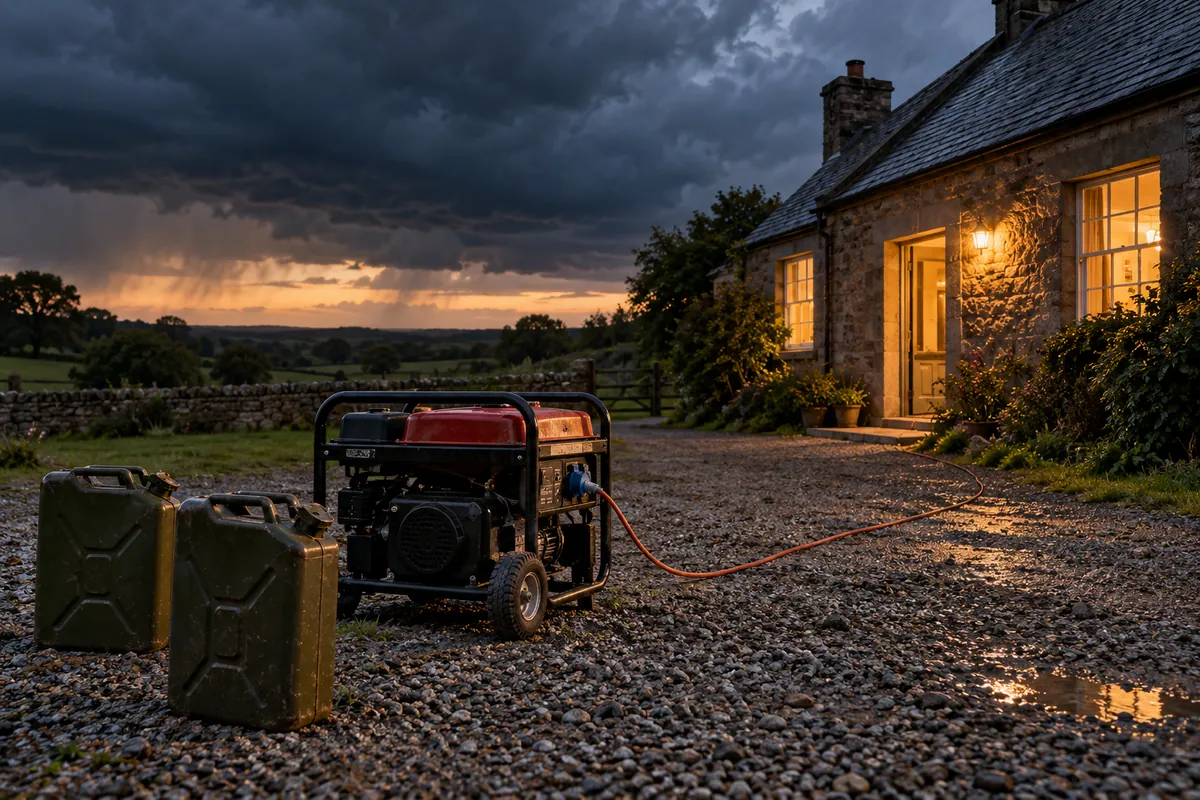
A diesel generator burns about 4.3 litres an hour at 75% load on a 20 kVA set and 17.4 on a 100 kVA set, so one 20-litre can lasts under five hours on the smaller one. Multiply litres an hour by the hours you need, add 20%, and divide by the can size. In Great Britain a home may keep 30 litres of petrol without telling anyone.
Quick answer: How much fuel does a generator use?
A 20 kVA diesel set burns about 4.3 litres an hour at 75% load and a 100 kVA set 17.4, so a 20 litre can lasts 4.7 hours on the smaller set. To count cans, multiply litres an hour by the hours, add 20% and divide by the can size. Your set's data sheet gives a better figure.
Our jerry can sizing calculator estimates diesel burn with a straight line fitted to Cummins data sheets for sets of 15 to 500 kVA: litres per hour = 1.0 + kVA × (0.008 + 0.208 × load), at a power factor of 0.8. The fit averages 6% error against those sheets and misses by up to 26% at its worst data point. As a check, the Cummins C17 D5 sheet lists 3.7 L/h at three-quarter load for its 16.5 kVA standby rating, and the formula gives 3.7.
| Diesel set | 50% load | 75% load | Full load | One 20 L can lasts, at 75% |
|---|---|---|---|---|
| 20 kVA | 3.2 L/h | 4.3 L/h | 5.3 L/h | 4.7 h |
| 50 kVA | 6.6 L/h | 9.2 L/h | 11.8 L/h | 2.2 h |
| 100 kVA | 12.2 L/h | 17.4 L/h | 22.6 L/h | 1.1 h |
| 200 kVA | 23.4 L/h | 33.8 L/h | 44.2 L/h | 0.6 h |
A plate or data sheet beats any estimate. Makers list litres an hour at quarter, half, three-quarter and full load, so read the row for the load you run, which is what the connected equipment draws.
On a 20 kVA diesel set at 75% load, 20 litres lasts 4.7 hours. On a 200 kVA set it lasts about 35 minutes. Divide 20 by the burn rate in litres an hour for your set at the load you run.
A small petrol inverter set lasts longer on 20 litres because it delivers less power. One maker lists a 1.8 kW inverter set with a 3.6-litre tank that runs 3.2 hours at rated load and 8.1 hours at quarter load. That is 1.1 litres an hour at rated load and 0.44 at quarter load, so 20 litres lasts about 18 hours at rated load and 45 hours at quarter load: more than five tankfuls. The kVA formula does not reach a set this small, so use the manual’s run time.
A 50 kVA diesel set at 75% load needs 14 cans of 20 litres for 24 hours, 27 for 48 hours and 40 for 72 hours. The sum is litres an hour times hours, plus a 20% planning reserve, divided by 20 and rounded up. The 20% is our calculator’s generator margin, an assumption you can change.
| Diesel set | Burn at 75% load | 24 hours | 48 hours | 72 hours |
|---|---|---|---|---|
| 20 kVA | 4.3 L/h | 7 cans | 13 cans | 19 cans |
| 50 kVA | 9.2 L/h | 14 cans | 27 cans | 40 cans |
| 100 kVA | 17.4 L/h | 26 cans | 51 cans | 76 cans |
| 200 kVA | 33.8 L/h | 49 cans | 98 cans | 147 cans |
Carrying the cans is a transport question. ADR 1.1.3.6 relaxes most of the full rules for a road load of up to 1,000 points. A litre of diesel (UN 1202) counts one point and a litre of petrol (UN 1203) counts three, so one vehicle can take 50 cans of diesel or 16 of petrol. The 72-hour count for a 100 kVA set, 76 cans or 1,520 litres, passes the diesel limit. The ADR 1,000-point calculator checks a mixed load, and at that scale a drum or fixed tank is easier to handle: see jerry can, drum or IBC.
Petrol in a tightly closed can kept cool keeps its quality for at least a year by Chevron’s figure, but engine makers set far shorter limits for fuel in a small engine: STIHL says 30 to 60 days, and American Honda notes that fuel in a carburettor ages faster than fuel in the tank. Our storing fuel safely guide compares the sources. A standby set can wait a year between outages, so treat its fuel and rotate it.
Rotate the stock. Write the fill date on each can, use the oldest first, and keep cans full and sealed so little air and moisture sit above the fuel. Add a stabiliser to fresh petrol; it does nothing for old fuel or for water. Diesel’s problem is water, which settles under the fuel and feeds the sludge that blocks filters, so drain any water before you use it.
In Great Britain a home or other non-workplace may keep up to 30 litres of petrol with no notice. The containers may hold 10 litres or less if plastic and 20 litres or less if metal (Petroleum (Consolidation) Regulations 2014, Schedule 2 paragraph 1 and Schedule 3). Between 30 and 275 litres you must notify the local Petroleum Enforcement Authority in writing before you start and every January. Above 275 litres you need a licence from it (regulation 14).
The store must not be living accommodation. Unless it stands in the open air, it needs a direct exit to the open air, ventilation to it and precautions against ignition sources and heat (Schedule 2 paragraph 3). At 30 litres a store inside a building must be fire-separated from the rest of the building and its exit routes. Above 30 litres, a home needs a detached store for the petrol over that amount, with fire-extinguishing and spill equipment to hand. Fuel in a tank connected to an engine, such as the generator’s own tank, does not count towards the total (paragraph 5). Our UK petrol container guide covers the container rules.
These figures apply to petrol, to Great Britain and to homes and other non-workplace premises. Northern Ireland allows two metal containers of up to 10 litres or two plastic containers of up to 5 litres in a domestic garage or within six metres of a building (HSENI). A workplace that does not dispense petrol falls outside the 2014 Regulations (regulation 3(1)(a)) and under DSEAR, which sets no fixed quantity: you assess the risk and control it. HSE’s HSG51 gives recommended maxima, not absolute limits: 50 litres of petrol in a workroom cabinet or bin and, for an outdoor store of up to 1,000 litres, 2 metres from buildings, boundary and ignition sources. See also DSEAR and ATEX for fuel stores and COSHH storage requirements.
In England the oil storage regulations apply to any container of 201 litres or more at a business that stands outside a building: a drum, an IBC, a fixed tank or a mobile bowser. GOV.UK extends them to a generator with a connected oil tank of 201 litres or more (Control of Pollution (Oil Storage) (England) Regulations 2001). That holds whether the set is a standby unit or runs daily on a tank that is not emptied within a day. A store of 20-litre cans sits outside them, however many cans it holds. A home is covered above 3,500 litres.
A container in scope needs a bund holding 110% of its capacity; with several containers the bund holds 110% of the largest or 25% of the total, whichever is greater. Fixed tanks must be bunded, and a UN-marked drum or IBC meets the container design standard. Drums may stand on a drip tray holding 25% of their volume. One 205-litre drum of generator diesel needs a 226-litre bund or a 52-litre drip tray.
Wales, Scotland and Northern Ireland set their own thresholds and scope, and English farms fall under SSAFO above 1,500 litres in total. Our oil storage regulations guide covers each nation, secondary containment requirements covers countries beyond the UK, and the bund capacity calculator works the figure. For the tax rules on red diesel, see red diesel rules.
For petrol in Great Britain, buy a metal can of 20 litres or less or a plastic can of 10 litres or less. For diesel any suitable can works, because the petrol container limits do not reach diesel. A petrol can must carry the words PETROL and HIGHLY FLAMMABLE, a hazard warning sign, its nominal capacity and the maker’s name with the date and month of manufacture. It must also hold 10 to 15% more than its nominal capacity when filled to the brim, which gives the fuel headroom (Schedule 3, paragraph 1). At work, HSE lets you fill a larger UN-approved petrol container at a retail filling station if the station agrees beforehand, the container meets the road carriage regulations and your risk assessment covers the filling.
Choose steel for petrol and for a can that lives outdoors beside the set, because steel does not permeate fuel. Plastic suits diesel in a grade made for fuel, and for petrol it needs a barrier such as fluorination. For the choice, see steel vs HDPE fuel cans and fluorinated vs plain HDPE.
Cans that travel by road carry fuel as a dangerous good, so buy UN-marked cans: UN 1203 for petrol and UN 1202 for diesel. No UK law sets a can colour, so label the contents (see jerry can colours). Jerry can sizes lists each size.
No. A generator’s exhaust carries carbon monoxide, a colourless, odourless gas that can kill. HSE says petrol-powered equipment such as generators can create dangerous levels within a few minutes indoors or in an enclosed space. It asks you to locate petrol generators outside in well ventilated spaces so fumes disperse and cannot drift into building openings. HSE Northern Ireland adds that you should not use a generator in a home, garage or crawl space even with partial ventilation, and that open doors, windows and fans do not stop carbon monoxide building up. The US Consumer Product Safety Commission gives the same rule for garages, basements and sheds.
Switch the set off and let it cool before you refuel. HSENI warns that fuel spilled on hot engine parts can ignite and that invisible vapour travels along the ground to a pilot light or a switch. HSE’s petrol guidance says to fill machines in the open air away from buildings. Keep generator fuel outside living areas in labelled containers and away from fuel-burning appliances.
The hours come from your risk assessment, your insurer or the code that applies to the building. NFPA 110, the US standard for emergency and standby power systems, classes a system by the minimum time it must supply power (Table 4.1(a)). Class 2 is 2 hours, Class 6 is 6 hours, Class 48 is 48 hours and Class X is any other time the application, code or user requires. Multiply that time by the burn rate at the load the system carries to find the fuel the class implies.
NFPA 110 also sets exercising and tank-capacity clauses, and its committee has revised the tank clause in recent cycles, so read the edition your authority has adopted. In Great Britain, DSEAR requires an employer to assess the fire and explosion risk from the fuel store. A care home, school or business that stores fuel for an outage needs water for the same hours: see emergency water for care homes, schools and businesses.
Match the set to the load. At quarter load a 100 kVA diesel set burns 0.35 litres per kWh. At half load it burns 0.31, at three-quarter load 0.29 and at full load 0.28. A set that idles at a fraction of its rating uses more fuel for every kWh it delivers, so pick a rating close to the load you run.
The 100 kVA diesel set burns less fuel per kWh than the one small petrol set we have maker data for. The 1.8 kW petrol inverter set burns 0.63 litres per kWh at rated load and 0.99 at quarter load, by its maker’s figures. The two sets differ in size and design, so treat the gap as an illustration. Clean fuel protects the engine: water and sludge block filters, so change the filter at the interval in the manual.
We make the cans and containment around a generator fuel store. The 20L NATO Steel Fuel Can is pressed steel coated inside for petrol, diesel, kerosene and JP-8, with a vented cap. The 20L Steel Fuel Tank with Spout places fuel in the filler neck without a funnel, and the 20L Horizontal Agricultural Fuel Can lies flat on a machine frame. The 25L and 30L NATO Can cuts the count on a long diesel run; for petrol it needs the work-use conditions above.
We hold UN certification for our dangerous-goods jerrican designs, and our factories hold ISO 9001, 14001 and 45001. Ask for the certificate that covers the design you order. For diesel held in drums, our drum spill pallets run from 42 to 488 litres of sump. Tell us your market, the hours you must cover and the fuel, and we size the can count and the containment together.
| Your use case | Recommended can | Why this one |
|---|---|---|
| Petrol or diesel in 20 litres | 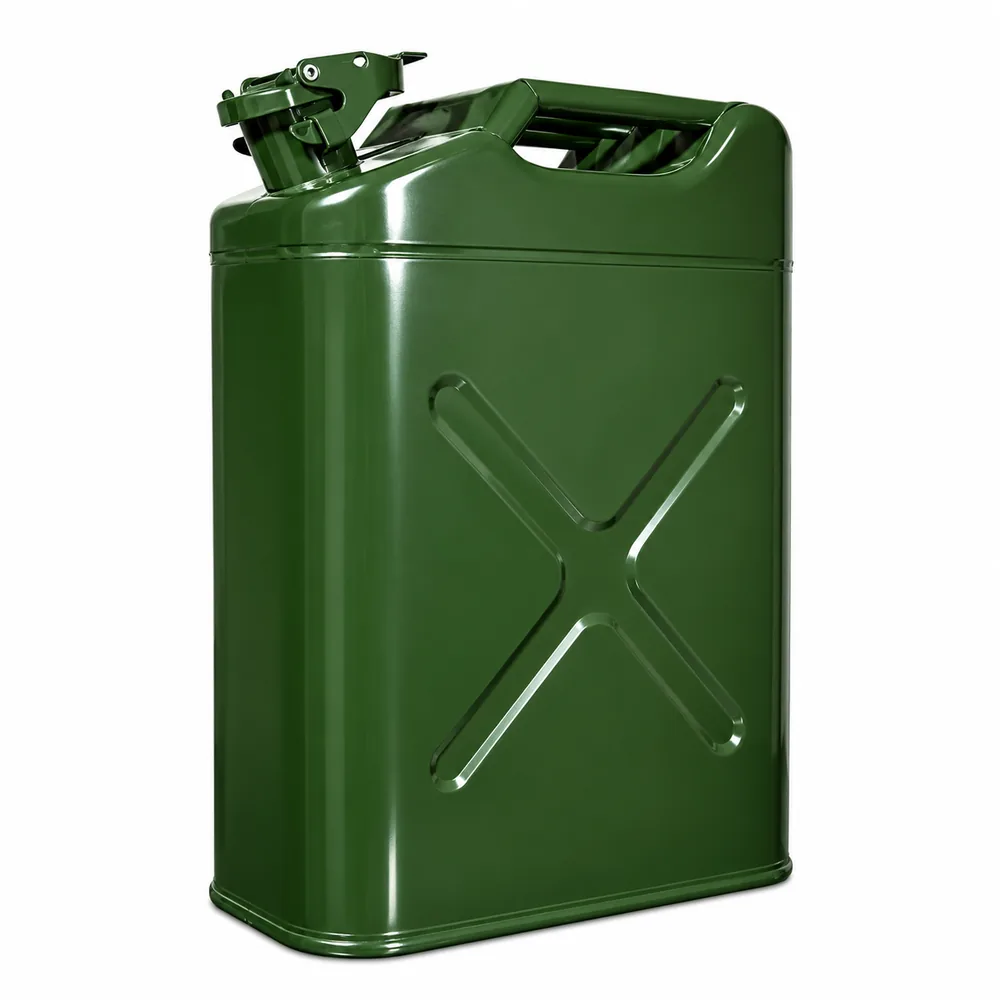 20L NATO Steel Fuel Can |
Pressed steel, coated inside for hydrocarbons, with a vented cap; metal at 20 litres is the largest petrol can Great Britain allows. |
| Refuelling the set from the can | 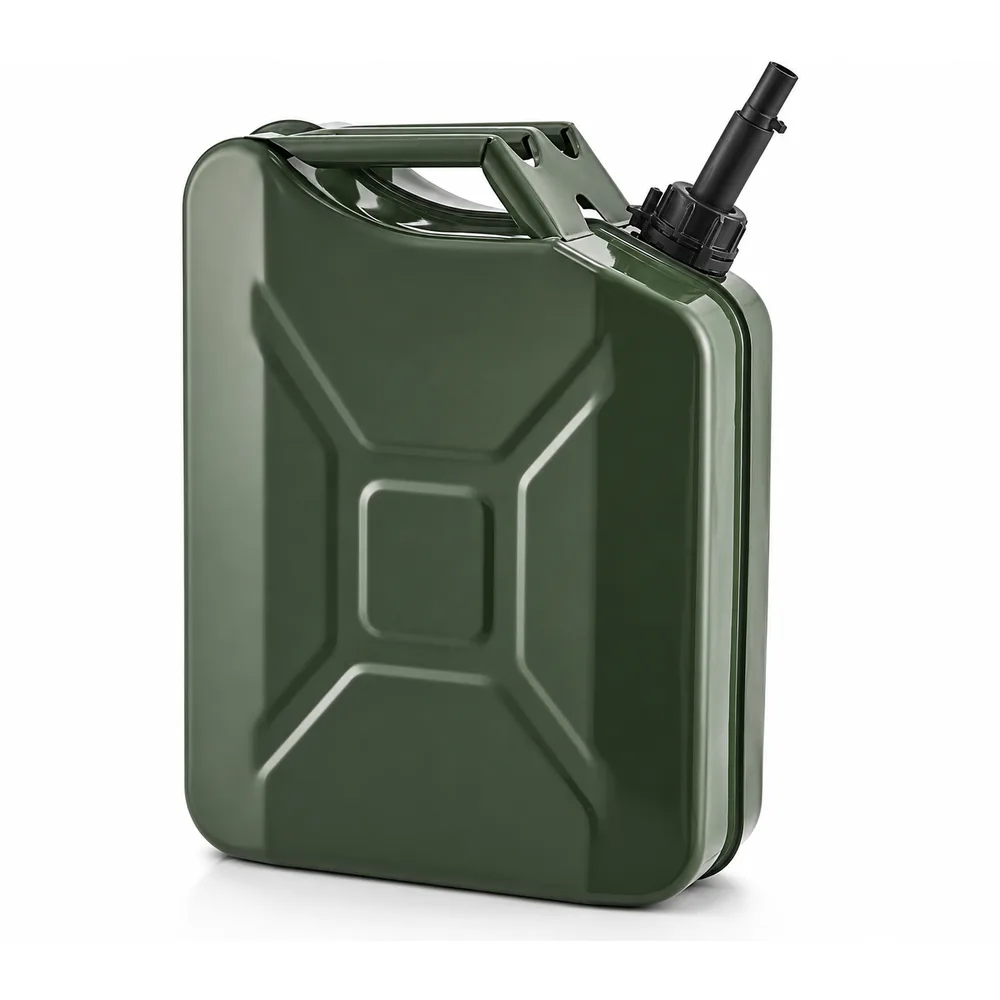 20L Steel Fuel Tank with Spout |
A fitted spout puts fuel in the filler neck without a funnel. |
| A can that lies on the set’s frame | 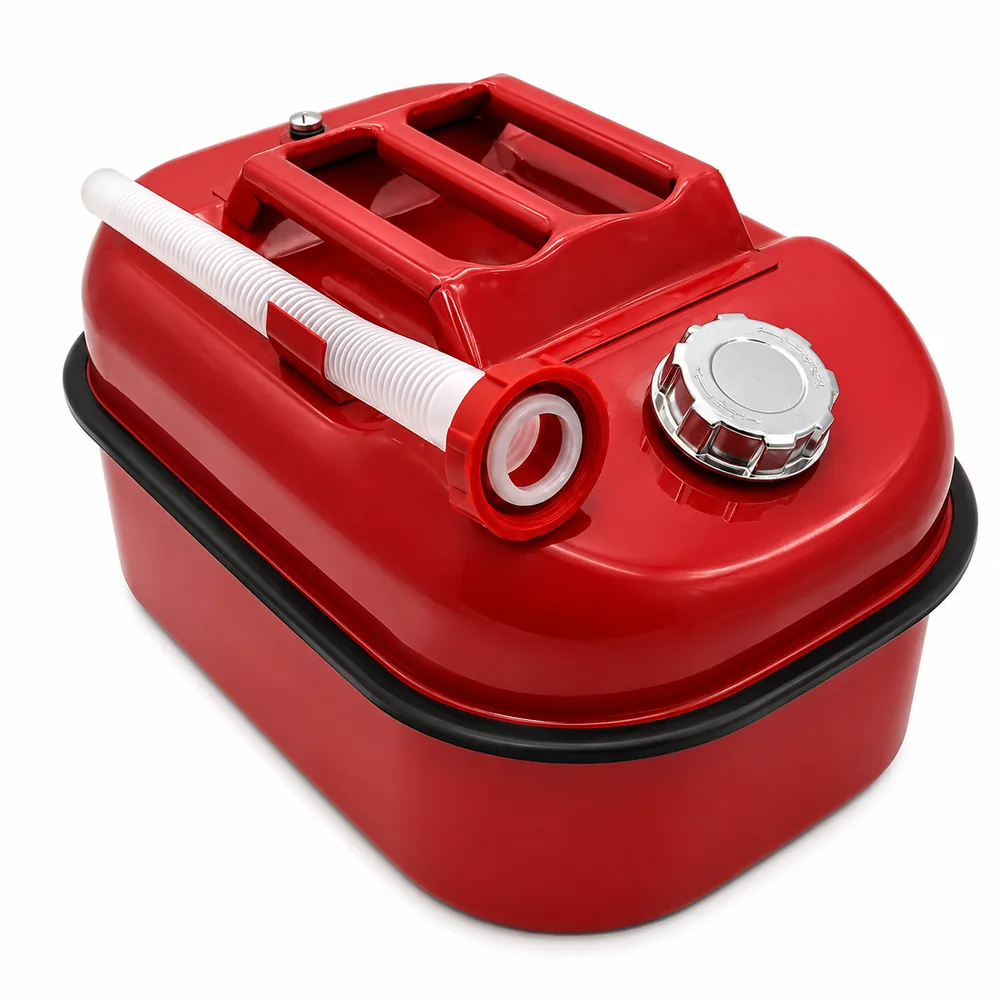 20L Horizontal Agricultural Fuel Can |
Horizontal steel format for mounting where an upright can will not sit. |
| Long runs, fewer cans | 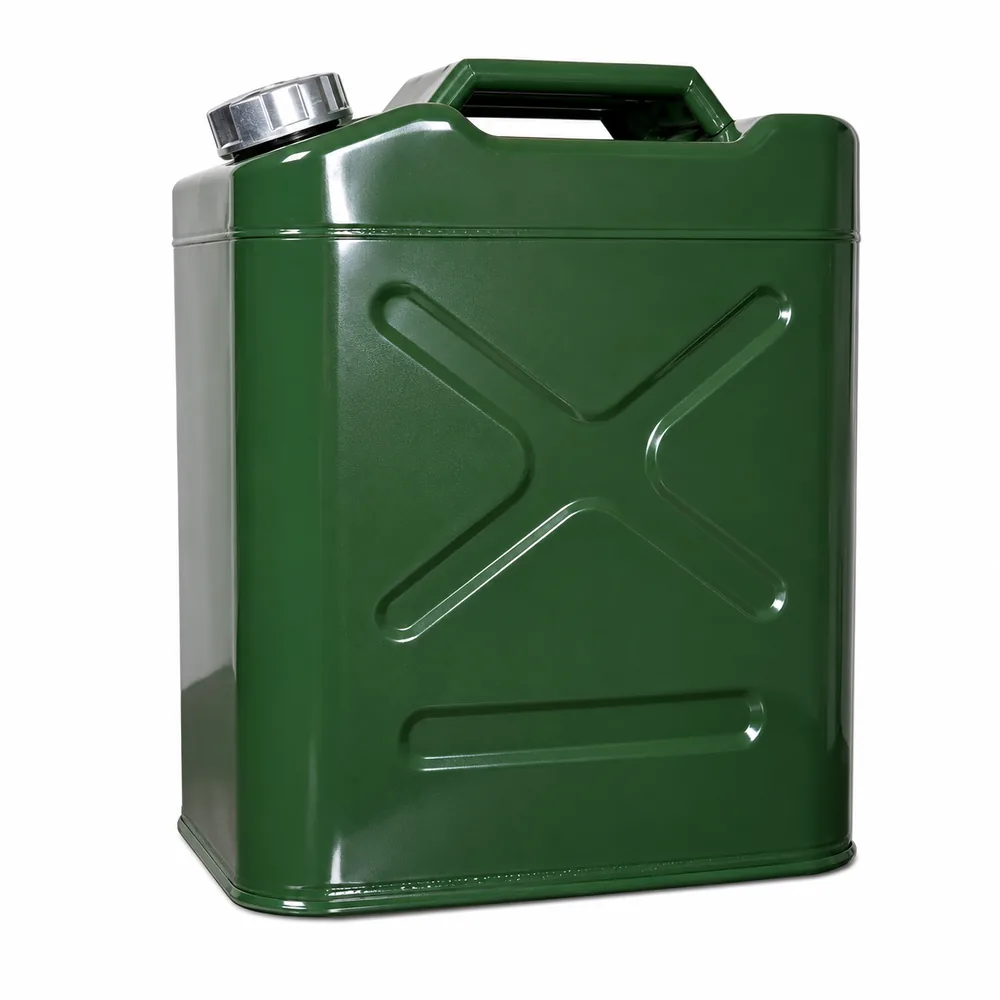 25L & 30L NATO Can |
More fuel per can for a long run; above the 20-litre petrol limit that applies at home in Great Britain. |
| Diesel stored in drums | 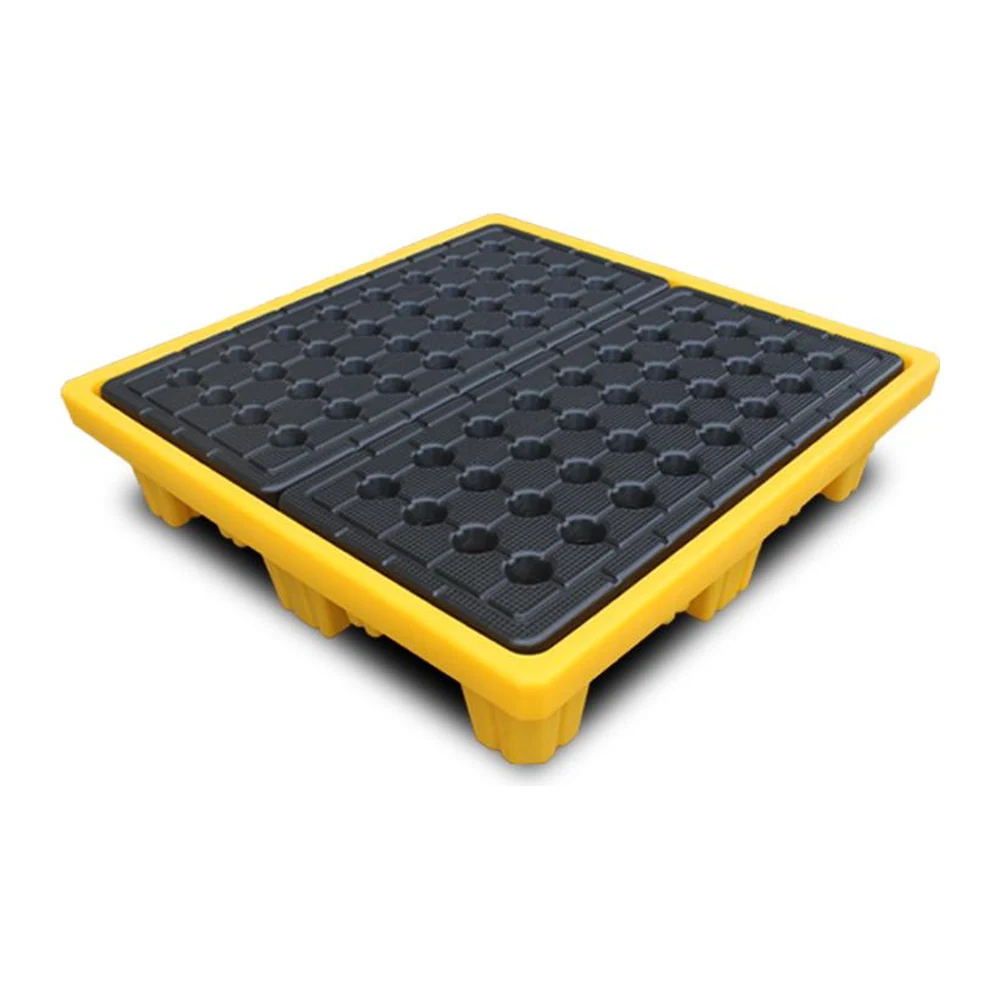 Drum Spill Pallets |
Sumps of 250 to 488 litres on the larger models exceed the 226 litres a bund for one 205-litre drum needs in England. |
Take litres per hour at your working load from the set’s plate or data sheet, then multiply by the hours you will run. For a diesel set of 15 to 500 kVA you can estimate it: 1.0 + kVA × (0.008 + 0.208 × load), at a power factor of 0.8. A 50 kVA set at 75% load burns 9.2 L/h. Our jerry can sizing calculator does the sum and returns the number of 20-litre cans.
About 17.4 litres an hour at 75% load, 12.2 at half load and 22.6 at full load, from the estimate fitted to Cummins data sheets. Over 24 hours at 75% load that is 418 litres, or 26 cans of 20 litres once you add a 20% margin. The plate figure for your own set is better than this estimate.
Diesel suits a set that must run for hours. A 100 kVA diesel set burns 0.28 to 0.35 litres per kWh, against 0.63 to 0.99 for the one small petrol inverter set we have maker data for. Diesel flashes at 55 °C or above and petrol at about −43 °C, so diesel is the easier fuel to store. Small portable sets run on petrol; match the can to the fuel.
Open while the set runs and closed when it stops, unless the manual says otherwise. Some sets let the engine run with the supply shut off so little fuel stays in the set before storage; the maker’s sheet for one 1.8 kW inverter set describes this. Valve design differs by model, so follow the manual for yours.
Stop the set and let it cool, work outdoors away from ignition sources, and drain into a fuel-rated can with room for the volume. Do not pour fuel onto the ground or down a drain. Treat fuel that has gone off, or diesel with water in it, as waste and ask your local council or a waste carrier how to dispose of it. Label the can with its contents.
Sometimes. HMRC’s Excise Notice 75 lets a generator use red diesel when 75% or more of its electricity serves premises not used for commercial purposes, such as a home, an NHS hospital, a state school or a place of worship. It also lets a generator use red diesel in machines used for agriculture, horticulture, aquatic farming, arboriculture or forestry. A generator on a commercial site needs full-duty diesel unless another listed use applies. See our red diesel rules guide.
The table in this guide is one: litres an hour for 20, 50, 100 and 200 kVA diesel sets at half, three-quarter and full load. Makers publish the same chart on each set’s data sheet, at quarter, half, three-quarter and full load, in litres or US gallons an hour. Use the sheet for your model, and the formula for a size between the rows.
Multiply the burn rate in litres an hour by the hours the set must run between deliveries, then add a margin. For 48 hours at 9.2 litres an hour that is 442 litres, or about 530 with a 20% margin. In England, a connected tank of 201 litres or more on a standby set needs a bund holding 110% of its capacity.
Fuel polishing circulates stored diesel through filters and a water separator, so water and particles come out without throwing the fuel away. It suits a standby tank that sits for months. It does not rescue petrol that has oxidised or an ethanol blend that has separated: those are disposal questions.
The petrol limits do not apply to diesel. In England the oil storage regulations reach a home above 3,500 litres in one container, so a few 20-litre cans fall outside them. Keep the cans outdoors or in a ventilated store away from ignition sources and living space, and check your lease and your insurer’s conditions.
The standards and regulations this page relies on, at their issuing body. Where a market rule is named here, check the current revision before you specify against it.
Last reviewed by Clarence Cheang, Co-Founder.
Tell us your market, your fuel and your volumes. We come back with a specification sheet and a quotation.