
How a plastic jerry can is matched to fuel, chemicals or food, and what fluorination does.
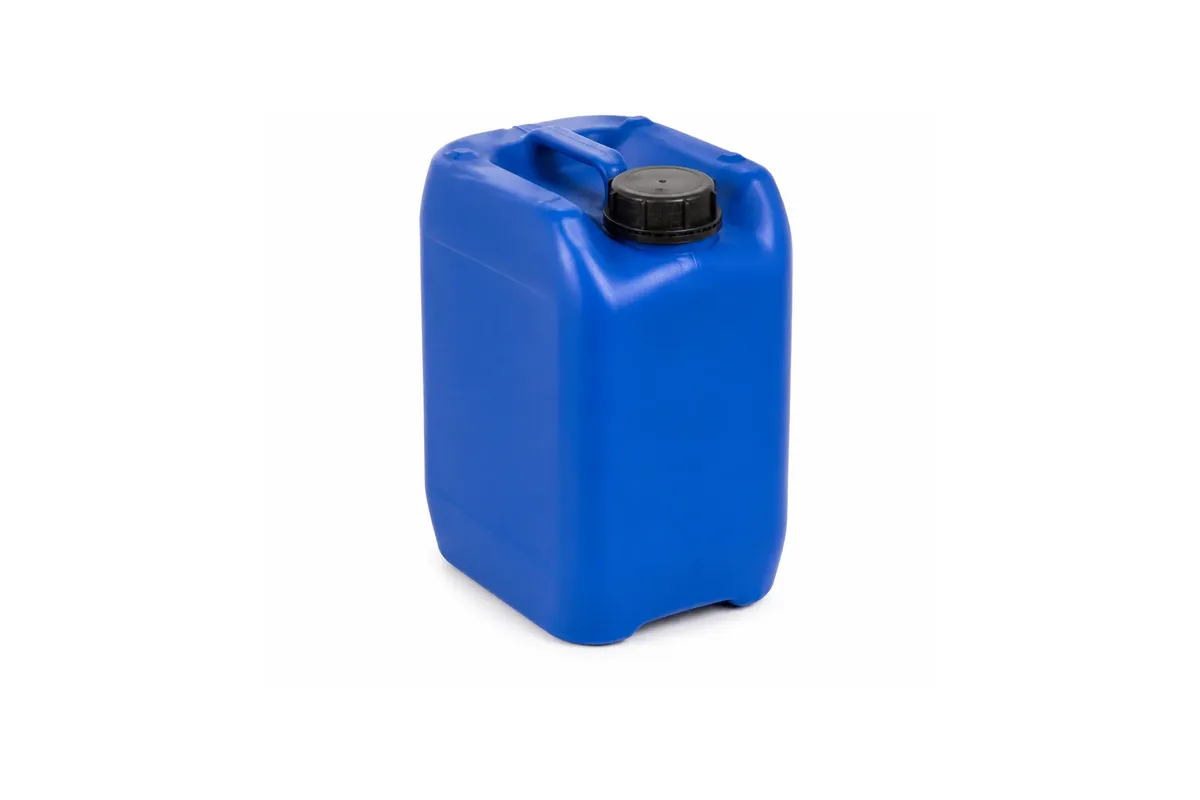
Not all HDPE is the same can. The grade, the wall and a surface treatment called fluorination decide whether a plastic container holds fuel, an aggressive chemical, or food.
High-density polyethylene is blow moulded into a seamless container with controlled wall thickness. The body forms as one piece, so there is no seam to split under pressure or a drop. It resists many chemicals, does not corrode, and is light and low-cost. Wall thickness carries the structural load. It earns the UN rating and lets a full can stack without crushing. A UN-rated HDPE jerry can carries a 3H1 code for a narrow neck or 3H2 for a wide mouth, and the UN packaging code records what that can was tested to hold.
The neck code decides how the can fills and empties. A 3H1 narrow neck pours a clean, controlled stream and seals tight, which suits thin liquids and careful decanting. A 3H2 wide mouth opens the whole top. Pick it for thick or viscous liquids that will not run through a narrow neck, and for anything you need to scoop, dose or clean out between fills.
The neck also decides what accessories exist for the can, which is the constraint that bites after the purchase. A narrow neck takes a threaded cap, a screw-in tap and a spout from a standardised size family, so replacements are findable years later. A wide mouth takes a lid and a clamp, and the fittings are far more model-specific. Choose the wide mouth when the contents demand it, not when it merely seems more convenient, because the convenience is at filling and the cost is at every refill afterwards.
Untreated HDPE behaves like a sponge towards volatile hydrocarbons. Fuel components dissolve into the polymer matrix, migrate through the wall and evaporate from the outside face, so a sealed can loses volume with the cap shut and nothing leaking. Depending on wall thickness, plain monolayer HDPE gives up somewhere between 10 and 30 g/m²/day. Some solvents go further and swell the wall, which softens the panel and lets a stacked can lean.
Regulators fixed numbers to that, and it is worth separating two that get quoted interchangeably because they measure different things. The container-level standards decide whether a can may be sold and are stated per gallon of capacity: EPA 40 CFR 59 Subpart F caps combined diurnal venting and permeation at 0.3 g/gal/day, and CARB 13 CCR 2467.2 caps permeation at 0.4 g/gal/day. The material-level threshold qualifies a wall construction and is stated per square metre of surface: 0.30 g/m²/day at a steady 28 °C.
Both matter and they are not interchangeable. A container standard is what an Executive Order or a certification is issued against; a material threshold is what tells a moulder whether a wall construction can get there at all. Everything that follows in this guide is stated per square metre, because that is the level at which fluorination and co-extrusion are chosen. Untreated HDPE misses the material threshold by roughly two orders of magnitude, which is why the treatment on the inner wall is a certification question rather than a quality preference. Our EPA and CARB guide covers the container-level side.
The test protocol is slow, and that is worth knowing before you plan a launch. The container is filled with a certification fuel, typically CE10 at ninety per cent benchmark gasoline and ten per cent ethanol, then held for at least 140 days so the wall reaches steady-state saturation before the measurement that counts even begins. A permeation programme is a five-month commitment on the calendar, and it cannot be compressed by paying more.
None of this applies to water or to most industrial chemicals, and it is why the same body ships treated and untreated. Plain HDPE is the right and cheaper answer for water, detergents and a long list of aqueous chemistry. It is the wrong answer for petrol, and the failure is invisible until you weigh the can.
Fluorination exposes the inner surface to fluorine gas, which substitutes fluorine atoms for hydrogen on the polyethylene chain. The result is a carbon-fluorine skin chemically grafted onto the wall rather than a coating sitting on top of it. Fluorine is small, electronegative and packs tightly, so the treated layer has a far lower diffusion constant for hydrocarbons than the HDPE beneath it. The barrier is a few micrometres deep, adds no weight and changes no external dimension.
Because it is a chemical change to the existing molecule and not an applied film, there is nothing to delaminate. The gas reaches every internal surface it can fill, so handles, tight radii and the awkward geometry around a jerry can shoulder are treated as evenly as the flat panels. Treatment runs either in-mould, with the gas introduced during blowing, or post-mould as a batch step in a vacuum chamber, and the post-mould route is the one that produces the deepest, most uniform layers.
Fluorination is sold by level, conventionally one to five, and the level sets how deep and how complete the substitution goes. It is not a quality ladder where higher is simply better: each tier is priced and specified for a class of contents, and paying for level five to hold a household cleaner wastes money the same way specifying level one for petrol wastes a production run.
Level 1 replaces very little and does about as much as an antistatic treatment, stopping mild flavour and odour migration in flavours, essential oils and light cleaners. Levels 2 and 3 convert part of the surface hydrogen to carbon-monofluoride groups and cover automotive additives, mild degreasers and agricultural chemicals. Level 4 goes denser and drops the diffusion rate for smaller aromatic molecules, which is the tier for hydrocarbon solvents, paint thinners, terpenes and aggressive crop oils. Level 5 drives the substitution close to a continuous PTFE-like difluorocarbon surface and cuts permeation by up to a thousandfold against untreated HDPE, which is where high-purity gasoline, xylene, toluene, acetone and volatile dangerous goods belong.
Put the tiers against the 0.30 g/m²/day barrier threshold and the picture is stark. Level 3 lands around 1.5 to 2.5 g/m²/day: fine for industrial surfactants and agricultural oils, and a clear fail against an ethanol-blend fuel standard. Level 5 lands at 0.15 to 0.25 g/m²/day and passes with margin. Between those two tiers sits the entire difference between a wall construction that can be taken to a fuel certification and one that cannot.
This is why we ask what the liquid is before quoting. Tell us the substance, the fill temperature and the market, and we specify the level against it; see the fluorinated HDPE jerry can for the treated body. A quotation that says fluorinated without naming a level has not answered the question.
There is a second route to the same outcome. Instead of treating the surface, a co-extruded wall builds the barrier into the structure: typically six layers, with ethylene vinyl alcohol or polyamide sandwiched between structural HDPE and bonded by adhesive tie layers. EVOH has one of the lowest gas diffusion constants available against hydrocarbons, and a co-extruded wall lands at 0.05 to 0.12 g/m²/day, comfortably the best number of any option here.
The trade-offs run the other way on almost every other axis. Co-extrusion needs multi-manifold heads, several extruders and layer-thickness control, so the tooling and capital cost are high and the process is not available on a standard single-layer blow moulder. Pinch-offs at the handle and the base seam can stretch or tear the internal EVOH layer, creating a thin spot exactly where a drop test applies load. Poor tie-layer adhesion or regrind contamination can separate the layers under impact. Fluorination has none of those failure modes, treats complex geometry uniformly and runs on standard tooling, which is why it dominates in the jerry can format specifically.
Recycling favours co-extrusion slightly, and neither route is clean. Fluorinated polymer can release trace toxic gases during conventional melt reprocessing and degrades standard recycling streams; EVOH layers need compatibilisers to go back into structural HDPE scrap. If your buyer is asking about recycled content or end-of-life under the EU packaging rules, raise this early, because it is the part of the specification that has changed fastest.
A blow-moulded container is inflated from a soft tube of polymer, so the wall thins wherever the material had furthest to travel. Corners, the base radius and the shoulders are systematically thinner than the flat panels, and that distribution is a design outcome rather than a defect.
It matters because the UN approval was granted against a design with a particular distribution, verified by weight and by section checks. Reducing the shot weight to save resin thins precisely the corners that the drop test lands on, and a can that passes visual inspection can fail the test it was approved against.
For a buyer the useful proxy is unit weight. A jerrican that suddenly weighs less than the one before it is not a bargain, it is a different design, and on a UN-marked line that is a question worth asking before the next order rather than after a failure.
A food-grade HDPE is made from an approved resin with food-contact documentation. The resin and the paperwork are what qualify it, so a standard can does not count as food-grade by default. Our food-grade HDPE jerry can ships with that documentation. An antistatic HDPE dissipates static charge, which matters when decanting flammable liquids, as one part of a proper earthing and bonding routine. The grade is carbon-loaded, so charge bleeds away instead of building on the wall. It supports bonding and earthing and does not replace them; see the antistatic HDPE jerry can. Match the grade to the liquid and the hazard.
UN approval for a plastic jerrican is decided by free-fall drop testing, run to the method described in ASTM D5276. The container is filled, conditioned and released from a set height onto a rigid, unyielding surface, and the drops are repeated across the orientations that load the seams and the closure. It is a pass or fail with no partial credit.
Plastics carry an extra condition that metal does not. The filled container is conditioned to −18 °C or lower before the drop, because polyethylene stiffens and loses impact toughness as it cools, and a wall that survives a warm workshop can split on a cold loading dock. That single requirement is why cold-weather markets are unforgiving of a thinned corner, and why unit weight is the proxy worth watching on repeat orders.
The height comes from the packing group, which is set by how dangerous the contents are. Packing Group I drops from 1.8 metres, Group II from 1.2 metres and Group III from 0.8 metres. Read the height back off a UN packing code and you know what the design was proven against, which is the number that matters when someone offers you a cheaper can with the same marking.
Passing means zero structural cracking, zero rupture and zero leakage from either the body or the closure system after impact. A weep at the cap counts as a failure exactly as a split seam does, which is why the closure is part of the approval rather than an accessory bought separately. Our note on dangerous goods transport covers what the rest of the test regime adds.
Run a plastic jerrican through ASTM B117 neutral salt spray, five per cent sodium chloride at 35 °C, and nothing happens. HDPE does not corrode or degrade under the test that defines outdoor life for a steel can. There is no coating to consume, no sacrificial layer to run out and no scratch that starts a reaction, so a plastic can in a coastal yard is limited by ultraviolet exposure and by the contents, never by salt.
That is the honest advantage of plastic over steel, and it is a narrower advantage than it first sounds. It buys you nothing on permeation, nothing on impact strength at low temperature and nothing on stacking load. Set against a galvanized steel can, the comparison comes down to which failure mode your operation actually meets: salt or solvent.
HDPE ages under long sun exposure. Ultraviolet light works on the polymer over years, so a can stored outdoors needs the right pigment and UV stabiliser to hold its strength. Indoors this matters little. For field, yard or marine use, specify a pigmented, stabilised wall rather than a natural translucent one.
Two errors repeat. The first is filling plain HDPE with fuel and trusting it to hold, when only a fluorinated wall passes permeation limits. The second is assuming any HDPE can is food-grade because it looks clean. Neither holds. The grade and its paperwork decide what the can may carry.
Both errors share a root, which is treating HDPE as one material. It is a family: blow-moulding grades differ in molecular weight and stress-crack resistance, food contact depends on the resin and its additive package together, antistatic is a carbon-loaded variant, and fluorination is a surface treatment applied afterwards at a chosen level. A specification that says HDPE has named the polymer and none of the four decisions that actually determine what the can can hold.
Our HDPE range covers fluorinated, food-grade, antistatic and wide-mouth cans. Send us the liquid and we specify the grade, the wall and whether fluorination is needed.
Grade and treatment follow the liquid. Here is the HDPE line.
| Your use case | Recommended can | Why this one |
|---|---|---|
| Fuel and aggressive solvents | 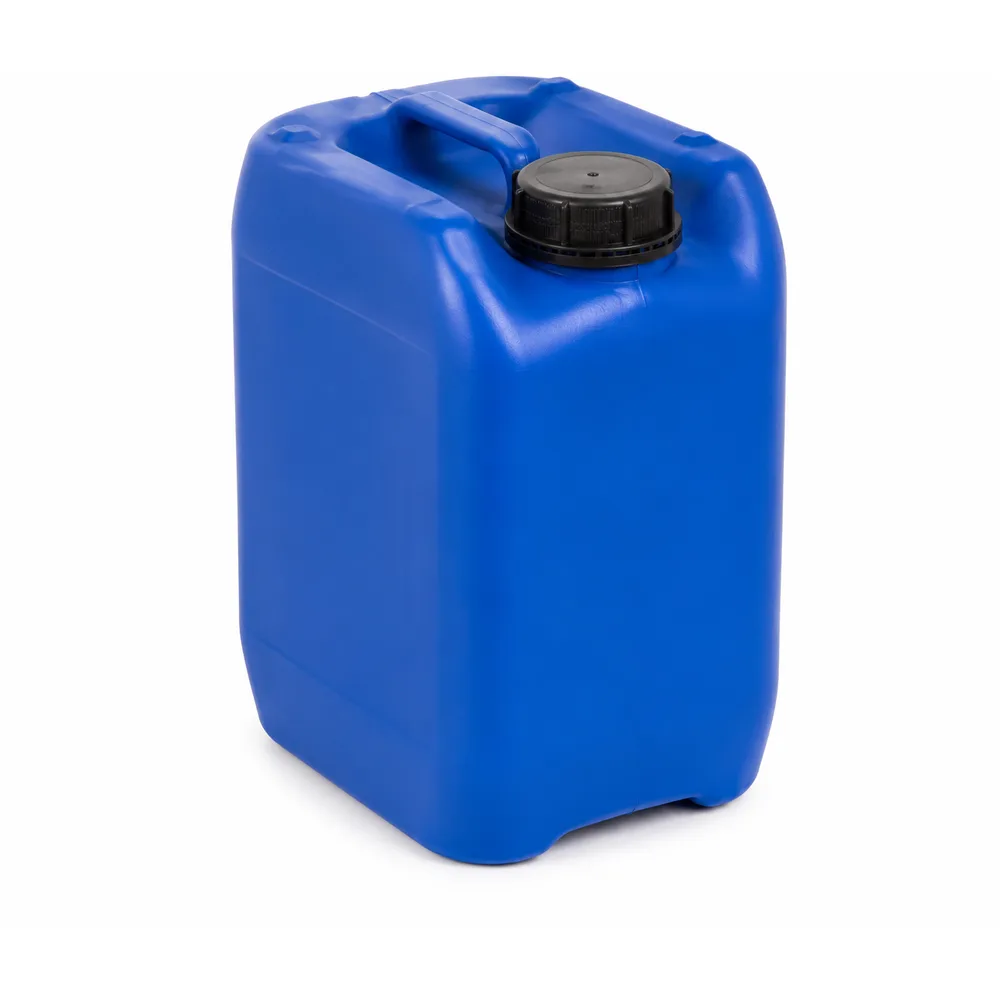 Fluorinated HDPE Jerrycan Fluorinated HDPE Jerrycan |
Fluorinated barrier controls permeation. |
| Food and potable liquids | 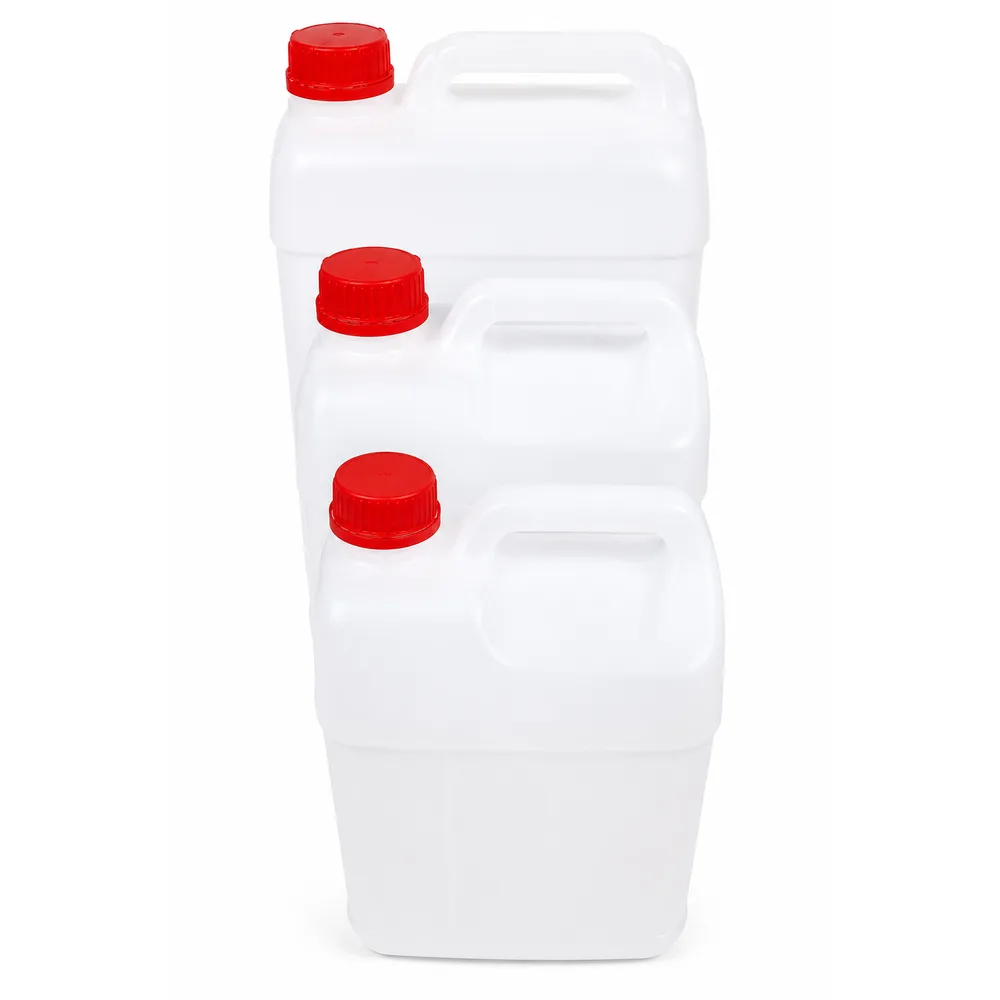 Food-Grade HDPE Jerrycan Food-Grade HDPE Jerrycan |
Food-contact resin with documentation. |
| Flammable-liquid decanting | 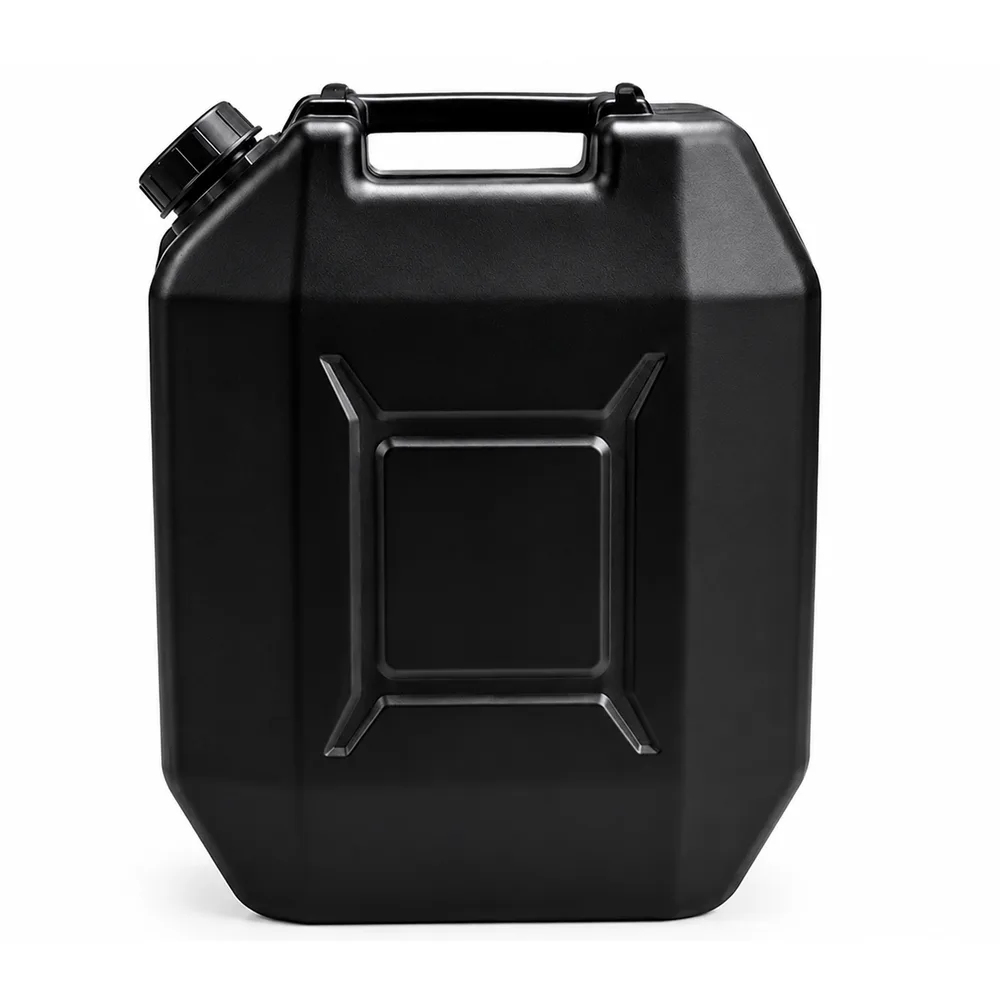 Antistatic HDPE Jerrycan Antistatic HDPE Jerrycan |
Carbon-loaded to dissipate static charge. |
| Thick or viscous liquids | 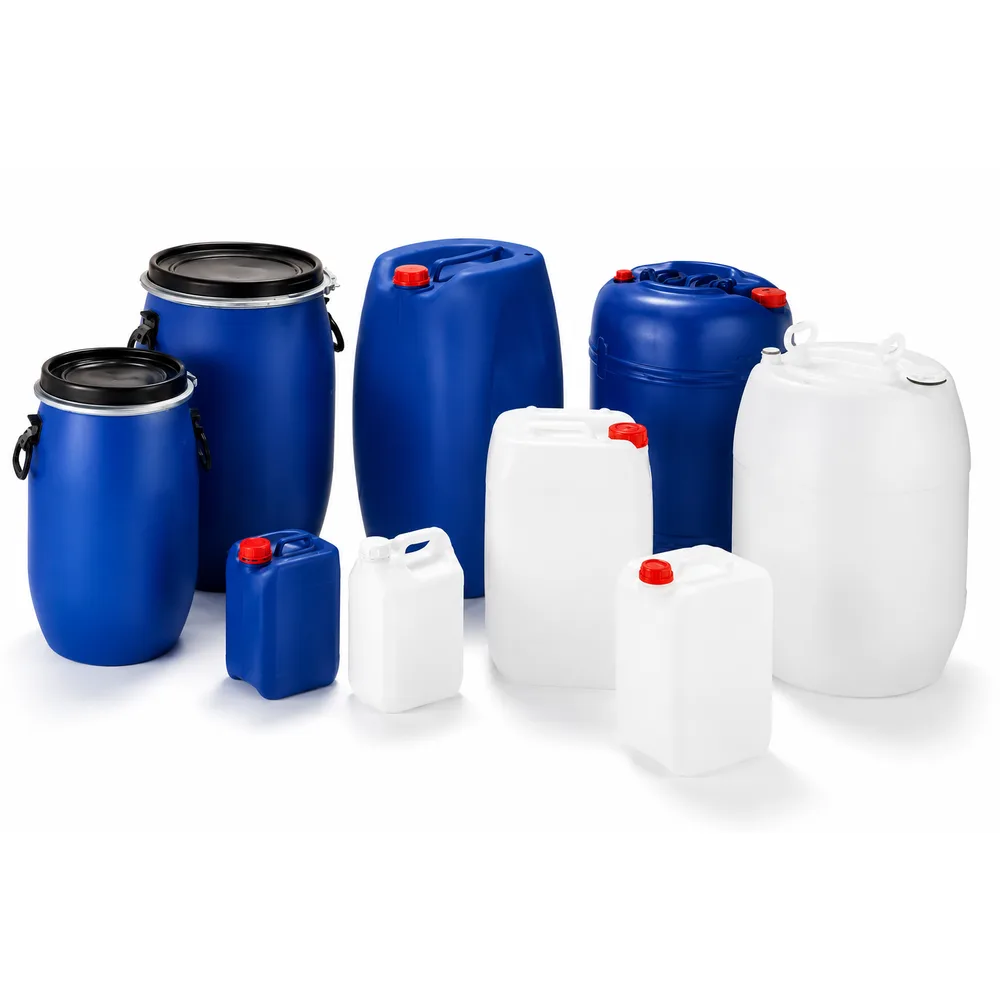 Wide-Mouth HDPE Jerrycan — UN 3H2 pattern Wide-Mouth HDPE Jerrycan — UN 3H2 pattern |
Wide 3H2 mouth for filling and cleaning. |
| Water and general chemicals | 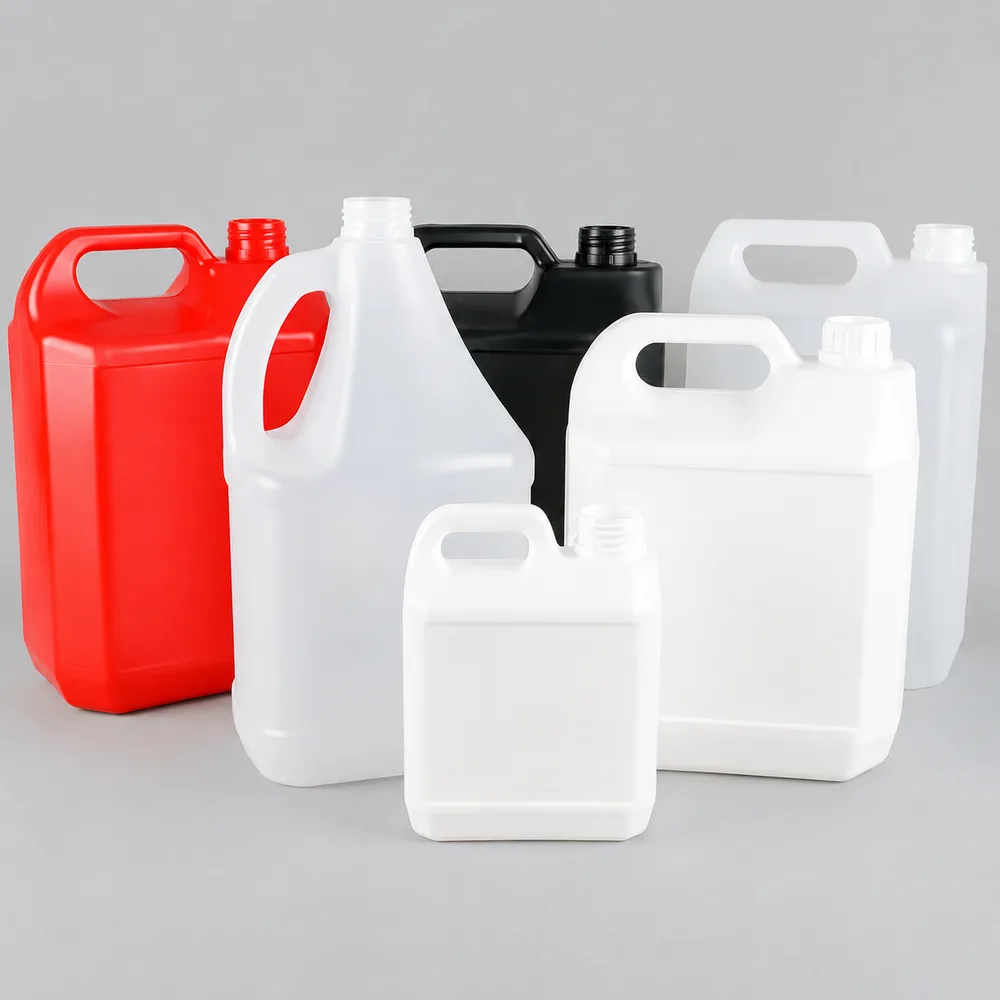 Economy HDPE Jerrycan — non-UN Economy HDPE Jerrycan — non-UN |
The volume line for non-fuel duty. |
Fluorine gas reacts with the inner surface after blow moulding, converting a thin layer of the polymer into a fluorinated barrier. That barrier cuts hydrocarbon permeation through the wall by an order of magnitude, which is what lets a plastic can hold petrol and still meet emissions limits.
Level 3 converts part of the surface hydrogen and lands around 1.5 to 2.5 g/m2/day, which suits industrial surfactants, agricultural oils and mild degreasers. Level 5 drives the substitution close to a continuous PTFE-like surface and lands at 0.15 to 0.25 g/m2/day. The threshold used to qualify a wall construction for fuel service is 0.30 g/m2/day, so level 3 fails an ethanol-blend fuel application and level 5 passes.
Two different measurements answer that and they are easy to confuse. The container-level standards that decide whether a can may be sold are stated per gallon of capacity: EPA 40 CFR 59 Subpart F caps combined diurnal venting and permeation at 0.3 g/gal/day, and CARB 13 CCR 2467.2 caps permeation at 0.4 g/gal/day. The material-level threshold that qualifies a wall construction is stated per square metre of surface: 0.30 g/m2/day at 28 degrees Celsius, with the container filled with a certification fuel such as CE10 and held at least 140 days to reach steady-state saturation before measurement. Untreated monolayer HDPE runs 10 to 30 g/m2/day and misses the material threshold by roughly two orders of magnitude.
By free fall to ASTM D5276, with the container filled and, for plastics, conditioned to minus 18 degrees Celsius or lower first, because polyethylene loses impact toughness as it cools. The height comes from the packing group: 1.8 m for Packing Group I, 1.2 m for Group II and 0.8 m for Group III. Passing requires zero cracking, rupture or leakage from the body or the closure.
Co-extrusion reaches a lower rate, 0.05 to 0.12 g/m2/day against 0.15 to 0.25 for level 5 fluorination, but needs multi-manifold tooling, can stretch or tear the EVOH layer at handle and base pinch-offs, and carries delamination risk under cold drop impact. Fluorination runs on standard single-layer blow moulding, treats complex jerry can geometry uniformly and cannot delaminate because it alters the existing molecule.
Blow-moulding grades of high-density polyethylene with high molecular weight and good environmental stress crack resistance. Food-contact applications need a grade with the relevant food-contact declaration, and UN-marked cans need the grade and wall thickness that were tested for that approval.
The standards and regulations this page relies on, at their issuing body. Where a market rule is named here, check the current revision before you specify against it.
Last reviewed .
Tell us your market, your fuel and your volumes. We come back with a specification sheet and a quotation.