
How high-density polyethylene compares with LDPE, LLDPE, polypropylene, PET and PVC on density, heat, cold, stiffness, chemicals, gas barrier and food contact, and which plastic each jerrycan, pail, drum and tank is made from.
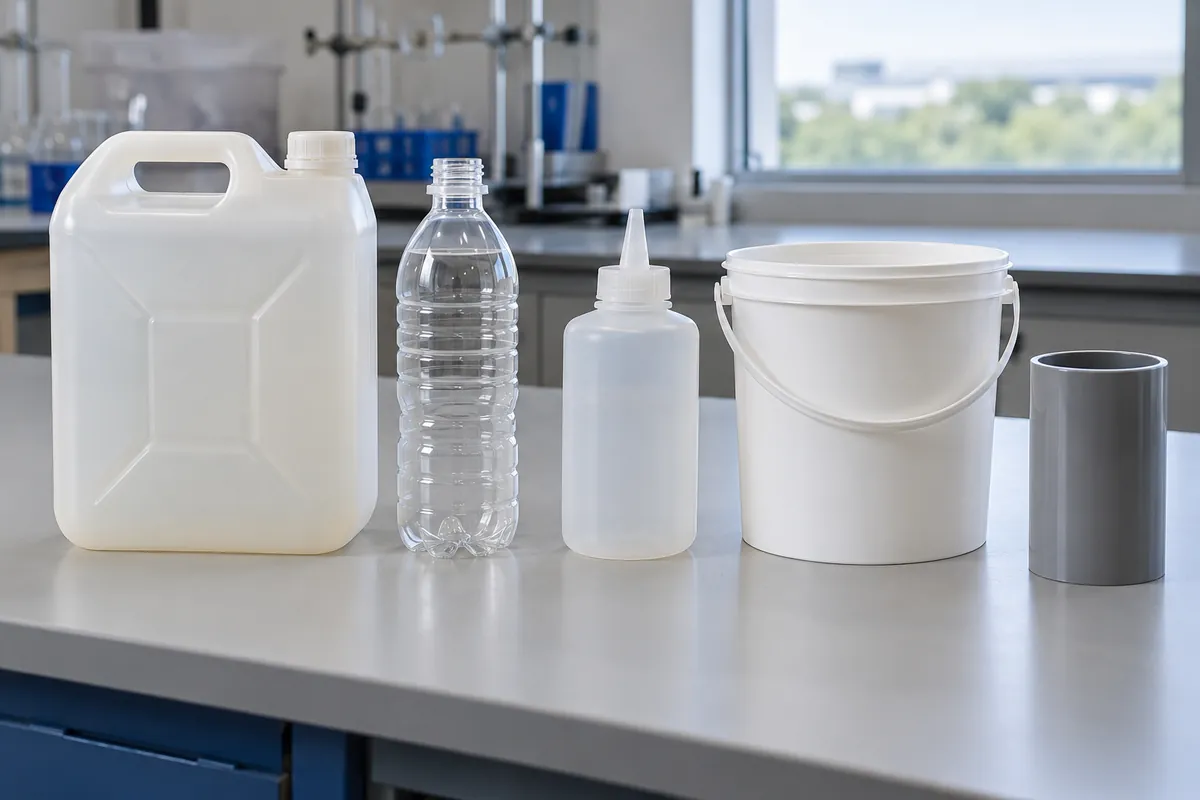
HDPE is polyethylene denser than 0.94 g/cm³, stiff enough to stack and tough far below the −18 °C of the UN drop test, so resin makers sell it for jerrycans and drums. LDPE is softer and takes less heat. Polypropylene is stiffer and takes more heat, but its homopolymer turns brittle at 0 °C. PET is the clear gas barrier for bottles; PVC is denser and contains chlorine.
Quick answer: How does HDPE compare with LDPE, polypropylene and PET?
Resin makers sell HDPE for jerrycans and drums because it is stiff enough to stack and stays tough below the minus 18 °C of the UN drop test. LDPE is softer and tolerates less heat; polypropylene is stiffer and tolerates more, though its homopolymer grade goes brittle at 0 °C. PET is the clear gas barrier used for bottles.
Work it out
HDPE sits between the others on most measures. It is lighter than PET and PVC, stiffer than LDPE and tougher in the cold than polypropylene, and it rates good to excellent with most water-based chemicals. Values are typical for one grade; check the data sheet for yours.
| Plastic | Code | Density, g/cm³ | Max use, °C | Brittle at, °C | Flexural modulus, MPa | Made into |
|---|---|---|---|---|---|---|
| HDPE | 2 | 0.948–0.956 | 120 | −100 | 900–1,200 | Jerrycans, drums |
| LDPE | 4 | 0.92 | 80 | −76 | Flexible | Wash and dropper bottles |
| LLDPE, rotomoulding | None of its own | 0.938–0.939 | – | below −60 | 700–890 | Tanks, IBCs |
| PP homopolymer | 5 | 0.90 | 130 | 0 | 1,480 | Caps and closures |
| PP copolymer | 5 | 0.90 | 121 | −40 | 1,150 | Pails, crates |
| PET | 1 | 1.33 | 65 | −40 | – | Bottles, 20 L water bottles |
| PVC, rigid | 3 | 1.44 | 60 | −15 | 2,630 | Water bottles, pipe |
| PVC, flexible | 3 | 1.19 | 71 | −32 | Flexible | Tubing |
Density, maximum use and brittleness temperatures are Thermo Fisher’s labware figures, with three exceptions. The HDPE jerry can grades come from LyondellBasell, Chevron Phillips and Reliance, and the LLDPE rotomoulding grades from SCG. The PVC-U is an Angst+Pfister sheet whose −15 and 60 °C are its operating limits. Flexural moduli come from the makers’ data sheets; the copolymer figure is LyondellBasell’s pail grade. The code is the number in Commission Decision 97/129/EC, which gives PET 1, HDPE 2, PVC 3, LDPE 4 and PP 5 and leaves their use voluntary. It names the polymer and says nothing about food contact or UN approval; food-grade buckets explains what does.
Density and branching. Both are polyethylene, and US federal rules count polyethylene at 0.940 g/cm³ or less as low density and above it as high density (40 CFR 60.561). The UK Trade Tariff splits polyethylene at a specific gravity of 0.94 as well (subheadings 3901.10 and 3901.20). Thermo Fisher traces the gap to the chain: LDPE carries more side branching, packs less densely and stays flexible without plasticisers, where HDPE is semi-rigid.
The branching costs LDPE heat resistance and barrier. Its maximum use temperature is 80 °C against 120 for HDPE, and it passes about 2.7 times as much oxygen through the same wall. Thermo Fisher’s chemical ratings match class for class at 20 °C except aliphatic hydrocarbons, where LDPE drops to fair. A plastic jerrican carries its stack load for 28 days at 40 °C in the UN stacking test (ADR 2025, 6.1.5.6), which calls for HDPE’s stiffness; Thermo Fisher makes wash and dropper bottles from LDPE.
LLDPE, linear low-density polyethylene, is sold in rotomoulding grades for tanks. SCG makes two at 0.938 and 0.939 g/cm³, with flexural moduli of 700 and 890 MPa against 900 to 1,200 for HDPE jerry can resins, for water tanks from under 5,000 to 22,500 litres and for IBCs. Our spill pallets use LLDPE or HDPE depending on the model. Polyethylene is the family name for all of these, so HDPE vs PE compares one grade with its own family.
At room temperature, yes. LyondellBasell’s general-purpose homopolymer, Moplen HP500N, has a tensile strength at yield of 34 MPa and a flexural modulus of 1,480 MPa. Its Hostalen ACP grades for dangerous-goods jerry cans yield at 26 and 27 MPa, and Chevron Phillips gives 25 MPa and 1,200 MPa for its jerry can resin. Polypropylene also takes more heat: Thermo Fisher rates it to 130 °C and autoclavable, HDPE to 120 °C and not. 21 CFR 177.1520 sets a melting point of 160 to 180 °C for food-contact polypropylene, where HDPE data sheets give 134 to 135 °C.
Cold reverses the order. Thermo Fisher says polypropylene products are brittle at 0 °C and may crack or break if dropped from benchtop height. It gives −40 °C for polypropylene copolymer and −100 °C for HDPE. Plastic drums and jerricans are chilled to −18 °C or lower before the UN drop test (ADR 2025, 6.1.5.3.2), colder than the point where homopolymer turns brittle. Pail grades are impact copolymers: LyondellBasell sells Moplen EP500N for crates and pails, at 27 MPa yield, 1,150 MPa flexural modulus and a notched Izod of 50 J/m at −20 °C.
The better plastic depends on the job. HDPE suits a can that must survive a cold drop full of liquid; polypropylene suits a pail, a cap or a part that sees heat. Thermo Fisher makes most of its bottle caps in polypropylene whatever the bottle is made of, for its stress-crack resistance, the best of the polyolefins, and because a cap seals best on a container of a different plastic.
At room temperature they rate alike, and they part over fuels, oxidisers and heat. Thermo Fisher gives HDPE and polypropylene the same rating in all 11 of its chemical classes at 20 °C and adds that polypropylene is slightly more susceptible to strong oxidising agents. The resin maker INEOS separates them at 21 °C: HDPE rates satisfactory with gasoline and fuel oil where polypropylene shows some attack, and polypropylene is unsatisfactory with white spirit.
Polypropylene comes out ahead with some acids and aromatics. INEOS rates it satisfactory with concentrated sulphuric acid and some attack with xylene, where HDPE shows some attack from 96% sulphuric acid and is unsatisfactory with xylene. Warm bleach favours HDPE: concentrated sodium hypochlorite stays satisfactory in HDPE at 60 °C and shows some attack on polypropylene. INEOS says its tables cover general chemical resistance only, and that permeation, stress cracking and container design need full testing. The chemical compatibility guide rates 22 liquids in HDPE and polypropylene side by side.
PET is the clear, rigid gas barrier; HDPE is the tougher, translucent all-rounder. Thermo Fisher’s figures for PETG, a PET copolyester, show about a seventh of HDPE’s oxygen permeability (9.7 against 71.9) and about a fifth of its carbon dioxide permeability (48.6 against 225.4). IVL Dhunseri sells PET bottle grades for carbonated soft drinks and for 20-litre refillable water containers, both under 21 CFR 177.1630 and Regulation (EU) No 10/2011.
PET gives up heat and chemical range for that barrier. It sinks, at a specific gravity of 1.33, and Thermo Fisher puts its maximum use temperature at 65 °C and its glass transition at 70 °C, against 120 °C for HDPE. The bottle grades melt at 240 and 247 °C. Thermo Fisher rates PETG not recommended with strong acids and alkalis, where HDPE rates good to excellent, and calls its chemical resistance inferior to that of the polyolefins.
Recycled PET has a named route back into food contact. Regulation (EU) 2022/1616 lists mechanical PET recycling as a suitable technology (recital 14). Regulation (EU) 2025/40 sets recycled-content floors from 2030 at the earliest of 30% for contact-sensitive PET packaging and 10% for other plastics (Article 7(1)), and exempts packaging for dangerous goods (Article 7(4)(f)). In Great Britain the Plastic Packaging Tax applies to packaging below 30% recycled plastic.
For a container that may be dropped in the cold or hold solvents, HDPE. Thermo Fisher describes PVC as similar in structure to polyethylene with a chlorine atom in each unit. That chlorine leaves it open to some solvents, makes it more resistant in many other uses and gives it very low permeability to most gases. Rigid PVC is heavier and stiffer: Angst+Pfister gives its PVC-U a density of 1.44 g/cm³ and a modulus of 3,000 MPa. Geon rates its clear water-bottle compound at 2,630 MPa in flexure, more than twice HDPE’s 900 to 1,200.
Rigid PVC pays for that in toughness. The Angst+Pfister sheet sets an operating range of −15 to 60 °C and a notched Charpy impact of 4 kJ/m², while HDPE stays tough to −100 °C in Thermo Fisher’s data. Angst+Pfister lists high resistance to acids, lyes and salt solutions. Flexible PVC gets its softness from plasticisers, which Thermo Fisher names as phthalate esters for its tubing. That tubing rates not recommended with aldehydes, esters, ketones and aromatic and halogenated solvents, and fair with the alcohols and alkalis HDPE handles well.
PVC also differs in fire and in food law. In a fire, PVC resin gives off hydrogen chloride as well as carbon monoxide and carbon dioxide (SCG PVC resin safety data sheet, section 5.2). For food contact, Regulation (EU) No 10/2011 allows no detectable vinyl chloride in the food and no more than 1 mg/kg in the finished article (Annex I, FCM substance 127).
The safest is the one its maker declares for food contact in your market, at your storage time and temperature. In the US, 21 CFR 177.1520 clears polyethylene, polypropylene and olefin copolymers, and 177.1630 clears PET. In the EU, Regulation (EU) No 10/2011 lists the monomers each plastic may be made from, and the declaration of compliance names the foods, time and temperature it covers.
| Plastic | US food-contact rule | EU entry, Regulation (EU) No 10/2011, Annex I |
|---|---|---|
| HDPE, LDPE, LLDPE | 21 CFR 177.1520 | Ethylene, FCM 125 |
| Polypropylene | 21 CFR 177.1520 | Propylene, FCM 275 |
| PET | 21 CFR 177.1630 | Ethylene glycol (FCM 227) and terephthalic acid (FCM 785), each under a group migration limit |
| PVC | Not covered here | Vinyl chloride (FCM 127): not detectable in food, at most 1 mg/kg in the article |
| Polycarbonate | 21 CFR 177.1580 | Bisphenol A prohibited in food contact materials (Regulation (EU) 2024/3190) |
Drinking water adds a second approval. WRAS in the UK and NSF/ANSI/CAN 61 in North America cover products in a water supply, and Fortitude21 holds neither; see WRAS approval and NSF/ANSI 61. Light and taste matter for any plastic store, and stainless steel vs plastic water containers sets out that evidence.
Resin makers sell HDPE for blow-moulded jerrycans and drums, polypropylene for injection-moulded pails and LLDPE for rotomoulded tanks.
| Container | Plastic | Process | Maker evidence |
|---|---|---|---|
| Jerrycans, UN 3H1 and 3H2 | HDPE | Extrusion blow moulding | LyondellBasell Hostalen ACP; Reliance Relene B56003, jerry cans to 20 L |
| Plastic drums, UN 1H1 | HDPE | Blow moulding | LyondellBasell, drums to 60 L; PTT HD7200B, drums of 20 to 120 L |
| Pails, UN 1H2 | PP impact copolymer | Injection moulding | LyondellBasell Moplen EP500N, crates and pails |
| Caps and closures | Polypropylene | – | Thermo Fisher, most of its bottle caps |
| Tanks and IBCs | LLDPE | Rotational moulding | SCG M3804RW and M9001RW |
| Spill pallets | LLDPE or HDPE | Rotational or injection moulding | Our range, by model |
| Bottles, 20 L water bottles | PET | Blow moulding | IVL Dhunseri bottle grades |
No transport rule names the polymer. In a UN code the letter H means plastics material, which ADR takes to include other polymeric materials such as rubber (ADR 2025, 6.1.2.6). The rules favour polyethylene in one place: a polyethylene can or drum may prove chemical compatibility by assimilating the liquid to standard liquids (4.1.1.21). A design in another plastic sits full of the liquid for six months before its drop, leakproofness, pressure and stacking tests, or passes an equivalent procedure the competent authority recognises (6.1.5.2.5). A design with a fluorinated inner surface can take the results of an equal polyethylene design (6.1.5.2.6). Read any mark with the UN packaging code decoder, and see the drum guide for larger formats.
Every jerry can grade we read, from LyondellBasell, Chevron Phillips, Reliance and PTT, is HDPE. Thermo Fisher’s labware data sets these plastics beside it.
| Plastic | Specific gravity | Max use, °C | Brittle at, °C |
|---|---|---|---|
| HDPE | 0.95 | 120 | −100 |
| ABS | 1.05–1.16 | 86–90 | 0 |
| Acetal (POM, sold as Delrin) | 1.42–1.61 | 120 | −55 |
| Polycarbonate | 1.20 | 130 | −135 |
| PTFE | 2.2 | 260 | −100 |
UHMW is the only polyethylene in this group. Mitsubishi Chemical Group gives one food-grade UHMW an average molecular weight of 9 million g/mol and a melting point of 135 °C, and sells it for components and replacement parts in food processing and packaging plants. PTFE takes 260 °C at more than twice HDPE’s density. ABS turns brittle at 0 °C and acetal at −55 °C. Polycarbonate stays tough to −135 °C, and Thermo Fisher rates it not recommended with strong acids, alkalis and esters.
We make containers in HDPE and polypropylene, and spill pallets in LLDPE or HDPE. Our jerrycans are blow-moulded HDPE from 5 to 30 litres: a natural 25-litre stackable can available UN 3H1 certified, food-grade and fluorinated cans, and an economy line without UN approval for non-hazardous liquids. Our pails are injection-moulded virgin polypropylene, round from 2.5 to 20 litres and rectangular from 3.7 to 32 litres, with a food-contact grade specified per build. We make nothing in PET or PVC.
Fortitude21 holds UN certification for its dangerous-goods jerrican designs, certified per design type and made under quality assurance the competent authority accepts, and our factories hold ISO 9001, 14001 and 45001. We hold no WRAS or NSF/ANSI 61 approval.
Tell us the liquid, its concentration, the hottest and coldest temperatures the container will see and the destination market, and we match the plastic and the grade.
| Your use case | Recommended can | Why this one |
|---|---|---|
| Industrial liquids and dangerous goods | 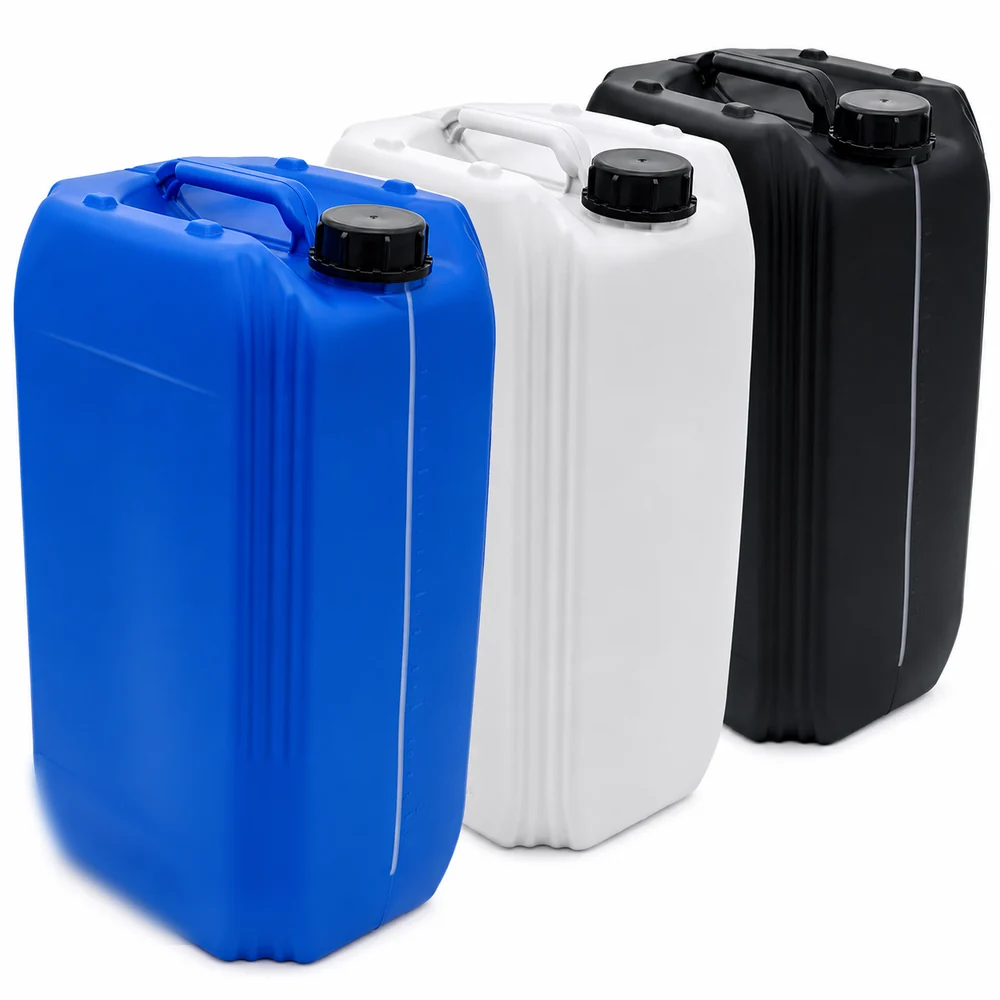 25L Stackable Plastic Jerrycan |
Blow-moulded natural HDPE, 25 litres, L-ring stackable, available UN 3H1 certified. |
| Water and liquid food | 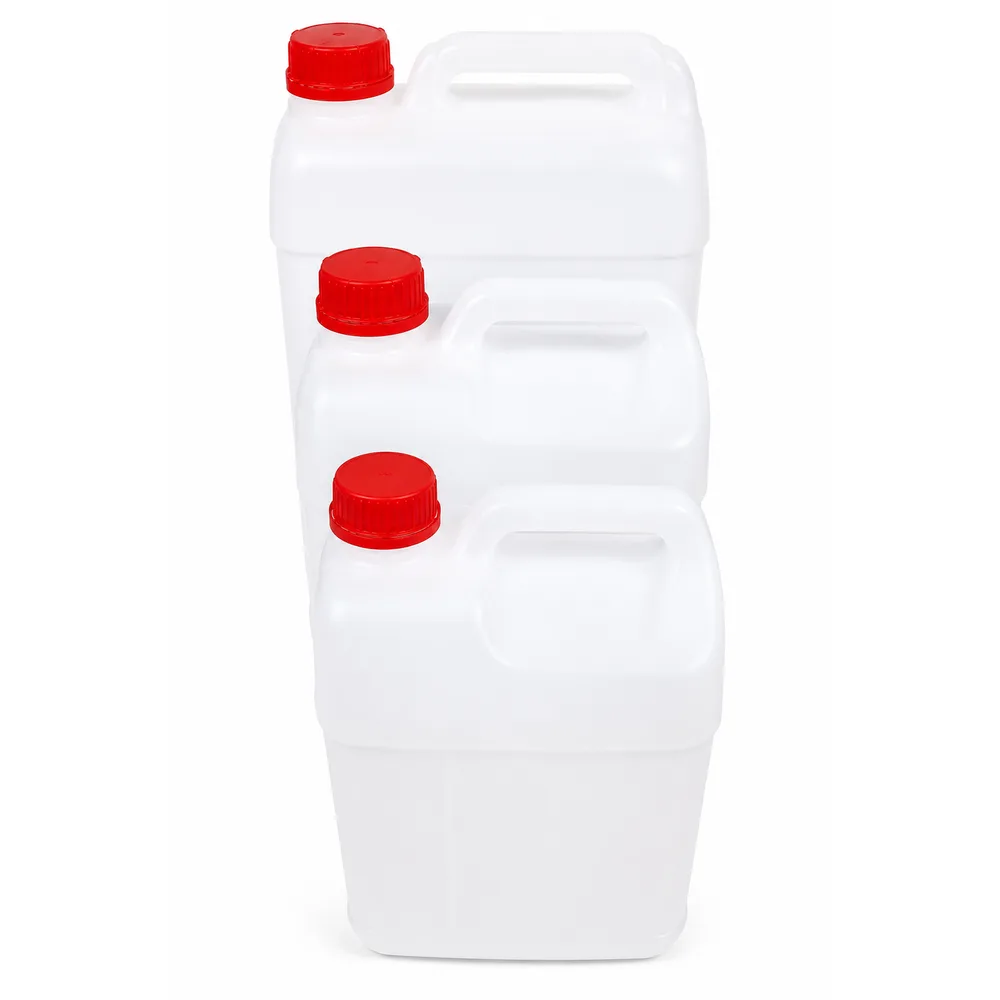 Food-Grade HDPE Jerrycan |
Natural food-contact HDPE; the declaration covers the cap and liner as well as the body. |
| Fuels, solvents and agrochemicals | 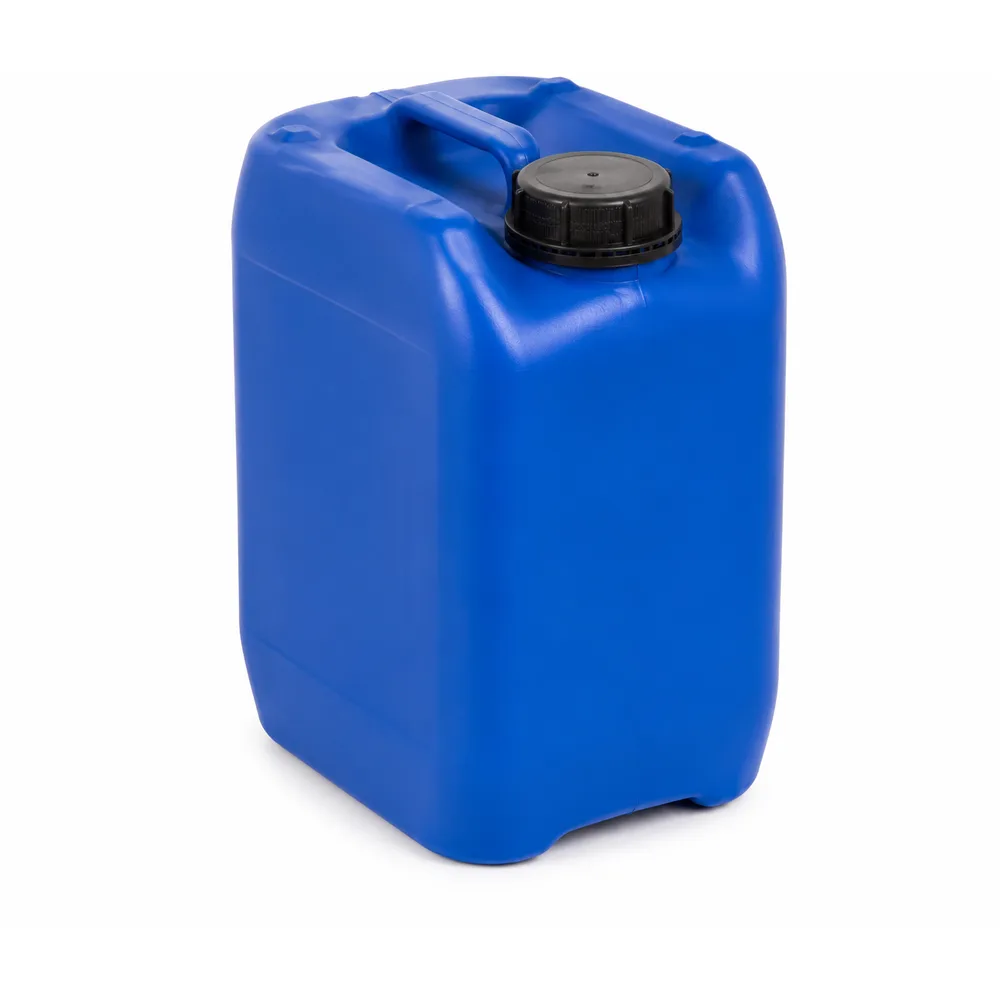 Fluorinated HDPE Jerrycan |
Fluorinated inner surface against the hydrocarbon permeation plain HDPE allows. |
| Pastes, oils and food, 2.5 to 20 L | 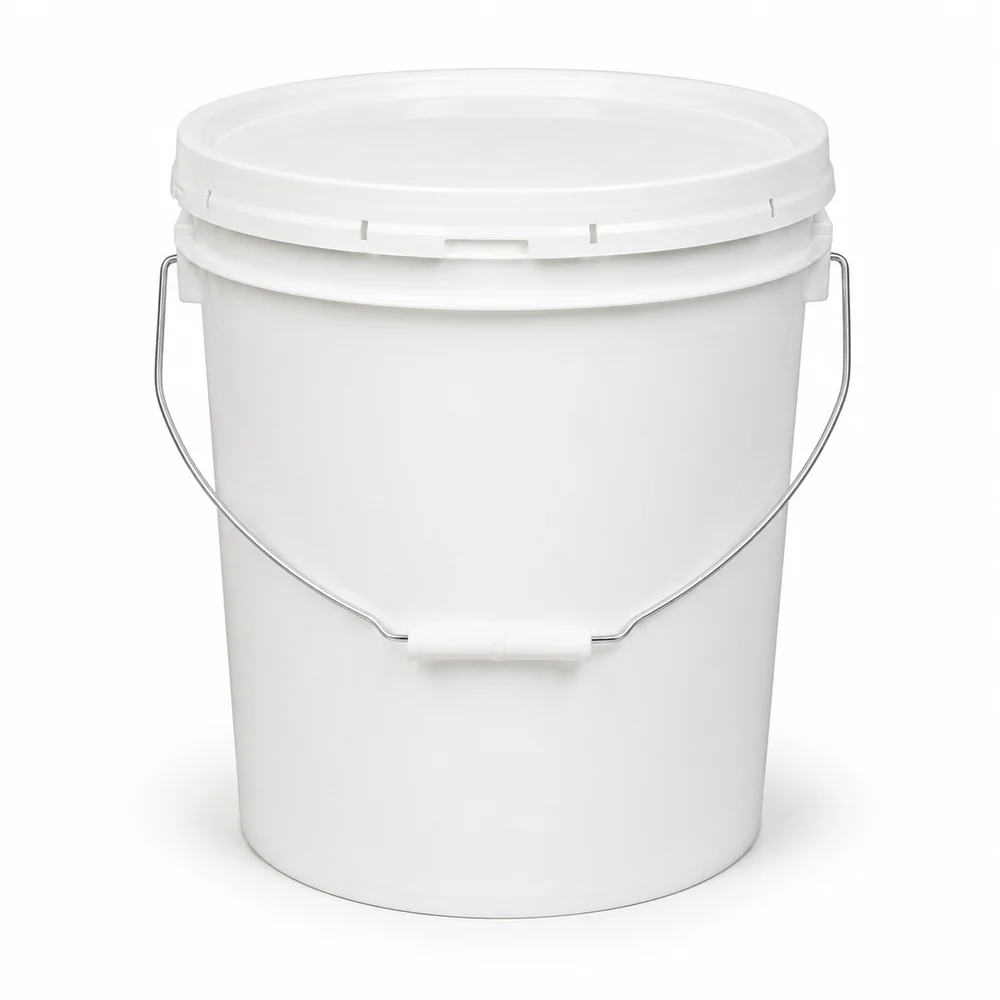 Round PP Bucket, 2.5L to 20L |
Injection-moulded virgin polypropylene in 18 sizes with a tamper-evident lid. |
| Pails that square off on a pallet | 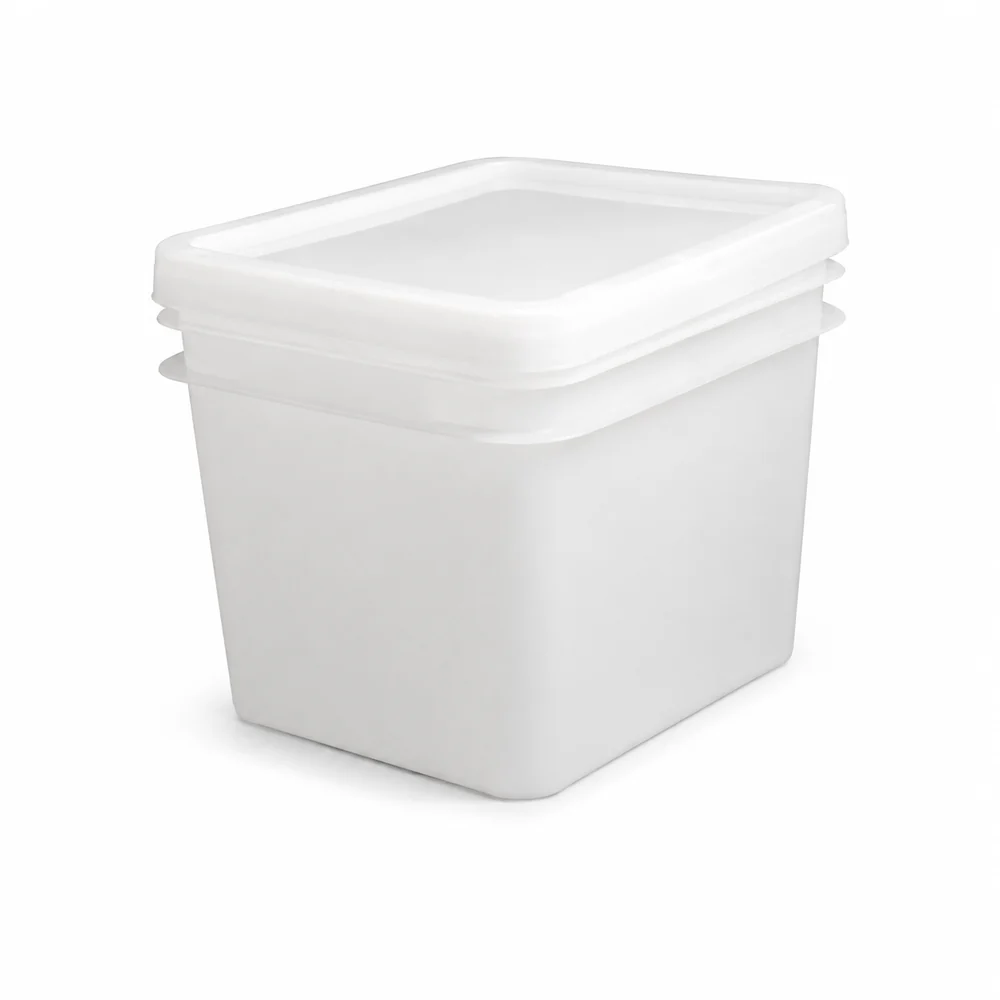 Rectangular & Square PP Bucket, 3.7L to 32L |
Polypropylene from 3.7 to 32 litres with flat faces for labels. |
| Non-hazardous liquids at volume | 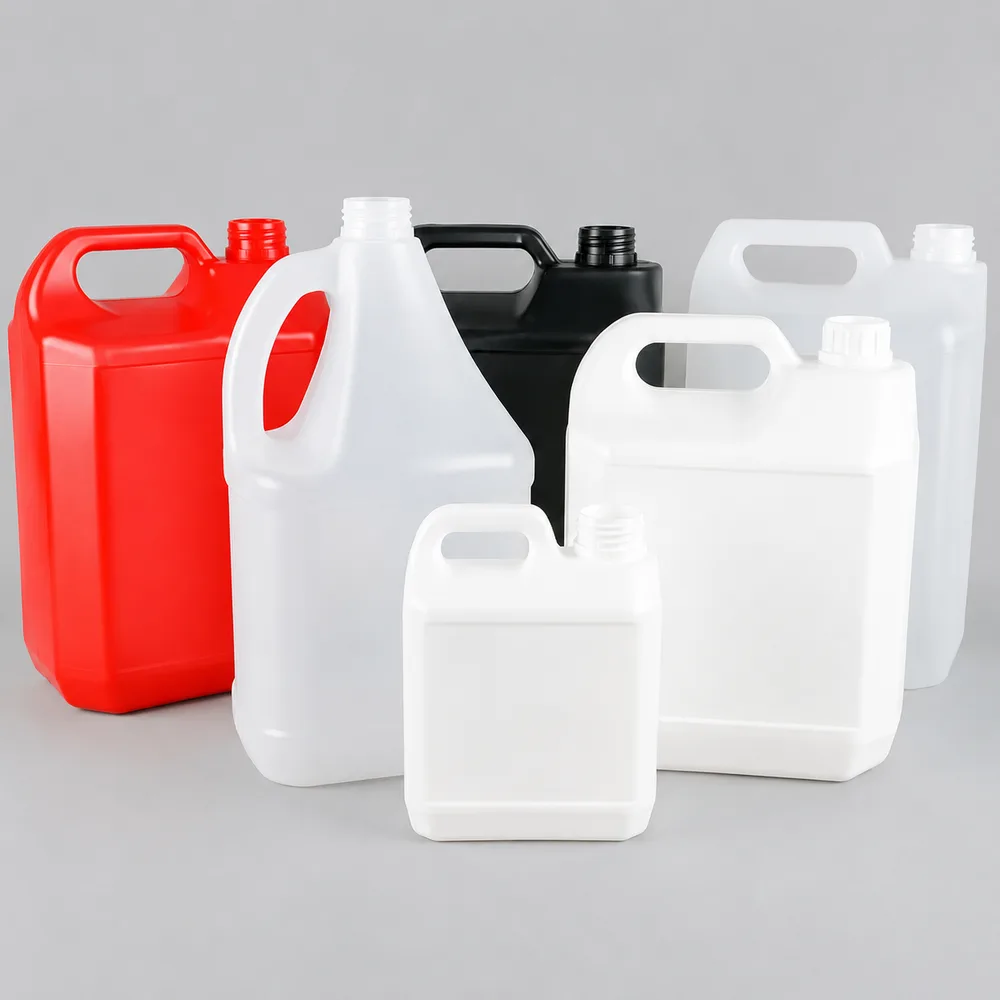 Economy HDPE Jerrycan — non-UN |
The same stackable HDPE body without a UN approval. |
For fuels and solvents, yes. Fluorination turns the inner surface into a barrier that slows hydrocarbons passing through the wall, while plain HDPE serves water and most water-based chemicals. ADR 2025 caps the permeability of plastic drums and jerricans for flammable liquids at 0.008 g per litre per hour at 23 °C (6.1.4.8.7). Keep food out of a fluorinated can; HDPE grades and fluorination explains the treatment levels and the PFAS question.
Density. MDPE is medium-density polyethylene, 926 to 940 kg/m³, the range ISO 10146:2019 quotes from ISO 17855-1. US federal rules count polyethylene above 0.940 g/cm³ as high density (40 CFR 60.561). Names and bands do not always line up: SCG sells rotomoulding grades at 0.938 and 0.939 g/cm³ as LLDPE, which puts them in the medium band. Read the density on the data sheet as well as the name.
We found no chart that rates the two apart. Both are polyethylene, and Thermo Fisher rates LDPE excellent or good with acids, alkalis and alcohols at 20 °C, fair with aliphatic hydrocarbons and not recommended with aromatic and halogenated solvents. For transport, ADR’s assimilation route applies to polyethylene packagings (4.1.1.21). Ask the resin maker for stress-crack data with your liquid, because a resistance chart cannot predict stress cracking, as the chemical compatibility guide explains.
Polypropylene, LDPE and HDPE float; PET and PVC sink. Water is about 0.998 g/cm³ at 21 °C (USGS). Polypropylene is 0.90, LDPE 0.92 and HDPE jerry can grades 0.948 to 0.956, while PET is 1.33 and rigid PVC 1.44. A full container is a different sum, because the contents count: HDPE properties works through a can full of water or acid.
Polypropylene takes the most heat. Thermo Fisher gives maximum use temperatures of 130 °C for polypropylene, 120 for HDPE and 70 for PETG, each for minutes to two hours. For food the declaration has to cover the fill. Regulation (EU) No 10/2011 defines hot fill as food at no more than 100 °C that cools to 50 °C within 60 minutes, or to 30 °C within 150 (Article 3(19)). See food-grade buckets.
Neither lasts without a stabiliser. Thermo Fisher rates natural HDPE poor and polypropylene and LDPE fair for UV resistance, and says long exposure damages all three. ADR 2025 requires a plastic jerrican to resist UV degradation, with carbon black, pigments or inhibitors where protection is needed (6.1.4.8.1 and 6.1.4.8.2). Ask whether the resin carries a UV stabiliser before a container stands outside; HDPE properties gives outdoor exposure figures.
Use a container made for petrol instead. INEOS rates polypropylene some attack from gasoline at 21 °C and unsatisfactory at 60 °C, where HDPE rates satisfactory at 21 °C. Plain HDPE still lets petrol vapour through the wall, so plastic fuel cans carry a fluorinated or barrier wall. Petrol is UN 1203; compare materials in steel vs HDPE fuel cans, and in Great Britain check the petrol container rules.
HDPS appears in neither the EU packaging code list nor the resin tables we read, so ask the supplier what it means. HIPS is high-impact polystyrene, which takes code 6 (PS) under Commission Decision 97/129/EC. Thermo Fisher gives HIPS a specific gravity of 1.04, a maximum use temperature of 90 °C and a brittleness temperature of 20 °C, against 0.95, 120 °C and −100 °C for HDPE. HIPS sinks and turns brittle below room temperature.
Yes, as a design type. ADR 2025 defines a drum as a flat-ended or convex-ended cylindrical packaging (1.2.1), so a removable-head plastic pail takes the code 1H2. Plastic drums are chilled to −18 °C or lower before the drop test (6.1.5.3.2), below the 0 °C at which Thermo Fisher finds polypropylene homopolymer brittle, and pail grades such as LyondellBasell’s Moplen EP500N are impact copolymers. See UN 1H2 and send us the contents.
Because HDPE resists sodium hypochlorite and the metals do not. INEOS rates concentrated sodium hypochlorite satisfactory in HDPE at 21 °C and still at 60 °C, where polypropylene shows some attack, and Thermo Fisher finds polypropylene slightly more susceptible to strong oxidising agents. Bleach attacks steel, stainless 304 and aluminium, so it belongs in plastic. HDPE also takes a cold drop better: Thermo Fisher calls polypropylene products brittle at 0 °C and gives minus 100 °C for HDPE.
Yes. HDPE is high-density polyethylene, a polymer made by the catalytic polymerisation of ethylene (21 CFR 177.1520(a)(2)(i)). Polyethylene is the family name, so HDPE vs PE compares one grade with its own family. US federal rules count polyethylene above 0.940 g/cm³ as high density and at 0.940 or less as low density (40 CFR 60.561). LDPE carries more side branching, packs less densely and stays flexible, where HDPE is semi-rigid.
Acetal, also called POM and sold as Delrin, is the denser plastic and the less tolerant of cold. Thermo Fisher's labware data give it a specific gravity of 1.42 to 1.61 against 0.95 for HDPE, so acetal sinks in water where HDPE floats. Both reach a maximum use temperature of 120 °C, but acetal turns brittle at minus 55 °C and HDPE at minus 100 °C. Every jerry can grade we read, from LyondellBasell, Chevron Phillips, Reliance and PTT, is HDPE.
The standards and regulations this page relies on, at their issuing body. Where a market rule is named here, check the current revision before you specify against it.
Last reviewed by David Guru, Co-Founder & Business Development Director.
Tell us your market, what the containers will hold and your volumes. We come back with a specification sheet and a quotation.