
What an NSF 61 listing proves, what the test leaves out, how it differs from NSF 372 and from food grade, and how to check one.
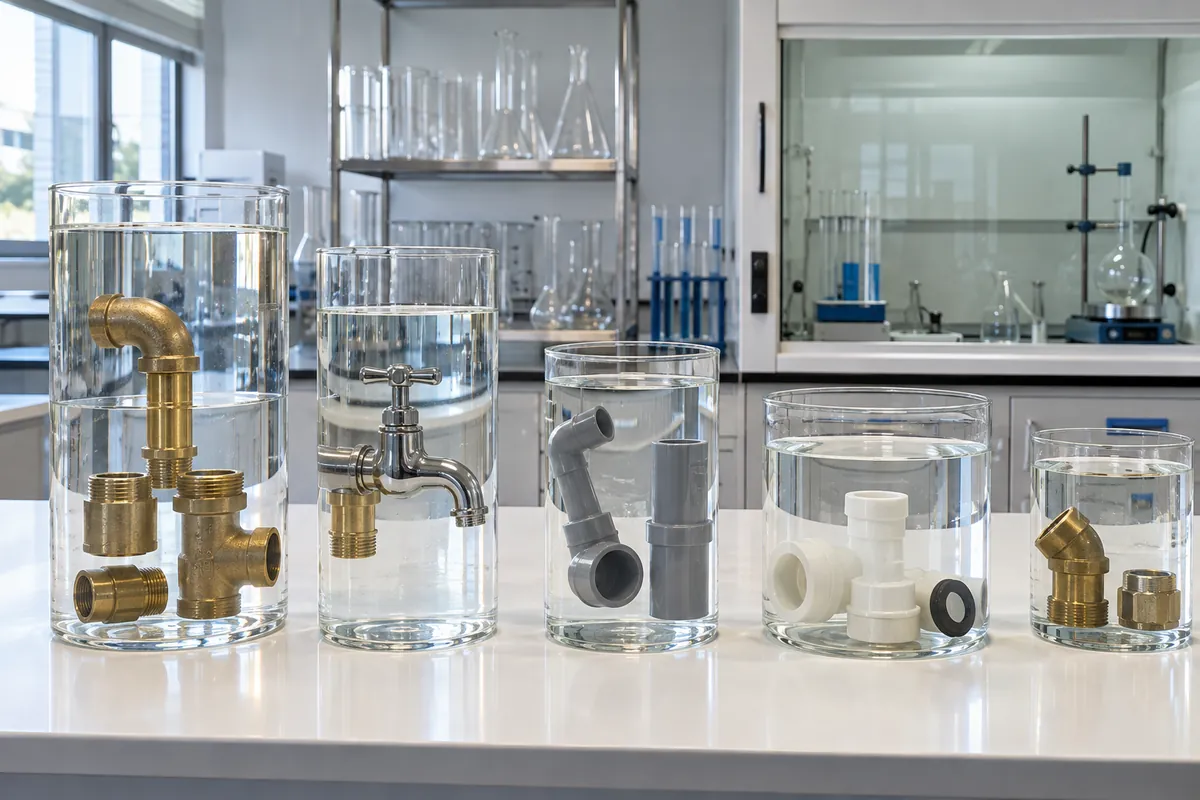
NSF/ANSI/CAN 61 is the North American health-effects standard for products that touch drinking water. A certified pipe, tank coating, seal or tap has been soaked in test waters, and what it released, scaled to the tap, stayed under health-based limits. It does not test taste, odour or microbial growth. Lead content sits in NSF/ANSI/CAN 372: a 0.25% weighted average, required within NSF 61 since October 2017.
Quick answer: What is NSF 61 certification?
It means an accredited certifier has reviewed the formulation, audited the plant, tested samples and listed that exact product as passing NSF/ANSI/CAN 61, the North American health-effects standard for drinking water parts. What the product released, scaled to the tap, stayed under health-based limits. Taste, odour and microbial growth fall outside it, and lead content sits in NSF 372.
NSF 61 certified means an accredited certifier has evaluated one specific product against NSF/ANSI/CAN 61, Drinking Water System Components: Health Effects, and lists it as passing. The standard sets minimum health requirements for chemicals that products, components and materials pass indirectly into drinking water (NSF/ANSI/CAN 61-2020, 1.1). NSF first adopted it in June 1988, at the request of the US Environmental Protection Agency.
The certification attaches to one product. It covers the formulation reviewed, made at the plant audited, for the use tested: cold or hot water, a size range and, for a coating, a set way of applying and curing it. “NSF 61 compliant” with no listing behind it is the maker’s own claim. The standard is voluntary until a regulator, a plumbing code or a buyer names it, and it leaves final acceptance to the regulator (1.4).
NSF 61 tests what a product releases into water; performance belongs to other standards. The certifier reviews the full formulation of every wetted material, picks the chemicals it could release, soaks samples in prepared test waters and measures what comes out (3.2, 3.3). The result is normalised: scaled from the laboratory’s surface-to-volume ratio to the one the product sees in service, to estimate the concentration at the tap (2.16).
The pass marks come from NSF/ANSI/CAN 600, formerly Annex A of NSF 61: a single product allowable concentration (SPAC) per contaminant, a total allowable concentration (TAC), and the US maximum contaminant level for regulated chemicals (2.21, 2.22). Taste, odour and microbial growth are outside the standard (1.1).
| Test condition | What NSF 61 specifies | Clause (2020 edition) |
|---|---|---|
| Metals | pH 5 and pH 10 waters, each with 2 mg/L free chlorine | Table N-1.3a, N-1.9.3, N-1.9.7 |
| Organic chemicals | pH 8 water with no chlorine added | Table N-1.3a, N-1.9.6 |
| Cold water use | 23 ± 2 °C | 4.2.1 |
| Domestic hot water | 60 ± 2 °C | 4.2.3 |
| Commercial hot water | 82 ± 2 °C | 4.2.2 |
| Pipe conditioning | 14 days at 23 °C, water changed at least 10 times | 4.5.5.1 |
| Tank coatings | Sample for analysis taken on day 5 | Table 5.2 |
| Taps and fountains | Day 19 result; at least 3 devices for lead | N-1.5.4 |
Most protocols hold water in the product for 12 to 24 hours at a time, and the 2020 edition’s foreword warns that water standing for weeks, in a rainwater tank or a school shut between terms, may carry more than the test predicts.
Yes, for products certified to an edition from October 2017 onwards, when NSF 61 began requiring compliance with NSF/ANSI/CAN 372 (US EPA, 2024). NSF 372 is the lead content standard: wetted surfaces may average no more than 0.25% lead, weighted by area, and solder and flux may hold no more than 0.2% (NSF/ANSI/CAN 61-2020, 3.6). It addresses content only, so most regulations pair it with a leaching test, usually NSF 61 (NSF, 372 technical requirements).
The 0.25% figure is US law. The Reduction of Lead in Drinking Water Act, signed on 4 January 2011, cut the federal limit from 8% lead in pipes to a weighted 0.25% across wetted surfaces. It took effect on 4 January 2014, each part counting by its share of the wetted area (40 CFR 143.12). Since 1 September 2023 manufacturers and importers must have products certified by an ANSI-accredited third party; firms with fewer than 10 employees, and custom-made products, may self-certify (40 CFR 143.19).
NSF 61 adds the lead leaching test that content alone cannot give. For taps and drinking fountains, the lead statistic Q in a 1-litre first draw could reach 5 µg; for products made from 1 January 2024 the limit is 1 µg, and 0.5 µg for supply stops and flexible connectors (9.5.1; Informative Annex 7).
US states, plumbing codes and water utilities require it; federal law does not. NSF reports that most state drinking water regulations require third-party certification of system components to NSF/ANSI/CAN 61. Washington, for one, applies it to every material in substantial contact with a public supply, such as filter media, tank interiors, distribution pipe and membranes (WAC 246-290-220(1)). The 2011 federal Act removed the old duty for plumbing fittings and fixtures to meet a voluntary lead leaching standard, which leaves leaching tests to states and codes (US EPA).
| Who sets it | What they require | Where |
|---|---|---|
| US federal law | Lead free: 0.25% weighted, 0.2% in solder and flux, third-party certified | 40 CFR 143.12, 143.19 |
| Plumbing code | NSF 61 for pipe, fittings, valves and tanks (605.3, 605.4, 605.5, 605.7, 608.12); Section 9 for taps and fountains (410.1, 412.1); NSF 372 for drinking-water pipe (605.2.1) | IPC 2021 |
| State rules | NSF 61 for materials in substantial contact with public supplies | e.g. WAC 246-290-220 |
| Canada | The same standard, designated a National Standard of Canada: the CAN in its name | NSF/ANSI/CAN 61-2020 |
NSF 61 sorts products into six sections, and a listing names the one a product passed. NSF 61-9 is shorthand for Section 9, the devices in the last litre of a building’s pipework; 61-8 means Section 8, the valves, meters and tanks in the line before them.
| Section | Covers | Examples |
|---|---|---|
| 4 | Pipes and related products | Pipe, fittings, tubing, hoses, well casings |
| 5 | Barrier materials | Coatings on pipes and non-residential tanks, liners, bladders, cement |
| 6 | Joining and sealing materials | Gaskets, solvent cements, solder, flux, lubricants |
| 7 | Process media | Ion exchange resin, filter media, adsorbents |
| 8 | Mechanical devices | Valves, water meters, pressure and expansion tanks, pumps |
| 9 | Mechanical plumbing devices | Taps, drinking fountains, supply stops, ice makers |
Each section lists exclusions too. Temperature and pressure relief valves, hose-thread valves and boiler feed valves sit outside Section 8 (Table 8.1); shower valves, drains and laundry or laboratory taps sit outside Section 9 (9.1.2).
The standard normalises a tank coating to the wall area a tank of a given size exposes per litre, from 40.4 in²/L at 5 gallons to 5.7 at 1,000 gallons (Table 5.6). A barrier that passed at one ratio covers that ratio or lower (4.1.2, note). The listing also fixes the primer, mix ratio, film thickness, cure time and cure temperature (5.3.2).
Most standards confused with NSF 61 answer a different question: performance, food contact or the pass marks themselves.
| Standard | What it covers | How it relates to NSF 61 |
|---|---|---|
| NSF/ANSI/CAN 600 | Health criteria: SPAC, TAC, short-term limits | The pass marks NSF 61 uses; formerly its Annex A |
| NSF/ANSI/CAN 60 | Treatment chemicals added to water | Sister standard; 61 covers what wetted surfaces add |
| NSF/ANSI 14 | Plastics piping: physical, performance and health | Potable-water products must also meet 61 |
| NSF/ANSI 42 and 53 | Filter claims: aesthetic (42) and health (53) | Point-of-use units are outside 61; point-of-entry units must comply |
| NSF/ANSI 62 | Distillation systems | A treatment-unit standard |
| NSF/ANSI 51 | Food equipment materials, reviewed against FDA rules | Food contact only |
| NSF H1 | Lubricants for incidental food contact, 21 CFR 178.3570 | A registration; lubricants in water fittings fall under 61 Section 6 |
| WRAS (UK) | Five BS 6920 tests on non-metallic materials | Adds taste, appearance and microbial growth |
WRAS overlaps most. Its five BS 6920 tests cover odour and flavour, appearance, growth of aquatic micro-organisms, cytotoxicity and extraction of metals (WRAS Material Guidance 4.4, section 6), and NSF 61 has no counterpart to the first three. A WRAS material approval lasts up to five years; an NSF listing is maintained each year. Neither replaces the other. See our WRAS approval guide and EU and UK drinking water contact.
No. NSF 61 covers contact with drinking water in a water system. US food contact is FDA law: 21 CFR parts 174 to 178 list the polymers, coatings and additives allowed to touch food, with polyethylene in 177.1520. NSF’s food standard is NSF/ANSI 51, based on FDA regulations and checked by formulation review; NSF 61 rests on EPA and Health Canada requirements and is checked by extraction testing (NSF, 51 and 61).
A gasket certified to NSF 61 has passed drinking water tests at a stated temperature, which says nothing about FDA rules for juice or oil. An FDA-compliant resin is not NSF 61 certified until the finished product is tested. For a part used in both a water system and a beverage machine, NSF recommends both. Our food-contact certification guide lists the documents for each market.
No material is NSF 61 approved as a class. Certification attaches to one compound from one maker, so an EPDM gasket, PVC pipe or brass valve counts only when that product is listed. Two EPDM compounds can differ in cure system, plasticiser and filler, which is what the formulation review looks for (3.3.1).
The standard does fix a minimum test list per material (Table 3.1). Brass: regulated metals plus zinc, nickel and bismuth, with lead content held to the 0.25% weighted limit (3.6). PVC and CPVC: metals, phenolics and solvents, with residual vinyl chloride monomer measured in the wall (4.3.2). EPDM: organic chemicals, phthalates where used, and nitrosamines if sulphur cured. Epoxy coatings: bisphenol A and epichlorohydrin, the resin’s building blocks.
Stainless steel comes closest to a blanket approval. Annex N-2 of the 2020 edition lists Types 304, 304L, 316 and 316L as acceptable materials up to 3,484 cm²/L (540 in²/L), qualified by tests on 30 samples from several makers. A product made only of them skips the material tests, but residues from the plant’s cutting, pressing and cleaning are still tested (3.4). See stainless 304 vs 316.
Apply to an accredited certification body, disclose everything, then hold the listing year by year. NSF lists seven steps: application; submission of formulation, toxicology and use information; review to set the tests; an on-site plant audit with sample collection; laboratory testing; technical evaluation; and certification, maintained annually. NSF writes the standard but is one of several certifiers: the EPA’s 2024 guide names eight ANSI-accredited bodies whose marks carry NSF/ANSI/CAN 61 or 372 text.
The submission gives the formulation of each wetted material to 100%, its wetted area, the volume held, the water seen in 24 hours and the maximum temperature (3.2). The tested sample must be the worst case: shortest conditioning, longest exposure, highest surface-to-volume ratio, highest temperature (3.1.4). One sample can cover a product line of the same material, process and design (4.4.1). Tell the certifier before changing a resin, a gasket compound or the plant: the listing covers what was reviewed.
Look the product up in the certifier’s own listing; a certificate PDF or a logo on a datasheet is not proof. NSF’s listing of drinking water system components searches by manufacturer, trade name, product type and plant location, and the EPA guide links every accredited certifier’s directory.
Check four things against your order: the exact model or compound; the use (cold, 60 °C or 82 °C); the size range; and, for a coating, the minimum tank or pipe size and the cure schedule. A 4-inch pipe listing does not cover half-inch pipe, because the smallest diameter in a range is usually the hardest to pass (4.3.1, note).
On the product, identifier text sits beside the certifier’s logo: NSF’s include NSF-61, NSF-372 and the legacy NSF-61-G. Taps certified to the lower lead limit show “NSF/ANSI/CAN 61: Q ≤ 1” on the packaging (9.5.1.1.2).
Usually not by law. The rules that name NSF 61 are written for public water systems and building plumbing, and none we found names a hand-filled carry can. In the US a portable container’s legal baseline is FDA food-contact law, such as 21 CFR 177.1520 for polyethylene. The standard does reach small vessels: its tank table starts at 5 gallons, about 19 litres (Table 5.6).
Some buyers name NSF 61 anyway, in emergency water tenders or a utility’s specification. Ask which section, which temperature, and whether a listed material is enough or the finished container must be listed. Annex N-2 steel does not make a stainless can certified: the cap seal is an elastomer with its own test list. The emergency water storage guide and the jerry can sizing calculator set quantities; stainless steel vs plastic water containers compares the materials.
Fortitude21 holds no NSF certification of any kind: none of our containers is listed to NSF/ANSI/CAN 61 or 372, and we hold no WRAS approval. We hold UN certification for our dangerous-goods jerrican designs, and our factories hold ISO 9001, 14001 and 45001.
For drinking water we make AISI 304 stainless cans in 5, 10 and 20 litres, pressed and welded with no internal lining, and natural food-grade HDPE jerrycans from 5 to 30 litres whose food-contact declaration covers the cap and liner as well as the body. If your specification names NSF 61, say so at enquiry and we will tell you what we hold for that design and market. See the water and food-grade range.
| Your use case | Recommended can | Why this one |
|---|---|---|
| Stored drinking water, refilled for years | 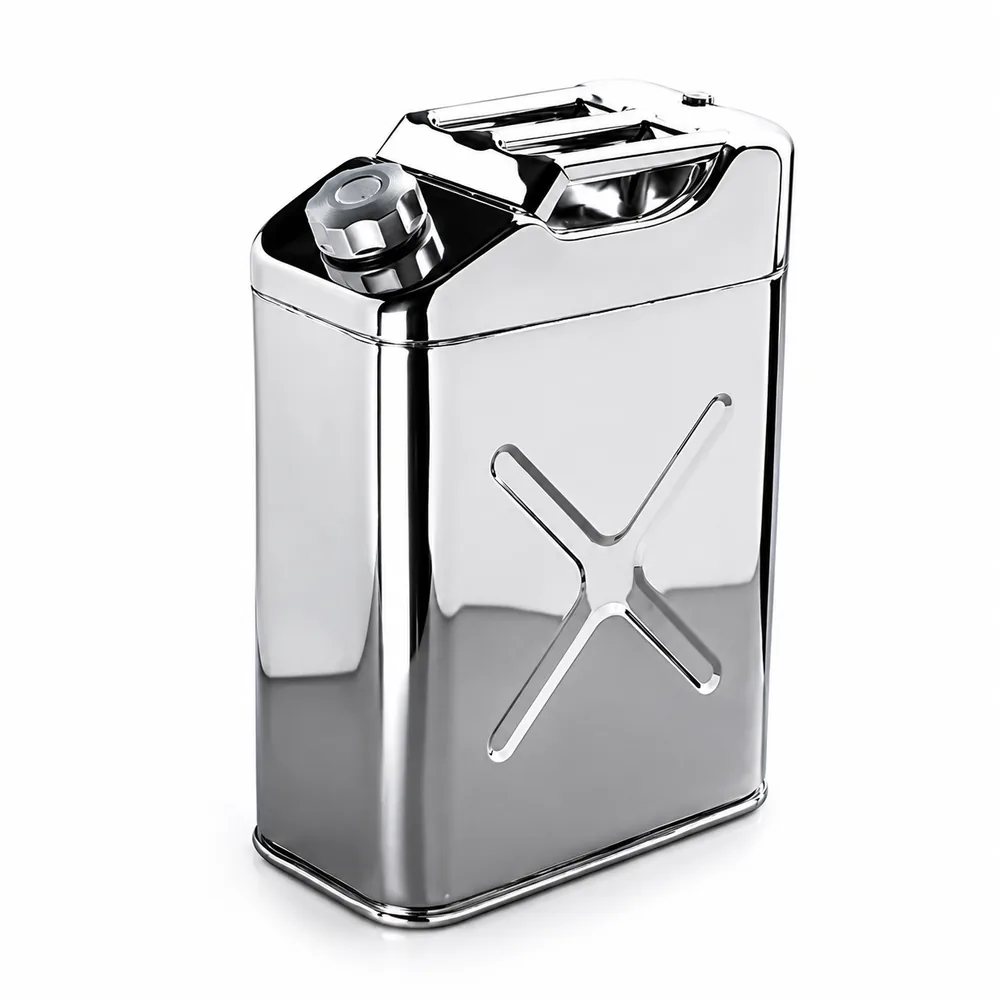 20L Stainless Steel Water Can |
AISI 304 body with no internal lining, food-contact grade with a mill certificate. Not NSF listed. |
| A lighter refillable can | 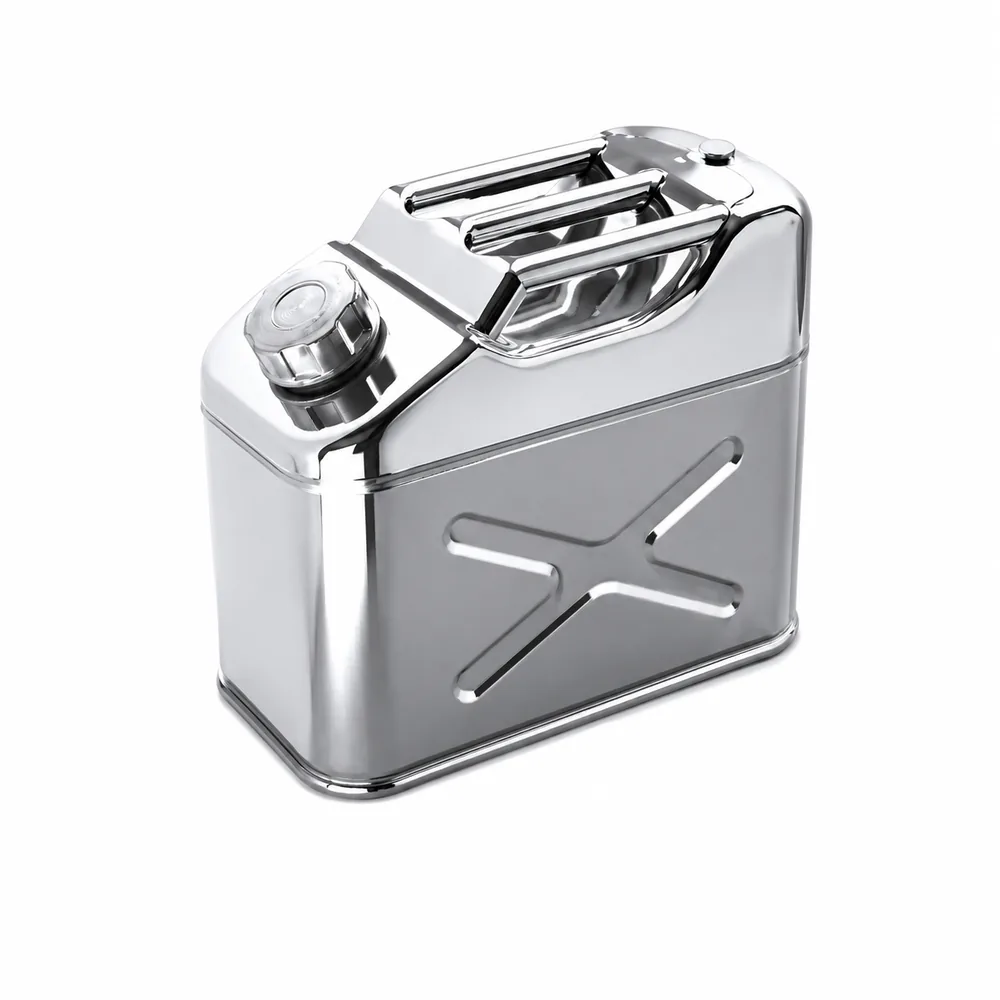 10L Stainless Steel Water Can |
The same 304 specification at about 13 kg filled. |
| Water that ships with the product | 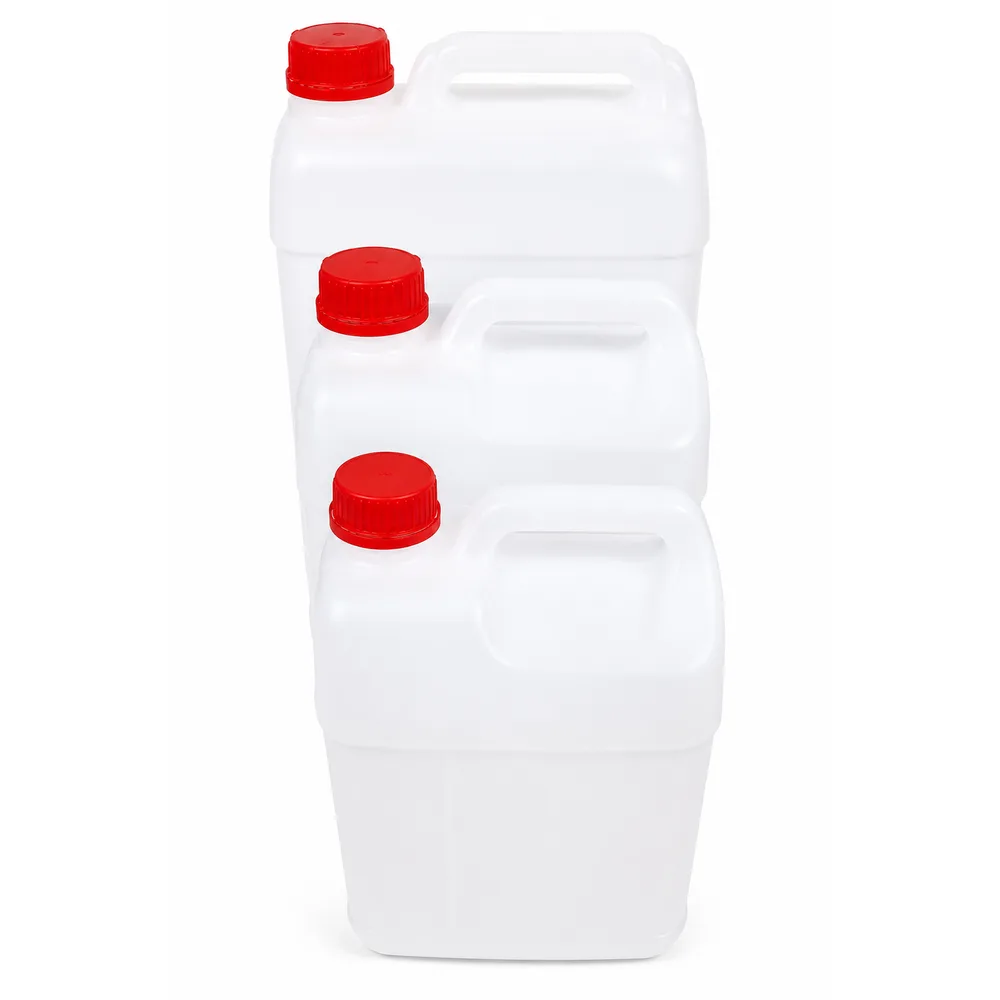 Food-Grade HDPE Jerrycan |
Natural HDPE, 5 to 30 litres; the food-contact declaration covers cap and liner. |
| Day use and samples | 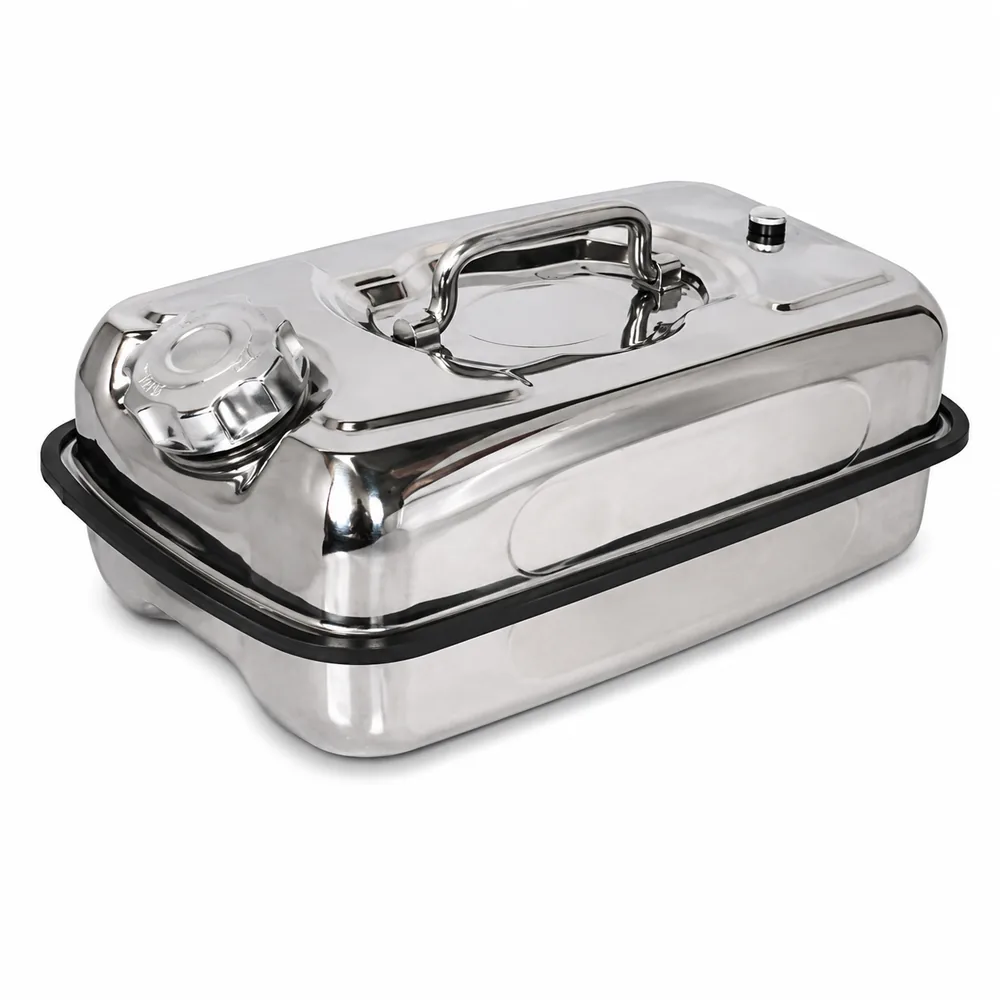 5L Stainless Steel Water Can |
The same 304 specification in the smallest size. |
NSF/ANSI/CAN 61 is the full name. NSF is the developer, ANSI marks it as an American National Standard and CAN as a National Standard of Canada. 61 is the standard’s number; its title is Drinking Water System Components: Health Effects. NSF began in 1944 as the National Sanitation Foundation, within the University of Michigan School of Public Health.
Certified means an accredited certifier has reviewed the formulation, audited the plant, tested samples and lists the product. Compliant is the maker’s own statement that the product would pass, with no listing behind it. NSF reports that most US state drinking water rules ask for third-party certification, so an inspector or a utility will ask to see the listing.
Yes, in the sense the standard defines: the chemicals a certified product releases, scaled to the tap, stay below health-based limits set in NSF/ANSI/CAN 600. It does not test taste, odour or microbial growth, and its 12 to 24-hour exposures can understate what builds up in water left standing for weeks. Stored water still needs turning over.
NSF 61-G marks a product certified to NSF 61 and to its Annex G, the 0.25% weighted-average lead content requirement that NSF 372 now carries. Annex G is retired, but the US EPA notes the text still appears on older stock, sometimes as NSF-61/9-G on taps. It confirms that both the leaching tests and the lead content were assessed.
It means the part passed Section 9 of NSF 61, which covers endpoint devices that dispense drinking water within the last litre of a building’s pipework: kitchen and bathroom taps, drinking fountains, water coolers, glass fillers and supply stops. Lead is judged on a 1-litre first draw, and since 1 January 2024 the lead statistic Q may not exceed 1 µg for most of these devices.
It means the pipe is listed with the certifier whose logo sits beside the text. The print line often adds the pipe standard, a pressure rating and the test temperature. Check the listing for the size you are buying: the smallest diameter in a range is usually the hardest to pass, so a listing for large pipe does not cover small pipe.
CPVC as a material is not; CPVC pipes and fittings are certified one product at a time. NSF 61 tests them for regulated metals, phenolics and solvents, for tin and antimony where those stabilisers are used, and measures the residual vinyl chloride monomer in the wall directly. Hot water pipe is tested at 60 °C or 82 °C, so match the listed temperature to your system.
Yes. Section 5 covers the constituents of concrete and cement mortar, including Portland and blended hydraulic cements, admixtures, sealers and mould release agents. Cement is tested for regulated metals, dioxins and furans, radionuclides and, where used as grinding aids, glycols and ethanolamines. Uncoated concrete in a storage structure of 1.33 million litres or more can skip testing when its admixtures are already compliant.
Not as a material. Neoprene is chloroprene rubber, and NSF 61 certifies individual compounds. Each is tested for organic chemicals, its own monomer (2-chloro-1,3-butadiene), phthalates where used, polynuclear aromatic hydrocarbons and, if the rubber is sulphur cured, nitrosamines. Ask the gasket supplier for the listing that names the exact compound and the water temperature it passed.
No. An epoxy is certified for the tank sizes, film thickness, cure time and cure temperature in its listing. A coating that passed at one wall-area-to-volume ratio covers that ratio or lower, which means larger tanks, never smaller ones. Cure it for less time, or line a smaller tank than listed, and the certification no longer covers the result.
NSF offers the 2016 edition free for educational use on its NSF/ANSI 61 knowledge-library page and sells the current edition through the NSF Standards Store. Regulators and public health bodies can ask NSF’s regulatory affairs team for a free copy. The free edition predates the 2017 lead change and the 2024 tap limit, so check any clause against the current text.
The laboratory exposures alone run from days to weeks. Tank coatings give their sample on day 5, pipe is conditioned for 14 days before its exposure starts, and taps give their result on day 19. A product with a borderline result can run a 90-day series. The formulation review, plant audit and evaluation come on top, so ask the certifier for its timetable.
The standards and regulations this page relies on, at their issuing body. Where a market rule is named here, check the current revision before you specify against it.
Last reviewed by David Guru, Co-Founder & Business Development Director.
Tell us your market, where the water will be stored and your volumes. We come back with a specification sheet, the food-contact documents for that market and a quotation.