
Food grade, taste, light, heat, cleaning, weight and cost, compared for AISI 304 and 316 stainless and food-grade HDPE.
Both materials can hold drinking water when the maker declares them for food contact. Food-grade HDPE costs less, and a 20-litre can weighs about 1 kg empty against about 3.8 kg for our 20-litre AISI 304 stainless can. Choose stainless for water kept in light, heat or long service, and HDPE for a cool, dark store you rotate.
In the EU, Regulation (EC) No 1935/2004 sets one test for every food contact material: in normal or foreseeable use it must not release constituents in amounts that endanger health, alter the food beyond what is acceptable or spoil its taste and odour (Article 3(1)). A can sold empty carries the words “for food contact” or the glass-and-fork symbol (Article 15). Plastics also meet Regulation (EU) No 10/2011: substances from its Union list, an overall migration limit of 10 mg per dm² of contact surface, and a declaration of compliance that states the foods and the storage time and temperature it covers (Annex IV, item 8).
Metals have no specific EU measure, so member states may set national rules; France requires at least 13% chromium in stainless steel for food contact. The Council of Europe guide Metals and alloys used in food contact materials and articles (EDQM, 2nd edition, 2024) has no legal force but serves as the reference, with release limits per kilogram of food such as 0.14 mg of nickel, 1 mg of chromium(III) and 0.55 mg of manganese. For an AISI 304 can, ask for the EN 10204 mill certificate and, where your market expects it, a release test.
In the US, 21 CFR 177.1520 clears polyethylene and polypropylene for food contact and caps what the resin gives up to solvents, at most 5.5% extractable in n-hexane at 50 °C for polyethylene outside cooking use. We found no matching 21 CFR section for stainless steel. Drinking-water approval is a further layer: NSF/ANSI/CAN 61 certification checks each product against health-effects criteria through a formulation review, a plant audit and testing, and is renewed each year. Our guides to food-contact certification and EU and UK drinking water contact list the documents to request.
Bisphenol A (BPA) concerns polycarbonate: Regulation (EU) 2024/3190 names polycarbonate among the plastics made with BPA and prohibits BPA in food contact materials, with transitional periods since corrected by Regulation (EU) 2026/250. HDPE is polymerised from ethylene (21 CFR 177.1520(a)(2)), and BPA is no monomer of it.
It can. In a 2007 Virginia Tech study (Water Research 41:757–764), a trained panel found a weak to moderate “waxy, plastic, citrus” odour in water left 72 to 96 hours in HDPE pipe, steady across repeated flushes; water from cPVC pipe had none. A Norwegian food-control study (Water Research 37:1912–1920, 2003) found 2,4-di-tert-butylphenol, a breakdown product of resin antioxidants, migrating from HDPE pipes, and odour at a threshold odour number of 4 or more in five of seven brands. Both tested pipe, so ask a container supplier for taste and odour data before long storage.
The 2007 study also found that HDPE pipe used up more of the water’s disinfectant than cPVC. Most people taste or smell chlorine well below WHO’s 5 mg/L guideline value, and some at 0.3 mg/L (WHO guidelines, chapter 10).
Sweden’s food agency, Livsmedelsverket, says water kept long and warm, in sunlight for example, can lose taste and smell and grow a slimy film of bacteria that live on sunlight, and tells households to store water dark and as cool as possible. CDC gives 10 to 21 °C (50 to 70 °F), out of direct sunlight, and the Water Supply (Water Fittings) Regulations 1999 require every storage cistern in England and Wales to have a cover that excludes light (Schedule 2, paragraph 16(4)(b)). A steel wall excludes light by itself. Natural HDPE, our food-grade jerrycan included, is translucent so you can read the level, which leaves the store to keep the light out.
Heat raises a paperwork question for plastic. In a Stanford-led study (Pediatrics, 2005), a dark saloon parked in sun on days of 22 to 36 °C warmed about 22 °C inside within an hour and reached at least 47 °C on the coolest day; earlier studies it cites recorded 57 to 68 °C on days above 30 °C. EU migration testing for plastics sets room temperature at 25 °C and covers storage beyond six months with 10 days at 60 °C (Regulation (EU) No 10/2011, Annex V, 2.1.4). We found no study of migration from an HDPE water can in a parked vehicle, so read the declaration: if it covers room-temperature storage, a can that lives in a vehicle sits outside it. WHO adds that warm water grows microorganisms faster, whatever the container.
Both materials grow biofilm, and coupon studies disagree on which grows more. A 2025 Polytechnique Montréal study (Chemosphere 376) ranked biofilm density from EPDM rubber through polypropylene, PVC and cross-linked polyethylene down to copper and stainless steel, while a 2010 Korean study (Water Science and Technology 61) found the highest biofilm potential on stainless and zinc-coated steel, with polyethylene also high. Rubber stands out twice: EPDM topped the Montréal ranking, and a 2004 German study found rubber-coated valves in water networks carrying massive biofilms that harboured coliform bacteria. On a water can that rubber is the cap gasket, so clean it each time you empty the can.
Livsmedelsverket warns against scratching a plastic can when you clean it, because scratches give bacteria a foothold, and reads slime, smell or taste that keeps returning as a sign the plastic is old or scratched and due for replacement. CDC’s sanitising method for storage containers, 1 teaspoon of unscented 5 to 9% bleach in 0.95 litres (1 US quart) of water shaken over every inside surface, applies to both. Rinse a stainless can with clean water afterwards: the UK stainless industry’s drinking-water code of practice accepts strong, short chlorine doses on condition that they are flushed away straight after. Our guide to cleaning and reusing jerry cans covers gaskets and inspection.
We found no rule that sets a service life for a water container, so dangerous-goods rules are the nearest benchmark. ADR 2025 requires plastics jerricans to resist ageing and UV degradation (6.1.4.8.1), using carbon black, pigments or inhibitors where UV protection is needed (6.1.4.8.2), limits their dangerous-goods use to five years from manufacture (4.1.1.15), and drop-tests them at −18 °C or colder (6.1.5.3.2). It sets none of the three for steel jerricans. Our stainless water cans use 0.8 mm AISI 304 at 10 and 20 litres and 0.7 mm at 5 litres, with no liner or coating to chip.
The ICRC buys its 20-litre rigid jerrycan in virgin food-grade HDPE, white or yellow, and checks that it survives two 1.5 m drops full of water. For plastic cans kept outdoors, ask whether the resin carries a UV stabiliser.
Our 20-litre stainless water can weighs about 3.8 kg empty, the 10-litre 2.8 kg and the 5-litre 1.9 kg; the ICRC specifies 1 kg (±5%) for its 20-litre HDPE jerrycan. Full, at about 1 kg per litre of water, the 20-litre stainless can weighs about 23.8 kg and the HDPE can about 21 kg.
HSE’s lifting filter for a load held close to the body between knuckle and elbow height is 25 kg for men and 16 kg for women (INDG143, Figure 1), and HSE applies it to carrying up to about 10 m. Both full 20-litre cans exceed 16 kg, while the 10-litre stainless can, about 12.8 kg full, sits inside both figures. In a vehicle, five 20-litre stainless cans weigh 14 kg more than five HDPE cans.
Chloride decides the grade. The code of practice for stainless steel in drinking water that the Steel Construction Institute wrote for the British Stainless Steel Association (2002) accepts 304 (1.4301) in flowing water below 200 ppm chloride and 316 (1.4401, with 2 to 2.5% molybdenum) up to 1,000 ppm. Where chloride can concentrate, as in a crevice, it gives conservative figures of 50 ppm for 304 and 250 ppm for 316. Water in a can stands still against the crevice under its gasket, so plan on the conservative figures. WHO puts the taste threshold for chloride at about 250 mg/L, so water that tastes salty sits near or above the conservative figure for 316.
For chlorine, the code accepts 304 up to 2 ppm in flowing raw water and gives 316 a greater margin. US tap water may carry up to 4.0 mg/L (the EPA maximum residual disinfectant level), so specify 316 if your supply or your own dosing runs above 2 ppm. The code assigns seawater to super duplex and super austenitic grades, beyond 316, and prefers 316 in salt-laden coastal air, with regular washing. Our 304 versus 316 guide explains the molybdenum, and the marine containers guide covers deck storage. A product-sheet line such as “compatible materials: stainless steel 304 and polyethylene” states chemical resistance and says nothing about food contact; our chemical compatibility guide rates materials liquid by liquid.
Price the can per year of service. If a stainless can costs three times a food-grade HDPE can of the same size, it pays its way once it outlasts three plastic cans: 15 years against plastic retired at ADR’s five-year dangerous-goods mark, or 3 years against plastic replaced each year for scratches and slime. Water rotation costs the same for both, since CDC says to replace stored water every six months.
The recycling figures favour steel, though the two measure different scopes. A Yale study for the Team Stainless industry group found 85% of stainless steel recycled at end of life in 2015. US EPA data put the 2018 recycling rate for HDPE natural bottles at 29.3%, and ASTM D7611 states that a resin identification code does not imply an article is recycled or that systems exist to process it.
| Use | Choose | Why | Watch for |
|---|---|---|---|
| Emergency store at home | Food-grade HDPE or 304 stainless | HDPE costs less and weighs about 1 kg per 20 L can; stainless blocks light | Keep it dark at 10–21 °C and replace the water every six months |
| Care home or business store | 10 L 304 stainless for water people carry; HDPE for bulk | A full 10 L stainless can, about 12.8 kg, sits inside HSE’s 16 kg filter | File the declaration of compliance and the mill certificate |
| Vehicle and overland | 304 stainless | Opaque, and cabin heat of 47–68 °C sits outside room-temperature test conditions | About 2.8 kg more per 20 L can than HDPE |
| Marine | 316 stainless, or HDPE stowed out of the sun | The code of practice prefers 316 in salt-laden air | Wash salt off the outside; seawater needs grades beyond 316 |
| Field and humanitarian | Food-grade HDPE | The ICRC buys 1 kg virgin food-grade HDPE cans, drop-tested at 1.5 m | Translucent walls: shade the store and retire scratched cans |
We make AISI 304 stainless water cans in 5, 10 and 20 litres and natural food-grade HDPE jerrycans from 5 to 30 litres. We supply the mill certificate for the grade, confirm which food-contact documents we hold for your market before you order, and quote 316 on the same designs for chloride-heavy or marine duty. If your market needs a national drinking-water approval or an NSF/ANSI/CAN 61 listing, name it at enquiry and we confirm whether the design holds it. Size the store with the jerry can sizing calculator or browse the water and food-grade range.
| Your use case | Recommended can | Why this one |
|---|---|---|
| A store kept in light, heat or a vehicle | 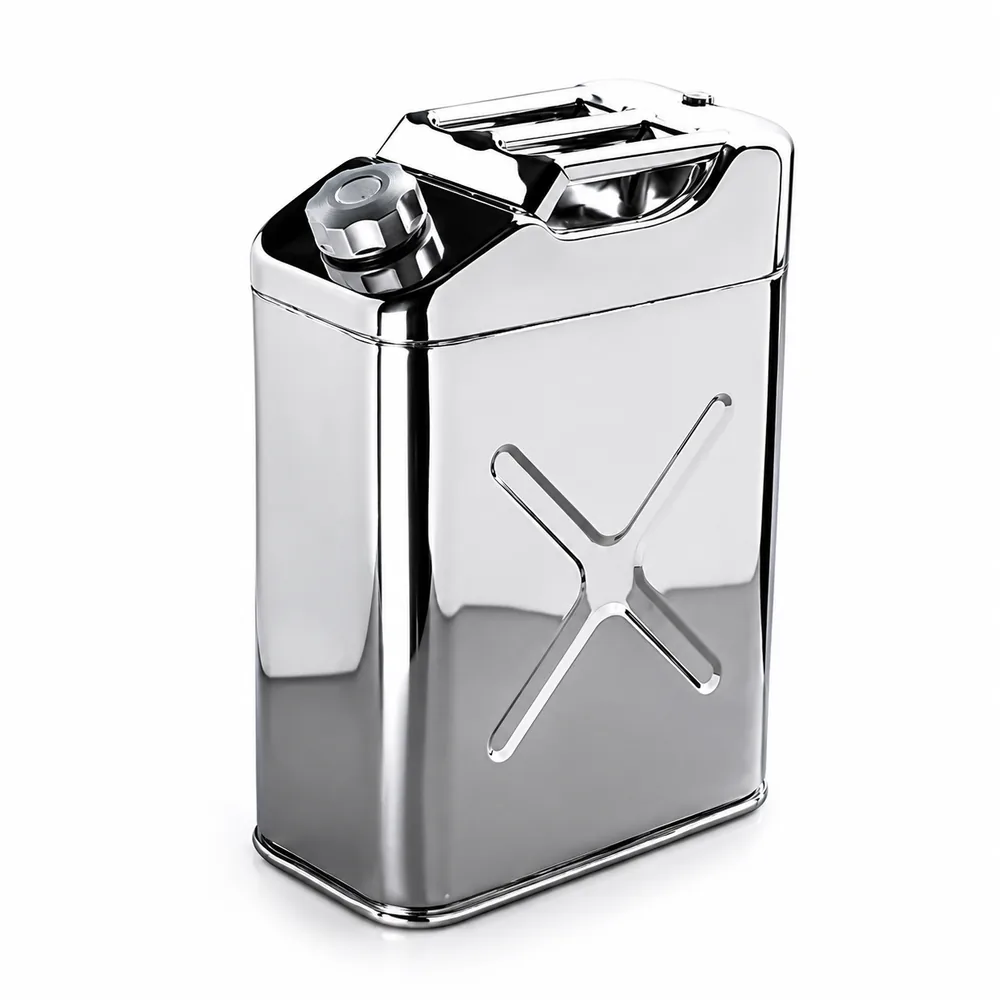 20L Stainless Steel Water Can 20L Stainless Steel Water Can |
AISI 304 with no liner, about 3.8 kg empty, and opaque, so no light reaches the water. |
| Water that people carry | 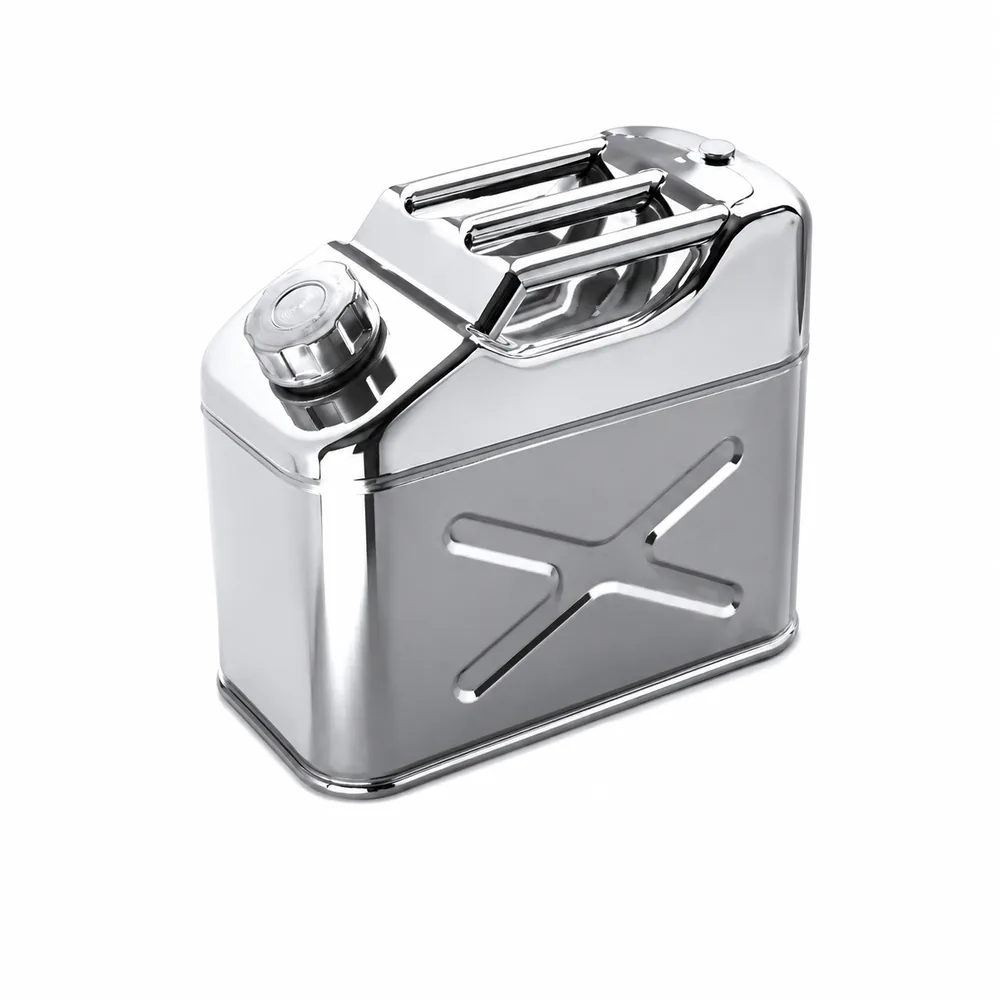 10L Stainless Steel Water Can 10L Stainless Steel Water Can |
About 12.8 kg full, inside the 16 kg HSE lifting filter for women. |
| A vehicle or grab-bag reserve | 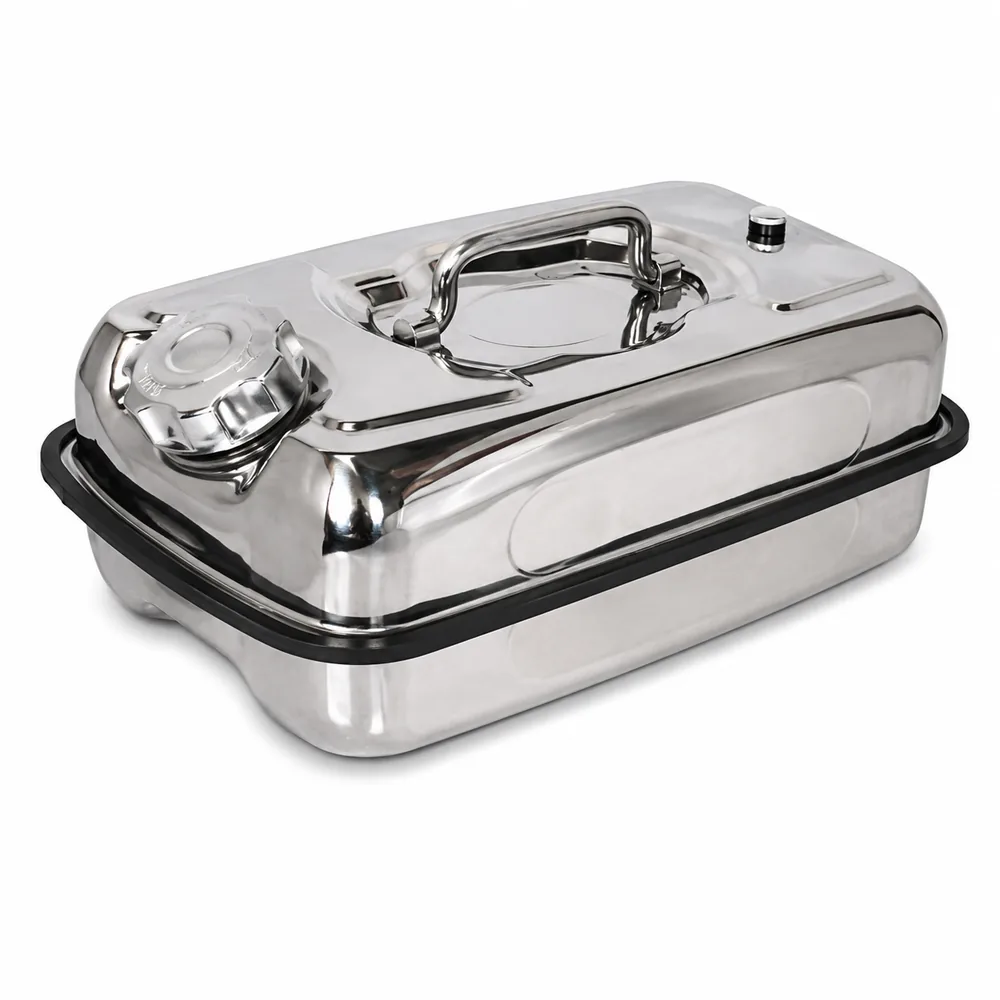 5L Stainless Steel Water Can 5L Stainless Steel Water Can |
About 1.9 kg empty in 0.7 mm AISI 304. |
| A cool, dark store or bulk distribution | 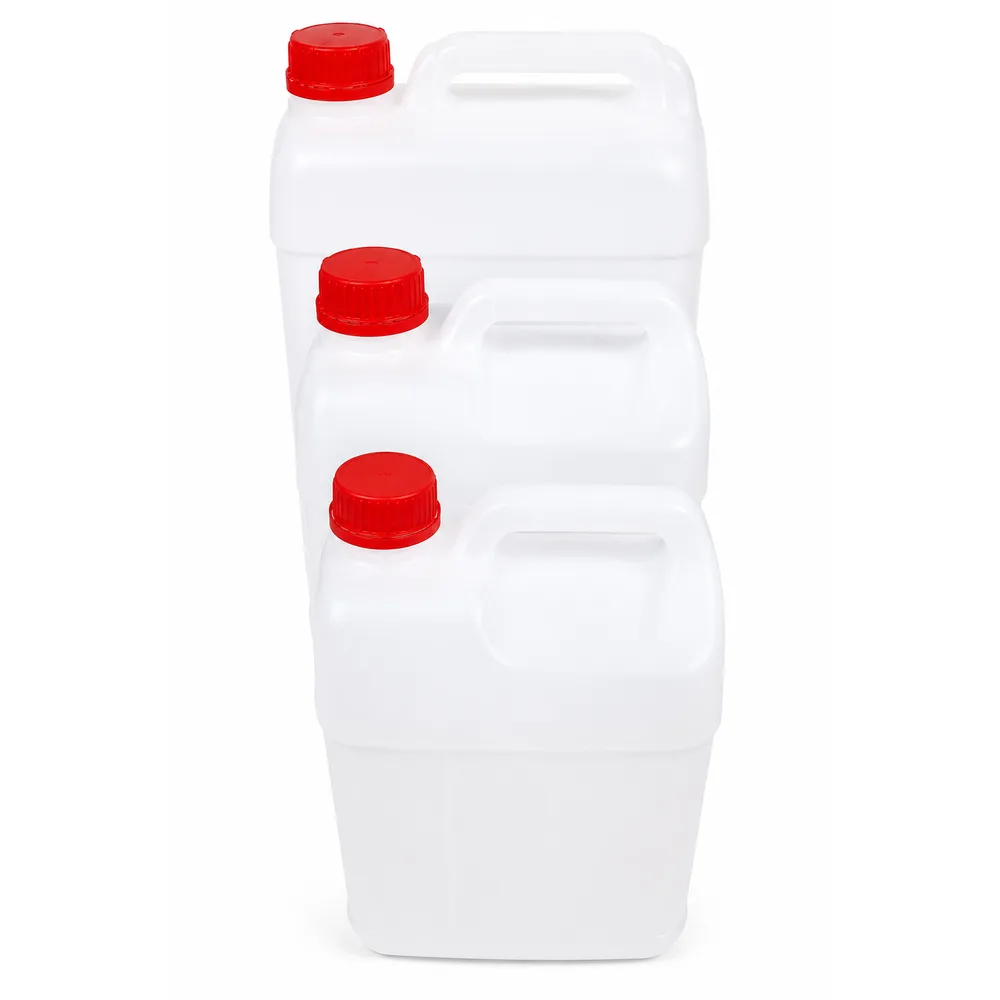 Food-Grade HDPE Jerrycan Food-Grade HDPE Jerrycan |
Natural food-contact HDPE from 5 to 30 litres; translucent, so keep it out of the light. |
| Drawing water without lifting | 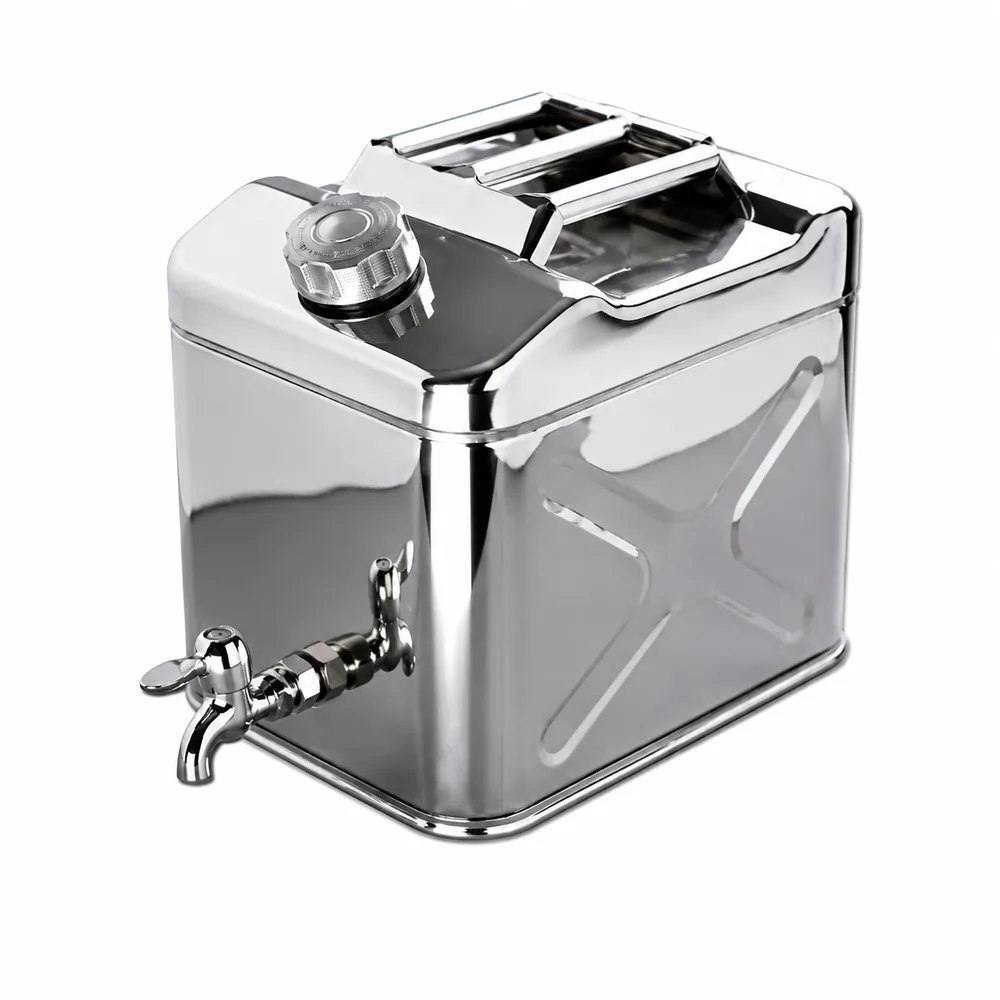 20L Stainless Dispensing Can with Tap 20L Stainless Dispensing Can with Tap |
A 20 litre stainless can with an integrated tap, for a static supply point. |
Both can hold drinking water when the maker declares the material for food contact. Food-grade HDPE costs less, and a 20 litre can weighs about 1 kg empty. Our 20 litre AISI 304 stainless can weighs about 3.8 kg, blocks all light and has no liner. Choose stainless for water kept in light, heat or a vehicle, and HDPE for a cool, dark store you rotate every six months.
It can. A 2007 study in Water Research found a weak to moderate waxy, plastic or citrus odour in water held 72 to 96 hours in HDPE pipe, and the odour persisted over repeated flushes. A 2003 Norwegian study traced odour from HDPE pipe to a breakdown product of resin antioxidants. Both studies tested pipe, so ask a container supplier for taste and odour data before long storage.
A parked car on a sunny day reached at least 47 °C inside within an hour in a 2005 Pediatrics study, and earlier studies recorded 57 to 68 °C on hotter days. EU migration tests for plastics treat room temperature as 25 °C. Check the storage temperature on the declaration of compliance, or use a stainless can for water that lives in a vehicle.
Choose by chloride. A UK code of practice for stainless steel in drinking water gives conservative limits of 50 ppm chloride for 304 and 250 ppm for 316 where chloride can concentrate, such as under a gasket. Use 316 for salty water, for water dosed above 2 ppm chlorine, and for cans kept in coastal or marine air. The same code assigns seawater to higher alloys than either grade.
Our AISI 304 stainless water cans weigh about 1.9 kg empty at 5 litres, 2.8 kg at 10 litres and 3.8 kg at 20 litres, so a full 20 litre can weighs about 23.8 kg. The ICRC specifies 1 kg for its 20 litre food-grade HDPE jerrycan, which makes stainless about 2.8 kg heavier per 20 litre can.
Bisphenol A is used to make polycarbonate and epoxy coatings, and EU Regulation 2024/3190 prohibits its use in food contact materials. HDPE is made by polymerising ethylene, as 21 CFR 177.1520 describes, and BPA is no monomer of it. For an HDPE can, ask instead for the food-contact declaration and for taste and odour data.
The standards and regulations this page relies on, at their issuing body. Where a market rule is named here, check the current revision before you specify against it.
Last reviewed by David Guru, Co-Founder & Business Development Director.
Use, volume, storage conditions and destination are enough for a first answer: 304 or 316 stainless or food-grade HDPE, the can size, the paperwork and a price.