
What the law asks of a bucket that touches food in the EU, UK and US, how to tell a food-grade bucket from a regular one, and the documents to ask a supplier for.
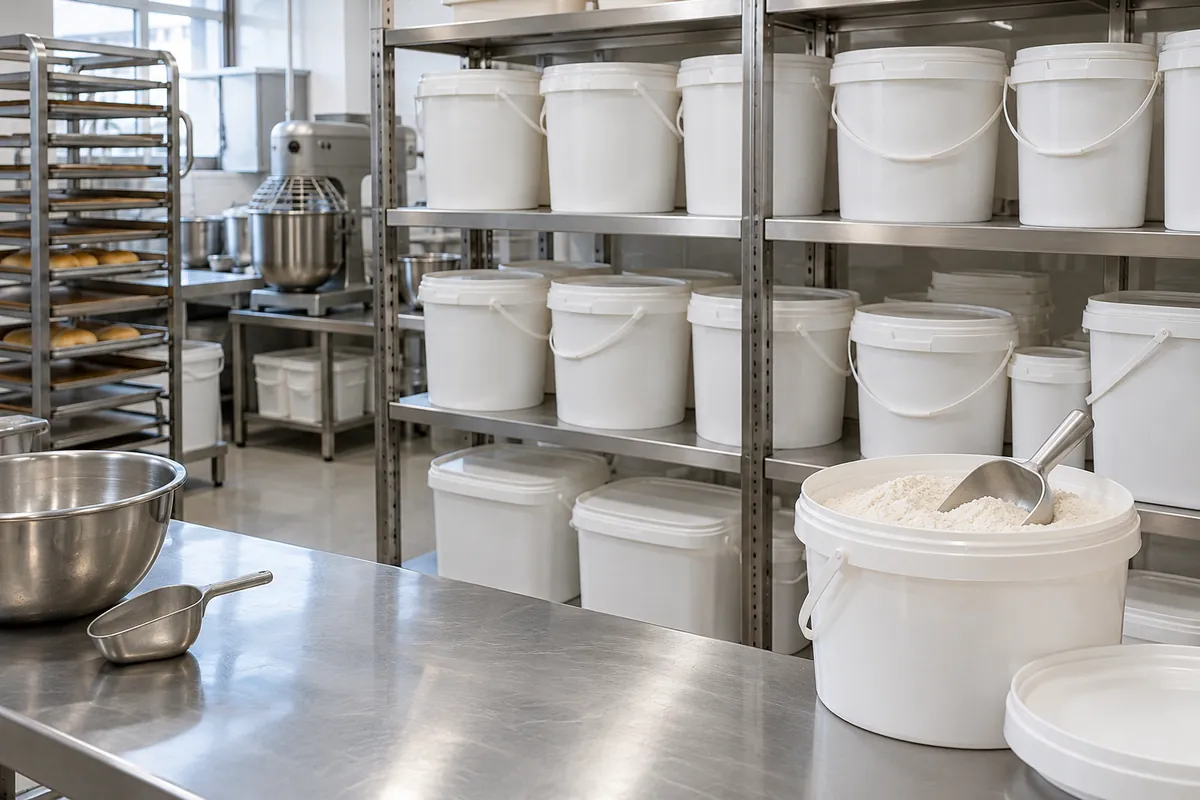
A food-grade bucket is one made from plastic authorised for food contact, moulded under good manufacturing practice, tested for what migrates into your food at your temperature, and backed by a written declaration of compliance. In the EU and UK the overall migration limit is 10 mg per dm² (Regulation (EU) No 10/2011, Article 12). Colour, the resin number and the words “food grade” prove none of it.
Quick answer: What makes a bucket food grade?
It takes four things: plastic and additives from an authorised list, a moulder with a documented quality system, migration tests within limits for your food, time and temperature, and a written declaration of compliance. Regulation (EU) No 10/2011 caps overall migration at 10 mg per dm² in the EU and UK. Colour and the resin number prove nothing.
Work it out
A container is food grade when it can hold food without passing its own constituents into that food in harmful amounts. Regulation (EC) No 1935/2004 sets the test in Article 3(1): made under good manufacturing practice, a food contact material must not transfer constituents in quantities that could endanger health, make an unacceptable change to the food or spoil its taste and smell, under normal or foreseeable conditions of use.
For a plastic bucket, four things have to line up. The polymer and its additives come from an authorised list; the moulder works under a documented quality system; migration tests show the finished bucket stays within limits for the food, time and temperature intended; and a written declaration says so. Miss one and the bucket may be new, clean and white, but nobody can show it is food grade. Our food-contact certification guide applies the same logic to cans, caps and taps.
The two can share a machine and a polymer; they differ in what goes into the hopper and the paperwork that comes out. Under Regulation (EU) No 10/2011, only the monomers and additives on the Union list in Annex I may be used on purpose in a food-contact plastic (Article 5), and colourants are left to national law (Article 6(2)). A general-purpose bucket can carry any pigment, processing aid or regrind the moulder has to hand.
Recycled content is the clearest dividing line. In the EU, recycled plastic may touch food only when it comes from a suitable recycling technology or a registered novel one (Regulation (EU) 2022/1616, Article 3), and the suitable technologies it names are mechanical PET recycling and product loops in a closed, controlled chain (recital 14). Polypropylene regrind from mixed post-consumer waste fits neither.
The plant matters as much as the pellet. Regulation (EC) No 2023/2006 requires the maker to run a documented quality assurance system, buy starting materials to set specifications and keep records of formulae and production for inspectors (Articles 5 and 7). That is what “food-grade facility requirements” means in law. The US rule is shorter: every component of a food-contact article must be “of a purity suitable for its intended use” (21 CFR 174.5(a)(2)).
Look for the words “for food contact”, a specific food use, or the glass-and-fork symbol. Regulation (EC) No 1935/2004 requires one of the three on a food contact article sold empty, unless its food use is obvious (Article 15(1)(a) and (2)), and allows them only on articles that comply (Article 15(9)). At retail the mark can sit on the bucket, its label or a notice beside the shelf (Article 15(7)). Between businesses, ask for the declaration of compliance, which Regulation (EU) No 10/2011 requires at every marketing stage before retail (Article 15(1)).
Three common signs prove nothing alone. The number in the triangle is a resin identification code, and ASTM D7611 states that it identifies the resin and nothing more (4.1): a 2 means HDPE and a 5 polypropylene, food grade or not. White is a pigment choice, so a white bucket is no more food grade than a blue one. A seller’s “food grade” with no document behind it is a description. A bucket with no mark, no label and no paperwork should be treated as a regular bucket.
Both polymers can be. Ethylene (FCM substance No 125) and propylene (No 275) are authorised monomers on the EU Union list, and 21 CFR 177.1520 clears polyethylene and polypropylene for food contact in the US. Each grade still needs its own evidence. For polypropylene, 177.1520 sets a density of 0.880 to 0.913 g/cm³, a melting point of 160 to 180 °C and no more than 6.4% extractable in n-hexane at reflux. Polyethylene outside cooking use may lose no more than 5.5% in n-hexane at 50 °C.
Our pails are injection-moulded polypropylene, with a food-contact grade specified per build; our food-grade jerrycans are blow-moulded from natural HDPE on a line kept clear of recycled regrind. A declaration covers the grade with its additives and pigment, so adding an unlisted colour masterbatch changes the material it describes. Neither polymer is made from bisphenol A. The HDPE properties guide covers heat, cold and UV, and HDPE grades and fluorination covers fuel and chemical grades.
Europe regulates in layers, and Great Britain kept the same text after Brexit.
| Market | Rules for a plastic bucket | What the buyer receives |
|---|---|---|
| EU, including Ireland | Regulation (EC) No 1935/2004 (framework); (EU) No 10/2011 (plastics); (EC) No 2023/2006 (manufacturing practice); (EU) 2022/1616 (recycled plastic) | Declaration of compliance to Annex IV of 10/2011; “for food contact” or the symbol at retail |
| Northern Ireland | EU food-contact rules, under the Windsor Framework | As for the EU |
| Great Britain | Assimilated 1935/2004, 10/2011 and 2023/2006, enforced in England by the Materials and Articles in Contact with Food (England) Regulations 2012; recycled plastic under assimilated Regulation 282/2008 | The same declaration, naming the assimilated rules |
| United States | 21 CFR parts 174 to 178; 177.1520 for polyethylene and polypropylene | A statement naming the 21 CFR sections, food types and conditions of use |
| Australia and New Zealand | Food Standards Code, Standard 1.1.1; AS 2070-1999 for plastic materials for food contact use | Ask which standard your customer works to |
Two recent changes reach buckets. Regulation (EU) 2025/351 amends 10/2011 for plastic food contact articles first placed on the EU market from 16 September 2026. Substances must be of high purity (new Article 8), a reusable article must be designed so migration does not rise over repeated use (Article 10(3)), and it must come with care instructions and a description of the signs of wear (Article 14a). EU changes made after Brexit do not reach Great Britain: the Food Standards Agency notes that the 2022 recycled-plastic regulation applies in Northern Ireland but not Great Britain.
No US regulation defines “food grade”. The legal question is whether every substance that can migrate from the bucket is cleared for that use. 21 CFR 174.5(d) lists five routes: generally recognised as safe in food, generally recognised as safe in packaging, a prior sanction, a regulation in parts 174 to 178, or an effective food contact notification. The FDA places the responsibility for compliance on the manufacturer of the food contact substance. A bucket sold as “FDA approved” should come with a statement naming the sections its resin and additives meet.
US clearances also carry conditions of use. 21 CFR 176.170(c) sorts foods into nine types, from non-acid aqueous products (Type I) to dry solids with free fat (Type IX). It sets conditions from A, heat-sterilised above 212 °F (100 °C), through E, filled and stored at room temperature, to G, frozen storage, with H for ready meals reheated in the container. Several 177.1520 clearances are limited by those tables, so the statement should name your food types and the highest condition of use.
A migration test proves compliance only for the use it matches. Regulation (EU) No 10/2011 tests food simulants in place of food: 10% ethanol (A) for aqueous foods, 3% acetic acid (B) for foods below pH 4.5, 20% ethanol (C), 50% ethanol (D1), vegetable oil (D2) for foods with free fat, and a synthetic polymer powder (E) for dry foods (Annex III, Table 1). Honey and sugar syrups go to simulant A, pickled vegetables and brines to B and C, and edible oils to D2 (Annex III, Table 2).
Time and temperature follow the same logic. Table 3 of Annex V sets the overall migration test by intended use: 10 days at 40 °C covers long-term storage at room temperature, hot fill included; 2 hours at 70 °C covers hot fill not followed by storage; 1 hour at 100 °C covers use up to 100 °C. Hot fill has a definition: food at no more than 100 °C when filled that cools to 50 °C within 60 minutes or 30 °C within 150 minutes (Article 3(19)). A full 20-litre pail of warm honey may cool slower than that, so give the supplier the real fill temperature and cooling time.
Size and reuse change the arithmetic. For containers over 10 litres, specific migration is expressed on a conventional 6 dm² of surface per kg of food (Article 17(2)), and a lid or gasket is assessed over the combined surface of closure and container where its use is known (Article 17(3) and (4)). A bucket sold for repeated use is tested three times on one sample and judged on the third result (Annex V, 3.3.2).
Ask for five documents in writing, each against the exact part number, lid included.
| Ask for | What it should state | Where the rule sits |
|---|---|---|
| Declaration of compliance | The bucket and lid, the regulation, the food types, the time and temperature, and the surface-to-volume ratio used | 10/2011, Article 15 and Annex IV |
| Migration test summary | Simulants and test conditions that match your food; the overall result against 10 mg/dm² | 10/2011, Article 12, Annexes III and V |
| Lid, gasket and tap | Each closure named in the declaration or covered by its own | 10/2011, Article 17(3) and (4) |
| Recycled content | Virgin resin, or the authorised process and its register entry | 2022/1616, Article 3 |
| US statement | The 177.1520 item for the resin, the additive clearances, food types and conditions of use | 21 CFR 174.5(d), 176.170(c) |
A declaration must be renewed when a change in composition or production alters migration (10/2011, Article 15(3)), so a new resin supplier or a new colour should bring a new one. For dangerous goods the bucket also needs a UN-approved design; see UN approval and food contact for pails and tins.
For stored drinking water, food grade is the starting point and the closure matters as much as the plastic. The US CDC advises food-grade containers with a tight top and, where possible, a narrow neck, warns against any container that held toxic chemicals, and says to replace stored water every 6 months. An open-head bucket fails the narrow-neck test, which is why our emergency water storage guide points to jerry cans; the jerry can sizing calculator turns people and days into containers.
NSF/ANSI/CAN 61 answers a different question: it covers products that touch drinking water in a water system. An NSF 61 listing is no food-contact clearance, and a food-contact declaration is no NSF 61 listing; our NSF 61 guide sets out the difference. Regulation (EC) No 1935/2004 excludes fixed public or private water supply equipment (Article 1(3)(c)), which the UK handles through WRAS and Regulation 31 and the EU through its drinking water positive lists. For the material choice, see stainless steel vs plastic water containers.
Wash with soap and water, rinse, sanitise and air-dry. The CDC method for water containers mixes 1 teaspoon of unscented household bleach containing 5–9% sodium hypochlorite into 1 quart (about 1 litre) of water. Close the container, shake so the solution wets every inside surface, wait at least 30 seconds, pour it out and let the container air-dry before filling. In a 20-litre bucket, make up enough to wet the walls and the underside of the lid.
A bucket that held paint, solvent or a chemical never returns to food, whatever the cleaning, and one that keeps a smell after washing should be retired; our guide to cleaning and reusing containers sets out why. Read the supplier’s care sheet before setting a routine: under Article 14a of 10/2011, a reusable plastic food article sold in the EU now has to come with one. Check your detergent against the plastic in the chemical compatibility guide.
We make open-head polypropylene buckets in three lines: round pails from 2.5 to 20 litres in 18 sizes, rectangular and square pails from 3.7 to 32 litres, and regional and specialty formats including a 20-litre screw-lid bucket and a 30-litre fermentation bucket with an airlock grommet. All are moulded in virgin polypropylene, and the round and rectangular lines carry a tamper-evident tear band as standard. A food-contact grade is specified per build, with a declaration naming Regulation (EC) No 1935/2004 and Regulation (EU) No 10/2011, or 21 CFR 177 for the US. See the pails and buckets range.
For water and liquid food we make natural food-grade HDPE jerrycans from 5 to 30 litres, whose declaration covers the cap and liner as well as the body, and AISI 304 stainless water cans with no internal lining; see the water and food-grade range. We hold UN certification for our dangerous-goods jerrican designs, and our factories hold ISO 9001, 14001 and 45001. We hold no NSF/ANSI/CAN 61 listing, no WRAS approval and no EU drinking-water positive-list approval. Tell us the food, the fill temperature and the market, and we tell you which declaration covers that build.
| Your use case | Recommended can | Why this one |
|---|---|---|
| Honey, sauces, oils and dry food, 2.5 to 20 L | 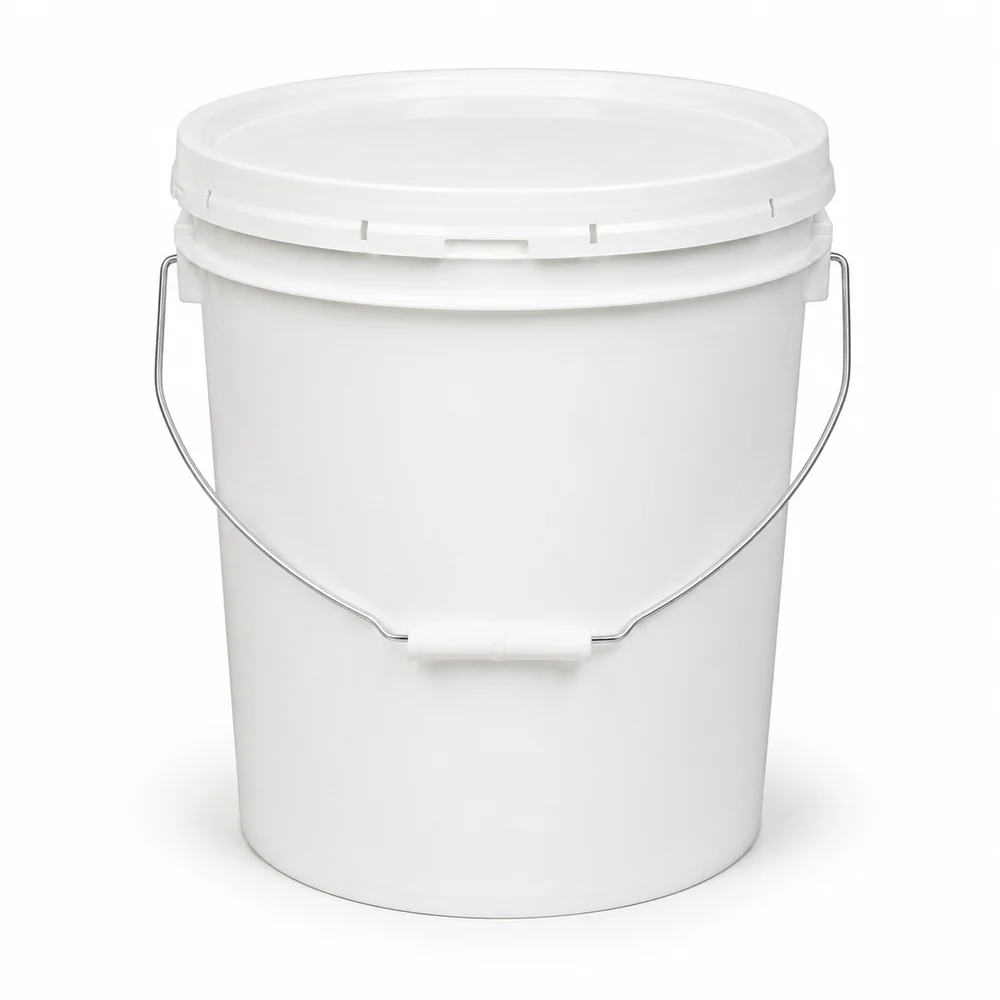 Round PP Bucket, 2.5L to 20L |
Virgin polypropylene in 18 sizes with a tamper band; food-contact grade specified per build. |
| Square pails that pack tight on a pallet | 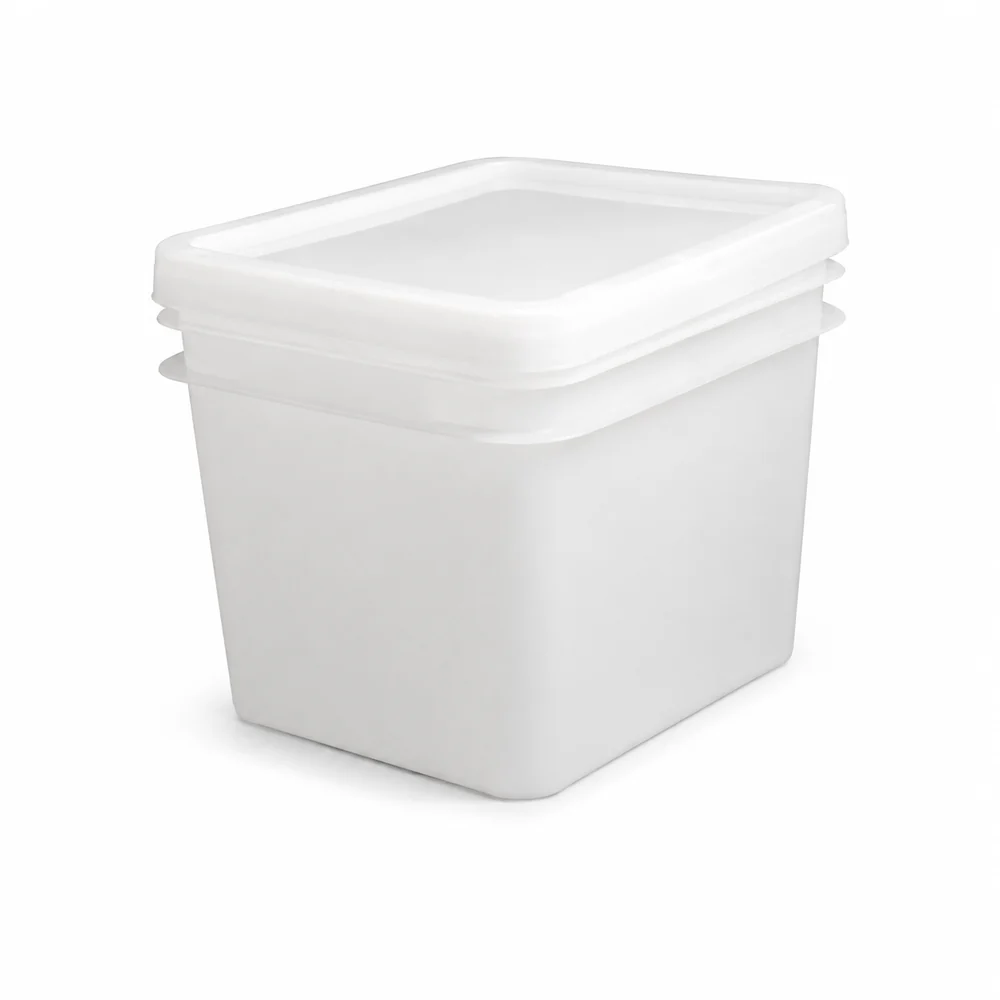 Rectangular & Square PP Bucket, 3.7L to 32L |
The same closures and tamper band as the round line, from 3.7 to 32 L. |
| Screw-lid, fermentation and regional 20 L formats | 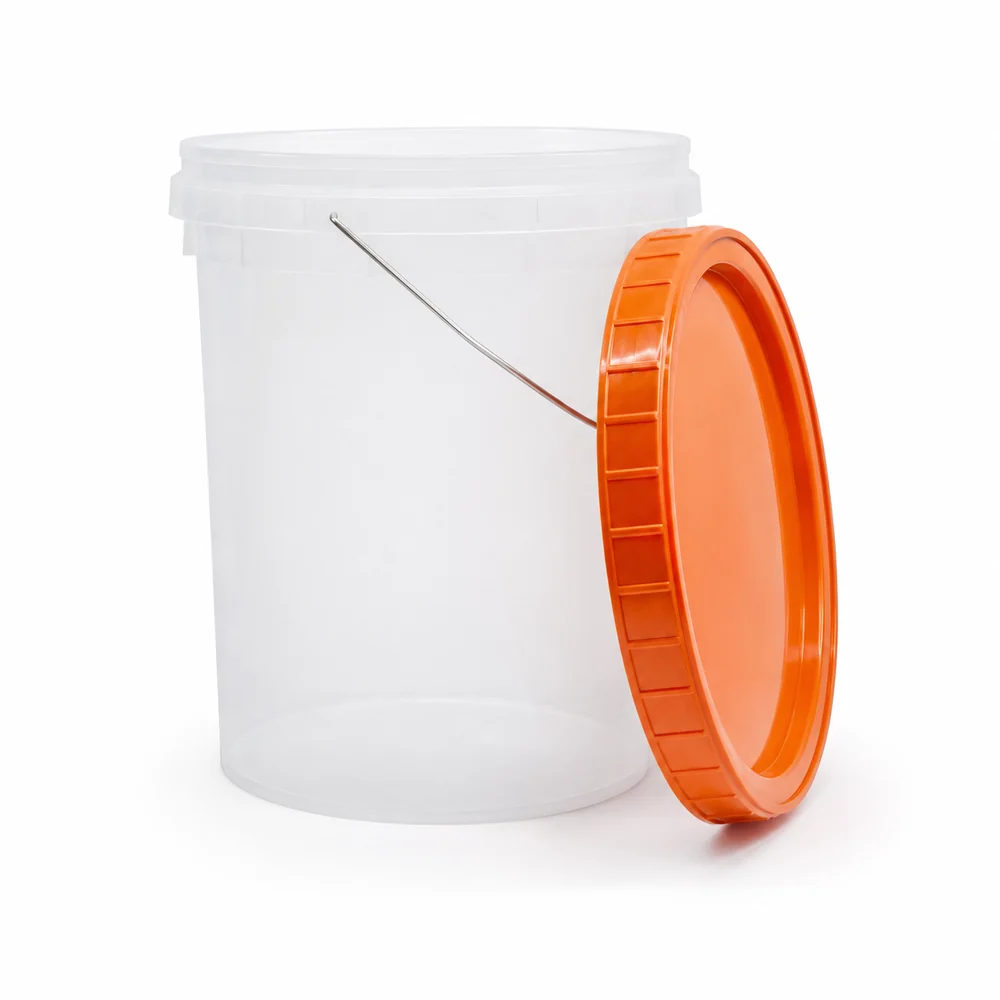 Regional & Specialty PP Buckets |
The screw lid reseals for products opened again and again; the 30 L takes an airlock. |
| Water and liquid food that ships out | 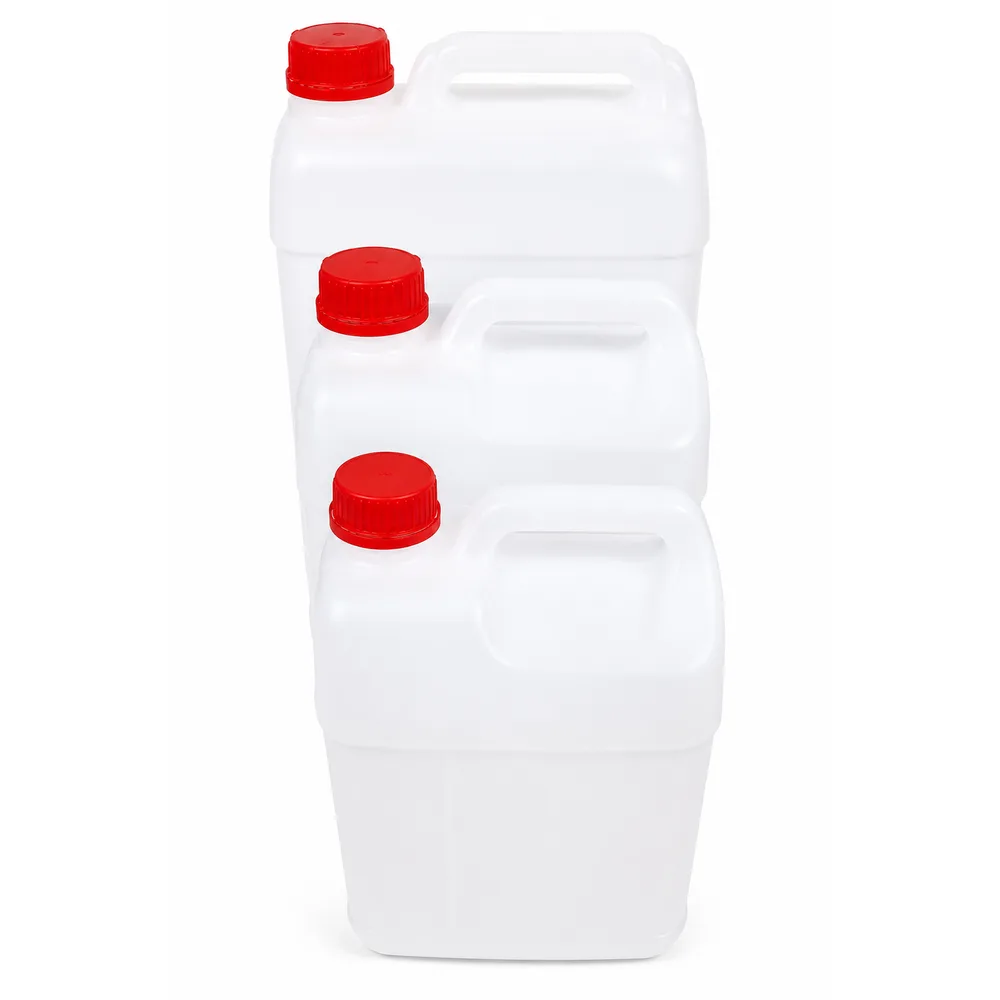 Food-Grade HDPE Jerrycan |
Natural HDPE, 5 to 30 L; the declaration covers the cap and liner as well as the body. |
| Drinking water kept and refilled for years | 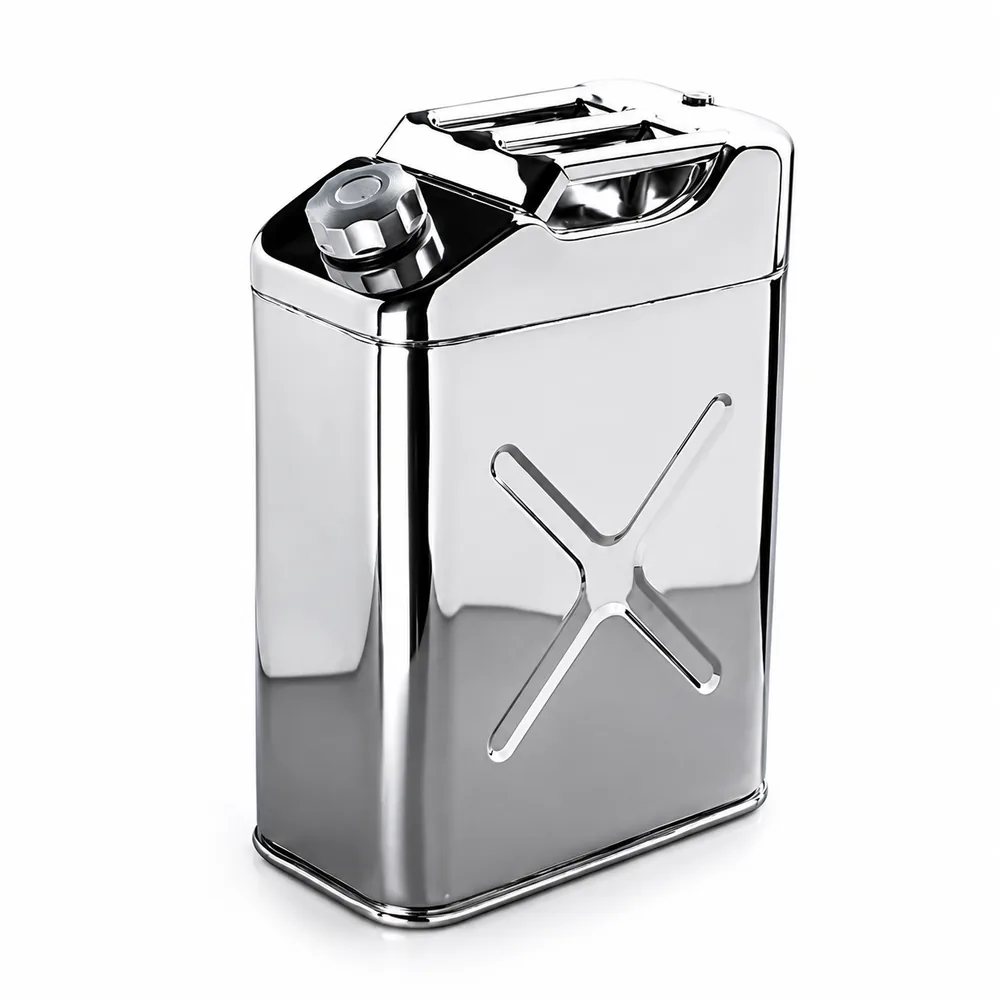 20L Stainless Steel Water Can |
AISI 304 with no lining; mill certificate on request. Not NSF or WRAS listed. |
Only when they are sold as such. A general-purpose bucket for paint, plaster or cleaning carries no food-contact claim, and its resin number and colour cannot supply one. In the EU and UK, a bucket sold empty for food must carry the words “for food contact”, a specific food use or the glass-and-fork symbol, on the bucket, its label or a shelf notice. In the US, look for a label or maker’s statement naming 21 CFR 177.1520.
Bisphenol A is no building block of polypropylene or HDPE. It is used to make polycarbonate and the epoxy resins behind can coatings, while 21 CFR 177.1520 describes polypropylene as polymerised from propylene and polyethylene from ethylene. Regulation (EU) 2024/3190 prohibits BPA in the manufacture of food contact materials (Article 3). A “BPA free” label on a PP bucket is true, and it says nothing about the rest of the bucket’s food-contact compliance.
No food-contact rule measures particles. The migration limits in Regulation (EU) No 10/2011 and the extraction limits in 21 CFR 177.1520 cover chemicals that move into food. Retire a bucket whose wall is scored, crazed or clouded: since September 2026 the EU requires reusable plastic articles to come with a description of the signs of wear. WHO’s 2019 review found no apparent health risk from microplastics in drinking water at the levels measured, and called the data limited.
Food grade describes what the plastic releases into food, and says nothing about the seal. A snap-on lid closes tight once seated, but in practice it is a one-use seal: prising it off strains the rim. A screw lid reopens and reseals by hand, which suits flour, grain or a product used over weeks. For fermentation, a lid with an airlock lets gas out without letting air in. Check the lid gasket is named in the declaration, since it touches the food too.
NSF H1 is a registration for lubricants that may touch food by accident, made under 21 CFR 178.3570. It covers oils and greases, so a bucket cannot be H1 registered. The regulation allows such lubricants as an anti-rust film on food-processing equipment, a release agent on the gaskets of tank closures and a lubricant for machine parts exposed to food, at the minimum amount that does the job (178.3570(b)).
Only one built as a food-grade tote. Its bottle, valve and gaskets need a food-contact declaration: under Regulation (EU) No 10/2011 in the EU and UK, or showing the polyethylene meets 21 CFR 177.1520 in the US. A used tote that held chemicals does not become food grade by washing. For food, take a new tote or one rebottled with a new food-grade bottle, and keep the declaration with the delivery note.
No food-contact law reaches a plant pot, because the bucket holds soil. The risk is what the bucket held before. One that carried paint, solvent, pesticide or oil can leave residue in the soil around edible roots, so start with a new bucket or a washed food bucket, and drill drainage holes in the base. A food-grade bucket costs little more and removes the question.
Honey and syrups, sauces, edible oils, pickles and brines, dry ingredients, fermentation, catering supplies and stored water. Each use asks something different of the declaration. Acidic foods need testing in 3% acetic acid, oils in vegetable oil, and hot filling in a hotter test than room-temperature storage. Name the food, the fill temperature and how long it will sit in the bucket when you order, so the declaration covers your use.
Both grades are used for food and drinking water. The EU has no specific measure for metals, so stainless steel answers to the general rule in Article 3 of Regulation (EC) No 1935/2004 and to national provisions. 316 adds molybdenum for better resistance to chloride; 304 serves water, most foods and drinks. Ask for the EN 10204 mill certificate that names the grade, and see our 304 vs 316 guide for the choice.
The same as for a bucket: every surface the contents touch is made from material authorised for food contact, backed by a declaration for the foods and conditions of use. A tank plumbed into a building’s water supply is a different case. Regulation (EC) No 1935/2004 excludes fixed water supply equipment, which falls under drinking water schemes such as WRAS and Regulation 31 in the UK or NSF/ANSI/CAN 61 in North America.
Pull off the tear band first if the lid has one, then lift the lid edge with a lid opener, working round the rim a little at a time. Snap-on lids grip hard to hold the seal, so expect resistance. A screw lid unscrews by hand. Once a moulded tear band is torn it cannot be refitted, which is how a buyer sees that a sealed pail has been opened.
The standards and regulations this page relies on, at their issuing body. Where a market rule is named here, check the current revision before you specify against it.
Last reviewed by Clarence Cheang, Co-Founder.
Tell us your market, the contents and your annual volumes. We come back with the material, the empty weight per unit and a quotation.