
What the 205, 208, 210 and 216.5 litre names mean, what a drum measures and weighs, the bungs and UN codes, and the storage rules that reach drums.
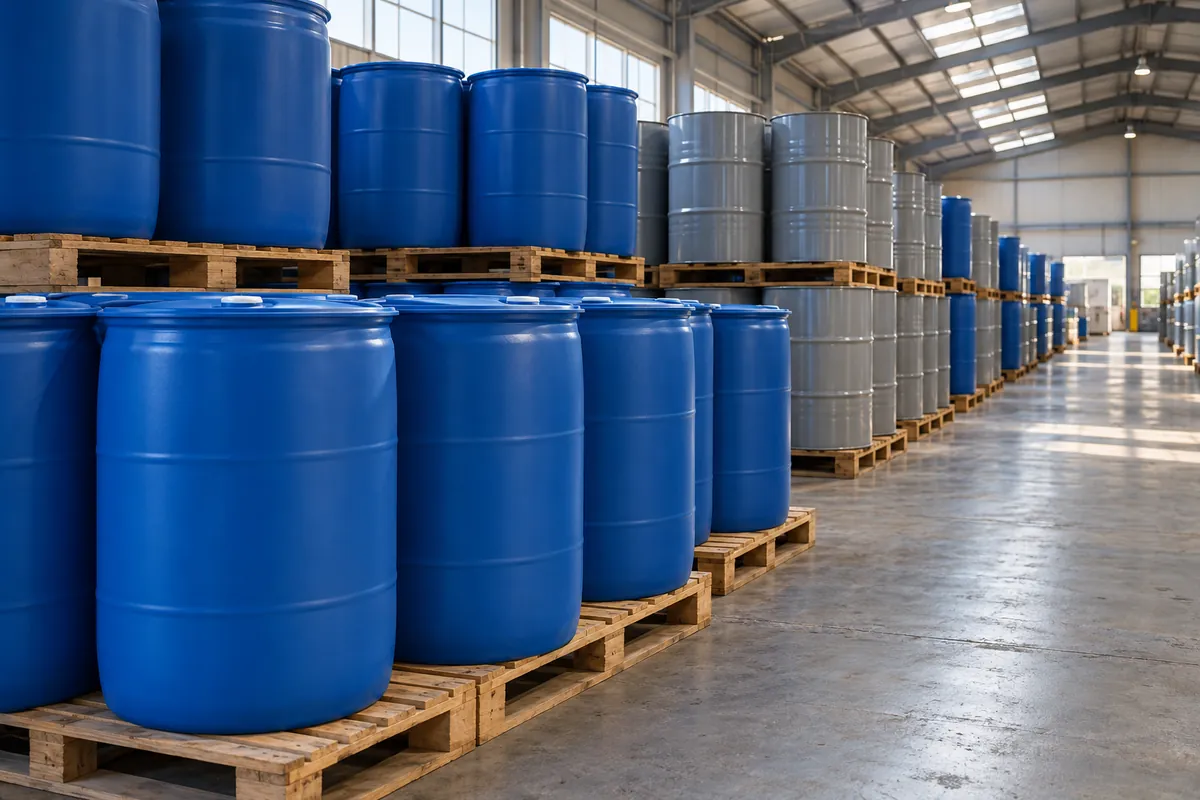
205 litre and 55 gallon drums are one class: 55 US gallons is 208.2 litres, and the drum holds about 216.5 litres to the brim. A tight-head steel drum stands about 880 mm tall and 585 mm across the hoops, and weighs 14 to 18 kg empty or about 220 kg with 205 litres of water. Its UN codes are 1A1 and 1A2 in steel, 1H1 and 1H2 in plastic.
Quick answer: How big is a 55 gallon drum?
A 55 gallon drum is rated at 208.2 litres, the same drum sold in Britain and Australia as 205 litres, and takes about 216.5 litres filled to the brim. European data sheets put a tight-head steel drum at 877 to 884 mm tall, with a 571.5 mm body and about 585 mm over the rolling hoops.
A 55 gallon drum is rated at 55 US gallons, or 208.2 litres at the 3.785412 L gallon of NIST Special Publication 811. The US federal drum specification, PPP-D-729E, rates it at 208 L but requires 216.5 to 218.6 L of actual capacity (3.4.3). The gap is headspace: the UN Model Regulations do not let a liquid fill a packaging completely at 55 °C.
The other names count the same drum in another unit or standard. In imperial measure it is the 45 gallon drum: 45 × 4.54609 L is 204.6 L, the 205 litre of British and Australian price lists. ISO 15750 sets steel drums by total capacity: Part 1 covers open-head drums of 208, 210 and 216.5 L, Part 2 tight-head drums of 212, 216.5 and 230 L.
| Name on the order | What the number measures | Litres |
|---|---|---|
| 200 litre, or 44 gallon | The usual fill; 44 imperial gallons | 200 |
| 205 litre, or 45 gallon | 45 imperial gallons | 204.6 |
| 55 gallon, or 208 litre | 55 US gallons, the rated capacity | 208.2 |
| 210 litre | ISO 15750-1 open-head class | 210 |
| 216.5 litre | ISO 15750-1 and -2 class; the US brimful minimum | 216.5 |
| 220 litre | The usual plastic tight-head drum | 220 |
A tight-head steel drum stands 877 to 884 mm tall on European data sheets, with a 571.5 mm (22.5 in) body and about 585 mm over the rolling hoops. PPP-D-729E draws the US drum 34¾ in (883 mm) tall and up to 596 mm over the hoops: the same body, 11 mm wider at the hoops. Plastic drums stand taller for the volume.
| Drum | Height | Diameter | Empty weight |
|---|---|---|---|
| Steel tight-head, 216.5 L class (UN 1A1) | 877–884 mm | 571.5 mm body, 585 mm over the hoops | 14.3–18.1 kg |
| US 55 gallon tight-head | 34¼–34⅞ in (870–886 mm) | 22½ in body, up to 596 mm over the hoops | About 38 lb (17 kg) |
| Steel open-top, 213 L (UN 1A2) | 880 mm | 571.5 mm opening, 585–607 mm over the ring | 16.6–20 kg |
| Plastic tight-head L-ring, 220 L (UN 1H1) | 935–942 mm | 580–583 mm | 8–10.5 kg |
| Plastic open-top, 220 L (UN 1H2) | 1,010 mm | 595 mm, with a 471 mm opening | Varies with the wall |
A tight-head drum has a fixed lid with bung openings no wider than 7 cm; a removable lid or a wider opening makes it an open-top drum. The UN codes record the difference: 1A1 and 1H1 for steel and plastic tight-head drums, 1A2 and 1H2 for open-top, with the same 7.0 cm line in 49 CFR 178.504 and 178.509.
Tight-head drums carry liquids through their bungs, thin liquids of packing group I included. Open-top drums carry solids, powders, pastes and liquids of packing groups II and III, and in packing group I only viscous liquids. The lid seals on a gasket under a clamp ring, bolted on the US federal design (PPP-D-729E 3.5.3.3) or closed by a lever, and the full-width opening suits scooping, mixing and overpacking smaller containers. The UN mark goes on the body, not the lid alone.
Empty, a steel drum weighs 14 to 18 kg and a plastic drum 8 to 10.5 kg; data sheets give 15.6 kg for a 216.5 L steel drum and 8.5 kg for a 220 L plastic one. Full, the contents dominate: a steel 55 gallon drum of water weighs about 223 to 226 kg, and a 205 litre drum of engine or hydraulic oil 189 to 196 kg.
| Contents (density at 15 °C) | 200 L | 205 L | 208.2 L (55 US gal) |
|---|---|---|---|
| Water (1.000 kg/L) | 200 kg | 205 kg | 208 kg (459 lb) |
| Diesel, EU maximum (0.845 kg/L) | 169 kg | 173 kg | 176 kg (388 lb) |
| Hydraulic oil, ISO VG 46 (0.851 kg/L) | 170 kg | 174 kg | 177 kg (391 lb) |
| Engine oil, 15W-40 (0.869 kg/L) | 174 kg | 178 kg | 181 kg (399 lb) |
The table shows contents only. Diesel is at the maximum density in Directive 98/70/EC, Annex II; the oils come from maker data sheets. The container loading guide adds petrol, AdBlue and acids.
Four drums fit on a pallet. Four 585 mm drums make a 1,170 mm square. It sits on a 1,140 × 1,140 mm CP3 chemical pallet with 15 mm over each edge, or on a 1,200 × 1,000 mm pallet with 85 mm over each long side. US drums at 596 mm make a 1,192 mm square, which fits the 48 in length of a 48 × 40 in pallet and overhangs its 40 in width by 88 mm each side.
A 20ft container takes 80 steel drums in two tiers, and a 40ft has floor for 160. Weight stops the 40ft first: a 40ft standard holds 123 drums of water. The load calculator in the container guide checks your liquid against your box.
Steel drums are carbon steel sheet, about 0.8 to 0.9 mm in the body and 1 to 1.2 mm in the heads on European and US data sheets. They come bare, lacquered or lined inside; 49 CFR 178.504(b)(7) asks for a lining wherever steel and contents are not compatible. Galvanised and stainless drums serve contents that must not pick up rust. Plastic drums are high-density polyethylene (HDPE), with carbon black or pigment for UV resistance (49 CFR 178.509(b)(2)).
Steel has no period-of-use limit for dangerous goods; plastic drums may carry them for five years from the month of manufacture (ADR 4.1.1.15). Polyethylene does not rust and resists many acids and alkalis that attack bare steel. Steel is non-combustible, which counts in a store assessed for fire, and takes solvents that can soften or pass through polyethylene; ADR tests plastic drums for flammable liquids against a permeation limit (6.1.5.7). Check both in the chemical compatibility guide.
A steel drum starts as flat sheet, rolled into a cylinder and welded along the side seam; a drum for more than 40 litres of liquid must have a welded body seam (49 CFR 178.504(b)(2)). Rolling hoops are expanded or rolled into the body, the heads are double-seamed on with a sealing compound, and bung flanges are set into the top head (PPP-D-729E 3.4.6 and 3.4.7; ISO 15750-3).
The outside is phosphated and painted, the inside lined where the contents need it. Under the UN rules every drum for liquids passes a leakproofness test before first use, on a design that has passed drop, pressure and stacking tests. PPP-D-729E also drops sample drums, 98 per cent full of water, from 1.2 m onto concrete (4.4.5).
A drum bung is the threaded plug that closes an opening in the head of a tight-head drum. A steel drum has two, set opposite each other in the top head: a 2 inch (51 mm) filling bung and a 3/4 inch (19 mm) vent bung (PPP-D-729E 3.5.3.1). The small bung on a 55 gallon drum is the 3/4 inch one; the 2 inch bung takes a pump, a tap or a drum adapter.
Thread forms differ under the same size. ISO 15750-3 sets three flange systems for steel drums: an octagonal base, a serrated base, and an octagonal G 2 with a hexagonal G 3/4 base. US data sheets list the two sizes as NPS or as G 2 and G 3/4, and one 220 L plastic drum data sheet lists S70x6 and S56x4 bungs. Match a tap or adapter to the thread, and keep the gasket: PPP-D-729E allows polyethylene gaskets only for products other than hydrocarbons (3.5.1).
A bung wrench, also sold as a bung spanner, socket or drum key, is a bar with lugs that fit the plug. Open the bung slowly. OSHA asks for drums to be opened so that excess pressure is relieved safely, with tools that cannot ignite a flammable atmosphere (29 CFR 1910.120(j)(2)), so use a non-sparking wrench on flammable contents.
A drum for dangerous goods carries a UN mark stating its code, performance level and limits. UN 1A1/X1.4/250/25/NL/VL824 is a tight-head steel drum for packing groups I to III, liquids up to relative density 1.4, tested at 250 kPa, made in 2025 and approved in the Netherlands. The UN code decoder reads any mark. Every drum code stops at 450 litres and 400 kg net, and for liquids P001 allows a 1A1 250 L in packing group I and 450 L in II and III. The UN number packaging finder lists the drums each substance may use.
| Mark or label | What it shows | US rule |
|---|---|---|
| UN packaging mark | Code, level, density or gross mass, year, country, maker | 49 CFR 178.503(a) |
| Metal thickness | In mm, on the bottom of every new steel drum over 100 L | 178.503(a)(9) and (a)(10) |
| Month of manufacture | On plastic drums, which starts the five-year clock | 178.503(a)(6) |
| UN number and shipping name | Both on the drum; the UN number at least 12 mm high above 30 L | 172.301(a)(1) |
| Hazard label | At least 100 mm on each side | 172.407(c)(1) |
| SALVAGE | Letters at least 12 mm high on a salvage drum | 173.3(c) |
The UN mark stays with the drum for life. The UN number, shipping name and hazard labels belong to each consignment. ADR for road and the IMDG Code for sea set their equivalents from the same UN model.
A reconditioned steel drum has been cleaned to bare metal, restored to shape with its chimes straightened and sealed, fitted with new gaskets and inspected, with pitted or thinned drums rejected (49 CFR 173.28(c)(1)). It then carries the reconditioner’s mark and the letter R, and L once it passes a leakproofness test (178.503(c)). A US drum reused without reconditioning needs its thickness embossed and, at 220 L, at least 0.92 mm of steel (or a 0.82 mm body with 1.11 mm heads) or 2.2 mm of plastic (173.28(b)(4)).
A plastic drum’s five-year clock runs from its month of manufacture and does not restart after reconditioning (ADR 4.1.1.15). An empty drum that held a dangerous substance is treated as a full one until the hazard has been removed (UN Model Regulations, chapter 4.1). Keep chemical drums away from drinking water: the CDC advises against containers that held toxic chemicals.
In England the oil storage regulations reach drums: a container includes a drum, and containers of 200 litres or less are excluded (Control of Pollution (Oil Storage) (England) Regulations 2001, regulations 1 and 2). A 205, 208 or 210 litre drum of oil outside a building at a business is in scope. It needs a bund of 110% of the largest container or 25% of the total, whichever is greater, with no drain valve, or a drip tray holding 25% of the drums (regulation 3(2) and 3(5)). Farm fuel oil falls under SSAFO above 1,500 litres, and Wales has its own 2016 regulations: see UK oil storage regulations.
| Rule | Which drums | Containment |
|---|---|---|
| England, Oil Storage Regulations 2001 | Over 200 L, outside a building, not at a home up to 3,500 L or a farm | 110% of the largest or 25% of the total; a drip tray of 25% for drums |
| US, SPCC rule (40 CFR 112) | 55 US gallons and up, once a site exceeds 1,320 gallons | The largest container plus freeboard for rain |
| US, hazardous waste storage (40 CFR 264.175) | Drums holding free liquids | 10% of the total or the largest drum, whichever is greater |
The US SPCC rule exempts a site while its aboveground oil capacity stays at or below 1,320 US gallons, counting only containers of 55 gallons or more (40 CFR 112.1(d)(2)(ii)). On drums alone that is 24; the 25th takes a site to 1,375 gallons and into the rule, if a spill could reach navigable waters. Portable containers then need a dike or catchment basin for the largest one plus rainfall (112.8(c)(11)), worked through in our SPCC containment guide. For a UK store, drum spill pallet size and the spill pallet sizing calculator give the sump for any drum count.
Drums themselves are not in our range. We make what goes around them: spill pallets and decks sized to the 110% and 25% rules, dollies that carry their own sump and cradles that turn a drum into a dispensing point. We also make salvage drums up to 95 gallons (360 litres) that take a failed 205 litre drum whole, and adapters for decanting into a jerry can.
At the other end of the decant we build steel and plastic jerry cans. Our dangerous-goods jerrican designs carry UN certification per design type and are made under quality assurance the competent authority accepts. Ask us what approval a salvage drum carries before you move dangerous goods in it.
| Your use case | Recommended can | Why this one |
|---|---|---|
| Drums in storage | 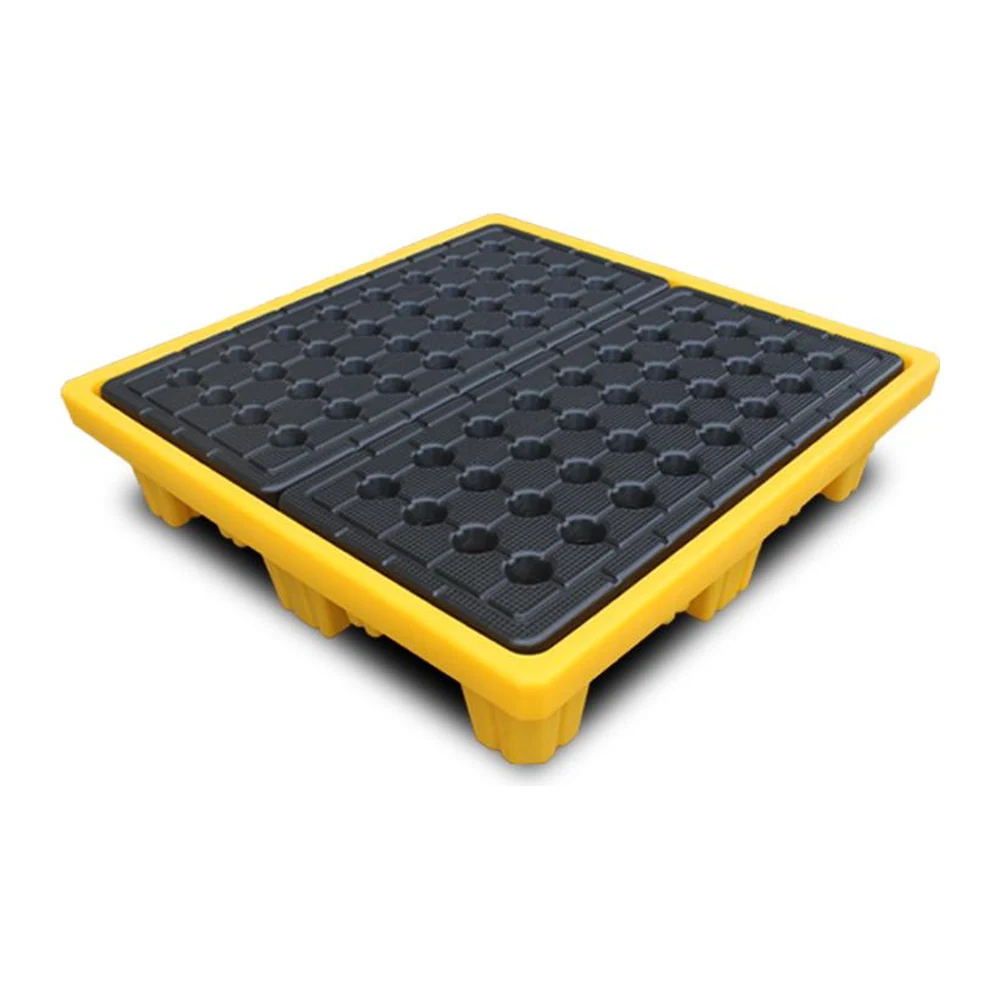 Drum Spill Pallets |
Sumps from 42 to 488 litres for one to four drums, sized to the 110% and 25% rules. |
| Drums being worked daily | 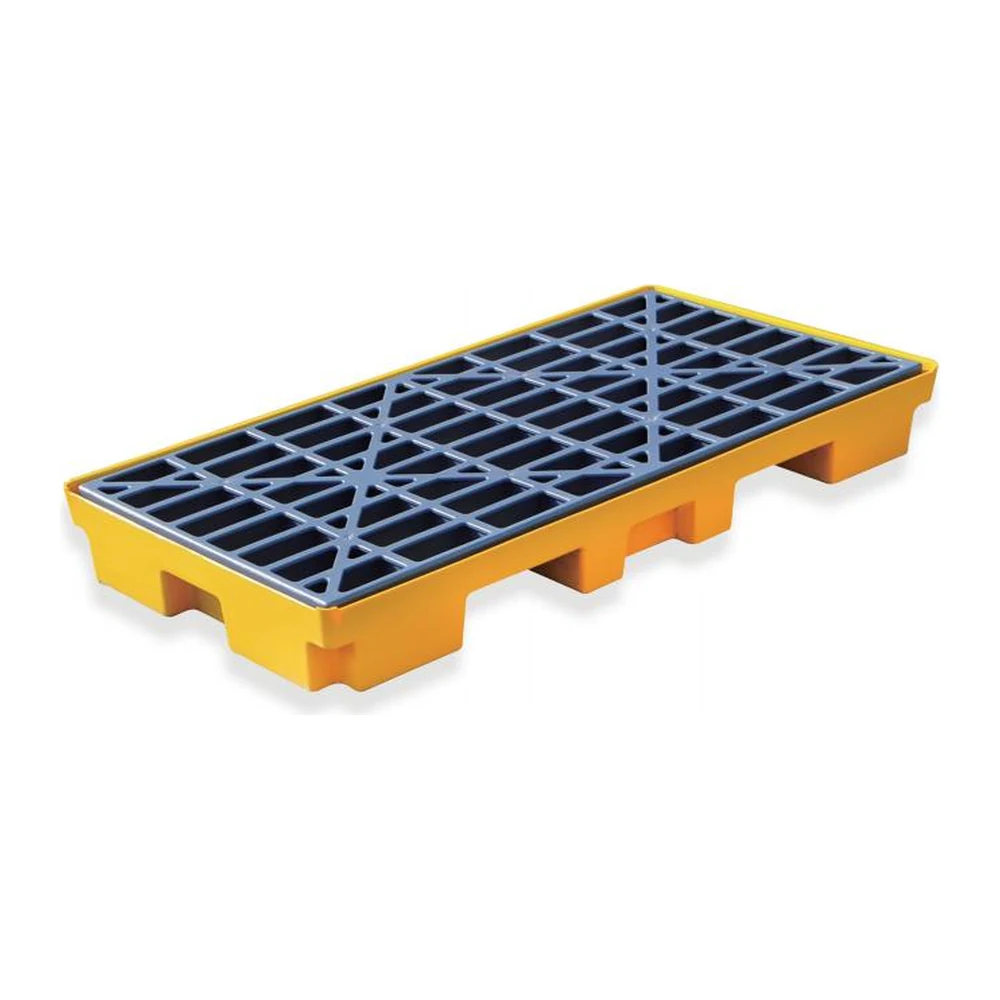 Drum Spill Decks |
Low decks with an open grate that shows a leak at the dispensing point. |
| Moving a full drum | 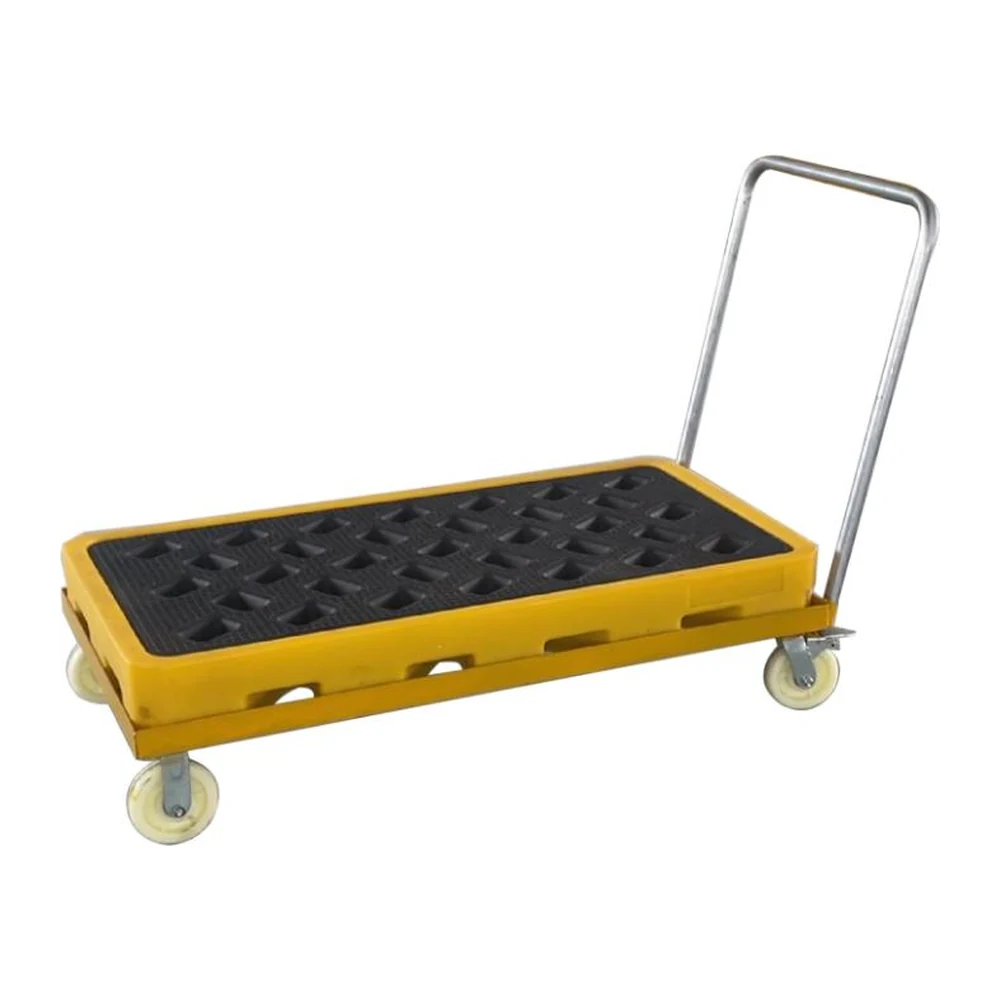 Drum Dollies & Trolleys |
Dollies with 20 and 300 litre sumps, so the containment travels with the drum. |
| Dispensing by tap | 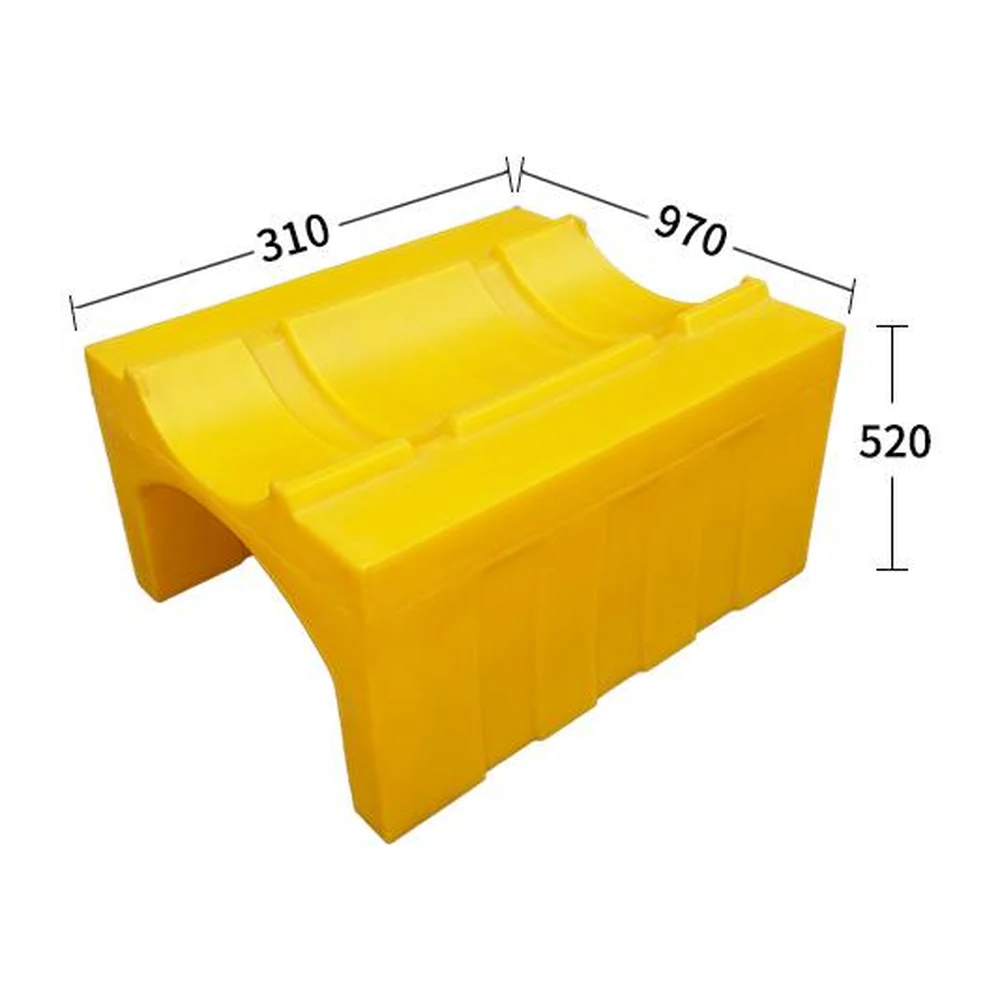 Drum Cradles & Dispensing Stands |
Cradles rated 260 to 600 kg hold a full drum on its side for gravity draw-off. |
| A drum that has failed | 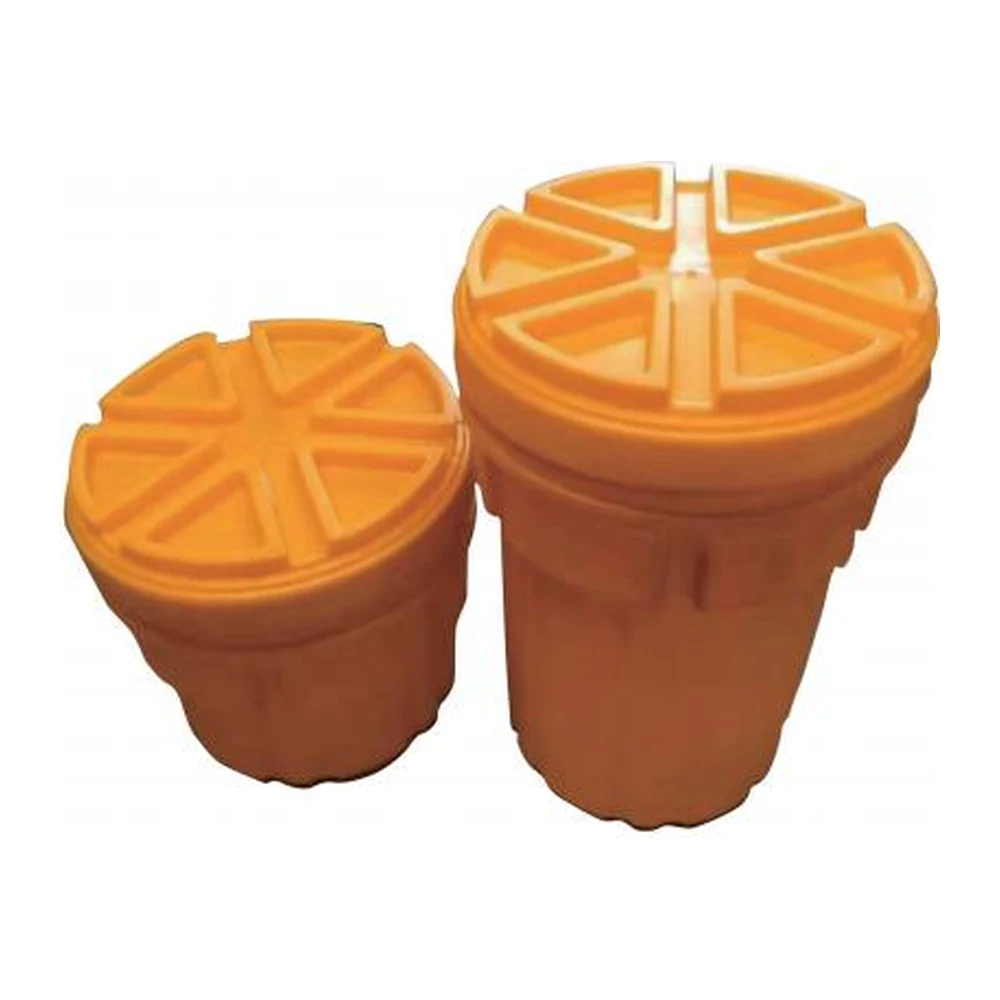 Salvage Drums & Spill Response Storage |
A 95 gallon (360 litre) overpack takes a 205 litre drum whole; ask us its approval status. |
| Drum to jerry can | 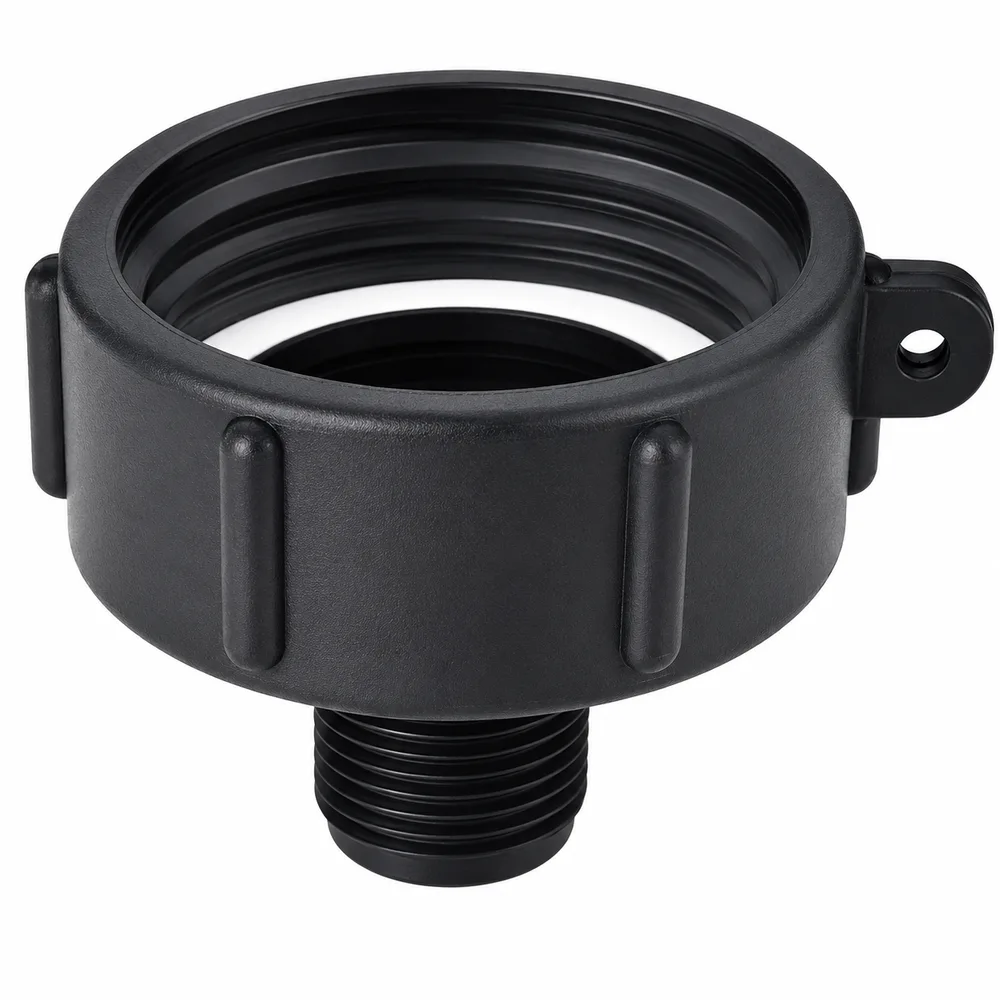 Drum & IBC Adapters |
A fitting between the drum bung and the can, in place of a funnel. |
Stand the drum upright, fit a bung wrench that matches the plug, and turn it anticlockwise slowly so any pressure vents before the thread lets go. Loosen the small 3/4 inch vent bung first, then the 2 inch bung. Keep the gasket with the plug, and use a non-sparking wrench if the drum held a flammable liquid.
Get a bung wrench rather than improvising. A screwdriver and hammer can split the plug, damage the flange and strike a spark on a drum that held a flammable liquid, and OSHA asks for tools that cannot ignite a flammable atmosphere when drums are opened. ISO 15750-3, the steel drum closure standard, includes plug wrench adaptors for its closures. An open-top drum needs no wrench: release the clamp ring.
Start with a new food-grade drum. The CDC advises against any container that held toxic chemicals. Wash the drum with soap, rinse it, then sanitise it with 1 teaspoon of unscented household bleach (5 to 9% sodium hypochlorite) per quart of water, about 5 ml per litre. Wait at least 30 seconds, empty it, let it air-dry and fill it. Replace stored water every six months.
Not for long without cover. Rain pools in the top chime around the bungs, rusts the head and can be drawn past a closure as the drum cools. Keep full drums under cover or on a covered spill pallet. In England an outdoor oil drum over 200 litres at a business needs a bund or drip tray, and an open bund fills with rain that has to be pumped out, because the regulations bar a drain valve.
Shipping and storing liquids and solids in 200 litre lots: lubricants, fuels, solvents, chemicals, food ingredients and waste. Tight-head drums carry liquids through their bungs; open-top drums take powders, pastes, viscous products and smaller containers. A drum sits between the 20 litre jerry can and the 1,000 litre IBC, and suits a site that draws the same liquid off by pump, tap or cradle.
In a steel drum, within the fire rules for your site. OSHA Table H-12 allows metal drums to DOT specification up to 60 gallons for every category of flammable liquid, and caps glass or approved plastic containers at 1 gallon or less. For transport, petrol (UN 1203, packing group II) may travel in UN 1A1, 1A2, 1H1 or 1H2 drums up to 450 litres. At a workplace in Great Britain, DSEAR applies.
Transfer the contents or overpack the drum rather than patch it. OSHA requires drums that cannot be moved without leaking to be emptied into a sound container, and the UN Model Regulations let a leaking package travel inside a salvage packaging with enough inert absorbent to leave no free liquid. Then find the cause: a crazed or split wall often means the plastic and the contents do not agree.
An oversized open-top drum that takes a damaged, leaking or non-conforming package so it can be moved. In the US it must be a UN 1A2, 1B2, 1N2 or 1H2 drum tested to packing group III or better, no larger than 450 litres, and marked SALVAGE in letters at least 12 mm high (49 CFR 173.3(c)). A 95 gallon (360 litre) salvage drum takes a 205 litre drum whole.
Through the 2 inch bung, with a hand, electric or pneumatic drum pump, or by laying the drum in a cradle with a tap in the 2 inch bung and the 3/4 inch bung opened as a vent. Put containment under the dispensing point, because a drum being decanted drips. Bond and earth the drum and the receiving container before you transfer a flammable liquid.
Only to carry dangerous goods. The UN mark shows that the drum design passed the UN drop and stacking tests and, for liquids, the leakproofness and pressure tests, at the levels it states. A drum for water, food or non-hazardous product does not need one. Storage rules ask for a sound container and containment rather than a UN mark, though a UN drum suits a hazardous liquid kept on site.
About 0.34 square metres. A steel drum measures about 585 mm across its rolling hoops, so in a row it fills a 585 mm square. Four stand on a 1,140 by 1,140 mm CP3 chemical pallet with 15 mm over each edge, about 0.32 square metres a drum. A drum stands 877 to 884 mm tall, so two tiers rise to about 1.76 m. A US 55 gallon drum, up to 596 mm over the hoops, needs a 1,192 mm square for four.
Both are in use, and each suits different contents. ADR 2025 packing instruction P001 lists steel drums, 1A1 and 1A2, beside plastic drums, 1H1 and 1H2. Steel has no period-of-use limit for dangerous goods, while plastic drums may carry them for five years from manufacture (ADR 4.1.1.15). Steel is non-combustible and takes solvents that can soften or pass through polyethylene. Polyethylene does not rust and resists many acids and alkalis that attack bare steel.
A standard drum is sold as 200, 205, 208, 210 or 220 litres, and a steel drum holds about 216.5 litres to the brim. Most of the names count the same drum in different units: 55 US gallons is 208.2 litres and 45 imperial gallons is 204.6. The brimful figure sits above the rated one because the UN Model Regulations do not let a liquid fill a packaging completely at 55 degrees Celsius. The usual fill is 200 litres.
A steel tight-head drum stands 877 to 884 mm tall, with a 571.5 mm body and about 585 mm across the rolling hoops. A 220 litre plastic tight-head drum stands 935 to 942 mm tall and 580 to 583 mm across. A plastic open-top drum stands 1,010 mm tall and 595 mm across. Empty, steel weighs 14 to 18 kg and plastic 8 to 10.5 kg. A US drum is 22.5 inches across the body and up to 596 mm over the hoops.
A bung hole is the threaded opening in the head of a tight-head drum, closed by a plug called a bung. A tight-head drum's openings are no wider than 7 cm. A steel drum has two, set opposite each other in the top head: a 2 inch (51 mm) filling opening and a 3/4 inch (19 mm) vent opening. The 2 inch opening takes a pump, a tap or a drum adapter. Thread forms differ under the same size, so match any fitting to the drum's thread.
Send sound drums to a reconditioner and the rest to an authorised waste carrier. A reconditioner cleans a steel drum to bare metal, restores its shape, fits new gaskets and inspects it, and rejects pitted or thinned drums. An empty drum that held a dangerous substance counts as full until the hazard has been removed. The CDC advises against using a drum that held toxic chemicals for drinking water. In England and Wales, waste goes only to a registered carrier or a permitted site.
Most plastic drums are blow moulded from high-density polyethylene of high molecular weight. A soft tube of molten plastic is inflated inside a mould, so the body forms as one seamless piece, and carbon black or pigment gives UV resistance (49 CFR 178.509(b)(2)). Some open-top drums are injection moulded instead. A design then passes the UN drop, stacking, leakproofness and pressure tests before the drum carries a UN mark.
The standards and regulations this page relies on, at their issuing body. Where a market rule is named here, check the current revision before you specify against it.
Last reviewed by David Guru, Co-Founder & Business Development Director.
Tell us the containers, the liquid and where the store is. We come back with the pallet or bund, its load rating and a quotation.