
Units per 20ft and 40ft, full weights by liquid, and the density at which the weight limit binds before the floor fills.
A 20ft container takes 80 drums of 200 L in two tiers, 18 to 20 IBCs of 1,000 L double-stacked, or 852 of our 20 L steel jerry cans. Full, a drum of water weighs about 217 kg and an IBC about 1,060 kg. A 40ft has floor for 160 drums, but 160 drums of diesel or water exceed its payload.
ONE, Hapag-Lloyd and Maersk publish reference figures for their dry boxes. They agree on space within a few millimetres and differ by about two tonnes of payload on a 40ft: ONE rates its 40ft standard at 26,840 kg on a 30,480 kg plate, Hapag-Lloyd at 28,750 kg on a 32,500 kg plate. Both lines say an individual container may differ from the reference, so plan on the CSC plate of the box you are given.
| Container | Inside L × W × H (mm) | Door height (mm) | Tare (kg) | Payload (kg) |
|---|---|---|---|---|
| 20ft standard (20GP) | 5,898–5,900 × 2,350–2,352 × 2,390–2,395 | 2,280–2,292 | 2,150–2,350 | 28,130–28,330 |
| 40ft standard (40GP) | 12,032 × 2,350–2,352 × 2,390–2,395 | 2,280–2,292 | 3,640–3,750 | 26,840–28,870 |
| 40ft high cube (40HC) | 12,032 × 2,350 × 2,695–2,700 | 2,585–2,597 | 3,700–4,020 | 26,460–28,800 |
Ranges across ONE, Hapag-Lloyd and Maersk, plus older Hapag-Lloyd high-cube data published by the German insurers’ transport information service (TIS-GDV). Doors are 2,340 mm wide.
Truck weight rules cut into the 28 tonnes a 20ft is rated to carry. In the United States, 23 CFR 658.17 caps a truck at 80,000 lb gross (36.3 t). Maersk publishes the OCEMA recommended maximum cargo weights for US highways: 39,200 lb (17,780 kg) for a 20ft on a slider chassis, 44,000 lb (19,960 kg) for a 20ft on a tri-axle slider or a 40ft standard on a gooseneck chassis, and 43,700 lb (19,820 kg) for a 40ft high cube.
Maersk’s 2026 Canada matrix lets a 20ft run to 47,900 lb (21.7 t) on Ontario–Quebec linehaul before a surcharge, without saying whether that figure is cargo or gross. Its summary of the Central American rules allows 37 t gross for a T3-S2 rig, and after the tractor, a two-axle chassis and the box, a 20ft carries 16.7 to 24.2 t. Across these carrier figures the road cap for a 20ft runs from 17.8 to about 24 t.
Directive 96/53/EC, Annex I, sets 40 t for a five- or six-axle articulated vehicle in the EU and 44 t with a three-axle tractor carrying a container of up to 45 ft in intermodal transport. We found no EU source for tractor and chassis tare; with the Central American tares as a stand-in, a 44 t move leaves about 31 t for cargo, above a 20ft’s box payload. National rules vary, so take the haulier’s figure. At sea, Maersk surcharges boxes from the Far East to the US East Coast above 25 t verified gross mass.
A tight-head steel drum to ISO 15750-2 (UN 1A1) has a minimum capacity of 216.5 L and ships filled to about 200 L. Maker data give a 585 mm maximum diameter, a height of 877 to 884 mm and an empty weight of 14.3 to 18.1 kg. Four across take 2,340 mm of a 2,350 mm floor and ten along take 5,850 mm of a 20ft: 40 per tier, and 80 in two tiers 1,760 mm tall. A 40ft takes 20 along, so 160. A box built to the ISO 668 minimum width of 2,330 mm will not take four across. Three tiers fit a 40HC on paper, but 240 drums of the lightest petrol weigh 38.6 t against a 28.8 t payload.
Pallets keep the count. A 1,140 × 1,140 mm CP3 chemical pallet takes four drums, 15 mm over each edge, and two rows fill 2,340 mm of width, so a 20ft floor holds 10 pallets (40 drums) and 80 palletised drums need two tiers. A stacked pair stands about 2,060 mm and clears the 2,280 mm door on a forklift.
Plastic 220 L L-ring drums (UN 1H1), 581 to 583 mm across, 935 to 940 mm tall and 8.2 to 10.5 kg empty, load the same 40 per tier. US 55-gallon drums need a check: spec sheets print a 22.5 in (572 mm) inside diameter, but the rolling hoops measure 23.5 in (597 mm), and four of those need 2,388 mm. Get the hoop diameter from your drum maker before you plan four across, and set aside published counts for empty drums, such as 106 to a 20ft, when you plan a filled load.
A caged 1,000 L composite IBC (UN 31HA1) sits on a 1,200 × 1,000 mm footprint, stands about 1,160 mm and weighs around 52 kg empty on a plastic base or 65 kg on steel, according to Australia’s heavy vehicle regulator, NHVR. A two-by-four grid plus one unit across the end puts 9 on a 20ft floor. Ten fit if each long wall takes one IBC crosswise and four lengthwise, mirrored end to end, with 98 mm to spare.
Two tiers give 18 to 20: one IBC maker states that its pallet designed for ISO containers raises a 20ft from 18 to 20. Our arithmetic shows why. Two standard IBCs stand 2,320 mm, above the 2,280 to 2,292 mm door, so the door-end units cannot go in pre-stacked. A 40ft takes 20 per tier on a two-by-ten grid; a mixed layout reaches 22 with 32 mm to spare, so plan on 20 to 21.
Density sets the stacking. One common 1,000 L model, approved to 1.9 kg/L, travels two high only up to 1.5; another maker builds standard IBCs to UN Y1.9 with a cage designed for two-high stacking. Under the first rule, 50% caustic soda (1.52) and 98% sulphuric acid (1.84) travel single tier, 10 to a 20ft. Check the HDPE bottle against the chemical in the chemical compatibility guide.
For jerry cans we hold first-hand figures. Our factories’ loading tables, unpalletised, give:
The tables count cans four to a carton; confirm the stack height for full cans with us before you book on them. We do not yet publish a figure for our HDPE jerrycans. The warehouse and export packing guide covers the empty-can side, where the floor fills long before the weight limit. Pails differ: a round 20 L polypropylene pail ships 3,020 to a 20GP empty on our pail table because tapered pails nest. A full, lidded pail cannot nest, so count full pails by footprint and tiers, as you would drums.
Full weight is litres times density plus the empty package. Water sits at 1.00 kg/L. EN 590 diesel runs 820 to 845 kg/m³ at 15 °C (845 is the EU maximum under Directive 98/70/EC, Annex II) and EN 228 petrol 720 to 775. Engine oil data sheets give 0.839 kg/L for a 0W-20 car oil and up to 0.88 for 15W-40 diesel oils. AdBlue to ISO 22241-1 sits at 1.087 to 1.093, 50% caustic soda at 1.52 and 95–98% sulphuric acid at 1.84.
| Liquid (kg/L) | 200 L in a steel drum | 220 L in a plastic drum | 1,000 L in an IBC | 20 L in a steel jerry can |
|---|---|---|---|---|
| Water (1.00) | 214–218 kg | 228–231 kg | 1,056–1,065 kg | 23.1–23.8 kg |
| Petrol (0.72–0.775) | 158–173 kg | 167–181 kg | 776–840 kg | 17.5–19.3 kg |
| Diesel (0.82–0.845) | 178–187 kg | 189–196 kg | 876–910 kg | 19.5–20.7 kg |
| Engine oil (0.839–0.88) | 182–194 kg | 193–204 kg | 895–945 kg | 19.9–21.4 kg |
| AdBlue (1.087–1.093) | 232–237 kg | 247–251 kg | 1,143–1,158 kg | 24.8–25.7 kg |
| Caustic soda 50% (1.52) | 318–322 kg | 343–345 kg | 1,576–1,585 kg | 33.5–34.2 kg |
| Sulphuric acid 98% (1.84) | 382–386 kg | 413–415 kg | 1,896–1,905 kg | 39.9–40.6 kg |
Empty weights: steel drum 14.3–18.1 kg, plastic drum 8.2–10.5 kg, caged IBC 56–65 kg, steel jerry can 3.1–3.8 kg.
A closed-top US 55-gallon steel drum (208.2 L, 35 to 38.4 lb empty) weighs about 494 to 497 lb full of water, 411 to 426 lb of diesel and 420 to 442 lb of engine oil. NHVR puts an IBC holding 1,100 L of AdBlue at around 1,270 kg, which matches 1,100 × 1.09 + 65 kg = 1,264 kg. Single cans by size are in jerry can sizes.
For N packages of V litres and empty weight T in a box with payload P, space and weight run out together at a break-even density of (P − N × T) ÷ (N × V). Above it, the load reaches the payload with floor to spare, and the count that ships is P ÷ (V × density + T), rounded down. On ONE’s payloads (28,330 kg for a 20GP, 26,840 kg for a 40GP, 28,800 kg for a 40HC), with 17 kg per steel drum and 60 kg per IBC:
Against the box payload, drums in a 20GP fill on space for everything up to caustic soda, while a 40ft of drums meets its payload with any liquid heavier than petrol.
| Load plan | Space count | Weight at that count | Limit | Units that ship |
|---|---|---|---|---|
| 20GP, steel drums, water | 80 | 17,360 kg | 28,330 kg box | 80 |
| 20GP, steel drums, sulphuric acid 98% | 80 | 30,800 kg | 28,330 kg box | 73 |
| 20GP, steel drums, caustic soda 50%, US slider chassis | 80 | 25,680 kg | 17,780 kg road | 55 |
| 40GP, steel drums, diesel | 160 | 29,360 kg | 26,840 kg box | 146 |
| 40GP, steel drums, water | 160 | 34,720 kg | 26,840 kg box | 123 |
| 20GP, IBCs, water, US slider chassis | 20 | 21,200 kg | 17,780 kg road | 16 |
| 20GP, IBCs, caustic soda 50% | 10 (single tier) | 15,800 kg | 28,330 kg box | 10 |
| 40GP, IBCs, water, two tiers | 40 | 42,400 kg | 26,840 kg box | 25 |
| 20GP, stainless water cans, water | 852 | 20,278 kg | 28,330 kg box | 852 (747 on a US slider chassis) |
| 40HC, NATO steel fuel cans, diesel | 2,016 | 39,816 kg | 28,800 kg box | 1,458 |
Diesel at the EN 590 midpoint of 0.8325 kg/L. Empty weights: steel drum 17 kg, IBC 60 kg, stainless can 3.8 kg, NATO steel can 3.1 kg. Box payloads are ONE’s reference figures; road limits are OCEMA’s recommended maximum cargo for US highways.
The water rows show the 40ft problem. A 40GP takes 123 water drums against 80 in a 20ft, about 1.5 times, and 25 water IBCs against 18 to 20, so the larger box buys floor space that its payload cannot fill.
The calculator below runs the same arithmetic for your box, package and liquid.
80 drums, 16,000 litres, 17.4 tonnes of cargo
Floor space sets the load. Weight alone would allow 130
Drums stand four across and two high, unpalletised. IBCs go two high up to a density of 1.5, the transport limit of a common IBC model, and one high above it. Can counts are our factories’ loading figures. Payloads are ONE’s published figures and the US caps are the OCEMA recommended maximums; the plate on your container and your carrier’s limits decide.
Count units from the floor plan and the tiers the package and its maker allow. Multiply by the full weight per unit and compare the total with the plate on the box. Then ask the forwarder which chassis carries it at each end: a US slider chassis takes 17,780 kg of cargo against a 20GP payload of 28,130 to 28,330 kg, and the smallest of the three counts is the load.
Diesel, petrol, acids and caustic solutions travel as dangerous goods in UN-approved packaging rated for the substance. The UN number packaging finder lists the drums, jerricans and IBCs that ADR allows for each UN number, and the guide to dangerous goods transport covers the sea leg under the IMDG Code. Before you refill reconditioned IBCs, read their plate dates with the IBC inspection date checker.
We build the jerry can and pail end of this table in steel, stainless and plastic, and quote every order with units per 20ft and per 40ft high cube from our factories’ tables. Send the liquid, its density, the box and the destination, and we return the count that ships, with the load weight checked against the payload. For drums and IBCs at the receiving store, we supply spill pallets and decanting adapters.
| Your use case | Recommended can | Why this one |
|---|---|---|
| Fuel by the container | 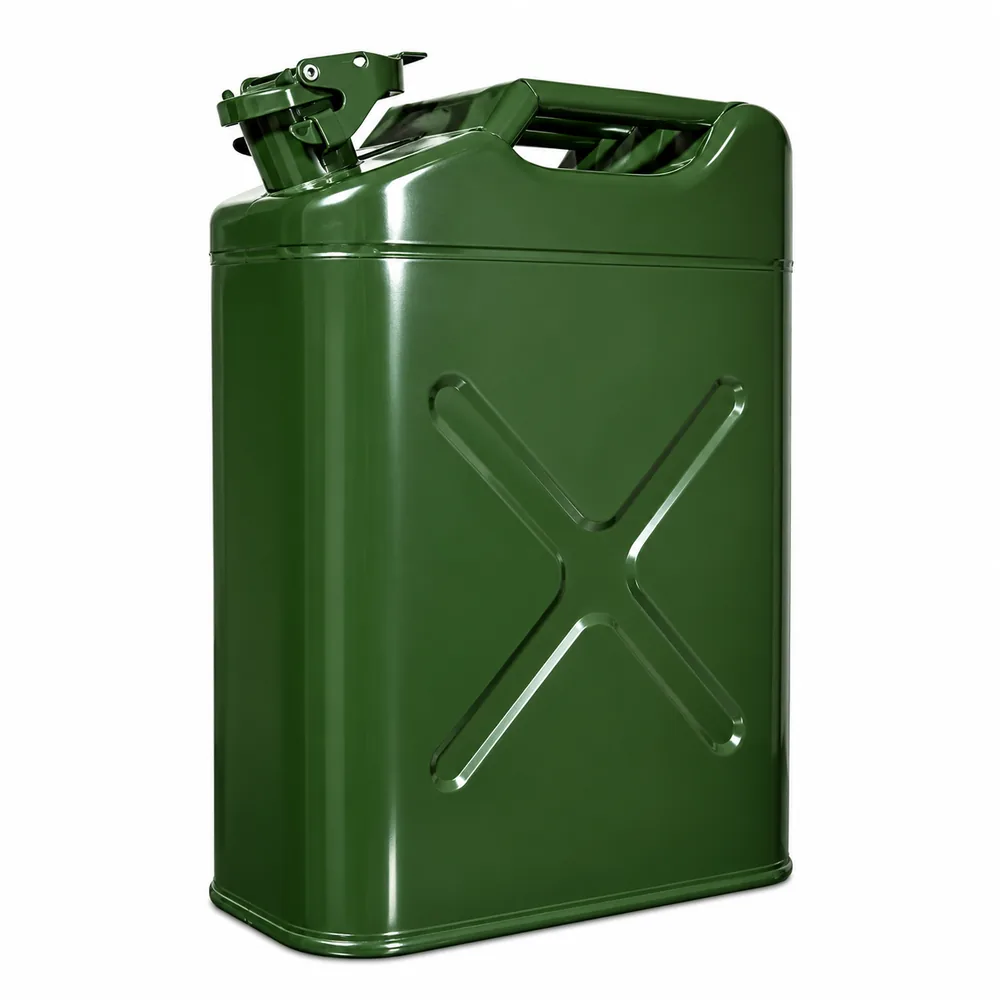 20L NATO Steel Fuel Can 20L NATO Steel Fuel Can |
852 per 20ft and 2,016 per 40ft high cube on our factory table. |
| Water by the container | 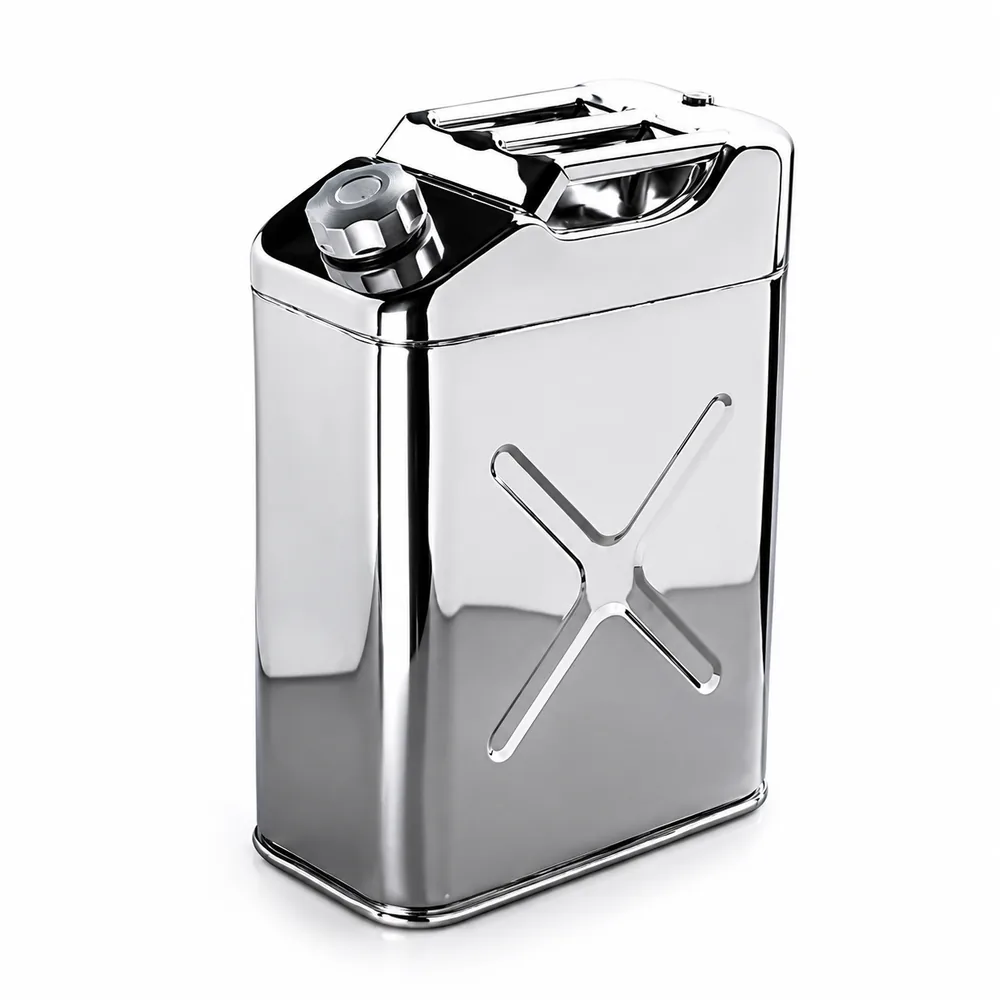 20L Stainless Steel Water Can 20L Stainless Steel Water Can |
A full 20ft of 852 cans weighs about 20.3 tonnes, inside the box payload. |
| Chemicals in UN 3H1 plastic | 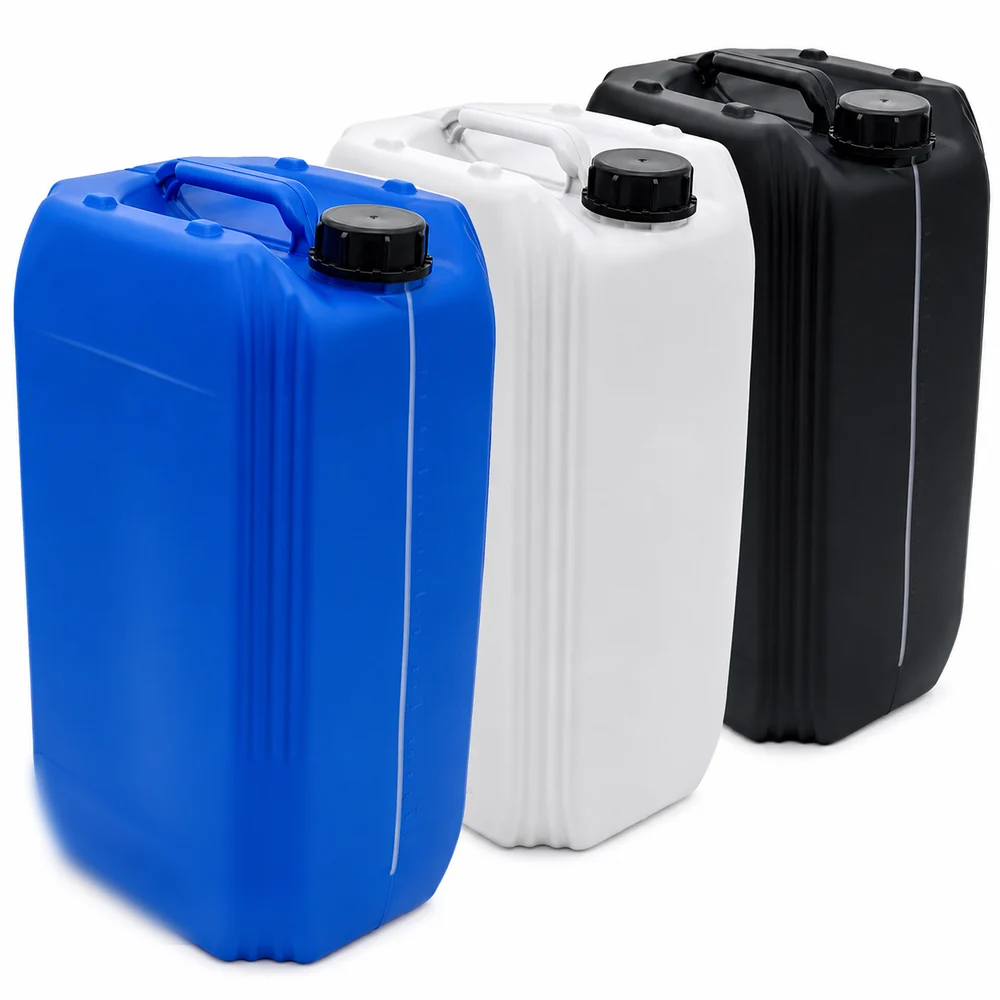 25L Stackable Plastic Jerrycan 25L Stackable Plastic Jerrycan |
Stackable HDPE; ask us for the loading count against your fill. |
| Decanting drums and IBCs into cans | 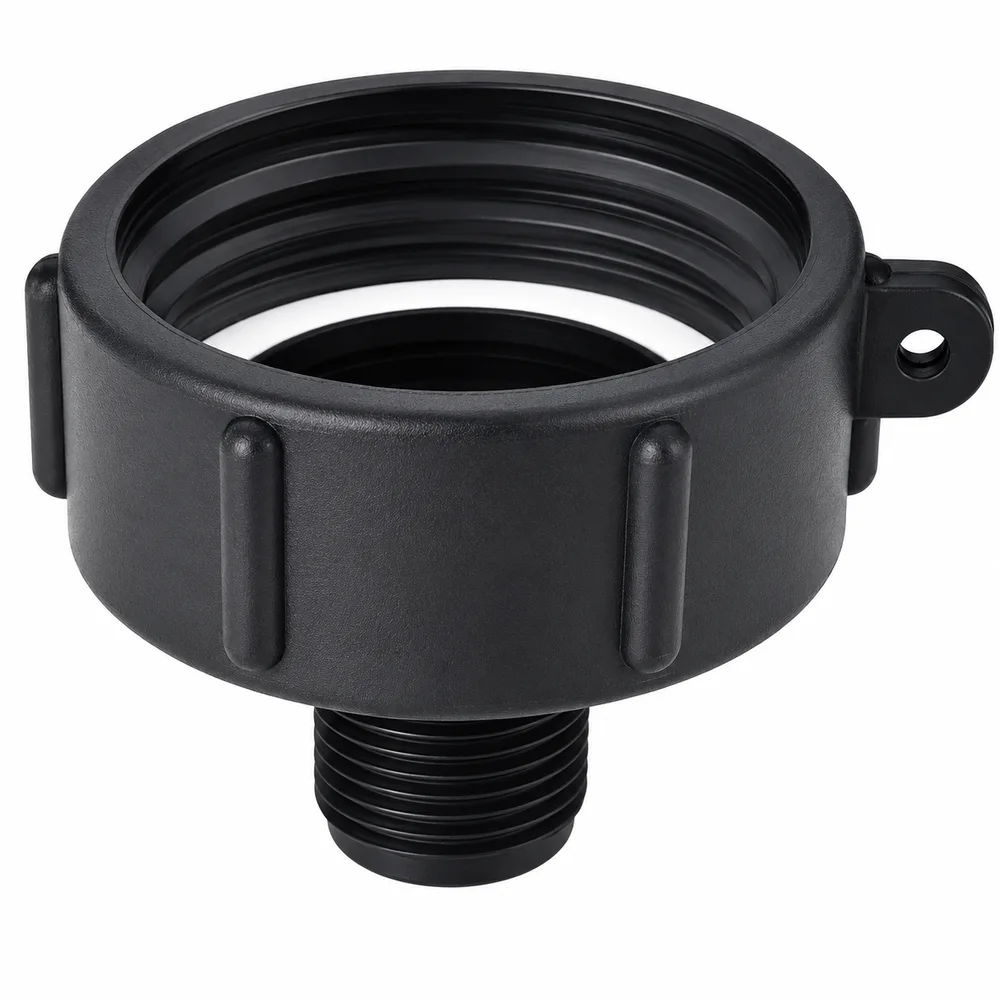 Drum & IBC Adapters Drum & IBC Adapters |
Fills cans from bulk at destination without a shared spout. |
| IBCs once unloaded | 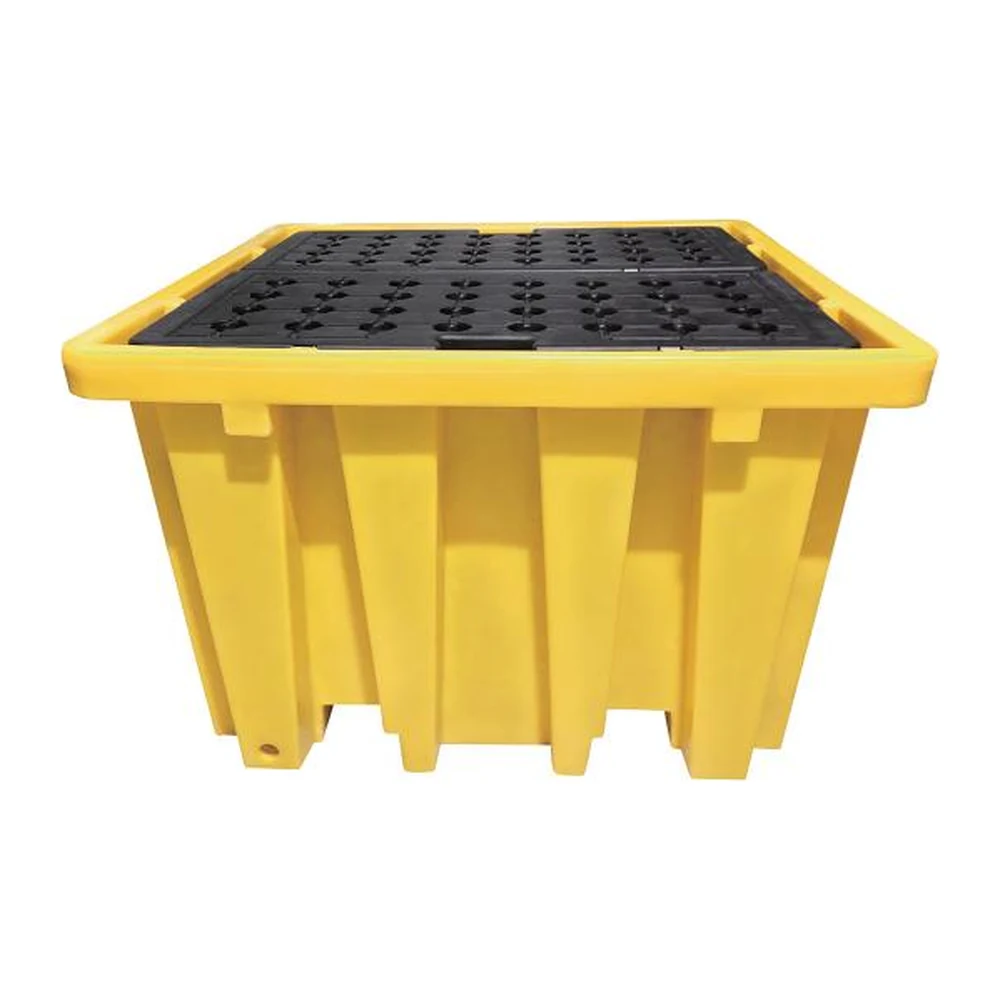 IBC & Multi-Container Spill Pallets IBC & Multi-Container Spill Pallets |
Linkable sumps for the store the container feeds. |
Eighty, in two tiers. Drums of 585 mm diameter sit four across and ten along, 40 per tier, floor-loaded or four to a CP3 pallet, and a 40ft takes 160. Weight can cut that: 98 per cent sulphuric acid stops at 73 drums on a 28,330 kg payload, and a 40ft standard with a 26,840 kg payload holds 123 drums of water.
Nine or ten 1,000 litre IBCs per tier on a 1,200 by 1,000 mm footprint, and 18 to 20 double-stacked, depending on the pallet. Two-high transport follows the maker's density rating: one common model allows it up to 1.5 kg per litre, so 50 per cent caustic soda or sulphuric acid travels single tier, 10 to a 20ft. A 40ft takes 20 per tier.
About 1,056 to 1,065 kg full of water, 876 to 910 kg of diesel, 1,143 to 1,158 kg of AdBlue, 1,576 to 1,585 kg of 50 per cent caustic soda and 1,896 to 1,905 kg of 98 per cent sulphuric acid, for 1,000 litres in a caged IBC weighing 56 to 65 kg empty. Twenty water IBCs in a 20ft weigh 21,200 kg.
A closed-top US 55 gallon steel drum weighs 35 to 38.4 lb empty. Full, it weighs about 494 to 497 lb with water, 411 to 426 lb with diesel and 420 to 442 lb with engine oil. In metric terms, 200 litres of water in a 216.5 litre steel drum weighs 214 to 218 kg.
Carrier reference figures give 28,130 to 28,330 kg for a 20ft standard, 26,840 to 28,870 kg for a 40ft standard and 26,460 to 28,800 kg for a 40ft high cube. Read the plate on the box you receive. Road rules cut it further: OCEMA recommends 17,780 kg of cargo for a 20ft on a US slider chassis.
In a 20ft it does not: 852 stainless 20 litre cans of water weigh about 20,300 kg against a 28,330 kg payload, though a US slider chassis caps the load at 747 cans. In a 40ft high cube it does: 2,016 NATO steel cans of diesel would weigh 39,800 kg, so the 28,800 kg payload stops the load at about 1,458 cans.
The standards and regulations this page relies on, at their issuing body. Where a market rule is named here, check the current revision before you specify against it.
Last reviewed by David Guru, Co-Founder & Business Development Director.
Liquid, density, container size and destination are enough for a first answer: the count that ships, the load weight against the payload, and a price.