
How to set up a chemical store: what may stand next to what, how big the sump must be, what the signs mean and which law applies in six countries.
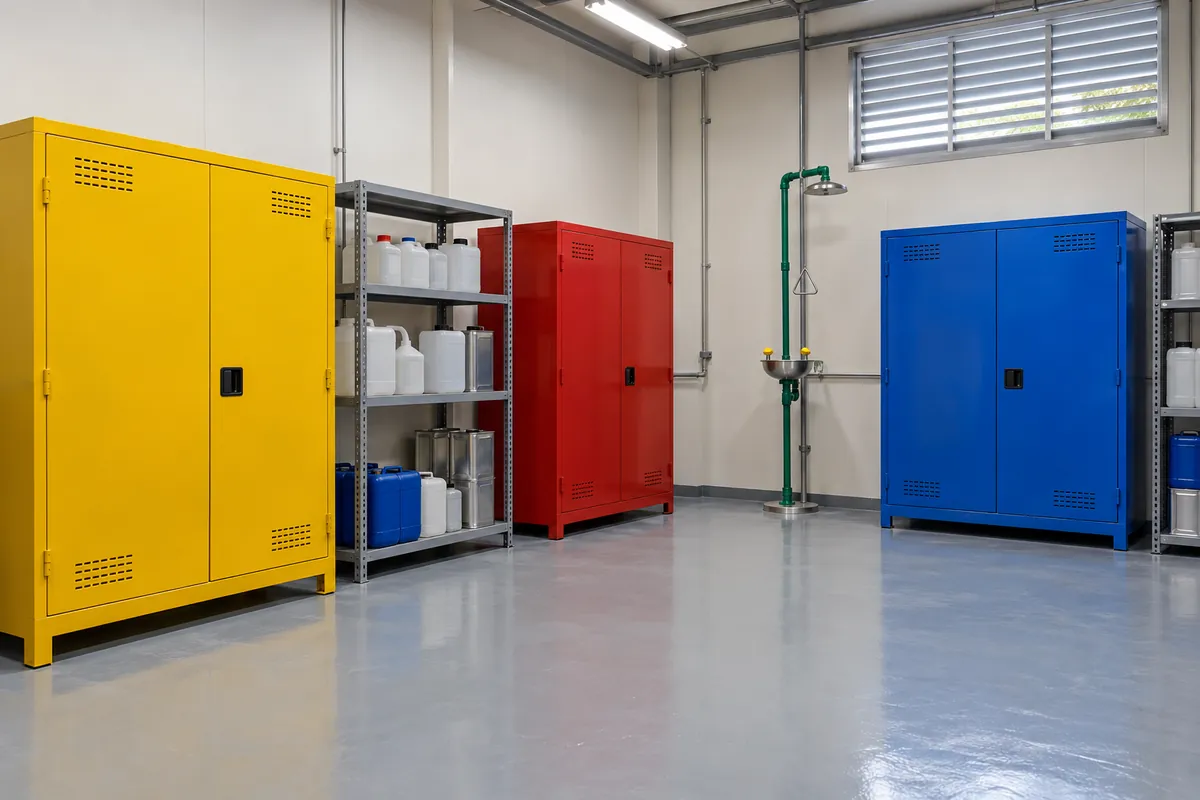
Chemical storage best practice rests on six habits. Group containers by hazard class and keep incompatible classes at least 3 m apart or in separate fire-resisting compartments (HSE HSG71). Stand liquids over a sump holding 110% of the largest container or 25% of the total, whichever is greater. Sign the store, keep each safety data sheet and a chemical register on site, and inspect weekly.
Quick answer: How should chemicals be stored safely?
By hazard class, read from the safety data sheet: incompatible classes stand at least 3 m apart or behind walls with 30 minutes' fire resistance (HSE HSG71). Every liquid stands over a sump holding the greater of 110% of the largest container and 25% of the total. Keep flammables in a fire-resisting cabinet, sign the store and inspect weekly.
The same eight steps apply from a cleaner’s cupboard to a warehouse bay. Follow them in order: the safety data sheet gives the class, the class decides the bay, and the bay decides the sump.
The UK legal duty behind each step is set out in COSHH storage requirements.
Storage decisions start from the SDS, which has the same 16 sections under OSHA and REACH. Section 7 gives storage conditions and incompatibilities, section 9 the flash point, and section 10 the incompatible materials and conditions to avoid, such as static discharge (OSHA 29 CFR 1910.1200 Appendix D). Section 14 carries the UN number, transport class and packing group that a segregation chart works from. It is optional on a US SDS, so when it is blank ask the supplier or use the UN number packaging finder.
The law then wants the sheets where workers can read them. OSHA requires SDSs within reach of workers during each work shift (1910.1200(g)(8)). Australia’s model WHS Regulations require a register listing each hazardous chemical with its current SDS (regulation 346, as Queensland applies it). New Zealand’s regulation 3.1 asks for the most: an inventory with each product’s name, UN number, maximum quantity, location, storage and segregation needs, and SDS.
Segregate by transport class, because every package and SDS carries one. HSE’s warehousing guide HSG71 sets out the standard chart in Table 2, and Malaysia’s DOSH storage guidelines (2005) reproduce it as Table 1. Each pair of classes gets one of three outcomes. Organic peroxides get a fourth, isolation in a dedicated building or a fire-resisting secure cabinet outdoors.
The International Fire Code 2024 (5003.9.8) sets a wider gap for incompatible materials in containers over 2 kg or 2 L. It asks for 6.1 m (20 ft), a non-combustible partition reaching 457 mm above and beside the stack, or hazardous materials cabinets, with no incompatibles sharing a cabinet. New Zealand’s regulation 10.5 requires incompatible class 2, 3 and 4 substances to be stored apart.
The chart misses reactions inside a class. HSG71 (para 120) and DOSH (7.5) list acids with hypochlorites (chlorine), with cyanides (hydrogen cyanide), with sulphides (hydrogen sulphide) and with alkalis (heat). Hydrochloric acid (UN 1789) and hypochlorite bleach (UN 1791) are both class 8, so the chart alone would let them share a bay. Check section 10 of each SDS, then the container: the chemical compatibility guide covers which plastics and metals each liquid attacks.
Size the sump from the largest container and the total. GPP 26, the drum and IBC guidance for Wales, Scotland and Northern Ireland, asks for 25% of the total or 110% of the largest, whichever is greater (5.2.3). DOSH wants a sill holding 110% of the largest container around outdoor stores (6.4.5). England sets a figure in law for oil alone (oil storage regulations UK). Secondary containment requirements compares the US, Australian and European figures, and the spill pallet sizing calculator does the arithmetic.
Australia’s model WHS Regulations also bar a containment system that would bring incompatible chemicals together (regulation 357(2)). An acid and an alkali, or an oxidiser and a flammable liquid, each need their own sump. The bund must also resist what it catches: polyethylene suits most acids and alkalis, and steel suits a store assessed against fire (choosing a spill pallet). Bottles on a shelf need a tray (drip trays and spill trays), and state figures are in bunding in Australia and New Zealand.
Set temporary containment wherever liquid moves between containers. Queensland’s hazardous chemicals code of practice (2021, page 42) says a transfer usually carries far more risk than static storage, and lists a spill containment system among the controls for one.
EPA Victoria’s liquid storage guidelines (Publication 1698, 2018) accept secondary containment that is temporary or mobile (page 21). Table 7 (page 32) sets the controls for a transfer:
Where staff close drains or lay booms by hand, EPA Victoria asks for regular drills and standard operating procedures (page 35). A temporary earth bund suits only clay or soil of very low permeability, backed by a soil remediation plan (page 25). Size a temporary bund the same way as a permanent one, using the state figures in bunding in Australia and New Zealand. For oil in the US, the SPCC rule holds a mobile or portable container in containment for the largest single compartment or container, plus rain (40 CFR 112.8(c)(11)). It lists booms, drip pans and sorbents among its containment methods (112.7(c)). Secondary containment requirements compares the figures.
If a spill escapes, GPP 22, the spill guide of the Welsh, Scottish and Northern Ireland regulators (2018, sections 4.1.2 and 4.1.3), lists the portable kit. A pop-up pool or overdrum goes under the leak. Water-filled barrier booms hold the spill or shield a drain, with sorbent booms behind them, and drain mats close the gullies. A portable tank needs level, stable ground and, for fuel or solvent, a pump that suits flammable atmospheres. The spill kits guide sets the response order; drip trays and spill trays covers the decanting point.
A chemical storage cabinet is a closed cupboard with a built-in sump that keeps a small stock near the work. For flammables it is a fire-rated product. OSHA 29 CFR 1910.106(d)(3) requires it to hold its inside at or below 163 °C (325 °F) through a 10-minute fire test. OSHA accepts a double-walled cabinet of 18-gauge sheet iron with a 38 mm air space, a three-point lock and a sill at least 51 mm high. The label reads “Flammable - Keep Fire Away”.
OSHA allows 60 US gallons (227 L) of Category 1 to 3 liquids in a cabinet. Its 2011 interpretation caps the total at 120 gallons (454 L), also the International Fire Code’s cap (5704.3.2.2). HSE’s HSG51 recommends 50 L for liquids with a flashpoint below the workroom’s maximum temperature and 250 L for others up to 60 °C (para 211). It keeps oxidisers and corrosives out (para 210). Corrosives and toxics need a cabinet their contents will not attack.
Bigger stocks need a store room. OSHA asks for liquid-tight sills or ramps at least 102 mm high at its openings and exhaust ventilation of six air changes an hour (1910.106(d)(4)). HSE treats the air in a low-flashpoint cabinet as zone 2 (HSG51 para 208), which limits the electrical equipment allowed there (DSEAR and ATEX zoning).
A chemical storage sign tells people the hazard before they open the door. In Great Britain the Safety Signs Regulations 1996 require a warning sign on any area holding significant quantities of hazardous substances, unless the container labels do the job. A mixed store may use the general danger sign, on or near the door (Schedule 1, Part III, para 5). Colour carries the meaning (Part I, para 4). A yellow triangle warns and a red circle prohibits, as with no smoking. A blue circle orders an action such as wearing eye protection, and green marks first aid and escape.
A GHS pictogram on a container is a black symbol on a white diamond with a red frame (OSHA HazCom Appendix C, C.2.3.1). The signal word is “Danger” for the more severe hazards and “Warning” for the less severe. Australia’s model regulations put signs next to the hazard, visible to anyone approaching (regulation 353). Above its Schedule 3 thresholds, New Zealand wants a sign at each store entrance with the word HAZCHEM, the hazard pictograms, the ignition precautions and the emergency action (regulations 2.5 and 2.6). Malaysia’s DOSH guidelines, citing regulation 29 of the USECHH Regulations 2000, want a warning sign at every entrance in Malay and English, dark red on white.
The NFPA 704 diamond is the US hazard sign for emergency responders. Three squares are rated from 0, least hazardous, to 4: blue for health, red for flammability, yellow for instability. The white square carries OX for an oxidiser, W for a water-reactive material or SA for a simple asphyxiant (NFPA and OSHA quick card). Health covers acute effects only, so a cancer risk does not show. The International Fire Code 2024 (5003.5) requires the diamond on stationary containers and tanks and at the entrances to places holding hazardous materials in permit quantities.
The numbers run opposite to the GHS categories in section 2 of an SDS, where 1 is the most severe. The quick card says not to copy those onto the diamond. Flammability comes from the flash point and boiling point in section 9 (NFPA 704 Table 6.2):
| NFPA flammability | Liquids that qualify |
|---|---|
| 4 | Flash point below 22.8 °C and boiling point below 37.8 °C |
| 3 | Flash point below 22.8 °C with boiling point at or above 37.8 °C, or flash point 22.8–37.8 °C |
| 2 | Flash point from 37.8 °C up to 93.4 °C |
| 1 | Flash point at or above 93.4 °C: must be preheated before it ignites |
| 0 | Will not burn in air at 815.5 °C over 5 minutes |
Each country hangs these practices on a different law. The table names the instrument a store is inspected against and what it adds.
| Country | Main law or code | What it adds for the store |
|---|---|---|
| UK (Great Britain) | COSHH 2002 and DSEAR 2002, with HSE guidance HSG71 and HSG51 | Risk assessment, segregation by HSG71 Table 2, warning sign on the store |
| United States | OSHA 29 CFR 1910.106 and 1910.1200, plus the fire code the state or city adopts | Cabinet and room limits, SDSs on every shift, segregation and NFPA 704 signs under the fire code |
| Australia | WHS Regulations Part 7.1, except in Victoria, which has its Dangerous Goods (Storage and Handling) Regulations 2022 | Register with SDSs (r 346), signs next to the hazard (r 353), containment that keeps incompatibles apart (r 357) |
| New Zealand | Health and Safety at Work (Hazardous Substances) Regulations 2017 | Inventory (r 3.1), HAZCHEM signs above Schedule 3 quantities (r 2.5–2.6), incompatible flammables apart (r 10.5) |
| Singapore | SS 586 parts 1 to 3, applied by MOM, NEA and SCDF; NEA hazardous substances permits | SS 586-1 storage of dangerous goods (since 10 December 2021); labels and SDSs to SS 586-2 and -3 (from 6 February 2025); NEA permit stores sheltered, fenced, locked and kerbed |
| Malaysia | OSH Act 1994 s 15 and the USECHH Regulations 2000, with DOSH storage guidelines (2005) | Segregation by DOSH Table 1, a 110% sill around outdoor stores, a warning sign at each entrance |
No single OSHA standard covers chemical storage: 1910.106 governs flammable liquids, 1910.1200 labels and SDSs, 1910.151(c) eyewash, and the adopted fire code adds segregation and signs. Safe Work Australia records the model WHS laws in force everywhere except Victoria, so NSW, Queensland and WA sites work from WHS Regulations.
Australia puts the technical detail of chemical storage in Australian Standards, one for each hazard class, and the codes of practice point to them. Queensland’s hazardous chemicals code (2021) cites AS 1940 for flammable liquids and bunding (pages 33 and 41), and AS 3780 and AS/NZS 3833 for corrosives (page 89). EPA Victoria asks sites to meet any relevant standard on top of its bund figures (Publication 1698, page 22). The table gives scope and edition only, as Standards Australia sells the texts.
| Standard | What it covers | Current edition (Standards Australia) |
|---|---|---|
| AS 1940 | Flammable and combustible liquids: minor storage, package stores, tanks, fuel dispensing and fire protection | AS 1940:2017, published 1 August 2017 |
| AS 3780 | Corrosive substances, class 8 of the ADG Code | AS 3780:2023, published 26 May 2023 |
| AS 4452 | Toxic substances, class 6.1 of the ADG Code | AS 4452:2025, published 25 July 2025; the joint AS/NZS 4452:1997 is marked superseded |
| AS 3833 | More than one class of dangerous goods in packages and IBCs of up to 1.6 m³ | AS 3833:2024, published 28 June 2024, superseding the 2007 edition |
The 2024 edition of the mixed-class standard is Australian only. The 2007 edition was joint, AS/NZS 3833:2007, and Safe Work Australia adapted the segregation chart in its storage guide from it (2021, page 16). Standards New Zealand consulted from 31 July to 28 August 2025 on rejoining it as AS/NZS 3833:2024. EPA Victoria’s list (page 52) adds AS 2507 for agricultural and veterinary chemicals, AS 4326 for oxidising agents, AS 2714 for organic peroxides and AS/NZS 4681 for class 9.
Quantity decides the paperwork: Schedule 11 of the model WHS Regulations sets a placard and a manifest quantity for each hazard category. For flammable liquids they are 50 and 500 litres in packing group I, 250 and 2,500 in packing group II, and 1,000 and 10,000 in packing group III. They are 10,000 and 100,000 for category 4 liquids, with flash points up to 93 °C (Safe Work Australia). Above the placard quantity the site displays placards (regulations 349 and 350). Above the manifest quantity it keeps a manifest (347). It gives the regulator written notice as soon as it knows the chemical is coming or at least 14 days before first use, whichever is earlier (348). It sends its emergency plan to the emergency service (361).
Victoria sets its own placard, manifest and fire protection quantities in Schedule 2 of its 2022 dangerous goods storage regulations, and the occupier notifies WorkSafe above the manifest quantity. South Australia runs a separate dangerous substances licensing scheme. Minor storage is a term from the standards: WorkSafe Queensland defines it as quantities below Table 2.1 of AS 1940, and at events it wants spill containment for any aboveground tank or package store above that line.
Where a corrosive could reach someone’s eyes or body, OSHA 29 CFR 1910.151(c) requires quick drenching or flushing facilities in the work area. The rule sets no figures. OSHA’s letter of 6 November 2020 treats ANSI/ISEA Z358.1-2014 as non-binding technical guidance, and Minnesota OSHA’s checklist (STD 1-8.2G, 2020) sums it up. The valve opens within 1 second and stays open, and the unit sits within 10 seconds’ walk (about 17 m) on the same level. An eyewash flows at least 1.5 L a minute for 15 minutes and a shower at least 76 L a minute, in tepid water at 16–38 °C. Run plumbed units weekly. For strong acids and alkalis the eyewash goes beside the hazard.
In Europe, EN 15154 part 2 covers plumbed-in eyewash units and part 4 non-plumbed units, the kind used where no water supply reaches the store. A portable unit must hold the whole flush: 15 minutes at 1.5 L a minute is 22.5 L, which a 30 L unit covers with a margin.
A written storage and handling procedure tells each worker how chemicals arrive, where they go, how they are decanted, what happens in a spill and who is trained for each job. Queensland’s code of practice asks a business to consult workers and develop safe work procedures when its controls change the way work is done (page 10), and names a written clean-up procedure for spills as an administrative control (page 36). In Great Britain, COSHH regulation 13 requires prepared procedures for accidents and emergencies, with safety drills tested at regular intervals (COSHH storage requirements).
| Stage | What the procedure sets out | Source |
|---|---|---|
| Receiving | The current SDS obtained before first use and the product added to the register; a container of unknown contents marked “do not use” and kept apart | WHS r 344 and 346; code page 18 |
| Storing | The bay, cabinet and sump for each class, with separate containment for chemicals that react | WHS r 351 and 357(2) |
| Decanting | Into a container labelled for that chemical, used for nothing else and made of a material it does not attack, over a tray or bund | WHS r 342; EPA Victoria 1698, Table 7 |
| Inspection and maintenance | Who checks tanks, bunds and transfer lines, how often, and how a defect is reported | WHS r 363; code page 43 |
| Spills and emergencies | Clean-up steps, the emergency equipment and where it is kept, the emergency plan | WHS r 360 and 361; code page 36 |
| Training and supervision | Who is trained for each task, the supervision each task needs, and a record of who was trained, when and on what | WHS r 363(2) and 379; code page 45 |
| Review | Review after any change to an SDS or the register, and at least once every 5 years | WHS r 352 |
Keep it short: Queensland’s code gives a one-page emergency procedure in point form as an example of an effective one (page 50). Point it to the register, the segregation chart and the chemical compatibility data for decanting containers. Drums need their own handling steps (drum storage requirements), and the spill steps should match the kit on the wall (spill kits guide).
Inspect at least weekly and record each check. GPP 26 asks for containers and bunds to be checked at least weekly, more often where the material needs it (section 7). In Malaysia, DOSH points to the safety committee’s inspection at least every three months (Safety and Health Committee Regulations 1996, regulation 12).
Laboratories add two checks from OSHA’s non-mandatory 1910.1450 Appendix A. Nothing goes in the fume hood, on the floor or on the bench, and open shelves are fixed to the wall with a 19 mm lip.
We make the containment and first-aid equipment around a chemical store. Polyethylene drum spill pallets carry one to four drums over sumps of 42 to 488 litres, and IBC spill pallets hold 120 to 1,600 litres. Bench and drip trays of 4 to 150 litres take bottles and pails, so each incompatible group can have its own sump. Steel spill pallets in double-layer 3 mm sheet suit a store assessed against fire, and covered pallets keep rain out of an outdoor sump.
Our portable eyewash units hold 30 and 53 litres, and a 304 stainless combination unit adds a safety shower. Tell us the standard your site is assessed against and we confirm what each unit holds. We do not make fire-rated cabinets. For decanting, our UN-certified jerrican designs give a closed container that takes a hazard label; each is certified per design type, made under quality assurance the competent authority accepts.
| Your use case | Recommended can | Why this one |
|---|---|---|
| Drums sorted by hazard class | 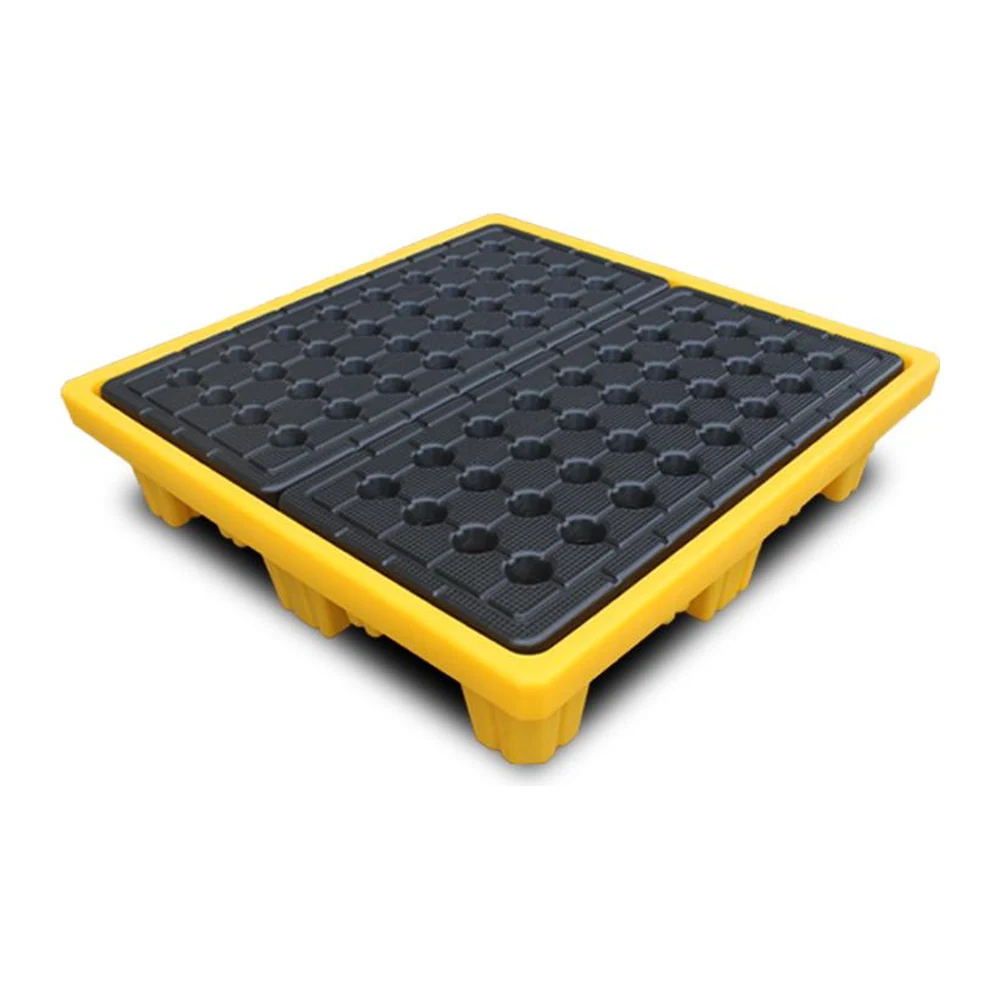 Drum Spill Pallets |
One to four drums per pallet over sumps of 42 to 488 litres, so each class gets its own sump. |
| IBCs of bulk chemicals | 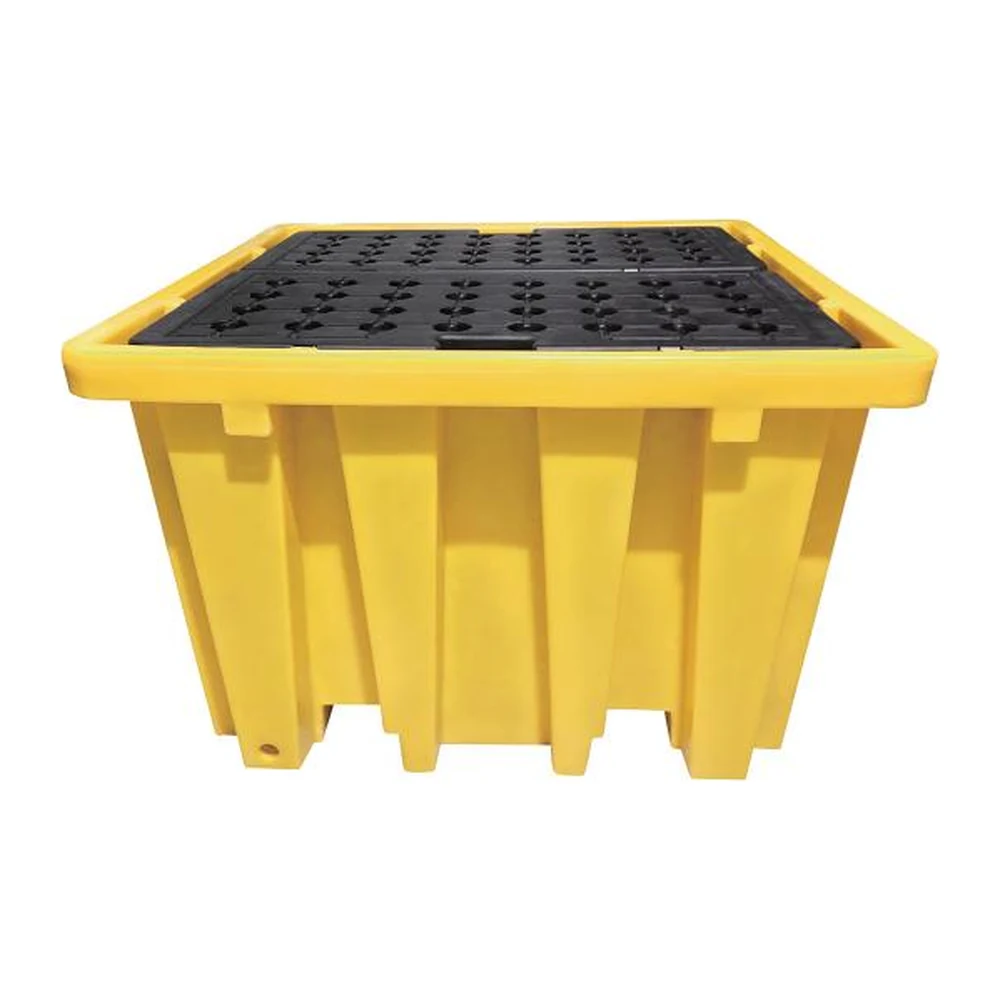 IBC & Multi-Container Spill Pallets |
Sumps of 120 to 1,600 litres for one to three IBCs, with linkable and rackable versions. |
| Bottles and pails on shelves and benches | 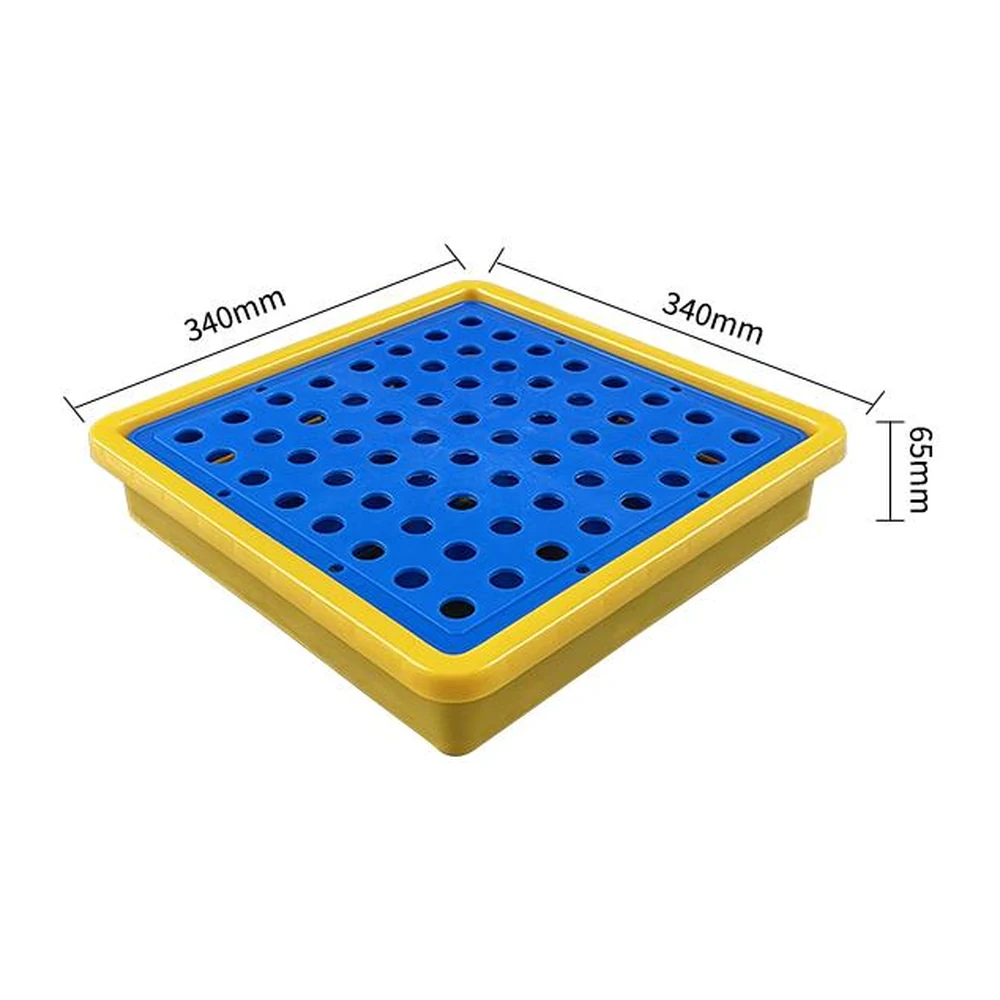 Bench Trays & Drip Trays |
Trays from 4 to 150 litres keep incompatible small containers on separate sumps. |
| Stores assessed against fire | 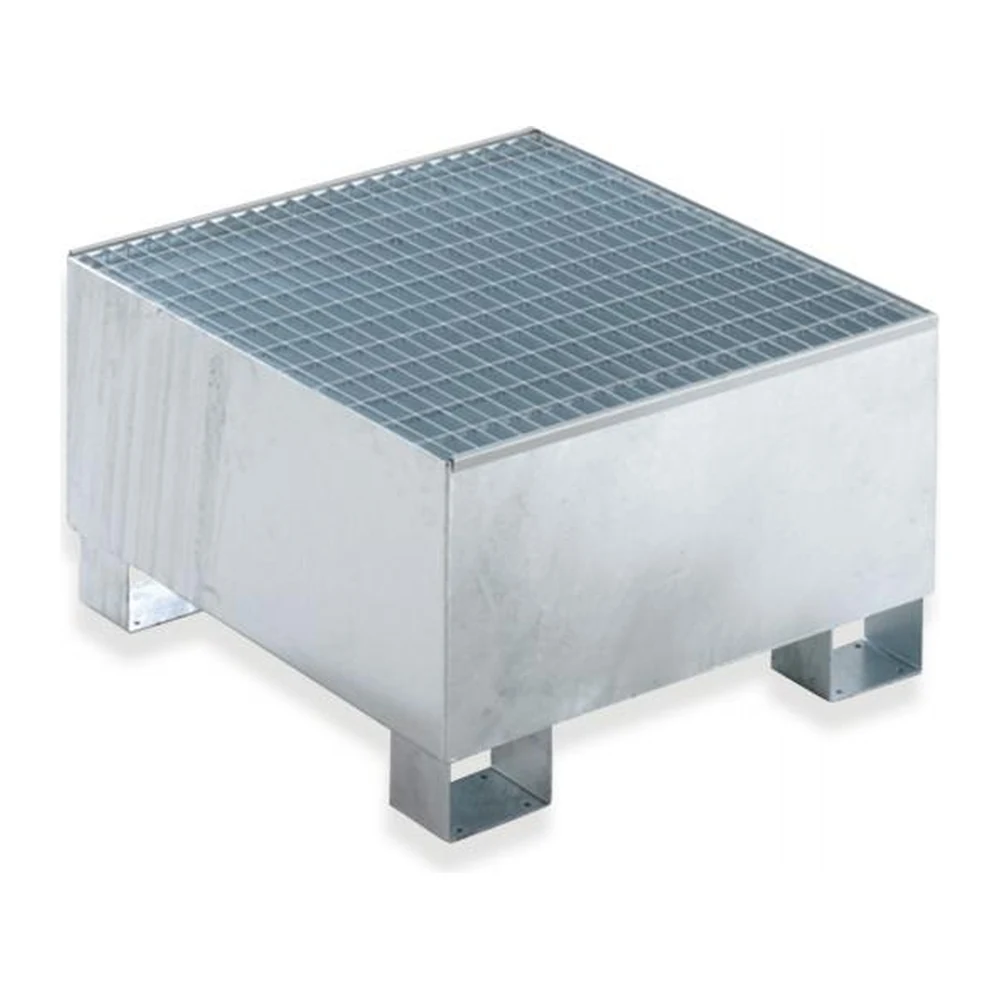 Steel Spill Pallets |
Double-layer 3 mm steel, powder coated or galvanised, where a plastic bund is ruled out. |
| Outdoor chemical stores | 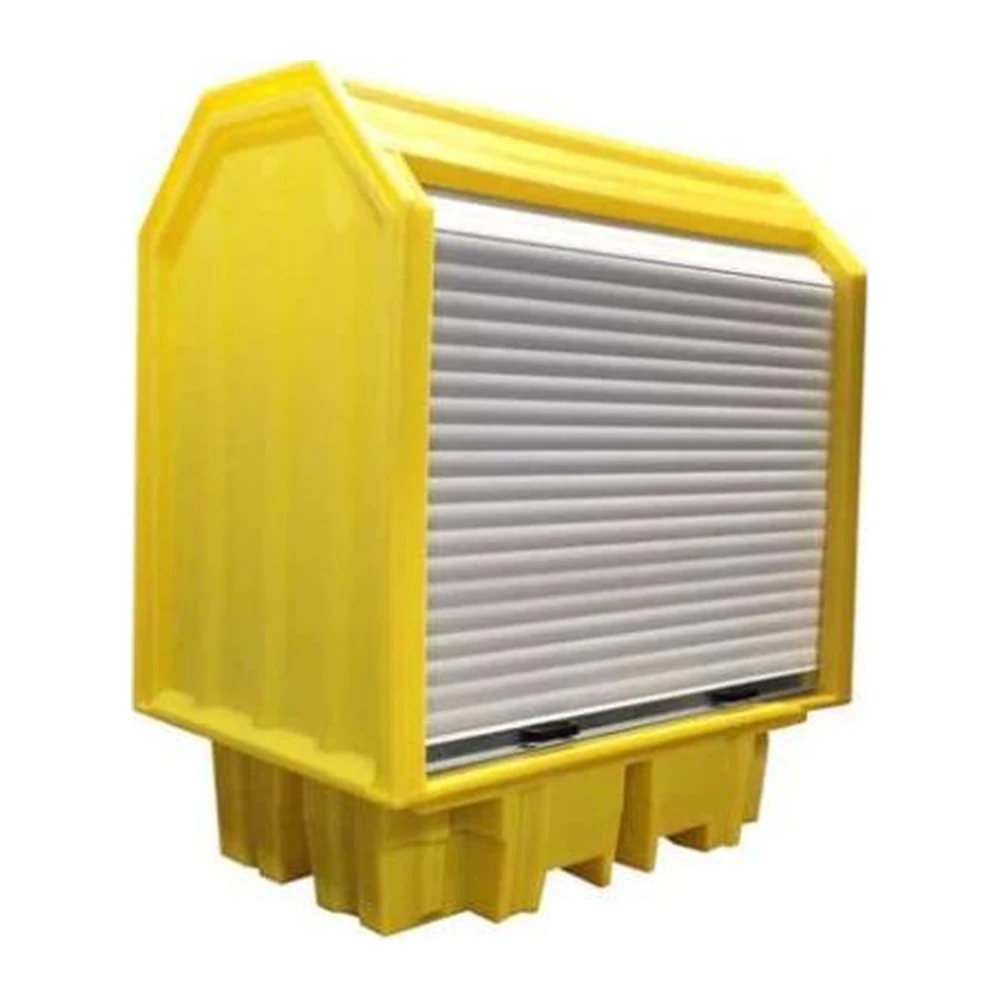 Covered Spill Pallets & Covers |
A roller shutter, hard cover or tarp keeps rain out of the sump. |
| Corrosives in store or in use | 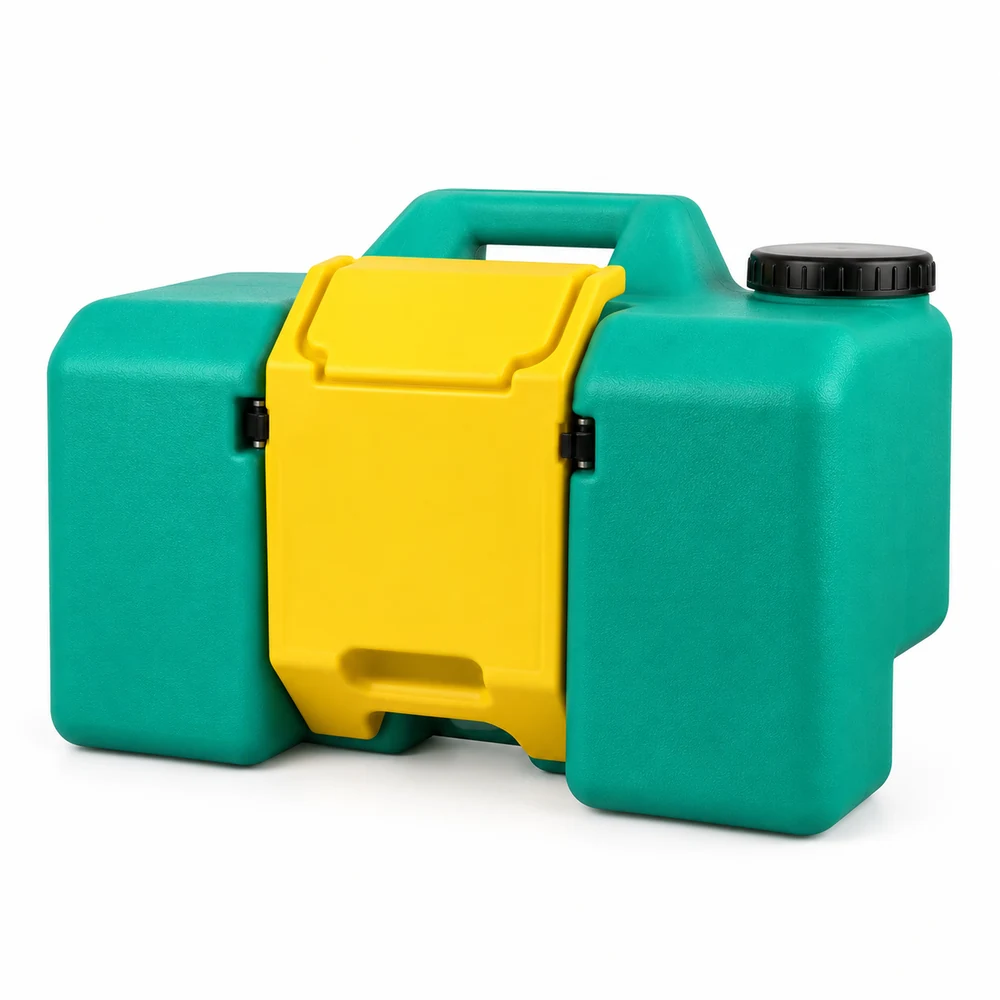 Emergency Eyewash & Safety Showers |
Portable 30 and 53 litre units where no plumbed water reaches the store. |
A chemical storage area is a room, cabinet, cage or outdoor compound set aside for hazardous chemicals that are not in use. Containers stay closed and labelled, grouped by hazard class, over a sump, with a warning sign at the entrance. In Great Britain the sign is a legal duty once the area holds significant quantities of hazardous substances (Safety Signs Regulations 1996, Schedule 1, Part III, para 5), unless the container labels already give the warning.
It warns that the area holds chemicals able to cause serious harm, so you take precautions before going in. In the US, OSHA 29 CFR 1910.145 requires employees to be told that danger signs indicate immediate danger and that special precautions are necessary. Caution signs, yellow with a black panel, mark potential hazards instead. In the UK the same warning comes from a yellow triangle with a black pictogram, often the general danger sign, on or near the door.
Not as a general rule. OSHA 29 CFR 1910.106(d)(3) and the International Fire Code (5704.3.2) set construction, capacity and labelling for flammables cabinets and contain no venting requirement, and in Great Britain the risk assessment decides. Vent a cabinet where the assessment finds vapour building up inside, as with fuming acids, and duct it to open air without breaking the fire rating. Ask the cabinet maker before you drill.
Neither OSHA 1910.106 nor the International Fire Code requires a storage cabinet to be earthed. The US bonding rule applies to dispensing. OSHA 1910.106(e)(6)(ii) bars dispensing Category 1 or 2 flammable liquids, or Category 3 liquids with a flash point below 37.8 °C, into a container unless the nozzle and container are electrically interconnected. In Great Britain, earth the cabinet where the DSEAR assessment finds static could ignite the vapour.
In a US plant where flammable liquids are incidental to the business, you need one once the stock in a fire area, outside cabinets and storage rooms, would pass set limits. OSHA 1910.106(e)(2)(ii)(b) sets them at 25 US gallons (95 litres) of Category 1 liquid and 120 gallons (454 litres) of Category 2, 3 or 4 liquid in containers. In Great Britain, HSE guidance HSG51 keeps workroom stocks in a fire-resisting cabinet or bin, up to 50 or 250 litres depending on flashpoint.
No. The rules fix the wording, and the colour of the cabinet is the maker's choice. OSHA requires a flammables cabinet to be labelled in conspicuous lettering FLAMMABLE - KEEP FIRE AWAY, and the International Fire Code asks for the same words in red letters on a contrasting background (5704.3.2.1.2). In Great Britain the colour rule applies to the sign on the store: a yellow triangle with a black pictogram.
No. Alphabetical order places products by name, so an acid can land beside a hypochlorite, or a solvent beside an oxidiser. OSHA's laboratory guidance (29 CFR 1910.1450 Appendix A) says to separate and store chemicals by hazard category and compatibility. Group them by transport class first, using a segregation chart such as HSE HSG71 Table 2, then check section 10 of each safety data sheet for reactions within the class. Alphabetical order can still run inside a compatible group.
In most cases, yes. Australia's model WHS Regulations require spill containment in each part of a workplace where hazardous chemicals are used, handled, generated or stored (regulation 357), with no allowance for a short stay. New Zealand exempts some short-term fuel stores from bunding: under 2,000 litres in containers each under 250 litres, sited clear of buildings and water, for under 14 days (regulation 10.30(6)(c)). Segregation, labels and signs still apply.
Not where the corridor is an escape route. OSHA 29 CFR 1910.106(d)(5)(i) bars storing flammable liquids so as to limit the use of exits, stairways or areas used for safe egress. HSE guidance HSG51 (para 209) asks for cabinets in designated, well-ventilated areas that do not jeopardise the means of escape, and away from the immediate process area where possible.
Only in a fridge rated for them. OSHA's non-mandatory laboratory guidance (29 CFR 1910.1450 Appendix A) recommends laboratory-grade, flammable-rated refrigerators and freezers for sealed containers of flammable liquids that need cool storage, and no food or drink in laboratory fridges. The same appendix asks laboratories to order only the amount the planned work needs and to keep an accurate inventory.
It should cover the hazards, the controls, the emergency arrangements and the procedures for each chemical a worker handles. Queensland’s hazardous chemicals code lists the nature of the chemicals and their risks, how to use and maintain the controls, spill clean-up and first aid. It lists PPE, how to read labels and SDSs, and the procedures for use, storage, transport and disposal (page 45). It asks for a record of who was trained, when and on what. OSHA requires training at first assignment and whenever a new hazard arrives (1910.1200(h)(1)).
Away from anywhere food is handled. Regulation (EC) No 852/2004 on food hygiene, in force in the EU and the UK, says cleaning agents and disinfectants are not to be stored in areas where food is handled (Annex II, Chapter I, paragraph 10). Hazardous substances must be labelled and kept in separate, secure containers (Chapter IX, paragraph 8). Queensland’s hazardous chemicals code adds that chemicals should never be stored where they could contaminate food or food packaging (page 33).
A tank carries the same hazard information as any other container of the chemical. Australia’s WHS Regulations require a container storing a hazardous chemical to be correctly labelled while it holds the chemical, and the chemical in pipework to be identified on or near the pipe (regulations 342(2) and 343). OSHA lets an employer use signs, placards, process sheets or batch tickets for stationary process containers instead of a label (1910.1200(f)(7)). Where the International Fire Code applies, stationary tanks also carry an NFPA 704 diamond (5003.5).
Only where the safety data sheet says so. Section 7.2 of an SDS gives any advice on controlling temperature, sunlight, humidity, weather and vibration, along with ventilation and quantity limits (REACH Annex II, as amended by Regulation (EU) 2020/878). Where a product must be kept cool, Queensland’s hazardous chemicals code warns, in its advice on organic peroxides, that air conditioners and unmodified refrigerators are ignition sources and asks for expert advice (page 89).
Yes. Safe Work Australia publishes the model Code of Practice, Managing risks of hazardous chemicals in the workplace (2021, updated June 2023), and says to check with your WHS regulator whether it has legal effect where you are. Queensland publishes its own 2021 edition. Victoria has WorkSafe’s compliance code for the storage and handling of dangerous goods, not yet updated for the 2022 Regulations. Great Britain has HSE’s COSHH Approved Code of Practice (L5) and, for chemical warehouses, guidance HSG71.
Yes, once dangerous goods on a site exceed the manifest quantities, unless an exemption applies. WorkSafe WA says the Dangerous Goods Safety (Storage and Handling of Non-explosives) Regulations 2007 then require a dangerous goods site licence. Two exemptions carry conditions: storage areas each below the manifest quantity and far enough apart that an incident cannot spread, and up to three times the manifest quantity for no more than six months, notified to the Chief Officer. The Work Health and Safety (General) Regulations 2022 add the workplace duties.
The Regulations for Hazardous Chemical Agents, 2021, made under the Occupational Health and Safety Act 1993, set the workplace duties. An employer may receive, use, handle or store a hazardous chemical agent only if it is correctly packed. That means sound, durably marked, compatible with the chemical and not of a kind used for food or drink, with packaging and fastenings meeting the UN dangerous goods requirements (regulation 14C). A decanted container must be labelled for its contents (14B), and training must cover storage, spillage and disposal (3(2)(f)).
Start from the chemical’s safety data sheet. Section 7.2 gives storage vessel design, ventilation, quantity limits and packaging compatibility (REACH Annex II), and the tank material must resist the liquid at its strength and temperature (chemical compatibility guide). Then apply the standard for its class, such as AS 1940 for flammable liquids, and plan the bund: EPA Victoria asks for at least 100% of the largest tank at a bulk store (Publication 1698, page 22).
The standards and regulations this page relies on, at their issuing body. Where a market rule is named here, check the current revision before you specify against it.
Last reviewed by Clarence Cheang, Co-Founder.
Tell us the containers, the liquid and where the store is. We come back with the pallet or bund, its load rating and a quotation.