
What the WHS Regulations, Victoria’s dangerous goods rules, each state’s EPA guidance and New Zealand’s hazardous substances law ask a bund, spill pallet or spill kit to do, with the figures side by side.
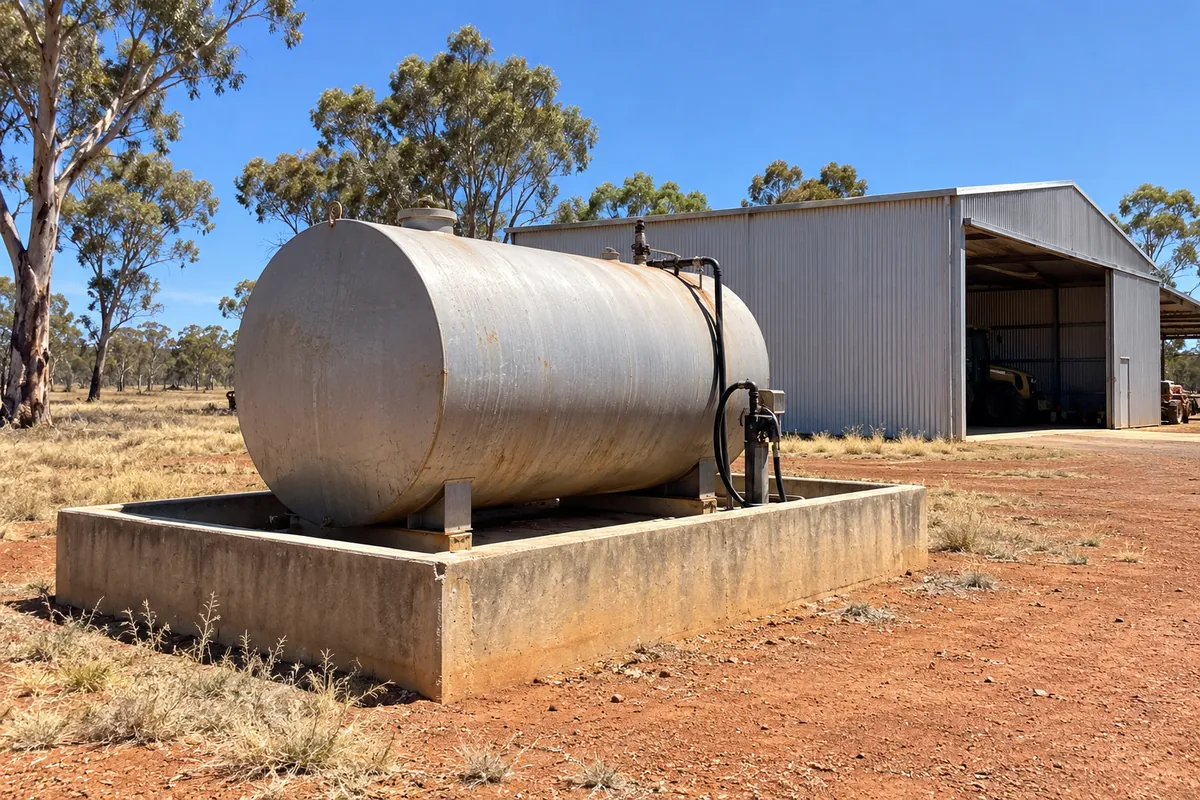
Australia has no national bund percentage. Workplace law (regulation 357 of the WHS Regulations, regulation 40 of Victoria’s dangerous goods regulations) requires spill containment without a figure. State guidance supplies one: the greater of 110% of the largest container or 25% of the total in NSW and Victoria, 120% of the largest tank in SA. New Zealand writes its figures into law, up to 100% of the total.
Quick answer: How big must a bund be in Australia and New Zealand?
Australian workplace law requires spill containment (regulation 357) but sets no size. States set one: for drum stores, NSW and Victoria ask for the larger of 110% of the biggest container or 25% of the total, and South Australia asks for 120% of the largest tank. New Zealand puts its figures in the law, up to 100% of the total.
Yes, as a duty without a number. Regulation 357 of the model Work Health and Safety Regulations makes a business provide a spill containment system wherever a liquid or solid hazardous chemical is used, handled, generated or stored, so far as is reasonably practicable. The system must keep the spill and its effluent within the workplace, must not bring incompatible chemicals together, and must allow for clean-up and disposal. Every state and territory except Victoria uses the national model laws (WorkSafe WA). NSW carries the duty in section 357 of its Work Health and Safety Regulation 2025, in force since 22 August 2025.
Victoria puts the duty on the occupier of a dangerous goods site through regulation 40 of the Dangerous Goods (Storage and Handling) Regulations 2022, which adds that a tank’s containment must not be shared with incompatible substances. Western Australia has a second layer for dangerous goods sites: regulation 51 of its 2007 storage and handling regulations asks for a drain, sump, tank, compound or other system that can contain and recover a spill. None of these texts gives a percentage.
The codes point to the standards. Queensland’s hazardous chemicals code (2021, page 42) says large quantities may need bunding built to the relevant Australian Standard, such as AS 1940 for flammable and combustible liquids. Standards Australia sells AS 1940 and AS 3780 (corrosives), so this page quotes no figures from them.
“Or” means whichever is greater. Guidance is the regulator’s expectation, and a licence, consent or approval condition can make it binding.
| Where | Law (the duty) | Guidance | Drums and packages | Tanks |
|---|---|---|---|---|
| NSW | WHS Regulation 2025, s 357 | Storing and Handling Liquids manual (2007) | 25% of total or 110% of largest | 100% of largest |
| Victoria | Dangerous Goods (Storage and Handling) Regulations 2022, r 40 | EPA Victoria Publication 1698 (2018) | 25% of total or 110% of largest | 100% of largest, plus 10% of the second largest |
| Queensland | WHS Regulation 2011, s 357 | WorkSafe Queensland, fuel at events | 100% of largest plus 25% of total | Over 100% of largest |
| Western Australia | WHS (General) Regulations 2022, r 357; DG regulations 2007, r 51 | Water quality protection note 65 (2015) | 110% of largest plus 25% of the rest | Referred to WQPN 56 and 61 |
| South Australia | WHS Regulations 2012, r 357 | EPA guideline 080/16 (2016) | 25% of total | 120% of largest; 133% if flammable |
| New Zealand | Hazardous Substances Regulations 2017 | Figures are in the law | 50% or 100% of total below 5,000 L | 110% of largest |
Tasmania, the ACT and the Northern Territory apply regulation 357 through their own WHS Regulations. We found no figure from their regulators to check, so ask them or work to the NSW and Victorian figure, which our spill pallet sizing calculator uses. The secondary containment requirements guide sets these rules beside the UK, US and Europe.
NSW guidance asks a drum store for the greater of 25% of the total or 110% of the largest container, and a bulk store for 100% of the largest tank. Both figures come from Storing and Handling Liquids: Environmental Protection (Department of Environment and Climate Change, May 2007, pages 40 to 43), a manual the EPA still publishes. It adds freeboard for rain and fire water where either can enter, 10% at the least, and suggests sizing rain on a 1-in-20-year, 24-hour storm and fire water on 20 minutes of sprinkler output.
The manual is strict about what counts. An area with a drain to stormwater is not secondary containment, a brick or block wall needs an internal waterproof lining, and unlined earth does not give the impermeable barrier it asks for. At liquid waste treatment facilities the EPA expects separate bunds for different classes of dangerous goods and bunds kept clear of anything that reduces their capacity (EPA, updated July 2023). An environment protection licence can turn any of this into a condition.
EPA Victoria’s Liquid storage and handling guidelines (Publication 1698, June 2018, page 22) ask a bulk store for 100% of the largest tank, plus a suggested 10% of the second largest and 10% freeboard for rain and fire water. A store of drums and small containers takes 25% of the total plus freeboard, and the guideline’s Figure 9 sizes it at the greater of that or 110% of the largest container. A tanker loading bay should hold the greater of the largest compartment, capped at 9,000 litres, or two minutes’ flow from the two fastest filling points.
The legal duty is regulation 40 of the Dangerous Goods (Storage and Handling) Regulations 2022, in effect since 26 November 2022 (WorkSafe Victoria). Publication 1698 still cites regulation 41 of the 2012 regulations they replaced. Beyond dangerous goods, section 25 of the Environment Protection Act 2017 sets a general environmental duty to eliminate or reduce the risk of harm from pollution and waste so far as reasonably practicable.
Queensland sets the duty in section 357 of the Work Health and Safety Regulation 2011 and the method in its Managing risks of hazardous chemicals in the workplace Code of Practice 2021. The code lists what sizes a spill containment system: the quantity, the largest container or reasonably foreseeable spill, fire water, separate containment for incompatible goods, and materials that resist the chemical. Under section 26A of the WHS Act, a duty holder follows an approved code or a method at least as safe.
WorkSafe Queensland does publish figures for temporary fuel storage at events. A package store needs a non-combustible spill compound holding 100% of the largest package plus 25% of all packages, so twenty 200-litre drums need more than 1,200 litres. A bulk tank’s compound holds more than 100% of the largest tank. Event package stores are capped at 10,000 litres and tanks at 50,000, and workers dispensing fuel must have access to a spill kit.
Western Australia’s figure comes from the Department of Water’s Water quality protection note 65 (April 2015): a storage compound should hold at least 110% of the largest container plus 25% of all the others, with room for rainfall outdoors. Containers under 250 litres should sit in a weatherproof building on a reinforced concrete floor that drains to a sump or has a perimeter bund. A short-term store, typically under 12 months, adds room for at least an hour of fire-fighting water and any captured stormwater.
South Australia’s EPA guideline 080/16, Bunding and spill management (updated May 2016), asks the most of tanks: at least 120% of the largest tank, 133% for flammable liquids. Where sprinklers cover the compound, the bund gains 20 minutes of sprinkler output or rises to 133%, whichever is greater. Drums and small containers need 25% of the total. Tank bund walls should stand 0.5 to 1.5 m high and at least 1 m from the tanks.
New Zealand sets the figures in law. The Health and Safety at Work (Hazardous Substances) Regulations 2017 require secondary containment at any place in a workplace where liquids of a hazard class exceed the quantity in Schedule 9 or Schedule 16 (r 10.30 and 13.30). The thresholds run from above 100 litres of class 3.1A flammable liquids or class 8.2A corrosives to above 10,000 litres of diesel. Petrol is exempt below 1,000 litres at the place. The bund size depends on container size and on everything at the place, and where sizes are mixed each band is sized and the bund holds the sum (r 10.30(3)).
| Containers at the place | Flammable, class 3 (r 10.31–10.33) | Toxic or corrosive only, class 6 or 8 (r 13.31–13.33) |
|---|---|---|
| Each 60 L or less | 50% of total below 5,000 L; above, 2,500 L or 25% | 25% of total below 20,000 L; above, 5,000 L or 5% |
| Any over 60 L | 100% of total below 5,000 L; above, 5,000 L or 50% | 25% of total or 110% of largest below 20,000 L; above, 5,000 L or 5% |
| Portable tank or tank wagon | 110% of largest tank or compartment | 110% of largest tank or compartment |
| Stationary tank above ground, 250 L or more | 110% of largest (r 17.100) | 110% of largest (r 17.100) |
| Stationary tank below ground | 100% of total (r 17.101) | 100% of total (r 17.101) |
A class 6 or 8 liquid that also has a class 1 to 5 hazard takes the class 3 figures. WorkSafe can approve a smaller bund for a stationary tank, never below 100% of the largest (r 17.100(3) to (5)). A regional council plan or resource consent can add its own conditions.
Multiply the inside length, width and wall height in metres, then multiply by 1,000 for litres. A bund 4 m by 3 m with walls 0.5 m high holds 6 m³, or 6,000 litres, before anything stands in it. Subtract the volume that tanks, plinths and containers take up below the top of the wall (EPA Victoria 1698, page 23; EPA SA 080/16), and treat tanks joined by pipework as one tank.
Then compare the result with your rule’s figure. The 25% figure takes over in a store of many small containers: ten 205-litre drums need 513 litres in NSW, Victoria and SA, against 226 for one drum. Outdoors, add freeboard for rain. Our drum spill pallet size and IBC bund size pages work the answer for one to four drums or IBCs in each country.
A diesel tank needs a bund of at least its own capacity in every state guide we checked, and 110% in New Zealand. There, the rule starts once more than 10,000 litres of diesel is at the place. An above-ground stationary tank of 250 litres or more then needs 110% of the largest tank, and a below-ground tank needs containment for everything in it, such as a double skin or a watertight pit (WorkSafe New Zealand).
| Rule | Bund for one 20,000-litre diesel tank |
|---|---|
| NSW and Victorian guidance | 20,000 L, plus at least 10% where rain or fire water can enter |
| EPA South Australia 080/16 | 24,000 L |
| WorkSafe Queensland, event fuel | More than 20,000 L |
| New Zealand, r 17.100 | 22,000 L |
For fuel decanted into cans and drums, see generator fuel storage and storing fuel safely.
The NSW manual counts mobile and prefabricated systems as secondary containment, so a spill pallet’s sump counts toward the figure. Ten 205-litre drums of petrol, 2,050 litres, need 513 litres of sump under NSW, Victorian or SA guidance, 687 under WA’s note, 718 under WorkSafe Queensland’s event figure and the full 2,050 in New Zealand.
EPA South Australia accepts spill pallets for temporary drum storage if each pallet can hold at least one drum’s contents, stands level and is covered so it does not fill with rain. The NSW manual warns that a plastic bund may stop working in a fire, and WorkSafe Queensland wants event fuel compounds in non-combustible material such as steel. A drip tray catches drips at a working point; see drip trays and spill trays and choosing a spill pallet.
Australian law asks for the means to clean up and names no kit. Regulation 357(3) makes the containment system provide for clean-up and disposal, and regulation 360 requires emergency equipment to be always available where hazardous chemicals are used, handled, generated or stored; NSW sections 357 and 360 read the same. The NSW manual and EPA Victoria name the kit: absorbent suited to the liquid, kept stocked and checked, with staff trained to use it.
New Zealand names the duty for toxic and corrosive liquids. Where class 6.1A to 6.1C, 8.2A or 8.2B substances are present, spill and clean-up equipment, or neutralisers and absorbents, must be readily available (r 13.45). Above the Schedule 5 quantities, an emergency response plan lists equipment that must be on site or able to arrive in the time the plan sets (r 5.9). Our spill kits guide covers contents and sizes.
We make the containment these rules size. Polyethylene drum spill pallets take one to four drums, with sumps from 42 to 488 litres, and IBC pallets take one to three tanks, with sumps from 120 to 1,600 litres. Double-layer 3 mm steel pallets suit stores where the bund has to be non-combustible. Our triple-IBC and ten-drum pallet holds 1,600 litres: above every Australian figure for ten drums of petrol, short of New Zealand’s 2,050.
Our four-drum pallets hold 216 to 488 litres, enough for South Australia’s one-full-drum test with 205-litre drums. For outdoor stores we supply covered pallets, and we quote models without a drain plug, since NSW and SA guidance rule out taps and drain valves in a bund. Send us the liquids, the containers and the state, and we will size the store to the figure that applies there.
| Your use case | Recommended can | Why this one |
|---|---|---|
| Drums in storage | 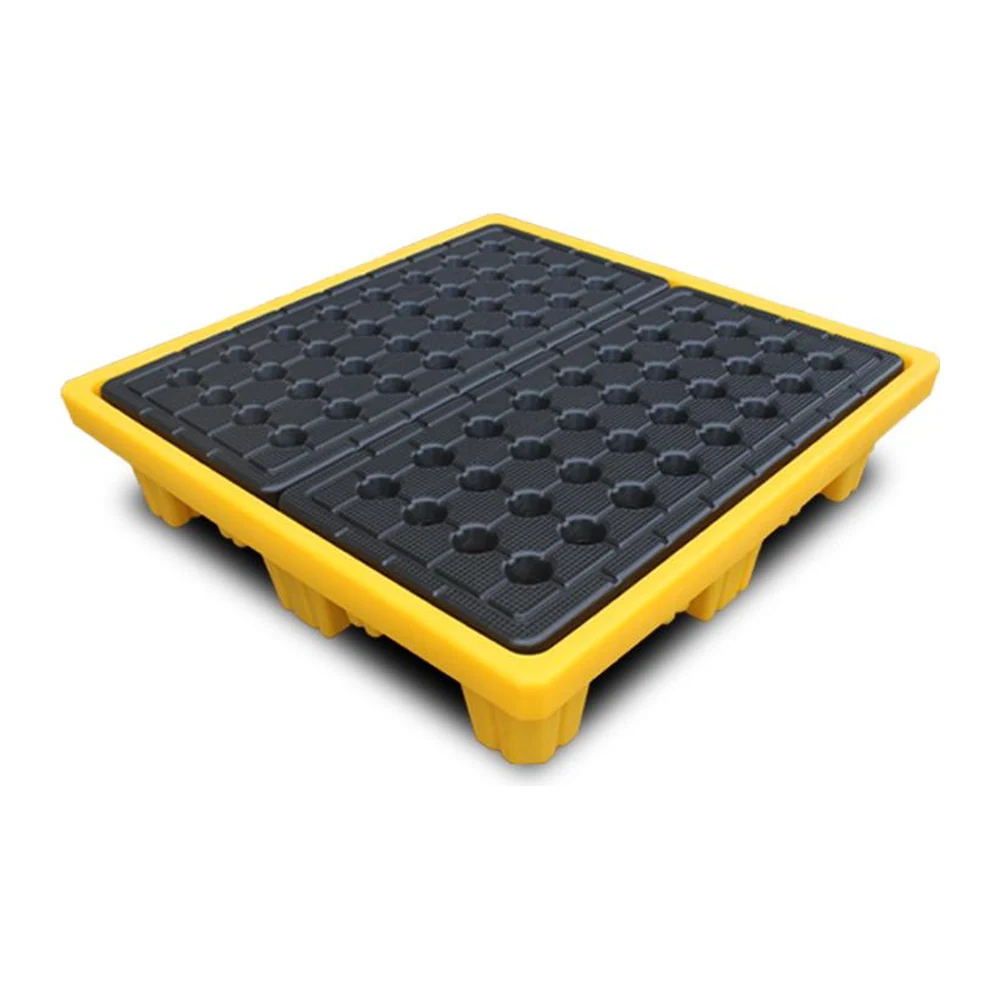 Drum Spill Pallets |
Sumps from 42 to 488 litres for one to four drums. |
| IBCs and ten-drum stores | 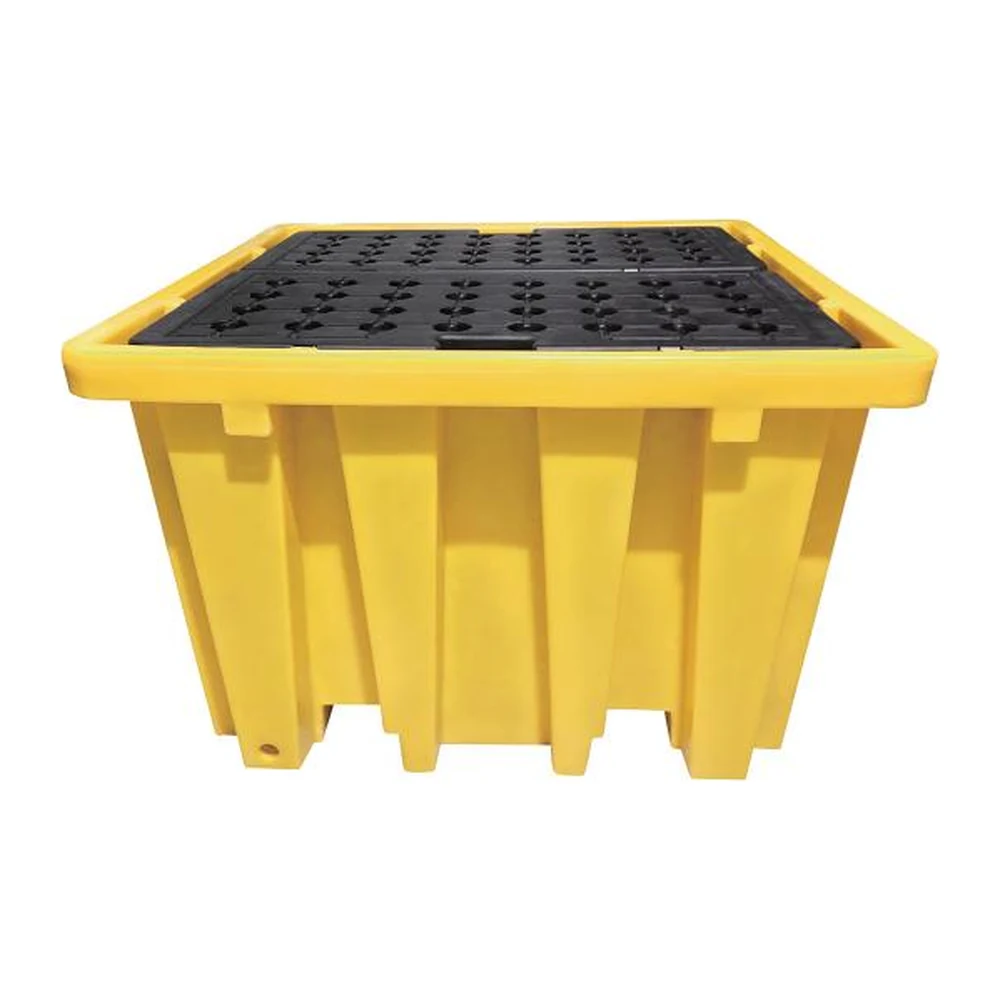 IBC & Multi-Container Spill Pallets |
Sumps from 120 to 1,600 litres; linkable models pool their sumps. |
| Fuel stores that must not burn | 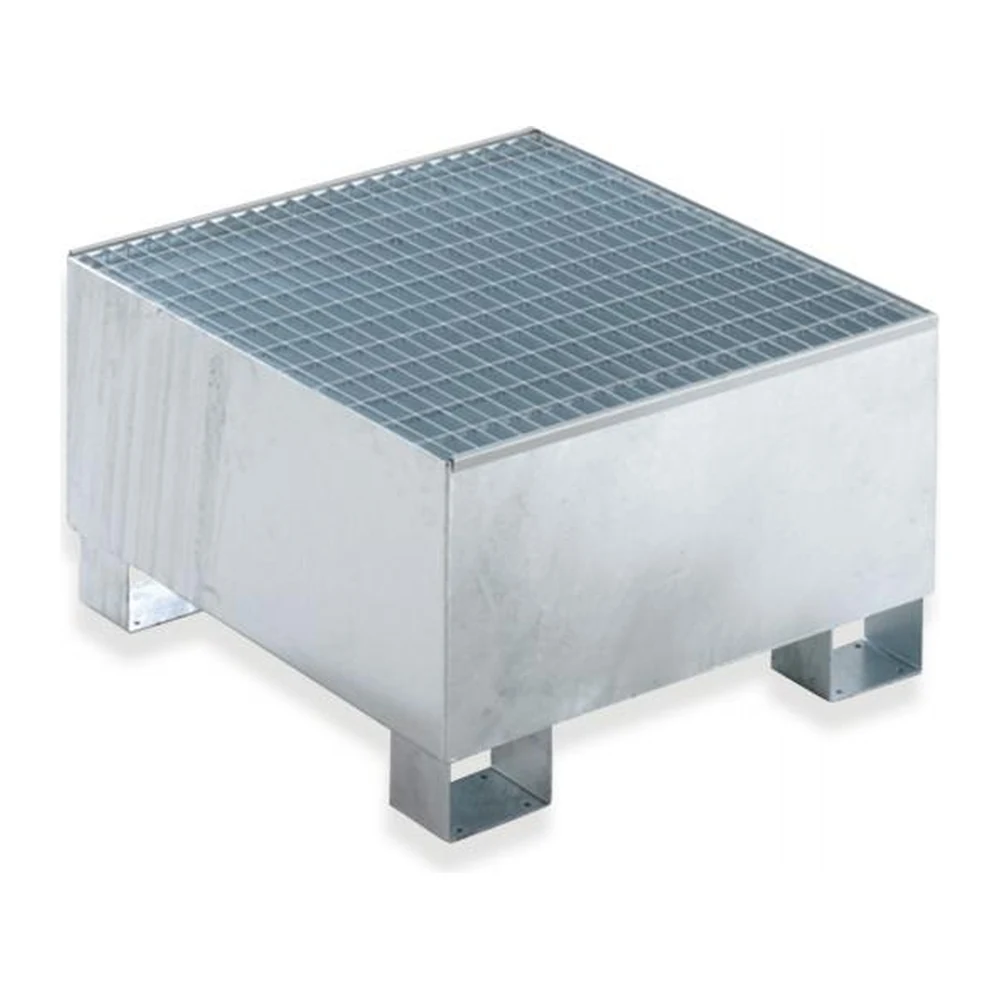 Steel Spill Pallets |
Double-layer 3 mm steel where the bund has to be non-combustible. |
| Outdoor stores | 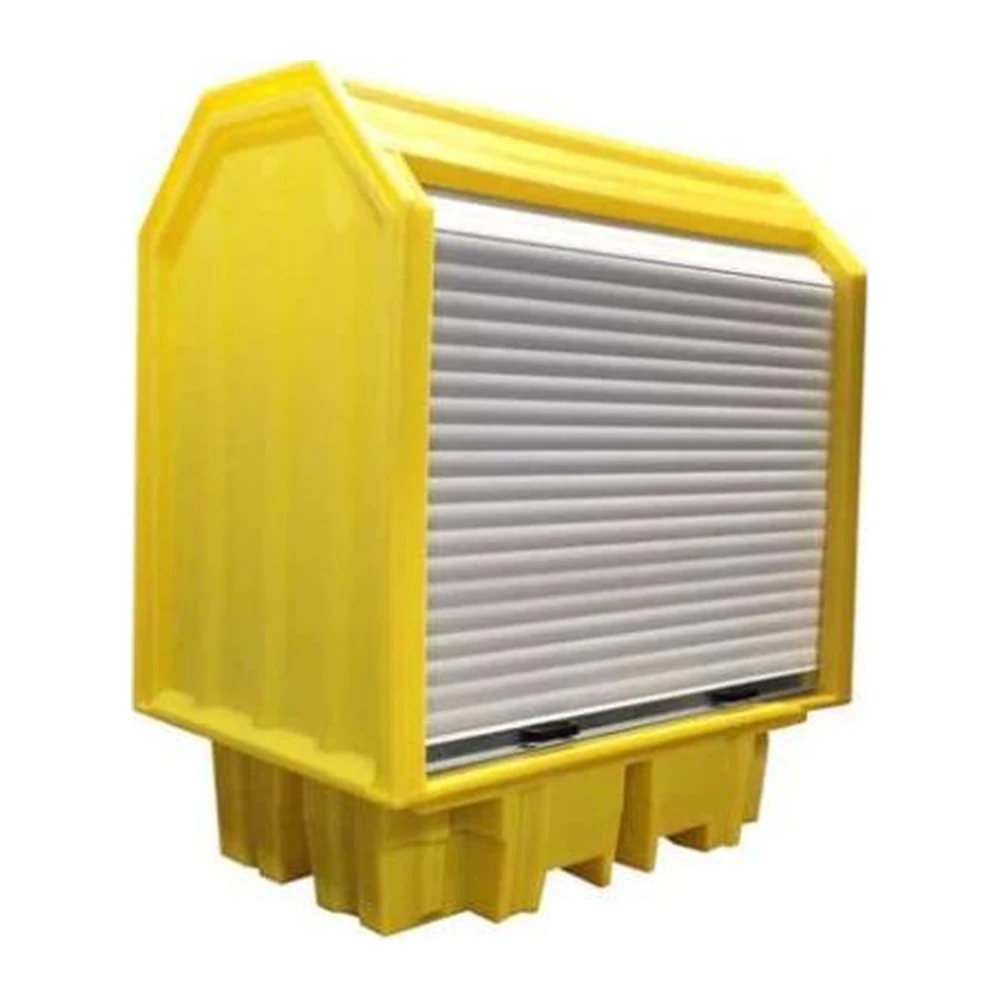 Covered Spill Pallets & Covers |
A cover keeps rain out of the sump the guidance counts on. |
| Decanting and small containers | 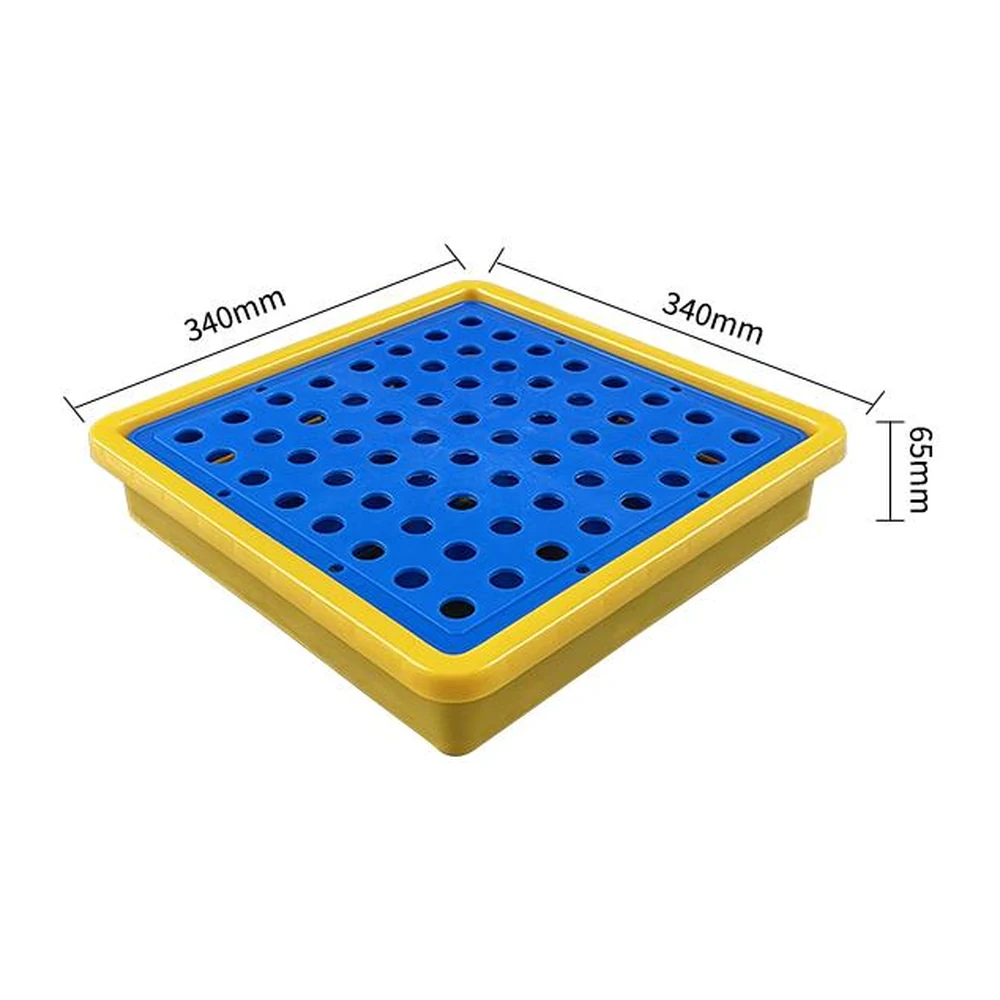 Bench Trays & Drip Trays |
Trays from 4 to 150 litres under cans, pails and bench work. |
| Spill clean-up | 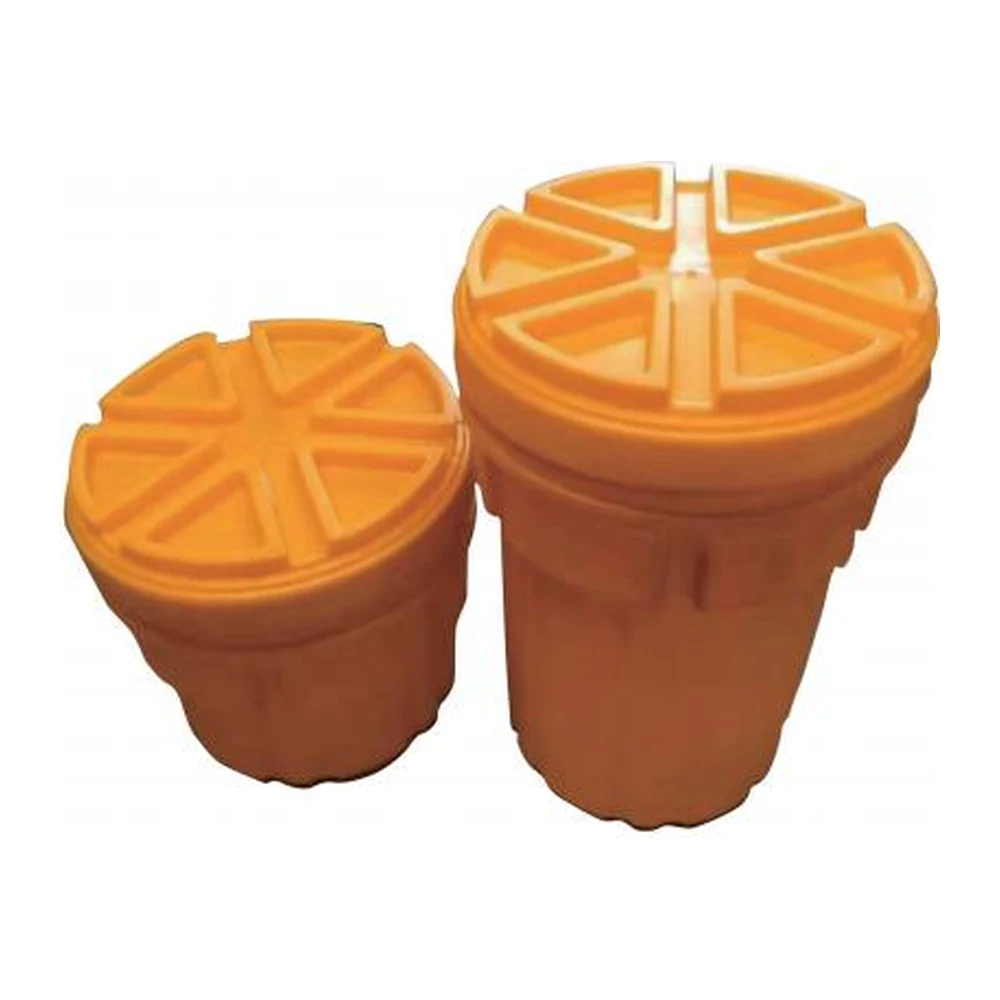 Salvage Drums & Spill Response Storage |
Overpack drums and kit storage for the clean-up regulation 357 asks for. |
A bund wall is a wall of brick, stone, concrete or other impervious material that, with an impervious floor, forms a compound around tanks or drums and holds back anything that leaks from them. That is how EPA South Australia’s guideline 080/16 defines it, adding that the whole contained area is often called the bund. A spill pallet does the same job in a moulded or welded tray you can move.
It means the bund holds the largest container inside it plus a tenth: 1,100 litres for a 1,000-litre IBC, 226 litres for a 205-litre drum. NSW and Victorian guidance set this figure beside 25% of the total and take the greater. New Zealand law sets 110% of the largest tank for above-ground stationary tanks of 250 litres or more and for portable tanks (r 17.100 and 10.33(1A)).
No rule reviewed here asks for one. Regulation 357 covers hazardous chemicals and New Zealand’s rules cover hazardous substances, and EPA South Australia’s list of sites that should be bunded covers those storing substances other than water or uncontaminated stormwater. A drip tray under a water dispenser, a washing machine or a water can protects the floor, and no bund rule sets its size.
Yes, where the waste is a hazardous chemical or dangerous goods. Regulation 357 covers chemicals generated at the workplace as well as those stored, and NSW EPA’s guidance for the liquid waste industry (2016) says tanks and drums of liquid waste must be stored with adequate secondary containment. At liquid waste treatment facilities the EPA expects every chemical container in a bund and a working stormwater cut-off valve.
Not below set amounts. A farm of 4 hectares or more is exempt where it holds under 2,000 litres of petrol, diesel or kerosene in containers, or under 2,500 litres in stationary tanks. The store must be sited so a spill cannot endanger a building or flow into a stream, lake or natural water (r 10.30(6)(d) and 17.99(6)(d)). Diesel on its own needs containment only above 10,000 litres at the place.
In New Zealand, not if it meets four conditions (r 10.30(6)(c)). It stays under 2,000 litres, sits in a tank wagon or in containers each under 250 litres, is sited clear of buildings and water, and is on site for under 14 days. In Queensland, WorkSafe’s event guidance wants containment once a store passes minor storage, built from non-combustible material such as concrete, steel or earth.
A compliance certifier, for flammable liquids. A hazardous substance location holding class 3.1 liquids needs a current compliance certificate, and the certifier confirms the secondary containment in regulation 10.30 where the quantity requires it (r 10.34(1)(h)). WorkSafe New Zealand enforces the regulations, and a breach of the containment rules carries a fine of up to $10,000 for an individual and $50,000 for anyone else.
Not under the NSW and South Australian guidance. The NSW manual says a drainage pipe makes the bund ineffective and that tap valves get left open, and EPA South Australia says bund drain valves should not be installed. Both say to pump collected liquid from a blind sump inside the bund. A stormwater cut-off valve on the site drains is a different control, and NSW EPA expects one at liquid waste sites.
Yes, where it can. NSW and South Australian guidance prefer a roof because rain uses up the capacity the bund was sized for, and both suggest an overhang of 12 degrees from vertical to keep driven rain out. Where a roof is unsafe or impractical, the NSW manual asks for a way to test, store and dispose of the water that collects. A cover does the same job for a spill pallet.
Where corrosives are handled, yes. Queensland’s hazardous chemicals code (2021, page 90) says eyewash and safety showers should be readily accessible where corrosives are handled or transferred. Regulation 362 of the model WHS Regulations requires safety equipment that controls a chemical risk to be provided, maintained and readily accessible. Keep the eyewash within reach of the decanting point.
Several, set by class of dangerous goods. The guidance names AS 1940 for flammable and combustible liquids, AS 3780 for corrosive substances and AS 3833 for mixed classes in packages and IBCs. It also names AS 2507 for agricultural and veterinary chemicals, AS 4326 for oxidising agents and AS 4452 for toxic substances. Standards Australia sells them, and the NSW manual tells you to meet them on top of its own figures.
Not always. The NSW manual counts a container with integral secondary containment as secondary containment, provided the design gives a way to check the inner tank. In New Zealand, WorkSafe lists a double-skinned tank as a common way to meet the below-ground rule, which asks for containment of everything in the tank (r 17.101). Above ground, check the figure your rule sets for the outer skin.
The standards and regulations this page relies on, at their issuing body. Where a market rule is named here, check the current revision before you specify against it.
Last reviewed by David Guru, Co-Founder & Business Development Director.
Tell us the containers, the liquid and where the store is. We come back with the pallet or bund, its load rating and a quotation.