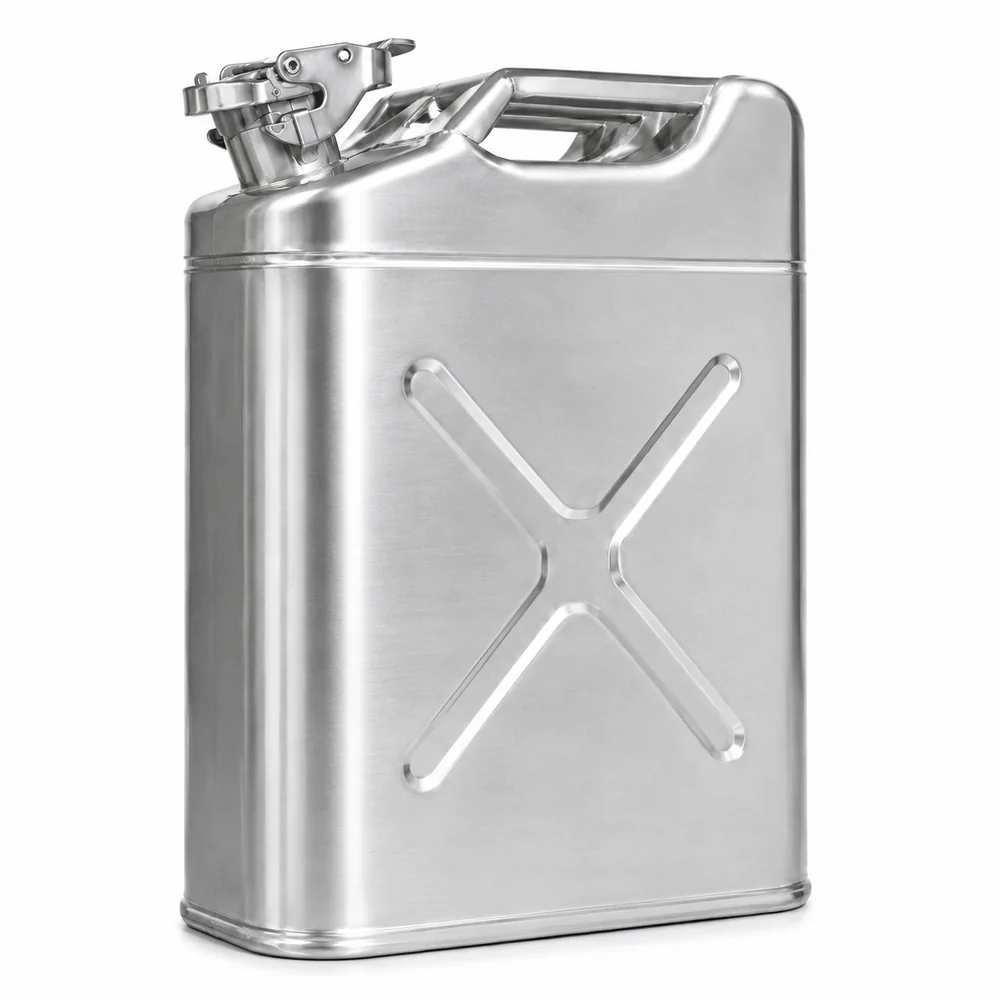
The aluminium jerrican: its limits, its construction rules and the tests behind the mark.
UN 3B1 is the packaging code for an aluminium jerrican with a closed head: 3 for jerrican, B for aluminium, 1 for a head that does not come off. It holds at most 60 litres and 120 kg net, and every seam is welded.
Decode a full 3B1 mark Ask for 3B1 containers
| Character | Meaning |
|---|---|
3 | Jerrican: rectangular or polygonal cross-section |
B | Aluminium, at least 99 per cent pure or an aluminium-based alloy |
1 | Non-removable head, with openings no wider than 7 cm |
| Maximum capacity | 60 litres (6.1.4.4.5) |
|---|---|
| Maximum net mass | 120 kg |
As a single packaging for liquids, packing instruction P001 sets the working limits by packing group. For a 3B1 that is 60 litres in every packing group, and 120 kg for solids.
Liquids or solids, in any packing group the mark allows. The body and heads are aluminium of at least 99 per cent purity or an aluminium-based alloy, every seam is welded, and any chime seam is reinforced with a separate ring (6.1.4.4).
| Test | What the design has to survive | Paragraph |
|---|---|---|
| Drop | Filled to at least 98 per cent and dropped on its weakest points: from 1.8 m for packing group I, 1.2 m for II and 0.8 m for III. Tested with water, a liquid denser than 1.2 drops from its relative density times 1.5, 1.0 or 0.67 m. | 6.1.5.3 |
| Leakproofness | Held under water for five minutes at an air pressure of 30 kPa for packing group I or 20 kPa for II and III. Every container made for liquids passes the same test before its first use. | 6.1.5.4, 6.1.1.3 |
| Internal pressure | Held for five minutes at the hydraulic pressure the mark states, at least 250 kPa for packing group I. | 6.1.5.5 |
| Stacking | Carries the weight of a 3 m stack of identical full packages for 24 hours without leaking or losing strength. | 6.1.5.6 |
A design marked S for solids needs the drop and stacking tests only. The leakproofness and pressure tests belong to designs for liquids.
No period-of-use limit applies to steel or aluminium drums and jerricans: the five-year rule in 4.1.1.15 covers plastics only. A container made for liquids passes a leakproofness test before its first use.
3A1 is the steel version. Steel body seams need welding only above 40 litres of liquid, while every seam on an aluminium jerrican is welded. A cylindrical aluminium bottle is a drum under the UN definitions, so it codes as 1B1, not 3B1.
UN 3B1/X1.2/250/25/NL/VL831A closed-head aluminium jerrican, approved for packing groups I, II and III, for liquids up to relative density 1.2, pressure-tested at 250 kPa, made in 2025, design approved in the Netherlands.
| Part | On the mark | What it means |
|---|---|---|
| Packaging code | 3B1 | Closed-head aluminium jerrican (3 = jerrican, B = aluminium, 1 = non-removable head) |
| Performance level | X | Approved for packing groups I, II and III (high, medium and low danger) |
| Relative density | 1.2 | Tested for liquids up to a relative density of 1.2 (water is 1.0) |
| Test pressure | 250 | Passed a hydraulic pressure test at 250 kPa |
| Year of manufacture | 25 | Made in 2025 |
| Approving country | NL | Design approved in the Netherlands |
| Manufacturer or approval number | VL831 | Identifies the manufacturer or the approved design, as set by the approving authority |
Another 3B1 mark, decoded: UN 3B1/Y1.6/150/25/D/BAM 2210
Approval is per design and per plant, and each design carries its own level, density and test pressure. Send your contents and we confirm the design that matches your mark.
An aluminium jerrican with a closed head that passed the UN tests for dangerous goods packaging: 3 is jerrican, B is aluminium and 1 is a head that does not come off.
3B1 is a jerrican, rectangular or polygonal, of up to 60 litres. 1B1 is a cylindrical aluminium drum, which includes round aluminium bottles, of up to 450 litres.
The standards and regulations this page relies on, at their issuing body. Where a market rule is named here, check the current revision before you specify against it.
Checked against the UN Model Regulations, Rev. 24, and ADR 2025 on 5 October 2026. Decode any other mark with our UN packaging code decoder.
Send what goes in them, the size and where they ship. We reply with the design certified to this code, the plant named on its certificate, and a price.