
What size a paint tin is, how its lid works, when paint counts as dangerous goods and where an empty tin goes.
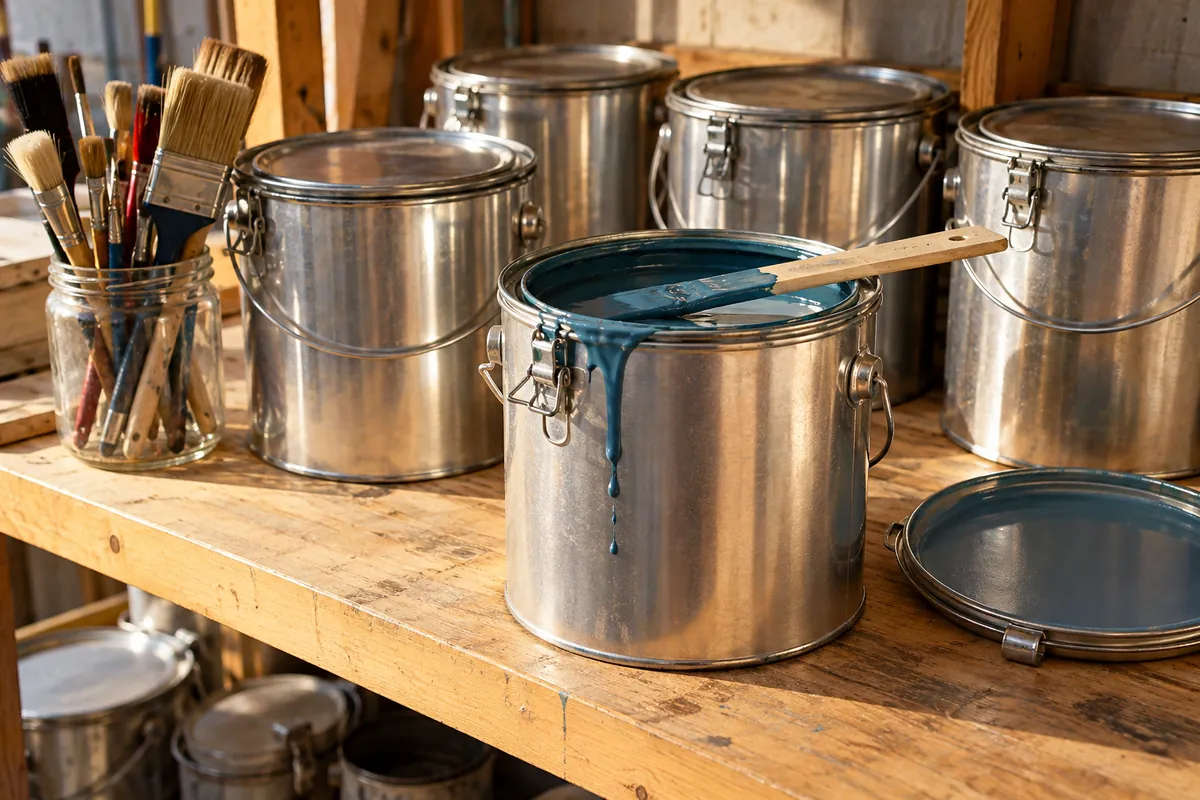
No paint tin size is standard: common UK tins hold 1, 2.5 and 5 litres, and US paint comes in a 0.946 litre quart or 3.785 litre gallon. Flammable paint is UN 1263 dangerous goods, but tins of 5 litres or less in packing group II or III can travel without UN-approved packaging. Empty, dry tins go to the recycling centre or, in some areas, the general bin.
Quick answer: What sizes do paint tins come in?
No size is standard; market convention sets them. In the UK the common tins are 1, 2.5 and 5 litres. US paint is sold by the quart (0.946 litres) and the gallon (3.785 litres), so a US gallon is 24% under a 5 litre tin. BS 1262:2002 covers round lever-lid tins of 125 ml to 10 litres nominal volume.
Paint tin sizes follow market convention, and they change with the maker and the country. The table shows what one maker lists in each of three markets; the UK row combines three products. The British Standard for the tin itself, BS 1262:2002, covers round lever-lid metal containers for paints and other surface coatings of 125 ml to 10 litres nominal volume. It sets tests for leaks, stacking strength, handle strength, lid security, print adhesion and corrosion, and its drop and topple lid tests apply up to 5 litres.
| Market | Pack sizes one maker lists there |
|---|---|
| UK | 500 ml, 750 ml, 1 L, 1.25 L, 2.5 L, 3 L, 5 L, 6 L, 7 L, 7.5 L, 10 L |
| Australia | 500 ml, 1 L, 2 L, 4 L, 10 L, 15 L |
| US | 8 oz sample, 1 quart (0.946 L), 1 gallon (3.785 L), 5 gallon (18.9 L) |
US and metric sizes sound alike but hold different volumes. A US quart is 5% under a litre. A US gallon is 24% under a 5 litre tin and 5% under the 4 litre tin of Australian ranges (NIST SP 811).
Our round metal tin covers the 250 ml, 500 ml, 1 L, 2.5 L and 5 L sizes in a range of fifteen from 50 ml to 6 litres.
A paint tin is tin-plated steel: cold-rolled steel with a tin coating, formed and seam-welded into a body. The wall of our round tins is 0.20 to 0.25 mm thick, and the print goes onto the flat sheet by four-colour offset lithography before forming. Tinplate and F-style cans explains the material and the can types.
Inside, a lacquer sits between the paint and the steel. Gold, clear and bare tinplate are not interchangeable: the lacquer is chosen against the contents, and a wrong one shows up as contamination or corrosion after shipping. Where a tin holds food, the food-contact document covers the lacquer that touches the food (food contact for pails and tins). Coatings on other steel containers are in corrosion protection and galvanizing.
The usual paint tin has a lever lid, a steel lid that presses into the channel around the rim. It opens with a screwdriver or a paint tin opener and reseals with the palm of your hand, the closure decorators and workshops want on a part-used tin. A screw cap suits a liquid you pour, such as thinners. Pails add two more: a flower lid, crimped on and opened once, and an iron hoop lever ring that reopens and reseals airtight.
To open a lever lid, lift it in several places around the rim so the lid stays flat and the seat round. A flat screwdriver does a tin opener’s job but bends the rim if you force one point. Wipe paint out of the channel before closing, press the lid down all round and, if it needs more, tap it down through a cloth with a rubber mallet.
Paint tinting adds colourant to a base paint in the tin and mixes it on a shaker, so a shop makes each colour to order from a base. A base tin can be filled short on purpose: one paint maker states that the volume in its can at filling is 10% less than the labelled amount, because it needs the spare volume for the colourant.
HSE’s guidance on storing flammable liquids in containers allows a tinting system in a shop’s sales area if the area is kept clean and well ventilated (HSG51 paragraph 261).
Keep paint out of sunlight, protected from damp and frost and away from extreme temperatures, as one UK paint maker advises. Heat is the risk to a brimful tin. HSE warns of containers “overfilled and liable to failure” and asks for ullage so the liquid can expand at the highest ambient temperature the tin will meet (HSG51 paragraph 69). ADR 4.1.1.4 says liquids must not fill a packaging to the brim at 55 °C.
Heat also raises the vapour pressure of a solvent-based paint, which is why ADR splits the UN 1263 entries at 110 kPa at 50 °C. HSE asks you to allow for warming in direct sunlight (paragraph 70), to shade stores where necessary (paragraph 72) and to keep containers off hot surfaces such as heating pipes (paragraph 73).
At a workplace, flammable paint falls under DSEAR, with COSHH covering the health risks. HSE recommends keeping in a workroom cabinet or bin no more than 50 litres of the most flammable liquids, including those with a flash point below the room’s highest ambient temperature. For other flammable liquids up to 60 °C the figure is 250 litres (HSG51 paragraphs 211 and 212; these are recommended maxima). Read COSHH storage requirements and DSEAR and ATEX for the rest.
Flammable paint is dangerous goods on the road because it is a flammable liquid: UN 1263 PAINT, Class 3, in packing group I, II or III. Section 14 of the safety data sheet lists the UN number, class and packing group (OSHA 29 CFR 1910.1200 Appendix D), and our UN 1263 page lists the six entries and the containers each allows. Two kinds of paint fall outside. A viscous paint with a flash point from 23 °C to 60 °C is not subject to ADR if it meets the conditions in ADR 2.2.3.1.5.1. Among them, it is not toxic, corrosive or environmentally hazardous; it is packed in 450 litres or less; and it passes the solvent separation and flow time tests. A water-based paint with no flash point at or below 60 °C is outside Class 3. It is dangerous goods only if its maker classes it as environmentally hazardous: UN 3082 in Class 9, where packagings of 5 litres or less need meet only the general packing provisions (special provision 375).
Limited quantities settle most tin shipments. Column 7a of ADR 2025 Table A sets the largest inner packaging for UN 1263: 500 ml in packing group I and 5 L in packing groups II and III. Inner tins of that size or less go in a suitable outer packaging of no more than 30 kg gross, or 20 kg on a shrink-wrapped tray (ADR 3.4.2 and 3.4.3), and the package carries the LQ diamond (3.4.7). The packaging does not have to be UN approved (HSE). The limited quantities guide has the full rules.
A second relief covers loads above limited quantities. Special packing provision PP1 on packing instruction P001 lets metal or plastic packagings of 5 L or less in packing groups II and III skip the Chapter 6.1 tests. This applies when they travel on pallets, or as inner packagings of a combination packaging up to 40 kg net. It covers UN 1263 and paints under UN 3082, and waives the packaging tests only. Packing group I has no such relief. The UN number packaging finder lists the containers every entry allows; packing groups explained covers the groups.
A container’s shape decides its UN code. A drum is a cylindrical packaging, and the definition takes in pail-shaped ones; a jerrican is a metal or plastic packaging of rectangular or polygonal cross-section (49 CFR 171.8). A round tinplate pail therefore certifies as a drum and a square tin as a jerrican.
| Format | Code it would take | Why |
|---|---|---|
| Round tinplate pail, flower lid or lever ring | UN 1A2 | Cylindrical steel, removable head |
| Round metal bucket, tight-head | UN 1A1 | Cylindrical steel, non-removable head |
| Square tin with a wide pouring head | UN 3A1 | Rectangular cross-section, non-removable head |
| Small tins packed in a fibreboard box | UN 4G on the box | A combination packaging takes its outer packaging’s code (49 CFR 178.502) |
The table gives the code each design would take. It makes no claim that a given build holds a certificate. Approval is certified per design type, made under quality assurance the competent authority accepts. Most paint tins of 5 litres or less need none of this, given the relief above. The UN packaging code decoder reads any mark; UN packaging codes explained lists each code.
It depends on your council. Of four checked for empty tins, three take them in the general waste bin and none lists the kerbside recycling bin. Worcestershire sends empty tins to the black or grey bin or the general waste container at a recycling centre, and rules out the green recycling bin. Nottinghamshire allows tins that are empty or hold only dried paint in the household waste bin or at any recycling centre. Durham takes empty tins at a recycling centre or in the general waste bin. North Tyneside sends empty metal tins to the scrap metal container at the tip. Recycle Now (WRAP) says empty or dry metal paint cans are accepted at most recycling centres; check your local authority first.
Liquid paint stays out of the household bin. Recycle Now says recycling centres cannot take liquid paint because liquid waste is banned from landfill. Councils differ: Derbyshire takes household quantities of decorative paint at its centres, and Durham takes leftover water-based paint but treats gloss, lead-based and spray paint as hazardous. Solvent-based paint, thinners and white spirit are hazardous waste (Recycle Now). For leftover paint that is not solvent-based, Recycle Now advises hardening it with a hardener or with sawdust, sand or soil and leaving the lid off until it is solid and dry.
A business classifies its own waste. In Great Britain, waste paint containing organic solvents or other hazardous substances is code 08 01 11* in the waste list, a hazardous code; waste paint without them is 08 01 12 (WM3, Appendix A). A container counts as packaging waste only when it is empty, and WM3 gives a half-empty tin of solidified paint as one that is not. An empty tin with hazardous residue is 15 01 10*, hazardous; an empty tin with none is metal packaging waste, 15 01 04 (GOV.UK).
In the US, EPA says household hazardous waste, which includes paints, is regulated at state and local level. Federal rules exclude household waste from hazardous waste (40 CFR 261.4(b)(1)). A business is under other rules. A container that held hazardous waste is empty when the contents are removed by normal practice and no more than 2.5 cm (1 inch) of residue remains. For containers up to 119 gallons, 3% of capacity by weight is the alternative limit (40 CFR 261.7(b)(1)). In Australia, Paintback takes up to 100 litres a visit in containers of up to 20 litres and recycles the containers, subject to contamination.
Tin makers quote against a specification. Settle six points first.
| Point | What to settle |
|---|---|
| Size and fill | Nominal volume, base fill and headroom for colourant |
| Closure | Lever lid, screw cap, flower lid or lever ring, set by how the paint is used |
| Wall | 0.20 to 0.25 mm on our round tins, up to 0.38 mm on 35 litre pails; gauge follows fill weight and stack height |
| Lacquer | Gold or clear, chosen against the paint chemistry |
| UN need | Packing group and tin size against the 5 L and 0.5 L limits |
| Test standard | What the tin is tested to, such as BS 1262:2002 for round lever-lid tins |
Our round tin loads as below per 20ft (20GP) and 40ft high-cube (40HQ) container, unpalletised, from the factory’s published tables; your packing list is the figure that ships.
| Round tin | Per 20GP | Per 40HQ |
|---|---|---|
| 250 ml | 70,000 | 155,200 |
| 500 ml | 34,000 | 74,000 |
| 1 L | 18,000 | 39,000 |
| 2.5 L | 8,000 | 17,000 |
| 5 L | 3,200 | 8,600 |
Into the EU, paint tins are a listed steel packaging type under PPWR (Regulation (EU) 2025/40, Annex II): EU packaging rules shows who registers.
Fortitude21 makes tinplate tins, pails and buckets for paint, adhesives, thinners and coatings, in Vietnam and China to one specification managed from Singapore. The round tin runs from 50 ml to 6 litres and the square tin from 250 ml to 25 litres. The pails run from 4 to 35 litres with a flower lid or lever ring, and the dauber and brush-in-cap tins from 60 ml to 1 litre. We sell to businesses only.
We hold UN certification for our dangerous-goods jerrican designs, and our factories hold ISO 9001, 14001 and 45001. For a tin or pail that must carry UN 1263 above the limited quantity limits, tell us the packing group, the fill and the destination. We confirm the code the design certifies under and say what we would need to obtain.
| Your use case | Recommended can | Why this one |
|---|---|---|
| Retail and trade paint tins | 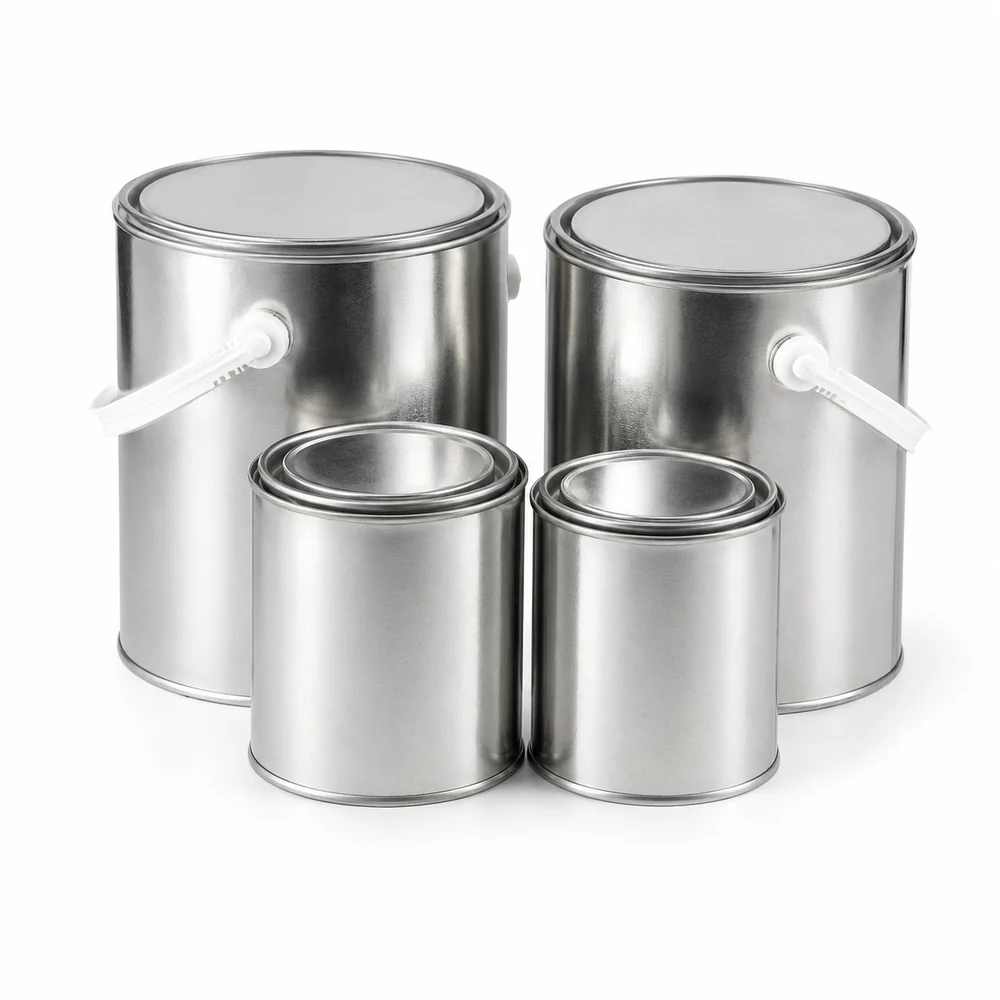 Round Metal Tin Can, 50ml to 6L |
Fifteen sizes from 50 ml to 6 litres on one body, with a lever lid or screw cap and gold or clear lacquer. |
| Thinners, solvents and additives | 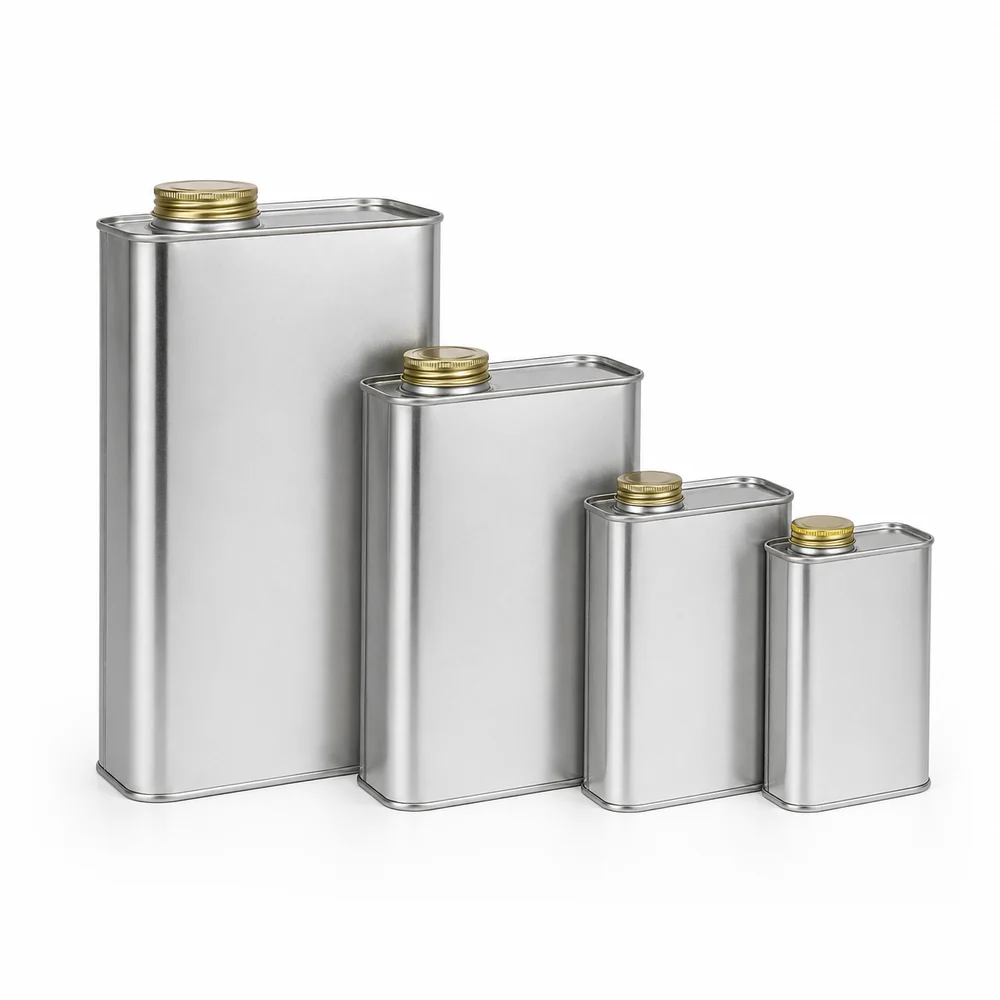 Square Metal Tin Can & Bucket, 250ml to 25L |
Square tins from 250 ml to 25 litres with a wide pouring head and four printable faces. |
| Trade paint in 4 to 35 litres | 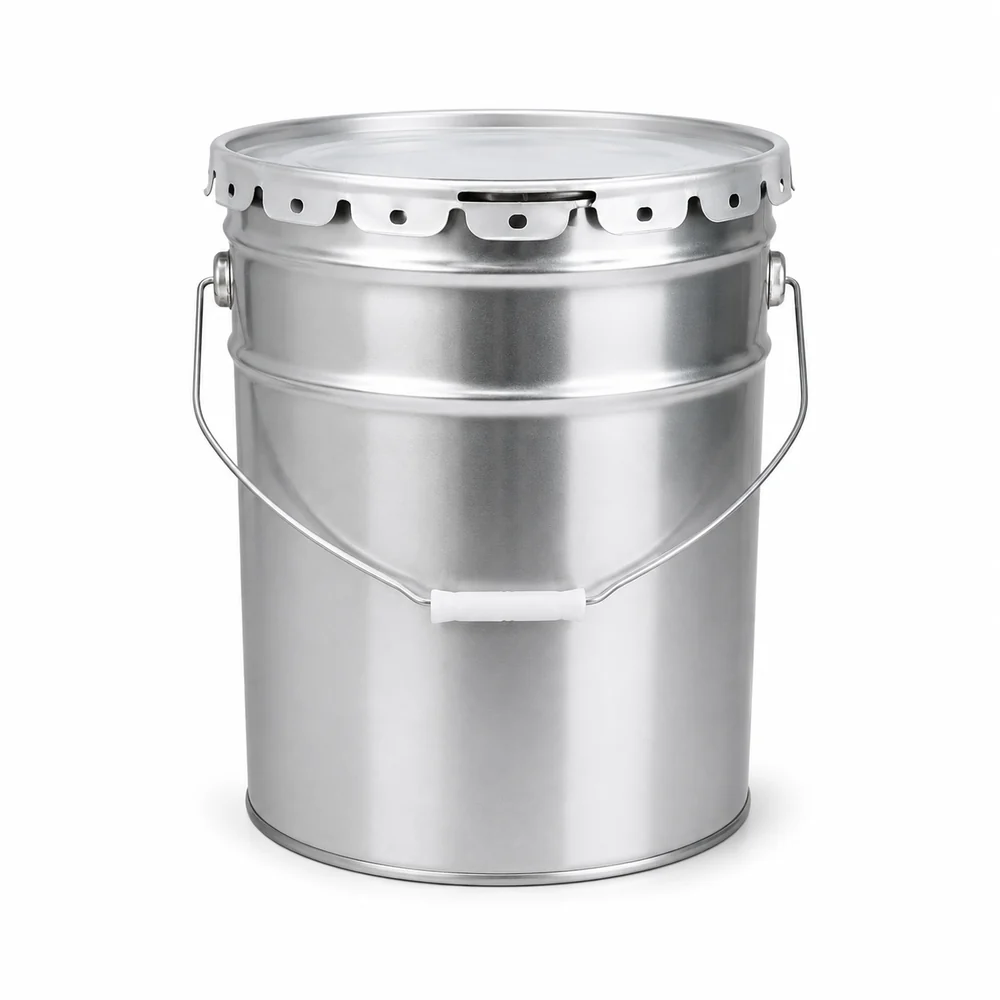 Metal Pail with Flower Lid or Lever Ring, 4L to 35L |
A flower lid for a permanent seal or a lever ring for a pail worked from over weeks. |
| Solvent-based paint that must not evaporate | 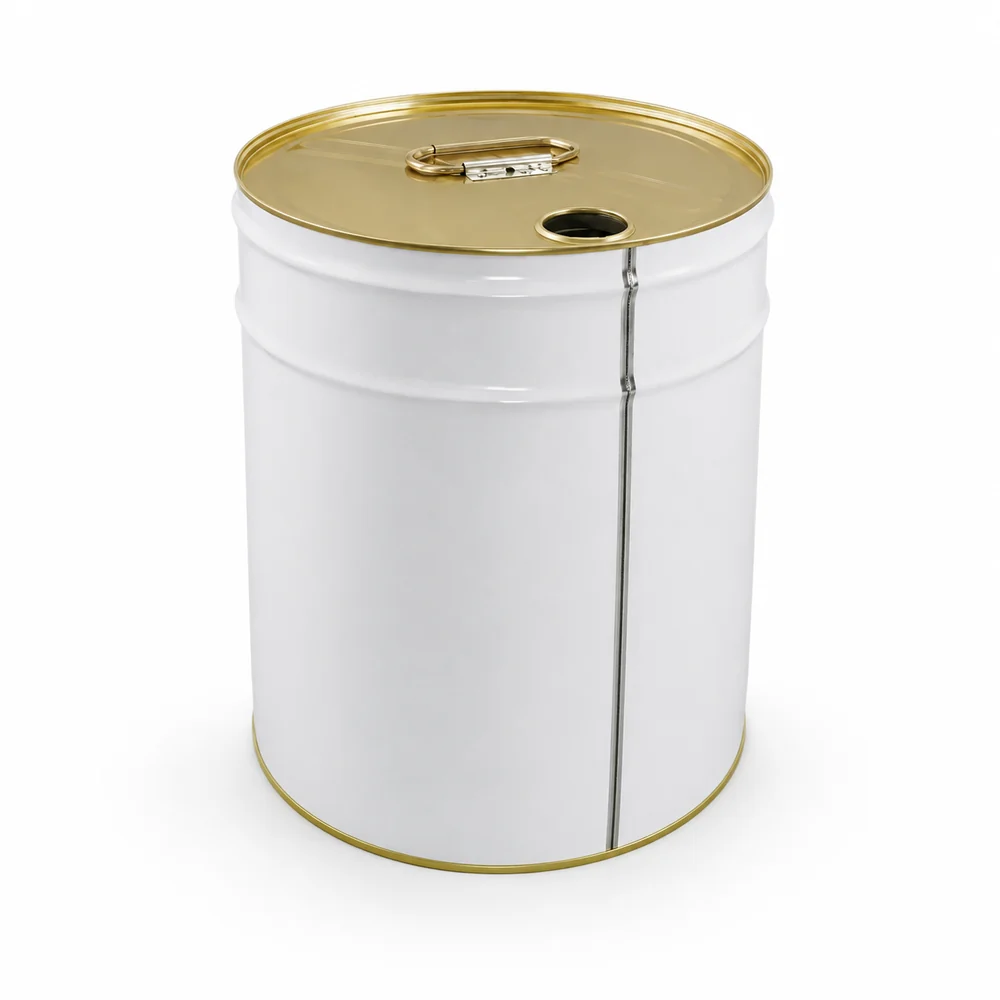 Round Metal Bucket, 5L to 25L |
Tight-head or open-head round tinplate bucket in four sizes from 5 to 25 litres. |
| Applied products in small tins | 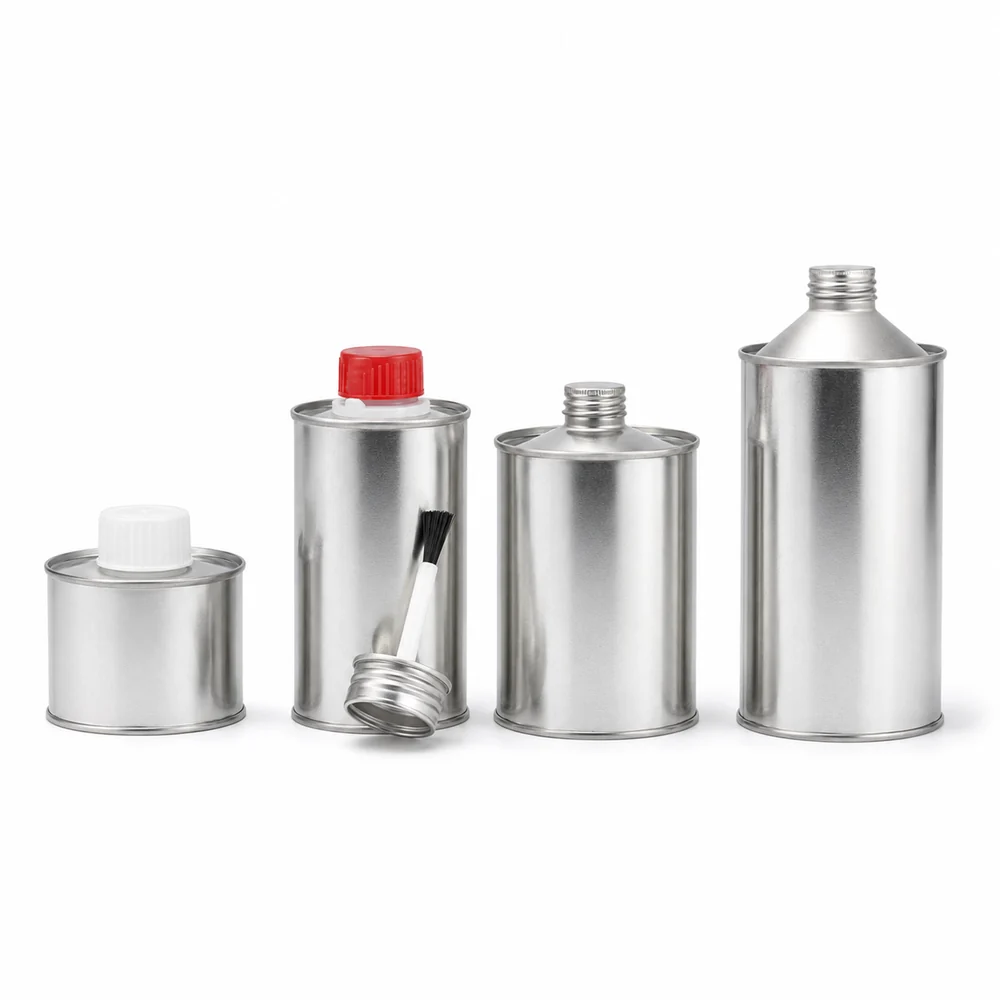 Dauber, Brush-in-Cap & Cone Top Tin Cans |
Dauber, brush-in-cap and cone-top tins from 60 ml to 1 litre with an air-tight screw top; dauber and brush tins are leak-tested. |
Empty, dry tins can go in a general-waste skip if the skip firm allows it; tins holding liquid paint should not. GOV.UK says you must not mix hazardous waste with non-hazardous waste, and Recycle Now classes solvent-based paint as hazardous. Householders are exempt from that rule; businesses and tradesmen are not. Take liquid paint to a recycling centre that accepts it or to a hazardous waste service, and ask the skip firm before you load anything that held paint.
That depends on the paint and your state. EPA treats paints as household hazardous waste, regulated at state and local level, and lists putting such products out with the regular trash as improper disposal. Many communities run collection programmes. Federal rules do not count household waste as hazardous waste (40 CFR 261.4(b)(1)), but your county or state can set a stricter rule, so check with your local solid waste office first.
Often not. Recycle Now says plastic paint cans are accepted at only some recycling centres and tells you to check your local authority. A metal tin and a plastic tub follow different routes, so do not assume the tub goes where the tin does. Empty the tub first: one with liquid paint in it follows the liquid paint rules.
One UK paint maker says leftover paint should last up to two years when stored out of sunlight in a frost-free place. An unopened tin has its own shelf life, which the maker sets for that product, so read the label or the data sheet; no single figure covers every paint. After each use, wipe the rim clean and press the lid down all round.
Use them for screws, brushes or garden tools, and keep food and drink out of them. EPA warns that even empty containers of household hazardous products can pose hazards from residual chemicals, and a tin that held paint carries a lacquer chosen for the paint it held. For tea, popcorn or lip balm, buy tins whose lacquer comes with a food-contact declaration of compliance.
Steel tins of up to 300 litres fall in heading 7310 of the customs tariff: tanks, casks, drums, cans, boxes and similar containers of iron or steel. Below 50 litres the tariff splits them into 7310 21, cans to be closed by soldering or crimping, and 7310 29, other. Which line a lever-lid tin takes is for your customs authority, so check the UK Trade Tariff or TARIC. Plastic tubs fall under 3923.
We do not publish prices, because cost follows the specification: size, wall gauge, internal lacquer, closure, print and quantity. Send the size, lid type, lacquer, artwork and volume and we quote against them. Production takes about one month and samples 7 to 15 days. We sell to businesses only, so a quote is for distributors, wholesalers, fillers and own-brand buyers.
None in the container. British usage calls the lidded steel container a tin and American usage calls it a can. In British English a tin of paint also means the tin with its contents, so context tells you which is meant. Size, lid and lacquer describe the container; volume and finish describe the paint.
From a tin maker, quoted against a specification. Fortitude21 makes round and square tinplate tins, pails and buckets in Vietnam and China and sells to businesses: distributors, wholesalers, fillers and own-brand buyers. The round tin comes with a lever lid or screw cap in fifteen sizes from 50 ml to 6 litres. Send the size, quantity and destination through the enquiry form.
Yes, in a garage or shed that stays dry and frost-free; a tin left in the open meets damp, frost and extreme temperatures. One UK paint maker advises keeping paint out of sunlight and protected from damp and frost. For flammable paint at a workplace, HSE guidance (HSG51) sets out outdoor stores as unenclosed, uncongested and at ground level (paragraph 146), with drainage so rainwater does not collect (paragraph 149).
No paint tin size is standard. Common UK tins hold 1, 2.5 and 5 litres, and US paint comes in a 0.946 litre quart or a 3.785 litre gallon. One maker's UK range runs from 500 ml to 10 litres and its Australian range from 500 ml to 15 litres. A US quart is 5% under a litre, and a US gallon is 24% under a 5 litre tin.
Often, if the tin is empty, though each council sets its own rules. Maroondah City Council in Victoria takes empty paint tins with the lids removed in its on-call hard waste collection, and Yarra Ranges lists hard rubbish as one way to dispose of empty, dry tins. A tin that still holds liquid paint is not empty. Paintback takes up to 100 litres a visit in containers of up to 20 litres.
The standards and regulations this page relies on, at their issuing body. Where a market rule is named here, check the current revision before you specify against it.
Last reviewed by David Guru, Co-Founder & Business Development Director.
Tell us your market, the contents and your annual volumes. We come back with the material, the empty weight per unit and a quotation.