
What tinplate is made of, what an F-style can is, and how tinplate cans are seamed, marked for transport and recycled.
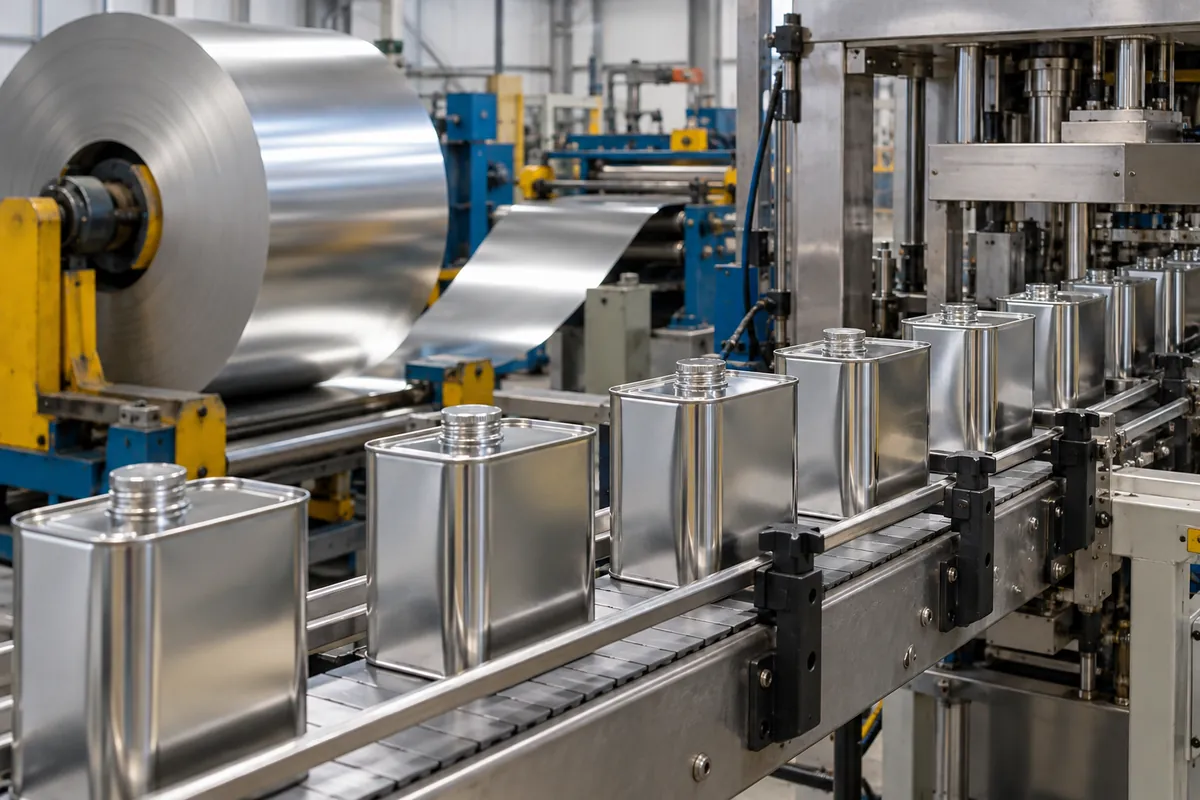
Tinplate is low-carbon steel sheet, 0.1 to 0.6 mm thick, coated on both faces with tin (ISO 11949). It is steel, so a magnet sticks to it and mills recycle it: 84% of EU steel packaging was recycled in 2024. An F-style can is a rectangular tinplate can with a screw-cap neck in the top, often sold in US pint, quart and gallon sizes.
Quick answer: What is tinplate?
Tinplate is low-carbon steel sheet, 0.1 to 0.6 mm thick, with a thin layer of tin applied by electrolysis to both faces (ISO 11949). Strength comes from the steel. The tin adds shine, resists corrosion and takes lacquer and print. An F-style can is the rectangular tinplate can with a screw-capped neck set into its top.
Work it out
Tinplate is cold-reduced low-carbon steel with a thin electrolytic coating of tin. ISO 11949:2026 covers it as sheet or coil, 0.150 to 0.600 mm thick when single-reduced and 0.100 to 0.390 mm when double-reduced. EN 10202:2022 covers tinplate and tin-free steel from 0.16 to 0.49 mm single-reduced and 0.12 to 0.29 mm double-reduced. In the US, ASTM A623 sets the general requirements for tin mill products.
Is tinplate magnetic? Yes. The base is steel, so a magnet sticks to it. A tin can is a steel can with a thin coating of tin for rust protection (Swiss Federal Office for the Environment). Tinplate reaches the can maker as flat sheet or coil that is already tinned, so it is a sheet steel product before it is a can.
A mill starts with cold-rolled steel strip and runs it through a continuous line. The line plates tin onto both faces by electrolysis and often melts the tin so it brightens and bonds to the steel as an iron-tin alloy. It then passivates the surface, in most cases with chromium compounds, and adds a light film of oil (ArcelorMittal). Electro-tinning replaced hot-dip tinning because it needs a thinner tin layer.
The tin is thin. In ArcelorMittal’s example grade, E 2.8/2.8 with passivation 311, the tin layer is 0.4 µm thick on a 0.1 µm alloy layer, under a passivation film of 0.002 µm and an oil film of 0.005 µm. The steel carries the strength and the magnetism. The coating gives a bright surface, corrosion resistance and a base for lacquer and print.
Mills name a grade by the tin mass on each face. E 2.8/2.8 puts 2.8 g/m² on both faces. D 8.4/2.8, a differential grade, puts 8.4 g/m² on one face and 2.8 g/m² on the other. The grade follows the finish wanted outside and the product packed inside, so name the grade, the thickness and the temper in the order, because “tinplate” alone fixes none of them.
In April 2024 Steel for Packaging Europe said its members’ EU authorisation for chromium trioxide and sodium dichromate in tinplate passivation ends with 2027 and cannot be extended. Chrome-free passivation replaces it.
Tin-free steel, sold as ECCS, swaps the tin for a layer of chromium and chromium oxide. ArcelorMittal lists its limits. It must be lacquered on both faces, it is not suitable for welding or soldering, and it is duller than tinplate. It is not appropriate for acidic food below pH 4 because its corrosion resistance is lower without tin.
Aluminium is a separate metal. It does not attract a magnet and has about a third of the density of steel, but it is less stiff: the aluminium vs steel guide gives the numbers. Galvanised steel is steel under zinc, which protects it even where scratched, but zinc is not food-safe, so corrosion protection and galvanizing treats galvanised cans as fuel and oil cans.
| Metal | Surface | Magnet | Watch for |
|---|---|---|---|
| Tinplate | Tin on steel | Sticks | Rusts where the coating is breached down to the steel |
| Tin-free steel (ECCS) | Chromium and chromium oxide | Sticks | Needs lacquer on both faces; not for acidic food |
| Galvanised steel | Zinc on steel | Sticks | Zinc is not food-safe |
| Aluminium | Dense oxide film | Does not stick | Lighter and less stiff than steel |
An F-style can is a rectangular tinplate can with a screw neck in the top face, closed by a screw cap. The neck often sits in a corner, and some sizes centre it. F-style is a trade name, and we know of no ISO, EN or ASTM standard behind it, so neck diameter, cap, liner and body size differ between makers. Specify the capacity, the outside dimensions, the neck diameter and the closure, not the name alone.
Trade sizes follow US measure. A pint is 16 fluid ounces (0.473 L), a quart 32 (0.946 L) and a gallon 128 (3.785 L), by the NIST SP 811 factors. Our square tin range is metric, fourteen sizes from 250 ml to 25 L. Its 500 ml, 1 L and 4 L square cans are each rated 5.7% above the US size beside them, so a buyer who needs the exact US volume should say so.
An offset head lets air in while liquid pours out, where a centred opening on a square body glugs. The flat faces take full-height print and leave no void between cans on a pallet. The cost is strength: flat panels bow before a round wall does, so the wall steps up with size, from 0.21 mm at 250 ml to 0.35 mm at 25 L on our square range.
A spout or cap fits only when its thread matches the neck, so quote the neck diameter when you order pouring spouts.
A branded tinplate can starts as flat sheet, printed by offset lithography before forming and often lacquered first (ArcelorMittal). The body is rolled to shape and its side seam joined. Electric welding replaced soldering for can bodies (ArcelorMittal). The ends go on with a double seam: a first rolling operation curls the end under the body flange and a second presses the body hook and the cover hook tight together (USDA).
ADR and RID 2025 require steel jerrican chimes, square tins included, to be mechanically seamed or welded, and body seams to be seamed or welded up to 40 litres and welded above that (6.1.4.4). Light-gauge packagings need welded or double-seamed joints and inner coatings that adhere to the steel at every point, closures included (6.1.4.22).
We specify gold lacquer for acidic and aggressive contents, clear lacquer where the tinplate finish is part of the look, and bare tinplate where neither applies. The wrong choice fails months into shelf life, so check the contents against the chemical compatibility guide before you fix the lacquer.
For food, the coating is the food-contact article, so the Declaration of Compliance must name the coating: see UN codes and food contact for pails and tins. In the EU, Regulation (EU) 2024/3190 bans BPA in food contact articles, varnishes and coatings included, except for uses listed in its Annex II (Articles 1 and 3). Single-use articles made with BPA could be placed on the market until 20 July 2026. The date is 20 January 2028 for articles that preserve fruit, vegetables or fishery products and for articles with a BPA coating only on the outer metal surface (Article 11).
APEAL lists food and drink, aerosols, household and automotive care products, industrial products and paint among the uses of steel packaging, and calls steel an absolute barrier against UV, light and oxygen with the best resistance to solvents. For solvent-based paint, thinners, adhesives and resins, that makes tinplate the alternative to polypropylene, which those contents can attack or deform.
| Container | Wall | Sizes | Typical contents |
|---|---|---|---|
| Round tin | 0.20–0.25 mm | 50 ml–6 L | Paint, solvents, adhesives, automotive chemicals |
| Square and F-style tin | 0.21–0.35 mm | 250 ml–25 L | Thinners, ATF, brake fluid, edible and industrial oils |
| Pail, flower lid or lever ring | 0.25–0.38 mm | 4–35 L | Paint, adhesives, resins, bitumen, edible oils |
| Galvanised steel oil tank | 0.8 mm | 20 L | Lubricants and workshop oils |
Oil can or bottle? A can blocks light and oxygen; a plastic bottle weighs less. A workshop that decants from bulk uses the 20 L steel oil tank, built for lubricants and not for food, water, acids or alkalis. Edible oil goes in lacquered tinplate with a coating declaration. See oil and workshop dispensing cans and pails and buckets.
Jerrycan or metal can? A NATO-pattern jerry can is pressed steel of 3 to 30 L with handles, made to carry fuel or water. A tinplate tin is thin-walled packaging sold with its contents in it. For the carrying cans, read jerry can sizes and how to choose a jerry can.
The shape of a tin decides its UN code. A cylinder is a drum under ADR and RID 2025 (1.2.1), pail-shaped packagings included, so a round tinplate pail takes UN 1A2 with a removable head or UN 1A1 with a non-removable one. A rectangular or polygonal cross-section is a jerrican, so a square or F-style tin takes UN 3A1, or 3A2 once the opening passes 7 cm (6.1.4.4). Steel jerricans stop at 60 litres and 120 kg net, and 49 CFR 178.511 sets the same limits in the US.
Small tins often travel as inner packagings in a fibreboard box, and the pair is certified together, so the mark sits on the UN 4G box. Packing instruction P 001 allows metal inner packagings up to 40 litres in a 4G outer of 60 kg. A quantity inside the limited-quantity limit in Table A needs no UN-approved packaging: ADR and RID 3.4 ask for inner packagings in a suitable outer with a gross mass up to 30 kg, and the 6.1.4 construction rules still apply. See ADR limited quantities and, for paint, UN 1263.
ADR and RID add one more kind of packaging. Light-gauge metal packaging has a wall under 0.5 mm, tinplate given as the example, and falls outside the drum and jerrican definitions. It takes code 0A1 (non-removable head) or 0A2 (removable head) and carries the RID/ADR symbol in place of the UN symbol. It is approved for road, rail and inland waterways under ADR, RID and ADN, and may not be accepted by other transport modes. For substances that list packing instruction R 001, the limit is 40 litres and 50 kg and packing group I is barred. Class 3 packing group II is open only to substances with no subsidiary hazard and a vapour pressure of 110 kPa or less at 50 °C, and to slightly toxic pesticides.
Every tinplate wall on our range is below 0.5 mm, so ask which route a given design certifies under and for the certificate that names it. Decode any mark with the UN packaging code decoder, find the packagings a substance may use with the UN number packaging finder, and read packing groups explained for the test levels.
Yes. Steel for Packaging Europe reports that 84% of steel packaging placed on the market was recycled in 2024, counted by the EU’s harmonised method. A magnet does the sorting: APEAL notes that steel’s magnetic properties let it be recovered from waste streams and recycled again and again without loss of material quality. Some plants strip the tin from the scrap first to recover it, a step called de-tinning.
Recycling covers empty cans. A tin that still holds oil, paint or solvent is waste in a container, and the paint tins and cans guide covers where it goes. For importers, Regulation (EU) 2025/40 (PPWR) Article 6 requires all packaging to be recyclable, with the design-for-recycling test applying from 1 January 2030 or 24 months after the delegated acts, whichever is later. EU packaging rules covers registration and fees.
Tinplate sheet and coil 600 mm or wider is Harmonized System 7210.11 at 0.5 mm or more and 7210.12 below 0.5 mm. Finished cans fall in heading 7310, containers of iron or steel up to 300 litres, and 7310.21 covers cans under 50 litres that are closed by soldering or crimping. Whether a lever-lid or screw-cap tin counts as such a can is a classification question for the importer. Codes diverge past six digits between markets, so get a ruling: see commodity codes and origin and, for EU imports of steel containers, CBAM.
We supply finished cans, tins and pails, not tinplate sheet or coil. Our product pages list substrate thickness and temper, tin coating weight, internal coating system and minimum order as quoted on enquiry.
We make tinplate tins, square and F-style cans, and pails in Vietnam and China to one specification managed from Singapore. The round tin comes in fifteen sizes from 50 ml to 6 L. The square and F-style tin comes in fourteen sizes from 250 ml to 25 L, as pouring cans with a wide offset head and as open square buckets. The pail comes in seventeen sizes from 4 to 35 L with a flower lid or lever ring, and the round metal bucket in four sizes from 5 to 25 L, tight-head or open-head. The 20 L steel oil tank is galvanised steel.
Our factories hold ISO 9001, 14001 and 45001, and we hold UN certification for our dangerous-goods jerrican designs, certified per design type and made under quality assurance the competent authority accepts. Tin coating weight, lacquer system, UN code and food-contact declaration are quoted per specification, so send the contents, the packing group, the fill and the market with your enquiry.
| Your use case | Recommended can | Why this one |
|---|---|---|
| Round tins, 50 ml to 6 L | 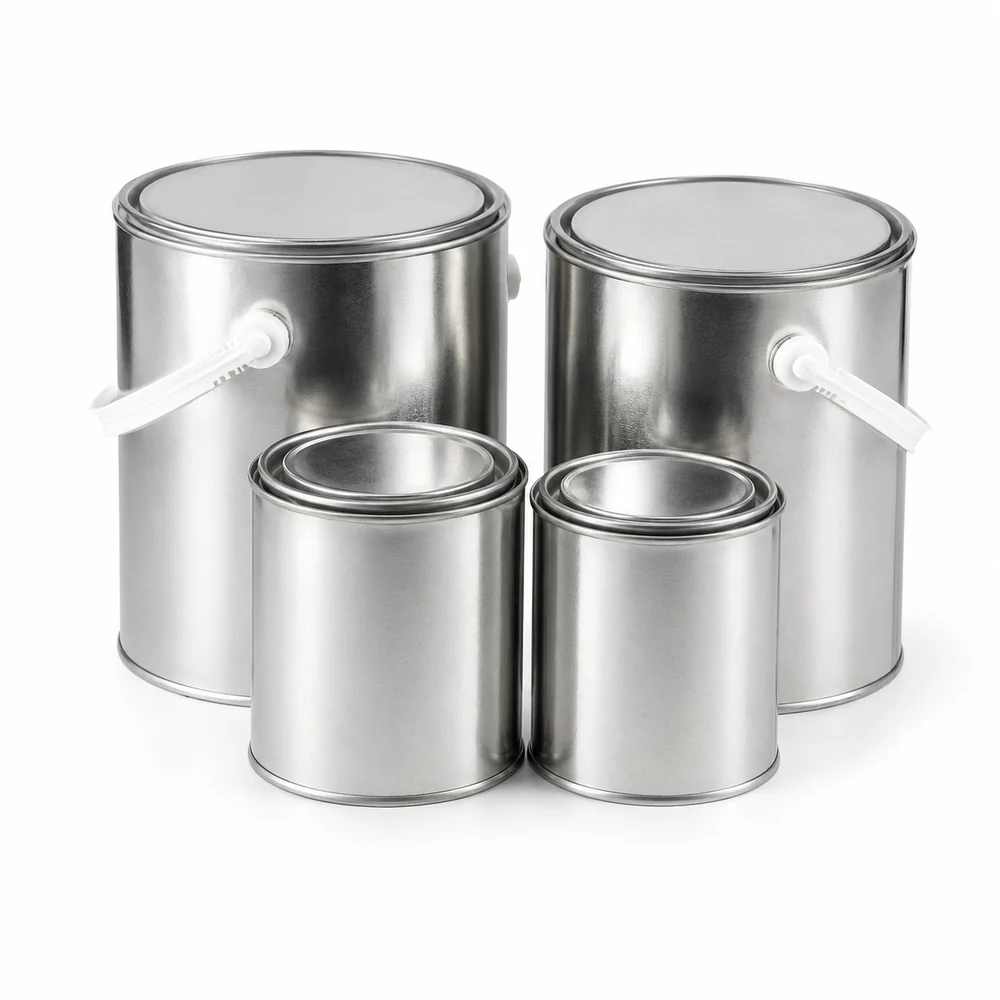 Round Metal Tin Can, 50ml to 6L |
Fifteen sizes on one body, gold or clear lacquer, lever lid or screw cap, full-surface print. |
| F-style and square cans | 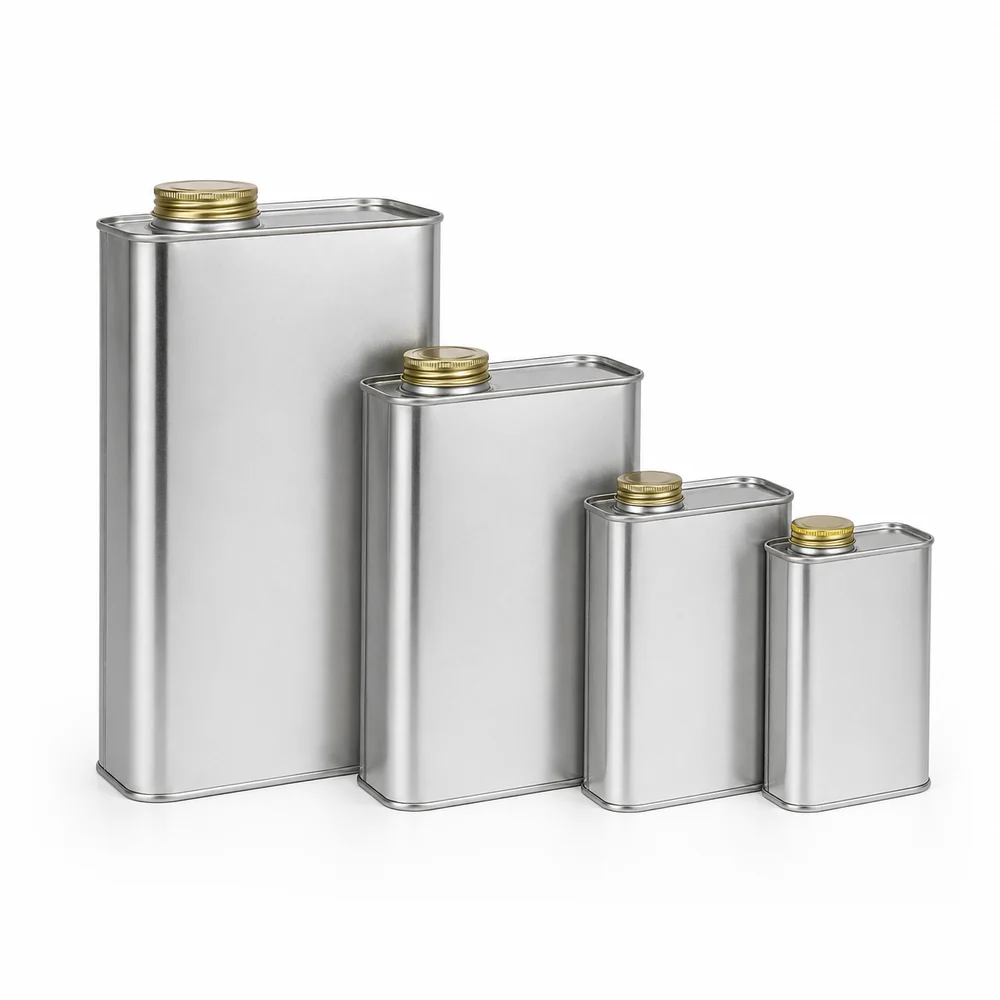 Square Metal Tin Can & Bucket, 250ml to 25L |
Offset wide head, 250 ml to 25 L, flat faces for full-height print and a tight pallet cube. |
| Pails, 4 to 35 L | 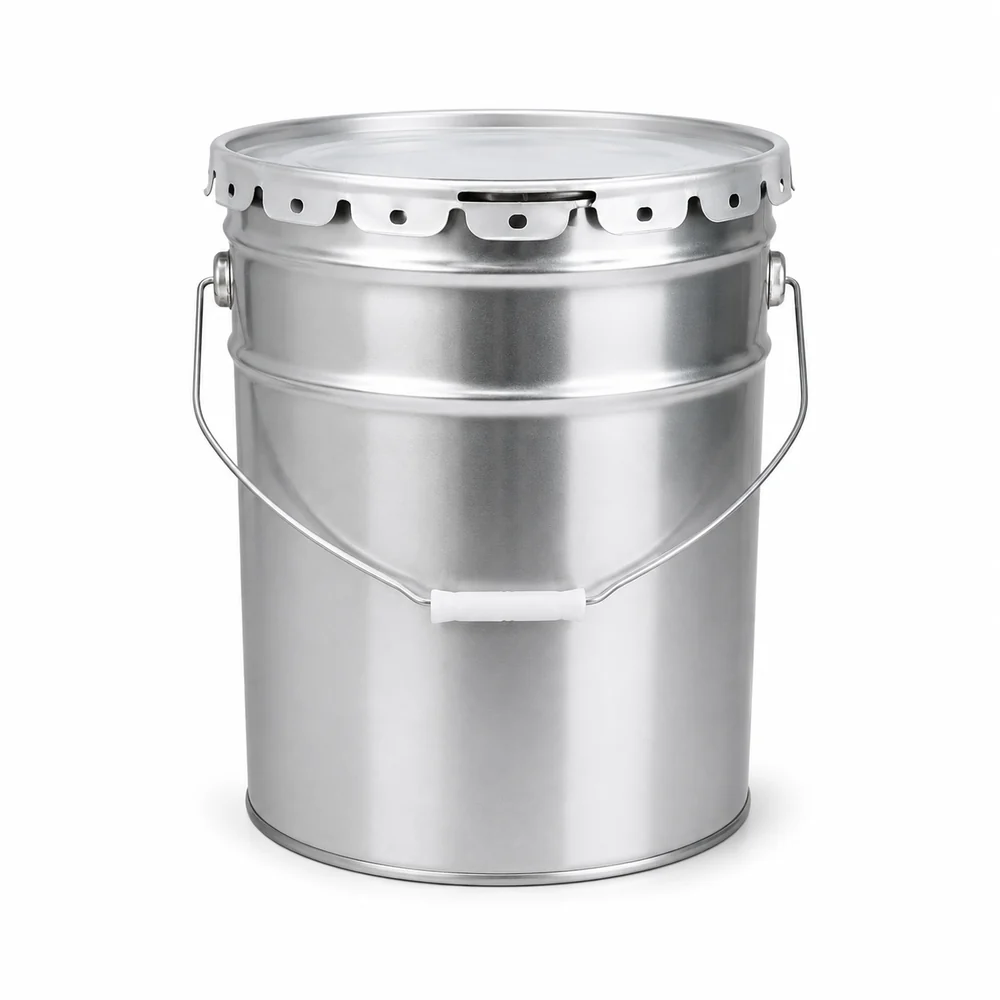 Metal Pail with Flower Lid or Lever Ring, 4L to 35L |
Flower lid for a permanent seal or a lever ring that reseals, in tinplate steel. |
| Tight-head and open-head buckets | 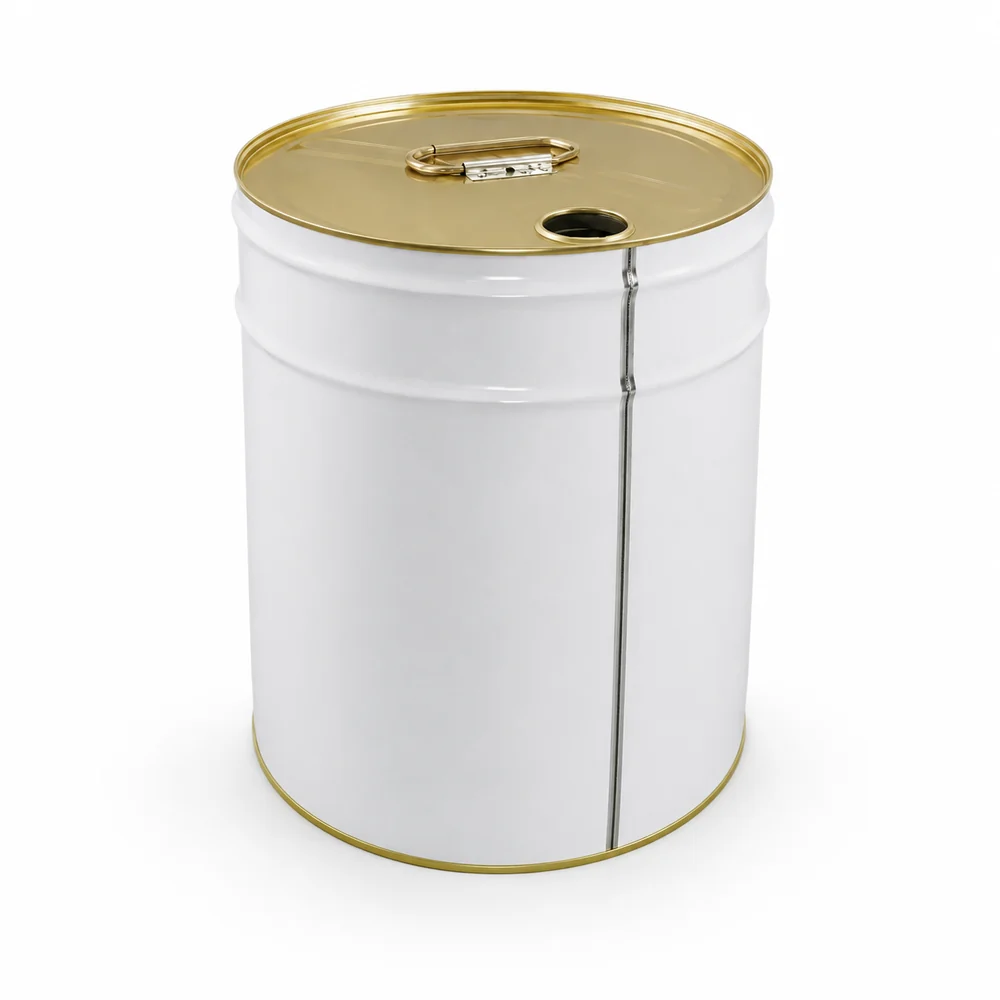 Round Metal Bucket, 5L to 25L |
Round tinplate buckets from 5 to 25 L with a screw cap and spout or a full-diameter lid. |
| Applied contents | 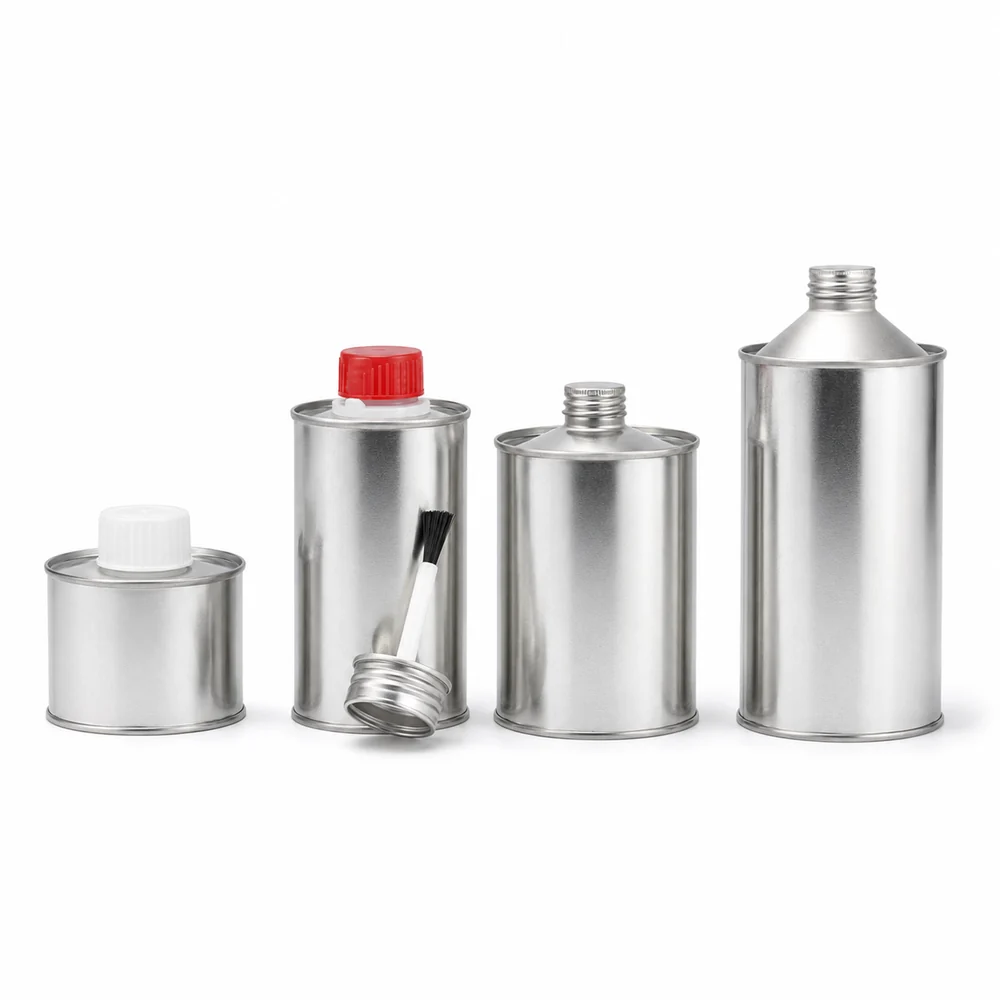 Dauber, Brush-in-Cap & Cone Top Tin Cans |
Dauber, brush-in-cap and cone-top tinplate cans from 60 ml to 1 L. |
| Decanting workshop oil | 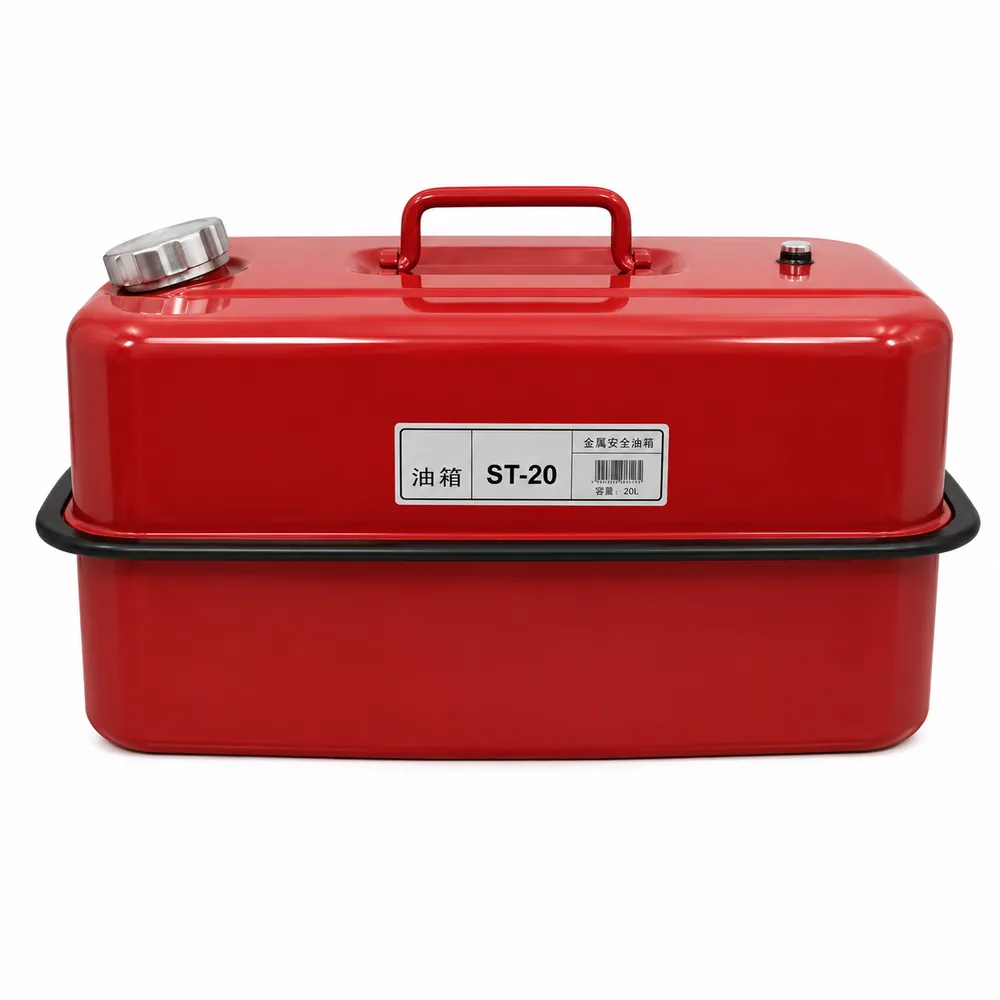 20L Steel Oil Tank |
A 20 L galvanised steel can with a screw cap, built for lubricants and not for food or water. |
Oil canning is visible waviness in the flat areas of a metal panel, also called elastic buckling or stress wrinkling (Metal Construction Association). ASTM E1514 treats it as an aesthetic issue that seldom affects structural integrity. It comes and goes with temperature and light, and thicker metal, narrower panels and ribs reduce it. Flat faces on square tins also flex, so their wall steps up with size.
Yes, where moisture reaches the steel through a scratch, a dent or a poor seam. The tin and the iron-tin alloy beneath it protect the steel, but together they measure 0.5 µm in the ArcelorMittal example, so the lacquer inside and the print outside add protection. Keep tinplate dry in store, and reject cans with dented seams or lacquer chipped through to metal.
Tinplate runs from 0.100 to 0.600 mm under ISO 11949:2026 and from 0.12 to 0.49 mm under EN 10202:2022. Cans use the thin end: our tinplate walls run from 0.20 mm on a 50 ml tin to 0.38 mm on a 35 litre pail. ADR and RID define light-gauge metal packaging as a wall under 0.5 mm, tinplate given as the example, outside the drum and jerrican definitions.
Yes, if the internal lacquer is approved for food. The coating is what touches the oil, so the Declaration of Compliance must name the coating: Regulation (EC) 1935/2004 in the EU and in Great Britain, where it is assimilated law, or 21 CFR 175.300 in the US. Our square tin page lists edible oils among its standard uses. The galvanised 20 litre oil can is not for food.
Empty, drained oil cans go to scrap steel, where a magnet lifts them from mixed waste. A can that still holds oil or paint is waste in a container, so take it to a household waste recycling centre or a licensed waste carrier and follow their rules. Our paint tin guide sets out the disposal route for coatings.
Not under the English oil storage rules. The Control of Pollution (Oil Storage) (England) Regulations 2001 exclude any container of 200 litres or less, counted per container and not in total. COSHH and DSEAR can still apply to the oil, and Wales, Scotland and Northern Ireland have their own rules. The UK oil storage guide sets them out.
A tinplate tin is thin-walled packaging, 0.20 to 0.38 mm on our range, sold with its contents and printed over the whole surface. A jerry can is a pressed steel carrying can of 3 to 30 litres with handles, built to carry fuel or water and certified as a UN jerrican where it carries dangerous goods.
We do not publish prices, because a quote moves with the tinplate gauge and temper, the tin coating grade, the internal lacquer, the print, the closure and the quantity. Send the size, the contents, the market and the volume, and we quote against that specification. Our product pages give about one month for a standard run and 7 to 15 days for samples, confirmed at quotation.
A small pump or squeeze oiler with a fine spout that matches the oiler. We do not make those. Our round tins hold 50 ml to 6 litres of product for sale, and the 20 litre steel oil tank decants workshop lubricant from bulk.
Yes. ISO 11949 specifies low-carbon mild steel for the base, and ArcelorMittal calls packaging steels thin-gauge flat carbon steels. A tin can is therefore a steel can with a tin coating, 0.4 µm thick in the ArcelorMittal example, and often a lacquer inside chosen for the contents. A magnet picks it up and recycling plants sort it like other steel.
No. We supply finished tins, F-style and square cans and pails, made in Vietnam and China. When you specify sheet elsewhere, give the standard (ISO 11949 or EN 10202), the thickness, the temper, the coating designation such as E 2.8/2.8 and the passivation, and ask for the mill inspection document under EN 10204.
Recycle them where your council takes metal tins, since rules differ. Colchester lists biscuit tins in its kerbside dry mixed recycling, Southend-on-Sea lists biscuit and sweet tins as recyclable, and Hinckley and Bosworth takes them in the blue bin, loose and clean. If a magnet sticks, the tin is tinplate or another steel, and steel mills recycle it.
Yes. Tinplate is cold-reduced low-carbon steel with a thin electrolytic coating of tin, supplied as sheet or coil to ISO 11949:2026. It reaches the can maker already tinned, so it is a sheet steel product before it is a can. Customs classes tinplate sheet and coil 600 mm or wider as HS 7210.11 at 0.5 mm or more and 7210.12 below. Finished cans fall in heading 7310.
Tinplate is low-carbon steel sheet with a thin coat of tin on both faces, and aluminium is a separate metal. A magnet sticks to tinplate and not to aluminium, and recyclers use that to recover steel cans from mixed waste. Aluminium has about a third of the density of steel, so a can weighs less, but it is less stiff, and makers thicken the wall to make up for it. Tinplate rusts where its coating is breached down to the steel; aluminium is protected by a dense oxide film.
The standards and regulations this page relies on, at their issuing body. Where a market rule is named here, check the current revision before you specify against it.
Last reviewed by David Guru, Co-Founder & Business Development Director.
Tell us your market, the contents and your annual volumes. We come back with the material, the empty weight per unit and a quotation.