
Who counts as a producer under the UK packaging waste regulations, the PackUK fee per tonne for each material, and how jerry cans, pails and tins are treated.
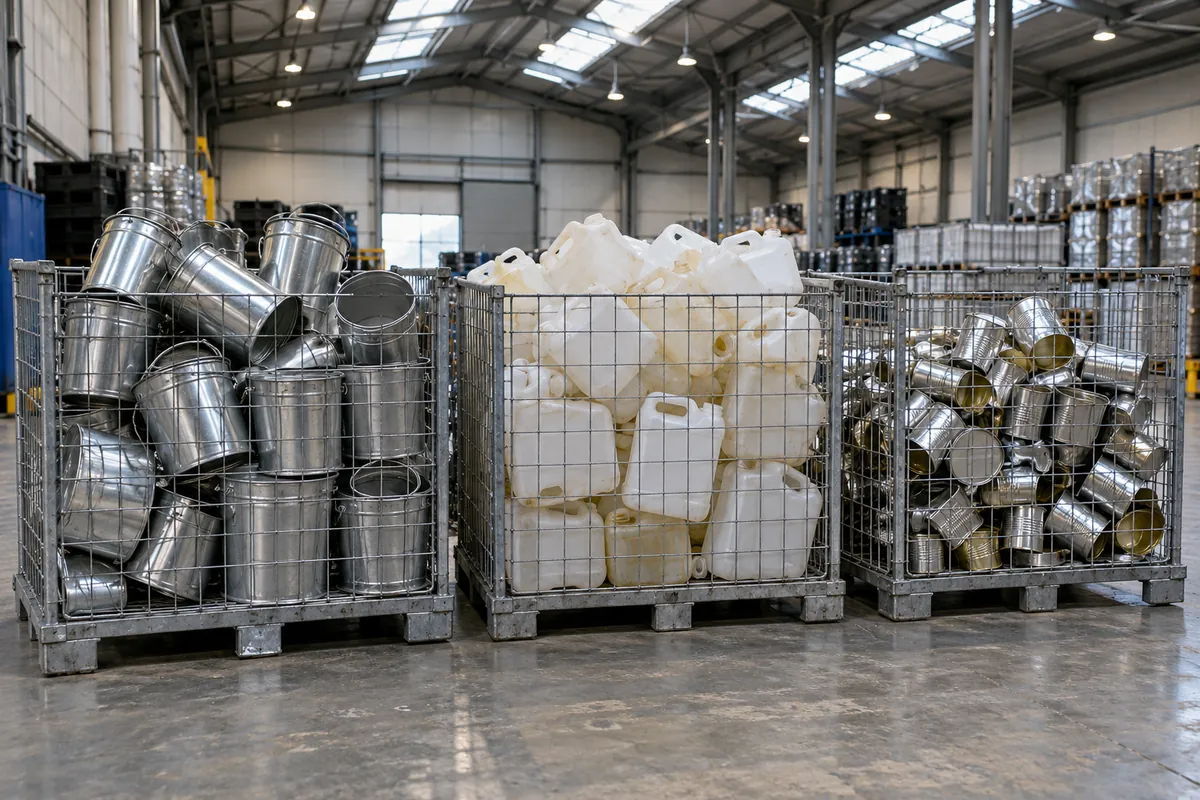
UK packaging EPR, under the Producer Responsibility Obligations (Packaging and Packaging Waste) Regulations 2024, applies to a UK business with turnover over £1 million that supplies or imports more than 25 tonnes of packaging a year. Above £2 million and 50 tonnes it is a large producer and pays PackUK a fee per tonne of household packaging: £423 for plastic and £259 for steel in 2025–26.
Quick answer: Who has to comply with UK packaging EPR?
Any UK business that turns over more than £1 million and supplies or imports over 25 tonnes of packaging a year. Past £2 million and 50 tonnes the business counts as a large producer, which reports twice a year, pays PackUK a disposal fee per tonne of household packaging and buys recycling notes. The overseas factory carries no UK obligation.
Work it out
Packaging EPR (extended producer responsibility) makes the businesses that supply packaging pay for collecting and managing it once it becomes waste. In the UK it runs under SI 2024/1332, which replaced the 2007 packaging waste regulations and has applied across England, Wales, Scotland and Northern Ireland since 1 January 2025.
The Environment Agency, Natural Resources Wales, SEPA and the Northern Ireland Environment Agency register producers, take their data and enforce. PackUK, the scheme administrator, sets and collects the disposal fees and pays local authorities for handling household packaging waste. Its 2026–27 plan forecasts £1.47 billion of disposal costs and £1.56 billion in fees.
Packaging, in regulation 7, is anything made to contain, protect, handle, deliver or present goods: primary packaging sold to the final user, secondary packaging grouping sales units, and tertiary packaging for transport. Pallets and stretch wrap count; road, rail, ship and air containers do not.
A business must comply when it is established in the UK, carries out a packaging activity, had turnover of more than £1 million and supplied or imported more than 25 tonnes of packaging in the previous calendar year (regulation 24). Above £2 million and 50 tonnes it is a large producer. For 2026 data, GOV.UK counts packaging handled from 1 January to 31 December 2025 and turnover from the last accounts before 7 April 2026.
| Duty | Small producer | Large producer |
|---|---|---|
| Turnover | Over £1 million | Over £2 million |
| Packaging supplied or imported | Over 25 tonnes | Over 50 tonnes |
| Register with the regulator | Each year, by 1 April | Each year, by 1 October |
| Report packaging data | Once a year | Every six months |
| PackUK disposal fee | No | Yes, on household packaging |
| Recycling notes (PRNs or PERNs) | No | Yes |
| Keep records | 7 years | 7 years |
The tonnage counts all packaging, household or not, and an item handled in two roles counts once (regulation 24(7)). A corporate group is tested as one: if the group meets the large-producer test, every UK member is a large producer. A business below either line has no duty of its own, though a packer/filler reports what it fills for a brand owner that is not a large producer (regulation 17).
The regulations name seven producer roles. One item of packaging can pass through several of them, and the rules assign it to one producer; where a UK brand owner is a large producer, the brand owner reports.
| Role | Who it is | Producer of | Rule |
|---|---|---|---|
| Brand owner | Its brand is on filled packaging | That packaging, every part of it | reg 16 |
| Packer/filler | Puts goods into packaging | What it fills, where no brand owner is a large producer | reg 17 |
| Importer | Responsible for the import | Filled packaging it supplies; packaging it discards here | reg 18 |
| Distributor | Makes or imports empty packaging and supplies it | That packaging, unless a large producer fills it | reg 19 |
| Online marketplace operator | Runs a marketplace for sellers outside the UK | Packaging on goods those sellers send in | reg 20 |
| Service provider | Hires out or lends reusable packaging | That packaging, on first supply | reg 21 |
| Seller | Supplies filled packaging to the final user | That filled packaging | reg 22 |
Three roles matter for container buyers. A UK business selling filled pails or cans under its own label is the brand owner, even when a contract filler fills them, and so is a private-label customer. A business importing empty containers to sell on is a distributor; one importing goods already packed is the importer.
Yes. Regulation 18 makes the importer the producer of filled packaging it supplies in the UK and of any packaging, filled or empty, it discards here, unless a UK brand owner that is a large producer brought the goods in itself. If the business responsible for the import is not established in the UK, the importer is the first UK-established business to own the packaging. An overseas factory has no UK obligation.
Transport packaging is where importers under-count. The pallet, cartons, corner boards and stretch wrap a shipment arrives in are packaging the importer discards, so they count towards its tonnage and recycling obligation, though regulation 8(1)(c) classes them as non-household, free of the disposal fee. Ask the supplier for each item’s weight by material; our export packing guide shows how cans are palletised.
Goods that overseas sellers send in through an online marketplace make the operator the producer (regulation 20). The customs entry settles none of this: the commodity code and origin decide duty, while EPR follows ownership and use. For EU sales, the matching local-presence rule for product safety is the GPSR responsible person.
In 2025–26 a large producer pays PackUK £423 for each tonne of household plastic packaging it supplies, £259 for steel and £266 for aluminium, with a rate for every material. These base fees, invoiced from October 2025 on 2024 data, are the only confirmed set. GOV.UK published illustrative 2026–27 fees in December 2025; PackUK’s plan says it will calculate the confirmed fees in November 2026 and issue notices of liability by the end of that month.
| Material | 2025–26 base fee, confirmed (£ per tonne) | 2026–27 amber fee, illustrative (£ per tonne) |
|---|---|---|
| Aluminium | 266 | 270 |
| Fibre-based composite | 461 | 525 |
| Glass | 192 | 205 |
| Paper and card | 196 | 210 |
| Plastic | 423 | 455 |
| Steel | 259 | 290 |
| Wood | 280 | 450 |
| Other | 259 | 225 |
At the illustrative amber rate a kilogram of household HDPE packaging carries 45.5p and a kilogram of steel 29p, so the weight of each container and component drives the bill. Invoices use the fees to four decimal places.
A large producer also pays the regulator a registration fee, £2,842 for 2027 if registered directly or £1,803 through a compliance scheme, and buys recycling notes at market prices to meet its recycling obligation.
From 2026–27, PackUK modulates the household fee by how recyclable the packaging is (regulation 64). Each producer rates its packaging red, amber or green using PackUK’s Recyclability Assessment Methodology (RAM), and must reassess when the design, the material or the methodology changes (regulation 26). Amber pays the base fee. Red pays 1.2 times amber in 2026–27, 1.6 times in 2027–28 and 2 times in 2028–29. The red surcharge funds a discount on green, 9% in the illustrative fees.
Steel and plastic sit at opposite ends. In the proportions GOV.UK published with the illustrative fees, 79% of steel packaging tonnage was green and 20% red, while plastic was 31% green, 24% amber and 45% red. A producer that gives no recyclability data has all its packaging in that material treated as the least sustainable packaging in the category (regulation 64(8)), so skipping the assessment costs money.
Only household packaging pays the disposal fee. Secondary and tertiary packaging is non-household. Primary and shipment packaging is household unless regulation 8 gives a way out. The ways out are supply direct to a business or public institution that is the end user; a product designed only for business use whose packaging is not reasonably likely to reach a household or public bin; or packaging an importer discards in the UK.
GOV.UK’s bin test asks whether the packaging fits a 240 litre household bin once broken down, whether it passes the 30 kg lift limit, whether law restricts its disposal, whether consumers can buy the product and where the packaging is removed. In its examples, business-labelled 20 kg metal drums sold through trade accounts may be non-household while the same product’s 350 g jars stay household, and chemicals restricted under the Poisons Act 1972 are non-household however they are sold. Each SKU is assessed on its own.
Evidence decides it, and GOV.UK says a label alone is not enough. Keep the safety data sheet showing specialist use, invoices with customers’ VAT numbers, contracts limiting onward supply and the stockist list for at least 7 years. A 20 litre pail of industrial adhesive sold on trade accounts can qualify; the same adhesive in a 1 litre tin on a public shelf is household.
A container sold filled is packaging. Sold empty to a business that fills it, it is unfilled packaging. The business that made or imported it and supplied it is the producer as a distributor, unless the filler is a large producer that takes it on once filled (regulation 19). GOV.UK tells distributors to report it as supplied empty.
A can sold empty to someone who will use it for their own storage is the open case, and GOV.UK publishes no example naming jerry cans. Regulation 7(3) points to Schedule 5 of the Packaging (Essential Requirements) Regulations 2015. That schedule lists tool boxes and CD spindles sold empty for storage as not packaging, and refillable steel gas cylinders, filled by the supplier for the user, as packaging. On those examples, a fuel can bought for the buyer’s own diesel sits nearer the storage cases, though no regulator has said so. Where one design sells both ways, agree the split with your regulator.
HMRC tests Plastic Packaging Tax on what the can was designed for: see Plastic Packaging Tax on containers. A UN mark changes neither answer. Reusable containers hired out and returned, such as steel drums or IBCs, are reported once, on first supply (regulation 21).
Large producers report packaging data by 1 October and 1 April each year; small producers report once, by 1 April.
| Producer | Data period | Report by |
|---|---|---|
| Large | 1 January to 30 June 2026 | 1 October 2026 |
| Large | 1 July to 31 December 2026 | 1 April 2027 |
| Small | 1 January to 31 December 2026 | 1 April 2027 |
A large producer registers for 2027 by 1 October 2026 and a small producer by 1 April. Large producers also carry a recycling obligation: evidence that a set share of the packaging they reported was recycled, material by material. The evidence is a packaging waste recycling note (PRN) from an accredited reprocessor or a PERN from an accredited exporter. Notes for 2026 must be in place by 31 January 2027, and a surplus in one material cannot cover a shortfall in another.
| Material | 2025 | 2026 | 2027 |
|---|---|---|---|
| Paper, board or fibre-based composite | 75% | 77% | 79% |
| Glass | 74% | 76% | 78% |
| Aluminium | 61% | 62% | 63% |
| Steel | 80% | 81% | 82% |
| Plastic | 55% | 57% | 59% |
| Wood | 45% | 46% | 47% |
They are separate regimes, and one plastic can may fall under both. EPR covers every packaging material and charges by material and recyclability. Plastic Packaging Tax is an HMRC tax on plastic packaging components with less than 30% recycled plastic.
| UK packaging EPR | Plastic Packaging Tax | |
|---|---|---|
| Run by | Environmental regulators and PackUK | HMRC |
| Materials | All packaging materials | Plastic packaging components |
| Who is caught | Turnover over £1 million and over 25 tonnes of packaging | 10 tonnes of finished plastic packaging components in 12 months |
| Charge | Disposal fee per tonne of household packaging, plus recycling notes | £228.82 per tonne from 1 April 2026 |
| What lowers it | A green recyclability rating | 30% or more recycled plastic |
A tinplate pail sits outside the tax and inside EPR as steel. EPR reports multi-part packaging component by component (regulation 7), so a steel can’s HDPE cap reports as plastic. An HDPE jerry can can carry both charges: the tax if it holds under 30% recycled plastic, and the EPR fee if it is household packaging.
Not in Great Britain. The Packaging and Packaging Waste Regulation, Regulation (EU) 2025/40, has applied in the EU since 12 August 2026, and DAERA says it does not apply to packaging placed on the market in England, Scotland or Wales. In Northern Ireland most of it applies from that date under the Windsor Framework, because it replaced the packaging directive listed there (Commission Notice C/2025/946). Its parts on reuse, EPR and deposit return do not, so Northern Ireland stays in the UK EPR scheme.
A UK business selling containers or packed goods into the EU meets PPWR there. The business that first makes the packaging available in a member state is the producer and registers in each country, as our EU packaging guide sets out. DAERA says the UK has not decided whether to align with PPWR.
We make the containers UK fillers, brand owners and importers report under EPR: steel and HDPE jerry cans, tinplate pails and tins, and polypropylene buckets, from our plants in Vietnam and China. We are not your UK producer. The obligation sits with the UK-established business that brands, fills, imports or supplies the packaging, and no overseas supplier can register or pay for it.
At quotation we give the empty weight of each container for your specification, closure and handle included, and on request the materials and weights of its export packing. The RAM rating is yours to assess; we supply the material and coating specification behind it.
| Your use case | Recommended can | Why this one |
|---|---|---|
| Filled industrial liquids sold to trade |  25L Stackable Plastic Jerrycan |
HDPE body and screw cap; ask for the empty weight by component for your plastic line. |
| Paint, adhesive and resin pails | 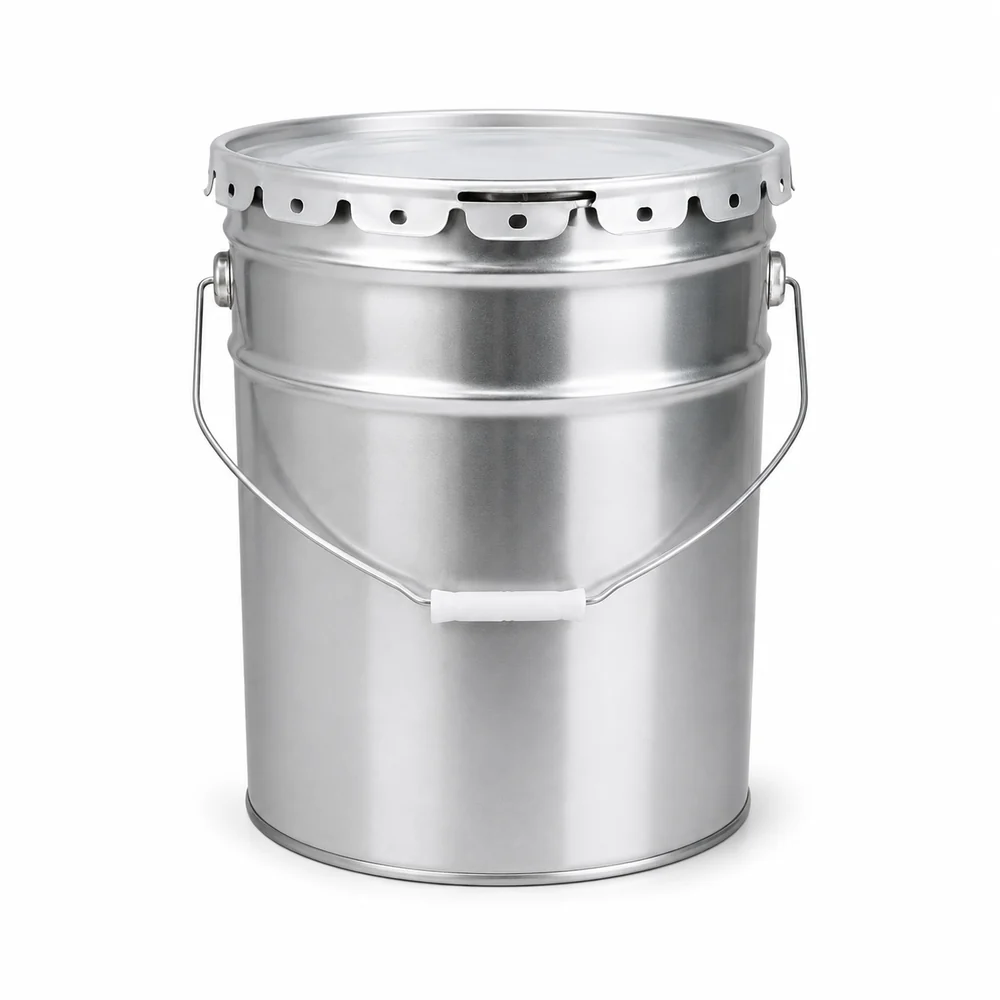 Metal Pail with Flower Lid or Lever Ring, 4L to 35L |
Tinplate reports as steel, and the steel grip option keeps the handle steel too. |
| Retail tins of paint or chemicals | 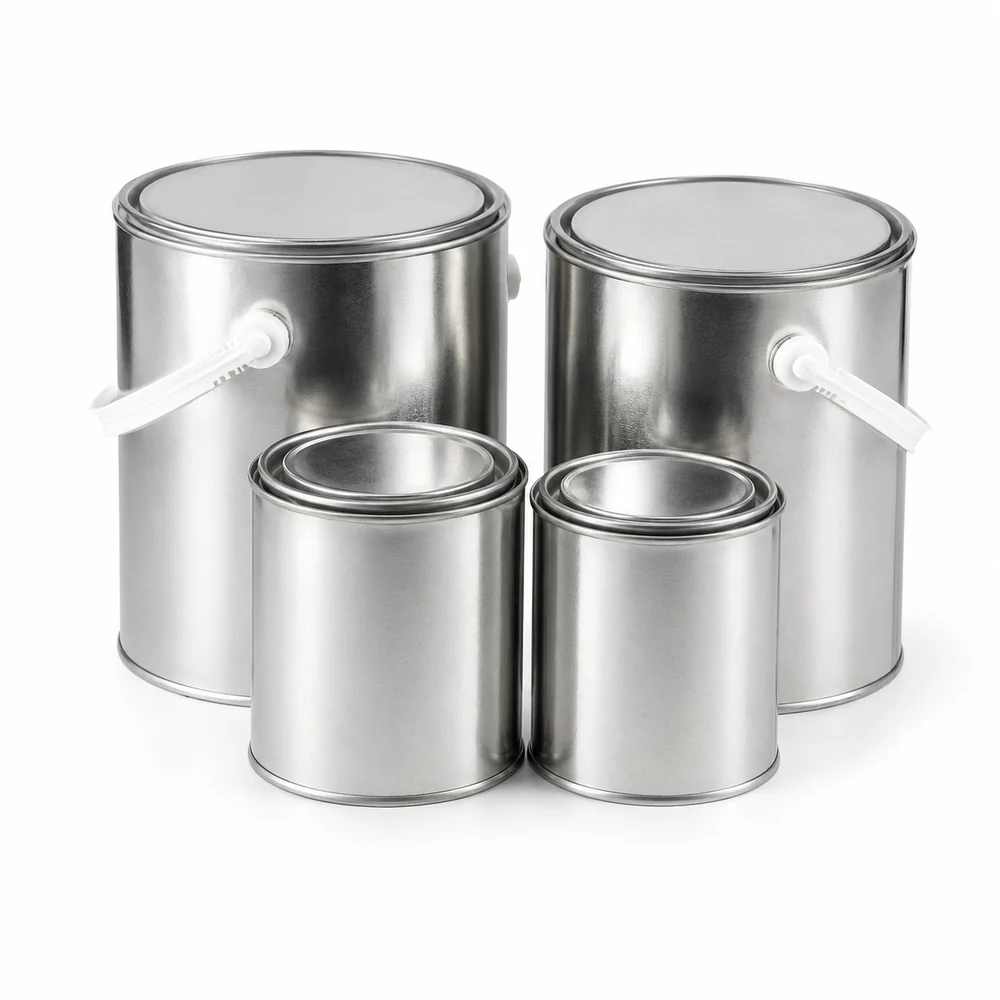 Round Metal Tin Can, 50ml to 6L |
Steel carried a £259 a tonne base fee in 2025 to 2026, against £423 for plastic. |
| Trade pails of construction chemicals | 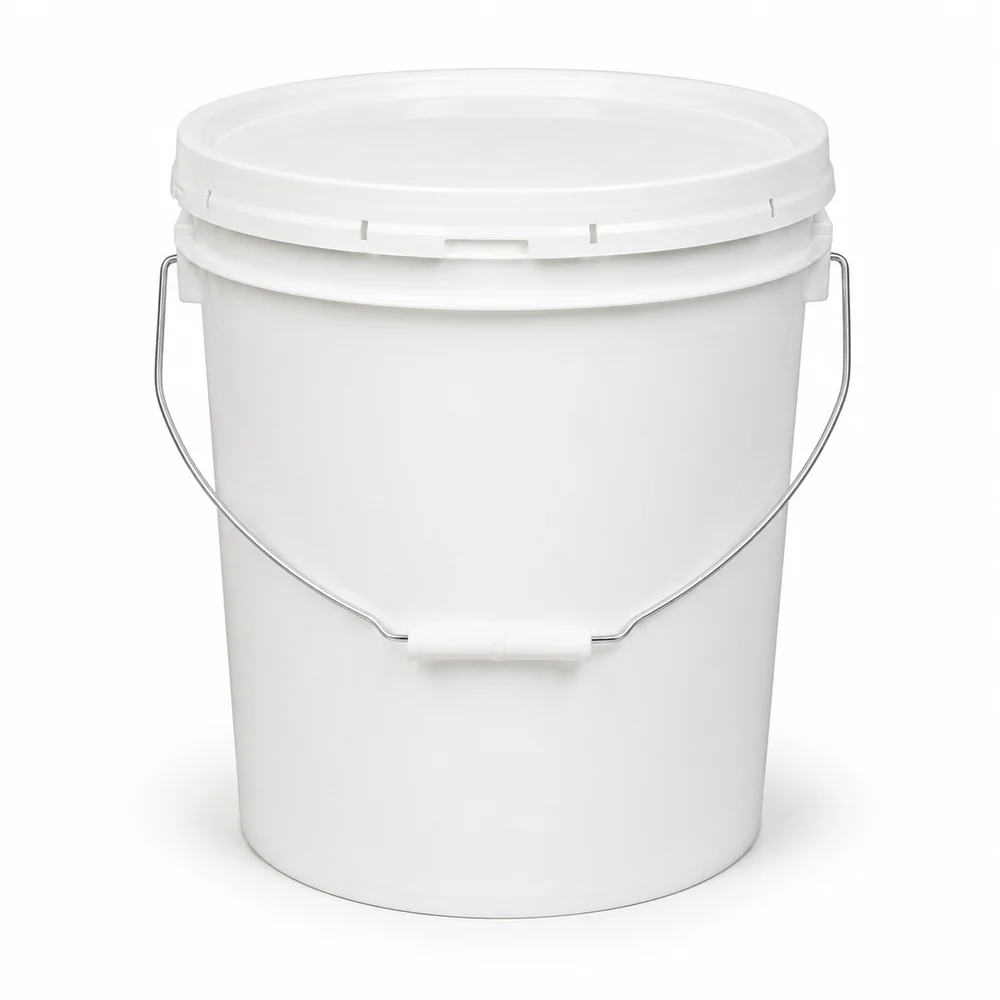 Round PP Bucket, 2.5L to 20L |
Polypropylene body and lid; report each component by its own material. |
PPWR is the Packaging and Packaging Waste Regulation, Regulation (EU) 2025/40. It was adopted on 19 December 2024, entered into force on 11 February 2025 and has applied in the EU since 12 August 2026. It replaced the packaging directive, Directive 94/62/EC (the PPWD), which each member state wrote into its own law. The regulation applies directly, so the same text runs in every member state.
No. EPR, extended producer responsibility, is the principle that the business supplying packaging pays for managing it as waste. PPWR is the EU regulation that sets packaging design, labelling and waste rules, and includes the EPR duties each member state administers. The UK runs its own packaging EPR scheme under SI 2024/1332, which is UK law and separate from PPWR.
Yes. Tertiary packaging used for handling and transport is packaging under regulation 7, and it counts towards your tonnage and, for a large producer, the recycling obligation. GOV.UK classes secondary and tertiary packaging as non-household, so it pays no PackUK disposal fee. Road, rail, ship and air containers are excluded, so the shipping container itself is not packaging.
Yes, once. GOV.UK says reusable packaging, designed to be reused and refilled many times, is reported the first time it is supplied. A business that hires out or lends reusable packaging is a service provider under regulation 21 and is the producer only on that first supply. Later trips of the same drum or IBC are not reported again.
Producers worked under the Producer Responsibility Obligations (Packaging Waste) Regulations 2007, which set recycling obligations met with PRNs, and from 2023 the packaging data reporting regulations of each UK nation. SI 2024/1332 revoked the 2023 reporting regulations on 1 January 2025 and the 2007 regulations on 1 January 2026 (Schedule 17). The 2024 regulations now cover reporting, fees and recycling together.
No. GOV.UK says an obligated producer must be established in the UK, with a registered office, head office or principal place of business here. Where the business responsible for an import is not UK-established, regulation 18 makes the first UK-established owner of the packaging the importer. An overseas factory can supply the weights and materials you report, but the registration and fees stay with the UK business.
A compliance scheme is a registered body that takes on its members’ registration, data reporting and recycling obligations, buying PRNs and PERNs for them. For 2027 a large producer pays the regulator £1,803 to register through a scheme against £2,842 to register directly. A scheme cannot pay the PackUK disposal fee for you: GOV.UK says that stays with the producer.
Breaching the producer duties is an offence under regulation 115. Regulation 119 sets an unlimited fine on summary conviction in England and Wales and on indictment anywhere in the UK, and a fine up to the statutory maximum on summary conviction in Scotland and Northern Ireland. The regulators can also use civil sanctions. Registering late costs a £386 late fee, and changing data after submission costs £807, or £512 through a compliance scheme.
Seven years. GOV.UK tells producers to keep the data behind their reports for 7 years, and to hold the evidence for any primary or shipment packaging classed as non-household for at least 7 years. That evidence is the safety data sheets, customer contracts, invoices and stockist lists that support the classification, so file it with the return it supports.
Yes, state by state. Maine enacted a stewardship programme for packaging in 2021 (Title 38, section 2146). Oregon’s Plastic Pollution and Recycling Modernization Act (SB 582) took effect on 1 January 2022, with programme changes from July 2025. California’s SB 54 was signed on 30 June 2022, and its permanent regulations were approved on 1 May 2026. Each state sets its own producers, fees and deadlines.
No, not in Great Britain. DAERA, Northern Ireland’s environment department, says the EU Packaging and Packaging Waste Regulation, Regulation (EU) 2025/40, does not apply to packaging placed on the market in England, Scotland or Wales. Much of it applies in Northern Ireland from 12 August 2026 under the Windsor Framework, but its reuse, EPR and deposit return parts do not. A UK business selling packaging into the EU meets PPWR there.
The standards and regulations this page relies on, at their issuing body. Where a market rule is named here, check the current revision before you specify against it.
Last reviewed by Clarence Cheang, Co-Founder.
Tell us your market, the contents and your annual volumes. We come back with the material, the empty weight per unit and a quotation.